
Our Marketing Team at PopaDex
How to Track Net Worth and Build Wealth

Tracking your net worth is the single most powerful habit you can build to understand your true financial position. It’s a simple calculation: subtract your total liabilities (what you owe) from your total assets (what you own). The result is a single, honest number that acts as your personal financial report card, giving you the clarity needed to build wealth effectively.
Why Tracking Net Worth Is a Financial Game Changer
 while keeping debt low.
On the surface, the high earner seems wealthier. In reality, their net worth might be negative. The second individual, however, is steadily building a positive net worth, putting them on a much stronger path to financial freedom.
Your Personal Compass for Building Wealth
Tracking your net worth transforms abstract financial goals into tangible, measurable progress. It becomes your personal compass, showing you exactly where you stand and pointing you toward your desired destination—whether that’s retirement, homeownership, or another major life goal.
This single number helps you:
- Stay Motivated: Watching your net worth increase each month or quarter provides a powerful psychological boost to keep saving and investing.
- Make Smarter Decisions: When your net worth is top-of-mind, you’re more likely to question large purchases and consider their impact on your overall financial position.
- Identify Problems Quickly: A dip in your net worth can be an early warning sign, prompting you to address issues like overspending or high-interest debt before they spiral.
The most effective tool for understanding whether you are going backwards or forwards financially is tracking your net worth. It’s the foundational habit that holds you accountable and reminds you that building wealth is a journey, not a sprint.
This isn’t about tedious accounting or judging your past choices. It’s about empowerment. Once you start consistently tracking this number, you gain a new level of control over your financial destiny.
As your assets grow and your strategy becomes more complex, you might even consider bringing in professional wealth management services to help protect and accelerate your progress. Ultimately, this simple practice shifts your focus from merely managing money day-to-day to strategically building long-term wealth.
Identifying Your Assets and Liabilities
Before you can start tracking your net worth, you have to get a clear picture of what you own and what you owe. Think of it as creating a personal balance sheet. This goes beyond a numbers game; it’s about moving from a vague sense of your finances to a concrete, factual understanding of where you stand.
This first step is all about gathering the facts, not making judgments. The goal is to create an honest, accurate snapshot that will become the baseline for your entire financial journey.
First, Round Up Your Assets
Your assets are everything you own that holds monetary value. To make sure you don’t miss anything, it’s smart to break them down into a few key categories. We’ll start with the most liquid—cash—and work our way to things that are a bit harder to sell, like your house.
Start by listing your most accessible assets:
- Cash and Cash Equivalents: This is the easy part. Pull up your banking apps and note the balances in your checking, savings, and any high-yield savings accounts (HYSAs) you have.
- Investments: For many people, this is where the real wealth-building happens. Tally up the current value of your 401(k), IRA (Roth or Traditional), and any brokerage accounts holding stocks, ETFs, or mutual funds. Don’t forget to include cryptocurrency if you have any.
- Physical Property: The big two here are usually your home and your car. For a quick home value estimate, sites like Zillow or Redfin are great resources. To find out what your car is worth, Kelley Blue Book (KBB) is the industry standard.
The process is all about organizing your various financial statements and account balances into one clear, consolidated view.
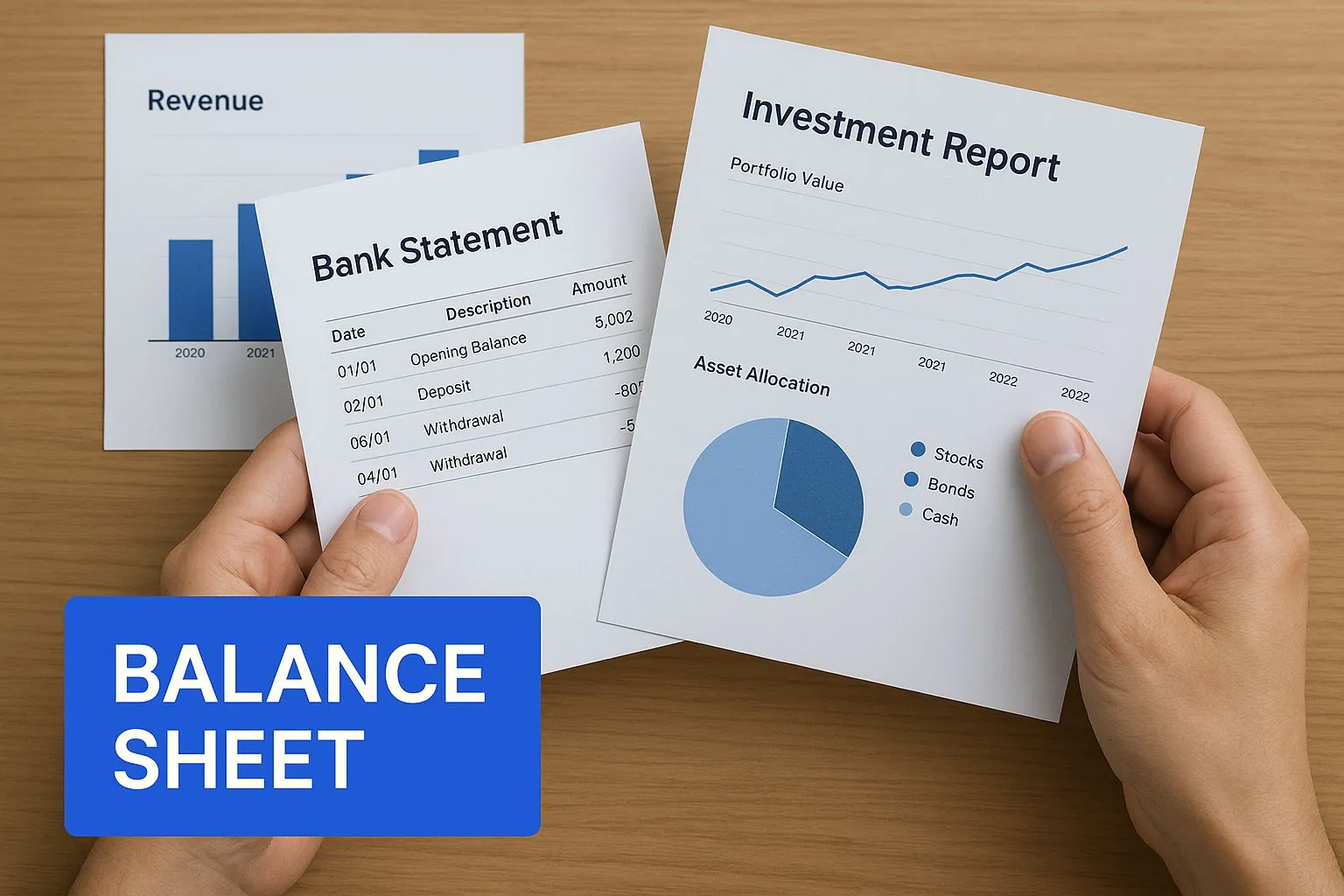
This visual really drives home the point: a methodical approach, where each piece of financial data contributes to the whole picture, is essential.
To help you get started, here is a quick reference table breaking down the most common assets and liabilities.
Common Assets vs Liabilities Breakdown
This table provides a clear, side-by-side comparison to help you categorize your finances accurately.
| Category Type | Specific Examples | Where to Find the Value |
|---|---|---|
| Asset | Checking Account, Savings Account, HYSA | Your bank’s website or mobile app. |
| Asset | 401(k), IRA, Brokerage Account | Your retirement or investment platform’s dashboard. |
| Asset | Your Home | Zillow or Redfin for a quick estimate. |
| Asset | Your Vehicle | Kelley Blue Book (KBB.com). |
| Liability | Mortgage Loan | Your mortgage lender’s latest statement. |
| Liability | Auto Loan | Your auto lender’s website or statement. |
| Liability | Student Loans | Your federal or private loan servicer’s portal. |
| Liability | Credit Card Debt | Your credit card issuer’s website or statement. |
This breakdown should make it much easier to see where everything fits as you build out your personal balance sheet.
Next, Catalog Your Liabilities
Now it’s time to look at the other side of the coin: your liabilities. These are simply your debts—any money you owe to someone else. Being just as thorough here is critical for getting an accurate net worth calculation.
Common liabilities include:
- Secured Debts: These are loans tied to an asset. Think of your mortgage (tied to your house) or an auto loan (tied to your car). You just need the current outstanding balance.
- Unsecured Debts: This covers things like credit card balances, personal loans, and medical debt. Log into each account and jot down the total amount owed.
- Student Loans: Whether they’re federal or private, list the total remaining balance for all of them.
Don’t get discouraged if this list feels long, especially if you’re early in your career. The simple act of listing and tracking these debts is the most powerful first step you can take to eliminate them. You can’t control what you don’t measure.
Putting It All Together for a Clear Picture
Once you have your two lists—assets and liabilities—you’re ready to organize them. While a simple notepad works, a structured format makes the process much smoother and easier to repeat month after month.
To get a running start, you can download our net worth statement template. It provides a clean, simple layout for organizing everything, taking the guesswork out of the process and giving you a solid foundation.
Let’s walk through a quick example. Imagine a woman named Sarah doing this for the first time.
Sarah’s Assets:
- Checking Account: $4,500
- High-Yield Savings: $15,000
- 401(k) Balance: $52,000
- Robinhood Account: $8,500
- Home Value (Zillow): $350,000
- Car Value (KBB): $18,000
Sarah’s Liabilities:
- Mortgage Balance: $280,000
- Auto Loan Balance: $11,000
- Student Loan Balance: $22,000
- Credit Card Debt: $3,500
By taking the time to list these figures, Sarah has created a complete and honest financial inventory. She now has all the raw data needed to calculate her net worth, turning abstract money worries into tangible numbers she can actually work with.
Finding the Right Net Worth Tracking Method for You
Once you have a handle on all your financial accounts, the big question is: where do you put all this information? Knowing how to track your net worth isn’t about finding some secret, “best” way. It’s about finding the best way for you. The only method that works is the one you’ll actually stick with, so let’s walk through the three most common approaches.
Each one has its own vibe—some are for the hands-on types, others are for people who want technology to do the heavy lifting, and one is for those who’d rather hand it all off to a pro. We’ll get into the real-world pros and cons of each.
The Do-It-Yourself Spreadsheet Approach
For anyone who loves being in complete control and doesn’t mind getting their hands dirty with data, a simple spreadsheet is a fantastic starting point. Using a program like Microsoft Excel or Google Sheets, you build your own personal balance sheet from scratch and update it on your own schedule.
This method forces you to look your numbers right in the eye. When you manually type in your 401(k) balance or your latest credit card statement, those figures become more tangible and real. It’s a deliberate, almost meditative process that keeps you intimately connected to your financial journey.
But the spreadsheet’s greatest strength is also its biggest weakness: it’s 100% manual.
- It’s a Time Sink: You have to set aside time every month to log into every single account, find the balance, and punch it into your sheet. This can feel empowering at first but can quickly become a chore.
- Oops, Typo: One misplaced decimal or a simple typo can throw your entire calculation off, leading to either a false sense of security or a mini panic attack.
- No Bells and Whistles: Forget about automatic updates, cool-looking charts, or trend analysis—unless you’re a spreadsheet guru who can build all that yourself.
This is a great fit for someone who’s naturally detail-oriented, enjoys the process, and has a relatively straightforward financial life to track.
Automated Aggregator Apps and Tools
If the very idea of manual data entry makes you want to take a nap, then automated net worth trackers are what you’re looking for. These platforms securely link to all your financial institutions—banks, brokerages, mortgage lenders, you name it—and pull all that data into one clean, simple dashboard.
This is the “set it and forget it” approach. It gives you a real-time, consolidated view of your finances with almost zero effort after the initial setup. Services like Empower or Tiller automate the most tedious part of the process, freeing you up to think about the bigger picture. A comprehensive net worth tracker like this means you can see your entire financial world update automatically.
Of course, that convenience comes with a few things to think about. You’re handing over your login credentials, and even though these platforms use bank-level security, that can be a non-starter for some people. Also, while many of these services have free versions, the most powerful features are often locked behind a subscription.
Automation is a game-changer, but it can’t replace your own engagement. The best tools don’t just show you the numbers; they present the data in a way that makes you want to dig in, understand the trends, and make smarter decisions.
Working with a Financial Advisor
The third option is to outsource the whole process to a professional. A financial advisor or planner won’t just calculate your net worth for you; they’ll put that number into the context of your life goals.
This is the most hands-off and personalized approach you can take. An advisor can help you make sense of why your net worth is fluctuating, spot opportunities you might have missed, and build a strategic plan to grow it. This is especially valuable for people with more complex situations, like owning a business, dealing with stock options, or planning a multi-generational estate.
The main downside here is the cost. Professional financial advice is an investment. Fees can be a percentage of the assets they manage for you (AUM), a flat annual fee, or an hourly rate. It’s easily the most expensive of the three options, but for the right person, the strategic guidance can be worth far more than the price tag.
Comparison of Net Worth Tracking Methods
Choosing the right method really comes down to your personality and where you are in your financial journey. The world of personal finance is enormous—private household financial assets hit a staggering EUR 269 trillion last year. While your own balance sheet is a bit smaller, the core principle of tracking what you own versus what you owe remains the same. You can dive deeper into these global wealth trends in the Allianz Global Wealth Report.
To help you decide, here’s a quick breakdown of the three methods:
| Method | Best For | Pros | Cons |
|---|---|---|---|
| Spreadsheets | Detail-oriented DIYers with simpler finances. | Total control, free, forces engagement. | Time-consuming, prone to error, no automation. |
| Aggregator Apps | Tech-savvy individuals who want automation. | Saves time, real-time data, visual dashboards. | Potential security concerns, subscription costs. |
| Financial Advisor | High-net-worth or complex financial situations. | Expert guidance, personalized strategy, hands-off. | Most expensive option, requires trust. |
Ultimately, there’s no wrong answer here. You could even mix and match—maybe use an app for a quick daily check-in and a spreadsheet for a more thorough quarterly review. The most important thing is to pick a system that makes you feel empowered and helps you track your net worth consistently.
How to Calculate Your Net Worth for the First Time
This is the moment of truth. You’ve wrangled all your financial statements into two neat piles: everything you own and everything you owe. Now it’s time to crunch those numbers and find the single figure that tells your entire financial story.
The formula itself couldn’t be simpler: Total Assets - Total Liabilities = Net Worth. This one calculation takes you from a fuzzy idea of your finances to a hard, measurable number. Think of it as your starting line.
A Real-World Example: Alex’s First Calculation
To take this out of the abstract, let’s walk through it with someone doing this for the very first time. Meet Alex, a 30-year-old professional who decided it was time to get a clear financial picture.
After about an hour of digging through accounts and statements, Alex had their lists ready.
Alex’s Assets:
- Checking & Savings: $12,000
- 401(k) Retirement Account: $45,000
- Car Value (Kelley Blue Book): $18,000
- Total Assets: $75,000
Alex’s Liabilities:
- Student Loans: $35,000
- Credit Card Debt: $5,000
- Total Liabilities: $40,000
With those numbers plugged into the formula, the math is easy.
$75,000 (Assets) - $40,000 (Liabilities) = $35,000 (Net Worth)
And just like that, Alex has a starting net worth. The goal isn’t to judge the number—it’s to finally know it. This single data point becomes the foundation for every financial move they make from here on out. For a deeper dive, check out our complete guide on how to calculate net worth.
Tackling Common Calculation Hurdles
When you do this yourself, a few questions almost always pop up. Getting these details right is key to making sure your calculation is realistic and, more importantly, consistent over time.
One of the biggest questions is how to value large assets that you can’t easily sell. You don’t need a professional appraiser every time you check in. For your home, an online estimator like Zillow gives you a good enough figure for tracking. For your car, Kelley Blue Book is the industry standard. The trick is to use the same source every time you track.
Another sticking point is what to actually include. Should you add your furniture, laptop, or that nice watch? My advice is to skip personal belongings that are hard to value and aren’t easily converted to cash. Sticking to core financial assets (cash, investments, property) gives you a much cleaner and more actionable number to work with.
Knowing your net worth is the first step toward controlling it. Whether the initial number is positive or negative, it provides a crucial benchmark for measuring progress and celebrating future financial wins.
Finally, remember this calculation is just a snapshot. The global economy is always in motion. For instance, the latest UBS Global Wealth Report noted that average wealth per adult in North America recently hit USD 593,347. At the same time, the number of USD millionaires worldwide grew by 1.2%, with the U.S. adding over 1,000 new millionaires every single day.
These massive trends show why tracking your own progress is so vital—it helps you understand your own financial journey within the larger economic context.
Completing your first calculation is a huge milestone. You’ve established your baseline, cleared away the financial fog, and given yourself the knowledge to start building wealth with real intention.
Making Net Worth Tracking a Consistent Habit

Calculating your net worth for the first time is a real eye-opener. It’s that moment of financial clarity you’ve been looking for. But the real magic isn’t in that one-time snapshot—it’s in watching the story unfold over months and years. This is where you shift from a simple calculation to a powerful habit that steers your financial life.
The secret? Consistency. Think of it like a business reviewing its quarterly performance. You need to get into a rhythm of checking in on your personal balance sheet. This routine is what keeps you honest, accountable, and fired up to keep going.
Setting Your Tracking Schedule
There’s no magic number here. The best schedule is the one you’ll actually stick with. Your goals and personality will point you in the right direction.
- Monthly Check-in: This is perfect if you’re in an active financial phase, like aggressively paying down debt or investing consistently. Seeing the needle move every 30 days gives you that quick feedback loop and a serious dose of motivation.
- Quarterly Review: A fantastic option if your finances are a bit more stable. This gives you a bird’s-eye view of your progress without getting lost in the day-to-day noise of the stock market.
Pick a frequency, put it on your calendar, and treat it like a can’t-miss appointment. That simple repetition is how you forge a rock-solid financial habit.
Understanding the Story Behind the Numbers
Your net worth is going to have its ups and downs. A perfectly straight upward line is a fantasy, so don’t sweat the dips. Learning to read the why behind the changes is just as important as the numbers themselves. A drop isn’t always a disaster, just as a jump isn’t always a victory lap.
For instance, your net worth will almost certainly tank right after you buy a home. You just swapped a liquid asset (cash for the down payment) for an illiquid one (home equity) while taking on a massive new liability (the mortgage). On paper, it looks like you went backward, but in reality, you made a huge move toward building long-term wealth.
Your net worth trend tells a story about your financial decisions. It reflects your spending habits, saving discipline, investment choices, and major life events. Learning to read this story is the key to making better decisions moving forward.
On the flip side, a sudden spike might be from a bonus or a hot stock market. Understanding the context keeps you grounded and helps you make smarter choices instead of just reacting.
Turning Trends into Actionable Goals
After you’ve tracked for a few months, you’ll have some data to work with. Now you can stop just tracking and start strategizing. That trend line becomes your new best friend for setting goals that are specific, measurable, and honestly, a lot more exciting.
Instead of a vague goal like “save more,” you can set a target like, “Increase my net worth by 15% this year.” This simple shift reframes your whole financial world. Now, paying an extra $500 on your car loan becomes more than a chore—it’s a direct deposit toward your net worth goal.
This mindset works even for more complex situations. If you’re an entrepreneur, blending personal and business finances demands discipline. Getting a handle on some practical small business bookkeeping tips is a good starting point, as clean records make tracking your total financial picture so much easier.
Keeping an eye on net worth is a habit shared by the most financially successful people on the planet. The ultra-high-net-worth (UHNW) crowd—about 510,810 individuals with over $30 million each—collectively hold a mind-boggling $59.8 trillion. This group has grown seven times faster than the global adult population since 2004, which shows the incredible power of focused wealth building.
By making net worth tracking a consistent habit, you stop being a passenger in your financial life and get in the driver’s seat, using real data to steer toward the future you want.
Answering Your Top Net Worth Questions
Once you get started tracking your net worth, some practical questions always pop up. It’s totally normal. Getting these details sorted out is the difference between feeling confident and getting bogged down in the weeds.
Let’s clear up some of the most common questions people have when they first dive in.
How Often Should I Update My Numbers?
For most people, a monthly or quarterly check-in is the sweet spot. The best rhythm for you really comes down to your financial situation and, frankly, your personality.
- Go for monthly if you’re in a really active financial phase—maybe you’re aggressively paying down debt or investing a big chunk of your income. Seeing the needle move every 30 days can be a huge motivator.
- Stick to quarterly if your finances are more stable. This gives you a great big-picture view of your progress without getting distracted by the day-to-day noise of market swings.
The key isn’t the exact timeline, but the consistency. Just pick a schedule you can stick with and make it a regular financial habit, like checking your bank account.
My Net Worth Is Negative. Is It Even Worth Tracking?
Yes, absolutely! In fact, this is probably one of the most powerful times to start tracking. Being in the red is completely normal, especially if you have student loans or are early in your career.
Think of it this way: you’re establishing your starting line. It’s not a grade on your financial past; it’s your “before” picture.
Honestly, watching your net worth climb from a negative number is one of the most satisfying parts of the whole journey. Celebrating the day you finally hit a net worth of zero is a massive win that proves all your hard work is paying off.
Having that initial negative number gives you a concrete benchmark. It turns a vague goal like “get out of debt” into something you can actually measure and achieve.
How Do I Figure Out the Value of My House or Car?
Good news: you don’t need to hire a professional appraiser every month. For tracking purposes, a good, consistent estimate is all you need.
For your home, checking a site like Zillow or Redfin gives you a solid ballpark figure. When it comes to your car, Kelley Blue Book (KBB) is the go-to source for its current market value.
Since the value of these big-ticket items doesn’t change dramatically overnight, updating them just once or twice a year is perfectly fine. The goal here is a realistic estimate, not obsessing over getting it right to the last penny.
Do I Need to Include Every Single Thing I Own?
It’s best to stick to significant financial assets—things that are either relatively liquid or have a clear market value. While your antique furniture or collection of vinyl records definitely has personal value, they’re tough to price accurately and even harder to sell quickly.
Including them can just muddy the waters and make your net worth a less useful financial planning tool.
Some people even take it a step further and exclude their primary home from their main calculation. This helps them focus on their investable net worth—the assets that are actively generating wealth. The most important thing is to pick a method that makes sense to you and use it consistently. That way, you’re always comparing apples to apples and getting a true read on your progress.
Ready to stop guessing and start knowing? PopaDex gives you a single, clear dashboard to see all your accounts in one place. Take control of your financial journey today by signing up for a free account and watch your progress unfold in real-time.