
Our Marketing Team at PopaDex
Using a 401k Contribution Calculator to Master Your Retirement Savings

Trying to figure out if you’re saving enough for retirement can feel like you’re just guessing. A good 401(k) contribution calculator cuts through that uncertainty and gives you real answers, instantly. Think of it as a crystal ball for your financial future—it shows you the actual impact of every dollar you save and proves how small tweaks today can lead to massive growth down the road.
Why a 401(k) Calculator Is Your Most Powerful Retirement Tool
Let’s be real: retirement planning can feel abstract, even a little overwhelming. You know you should be saving, but the big questions always linger. Am I doing enough? What will my current contribution rate actually look like in 30 years? This is exactly where a 401(k) calculator turns vague anxiety into a clear, actionable game plan. It’s not just a math tool; it’s a personal simulator for your financial independence.
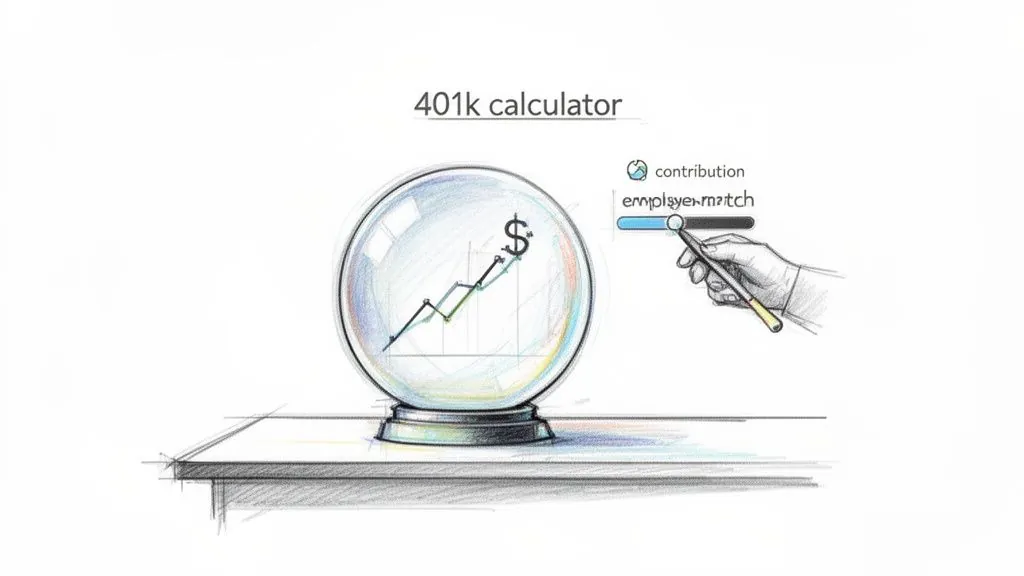
See Your Financial Future in Seconds
Instead of just looking at a percentage on your pay stub, a calculator gives you a tangible glimpse into the future. It takes your current savings habits and projects them forward, showing you a concrete number you can expect to have when you retire. For many people, that simple act of visualization is the spark they need to get serious about saving.
The 401(k) is, without a doubt, the cornerstone of American retirement savings. By September 30, 2025, Americans had a staggering $10.0 trillion in 401(k) plans, with the average balance hitting a record $144,400. That data really drives home how critical this one account is for building wealth. You can explore the full statistical report on ici.org for more on these trends.
Unlock the Power of Free Money
One of the most eye-opening things a 401(k) calculator does is show you the power of your employer match. Most of us know the match exists, but we don’t always grasp its monumental impact. The calculator shows you, down to the dollar, exactly how much “free money” you’re leaving on the table by not contributing enough to get the full match.
A 401(k) match is one of the only investments that offers a guaranteed 100% return. Failing to capture it is like turning down a pay raise every single year.
Seeing that number visually often gives you all the motivation you need to bump up your contribution rate. It completely reframes the decision from “Can I afford to save more?” to “Can I afford not to?”
Watch the Magic of Compounding Unfold
Small, consistent actions create massive results over time. Nowhere is that more true than with your retirement savings, and a calculator is the perfect tool to demonstrate the incredible power of compounding.
Here’s how it helps you get it:
- Model Small Increases: You can instantly see what a huge difference a tiny 1% increase in your contribution rate makes over 20 or 30 years. That small change in your take-home pay—something you might not even notice—can translate into tens or even hundreds of thousands of extra dollars for retirement.
- Connect to the Big Picture: Once you understand these dynamics, it’s easier to fit your 401(k) strategy into your broader financial plan. For a refresher on the fundamentals, check out our guide on retirement planning basics.
Ultimately, a good 401(k) calculator demystifies the whole process. It proves you don’t need to be a financial wizard to take control of your future—you just need the right tool to light up the path ahead.
Getting the Right Numbers for an Accurate Forecast
Any 401(k) contribution calculator is only as smart as the information you feed it. Think of it like a GPS—if you punch in the wrong starting address, your final destination is going to be way off. To get a forecast that’s actually useful, you’ve got to gather a few key pieces of your financial life first. This is what grounds your projection in reality, not just wishful thinking.
The good news? Finding these numbers is a lot easier than you might think. Most of the details are sitting right there in your company’s benefits portal or on your latest pay stub. Taking a few minutes to collect them now will pay off big time in the accuracy and confidence you get from the calculator’s results.
Your Personal Financial Snapshot
Before we even get to the retirement-specific stuff, you need a solid baseline of where you stand today. These numbers are the foundation.
- Your Current Age: Simple, but this is the most critical piece for figuring out your investment time horizon.
- Current Annual Salary: Pull your gross (pre-tax) salary. If your income bounces around, play it safe and use a conservative estimate based on last year’s earnings. This figure directly shapes how much you can sock away.
- Current 401(k) Balance: Log into your 401(k) provider’s website (like Fidelity, Vanguard, or Schwab) to grab the most up-to-date total.
- Current Contribution Rate: Check your pay stub or benefits portal for the percentage of your pre-tax salary you’re currently saving.
With these four data points, you’ve already got the core of what you need. Now, let’s layer in the details that make the projection truly yours.
Your Employer’s 401(k) Plan Rules
This is where you can unlock some serious value. Every company’s 401(k) plan has its own unique rulebook, especially when it comes to the employer match. Nailing down these specifics is absolutely essential.
Your employer match formula is the most important piece of this puzzle. It’s rarely a simple dollar-for-dollar deal. You’ll often see formulas like “50% of the first 6% you contribute” or “100% of the first 3%.” This info is usually spelled out in your plan summary document or benefits handbook. If you can’t find it, a quick email to HR is well worth the effort. To ensure your forecast is built on solid ground, understanding effective methods for secure and automated financial data processing, known as acquisition of data, is paramount.
Capturing your full employer match is the closest thing to a guaranteed 100% return on your investment you’ll ever find. A 401(k) contribution calculator will show you exactly how much “free money” you might be leaving on the table.
To help you get organized, here’s a quick-reference guide to gathering all the necessary data for an accurate 401(k) projection.
Essential 401(k) Calculator Inputs and Where to Find Them
| Data Point | What It Is | Where to Find It |
|---|---|---|
| Current Age | Your age today. | You know this one! |
| Annual Salary | Your gross, pre-tax income for the year. | Latest pay stub or employment contract. |
| Current 401(k) Balance | The total value of your 401(k) account right now. | Your 401(k) provider’s online portal (Fidelity, Vanguard, etc.). |
| Contribution Rate | The percentage of your salary you contribute. | Pay stub or benefits portal. |
| Employer Match | The formula your employer uses to contribute. | Plan summary document, benefits handbook, or by asking HR. |
| Salary Increase | Your estimated annual raise. | Base it on past raises or a conservative 2-3%. |
| Rate of Return | Estimated annual growth of your investments. | Use a long-term average like 6-7% for a diversified portfolio. |
Having these details handy will make the process smooth and the results far more reliable.
Making Smart Future Projections
A great calculator doesn’t just look at today; it helps you model what’s to come. For this part, you’ll need to make a few educated guesses. The key here is to be realistic, not overly optimistic.
- Expected Annual Salary Increase: A conservative estimate of 2-3% per year is a reasonable place to start. This accounts for typical inflation and cost-of-living adjustments.
- Expected Rate of Return: This is your best guess for how much your investments will grow each year. While past performance is no guarantee of future results, a long-term average of 6-7% is a common and sensible assumption for a diversified portfolio. It can be tempting to plug in 10% or higher, but that can give you a false sense of security.
Once you have these figures, you’re ready to put the 401(k) contribution calculator to work. For those looking to see how this fits into your larger financial world, understanding how to calculate your overall savings rate provides fantastic context for your 401(k) goals.
Putting the 401(k) Calculator into Action with Real Scenarios
Alright, this is where the rubber meets the road. Once you’ve gathered your numbers, a good 401(k) contribution calculator turns abstract figures into a concrete picture of your future. It’s not just about getting a single number; it’s about seeing how small changes can create massive ripples down the line.
Let’s walk through this with a realistic example. Meet Alex, a 40-year-old who’s decided it’s time to get serious about retirement. They want to know where they’re heading and, more importantly, what levers they can pull to get there faster.
The calculator’s logic is pretty simple: it takes what you have now, adds what you’re contributing, factors in your employer’s help, and projects it forward.
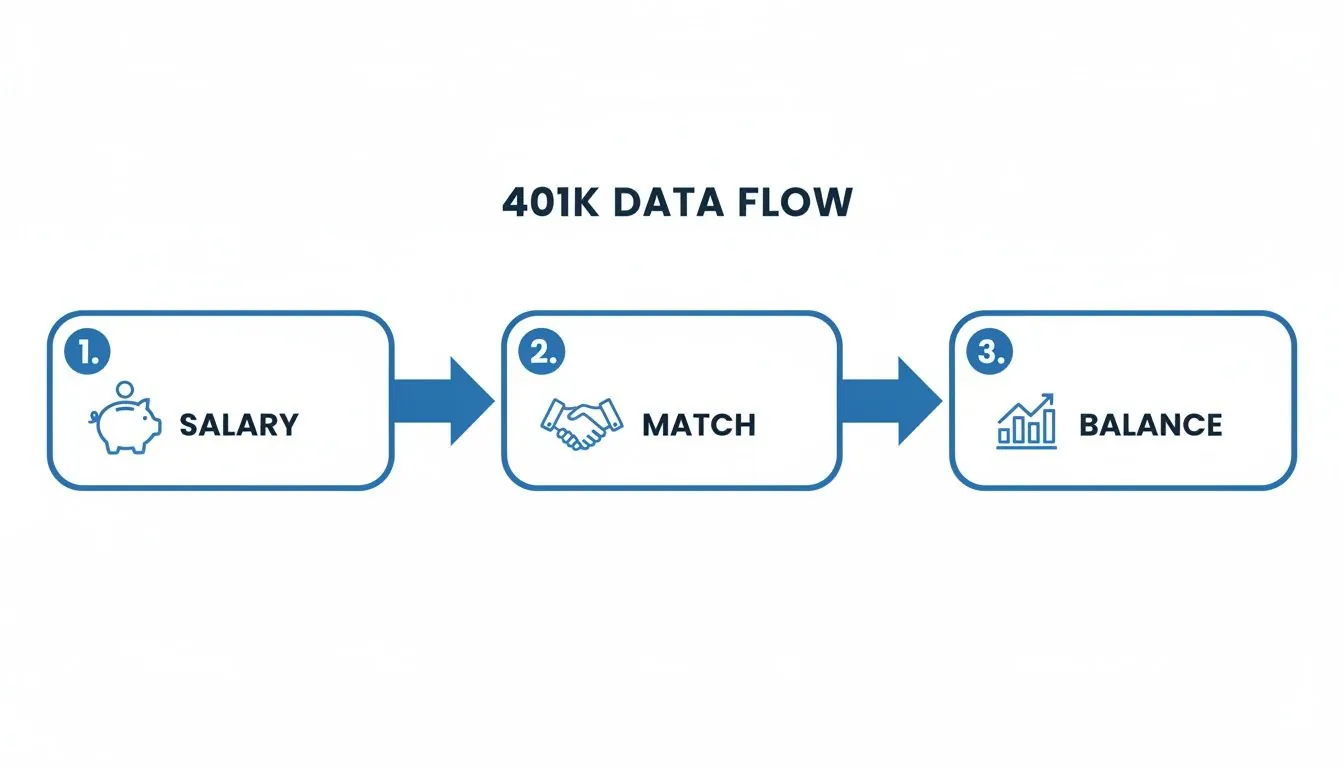
Each input builds on the last, ultimately giving you a powerful forecast of what your retirement could look like.
Scenario One: The Baseline Projection
First things first, Alex needs a starting point. They plug in their current financial snapshot to see where they’ll land if they just keep doing what they’re doing.
Here are Alex’s numbers:
- Current Age: 40
- Retirement Age: 67
- Annual Salary: $85,000
- Current 401(k) Balance: $120,000
- Current Contribution Rate: 4% of salary
- Employer Match: 50% on the first 6% of contributions
- Expected Salary Increase: 3% annually
- Expected Rate of Return: 7% annually
After running these numbers, the projection is okay, but it’s not quite hitting Alex’s retirement goals. The glaring red flag? By contributing only 4%, Alex is leaving free money on the table. They aren’t contributing enough to get the full employer match.
Scenario Two: Maximizing the Employer Match
Now for the first, and most critical, adjustment. Alex runs a new scenario, changing just one thing: bumping their contribution rate from 4% up to 6%.
This seemingly tiny 2% increase works some serious magic. It obviously increases Alex’s own savings, but the real win is that it unlocks the full employer match. Suddenly, an extra 1% of their salary is being dropped into their account by their company, completely free.
The new projection is dramatically better. That small tweak, which only costs Alex a modest amount from each paycheck, results in a significantly larger nest egg at retirement, all thanks to capturing that “free money” and giving it decades to compound.
Scenario Three: The Power of Annual Increases
Feeling motivated, Alex models one more scenario. They decide to try the “1% challenge,” a popular strategy where you increase your savings rate by 1% each year until you hit a comfortable target.
- Year 1 Contribution: 6% (to lock in the full match)
- Year 2 Contribution: 7%
- Year 3 Contribution: 8%
- …and so on, until they reach their goal of 15%.
This is where a good 401(k) calculator really shines. The new output graph shows an even steeper growth curve. By automating these small, manageable increases, Alex can ramp up their savings without ever feeling a big hit to their take-home pay. It’s a painless way to get to a serious savings rate.
The results speak for themselves. The charts and graphs clearly show how each small adjustment layers on top of the last, creating a powerful snowball effect. It transforms the overwhelming task of “saving for retirement” into a series of achievable steps.
If you want to zoom in on how these contributions multiply over the years, our dedicated 401(k) growth calculator provides even more detailed projections.
As you run your own scenarios, remember that the government gives you more room to save over time. For 2024, the IRS 401(k) contribution limit is $23,000, with an additional $7,500 catch-up contribution for those aged 50 and over. These limits usually increase every year or two, giving you even more space for tax-advantaged growth.
These examples prove you don’t need a sudden windfall or a drastic lifestyle change to reshape your financial future. By using a calculator to play with the numbers, you can find a comfortable, realistic path to building the wealth you’ll need.
Putting Your 401(k) Calculator Results into Action
Seeing the final number from a 401(k) contribution calculator is always an eye-opener. It can be a huge motivator or a bit of a reality check. Either way, that number isn’t the finish line—it’s the starting gun. Now it’s time to turn those figures into a real, sustainable plan that gets you from where you are today to where you want to be.
The idea isn’t to suddenly slash your budget or make drastic changes overnight. That almost never sticks. Instead, the smart money is on making a series of small, intelligent tweaks that will have a massive impact over the long haul. Let’s break down what your calculator results are telling you and build a personalized roadmap.
First Things First: Are You Getting All Your Free Money?
Your absolute top priority is grabbing every single dollar of your employer’s match. A 401(k) calculator makes it painfully obvious if you’re leaving free money on the table. If you’re contributing less than the amount needed to get the full match, fixing that is your immediate, non-negotiable next step.
Think of it this way: if your employer offers a 50% match on the first 6% you contribute, but you’re only putting in 4%, you’re literally turning down a guaranteed 50% return on the next 2% of your salary. You won’t find a risk-free return like that anywhere else on the planet. Correcting this is easily the most powerful financial move you can make today.
The Immediate Win: Understanding Your Tax Savings
One of the best perks of increasing your pre-tax 401(k) contributions is seeing your taxable income drop right now. The calculator shows you exactly what this looks like. For instance, if you decide to contribute an extra $2,000 a year and you’re in the 24% federal tax bracket, you’ve just pocketed an instant $480 in tax savings.
This completely reframes the “cost” of saving. That extra $2,000 doesn’t actually shrink your take-home pay by $2,000; it costs you much less. Knowing that specific number makes the decision to bump up your contributions feel a whole lot easier.
Your 401(k) contributions automatically lower your taxable income on your W-2. You don’t need to do anything extra when you file—the savings happen with every single paycheck. It’s a seamless way to cut your tax bill while you build wealth.
Your Action Plan if You’re Playing Catch-Up
If the calculator shows you’re falling short of your retirement goal, don’t sweat it. This is exactly why you ran the numbers—to find a gap while you still have plenty of runway to fix it. Here are a few simple but powerful strategies to get back on track.
- Take the 1% Challenge: This is the most painless way to boost your savings. Log into your 401(k) account right now and increase your contribution rate by just 1%. Then, set a calendar reminder to do it again in six months. A 1% bump is so small you probably won’t even feel it in your paycheck, but compounded over decades, it’s a game-changer.
- Automate Your Raises: Make a pact with your future self. Every time you get a raise or a bonus, automatically send half of that new money straight to your 401(k) before you even get used to seeing it. This lets you ramp up your savings rate without ever feeling like you’re cutting back on your current lifestyle.
- Make It an Annual Check-Up: Your life isn’t static, so your retirement plan shouldn’t be either. Get in the habit of revisiting the 401(k) contribution calculator at least once a year or after any big life event, like a promotion or new job. This keeps your plan dialed in with your reality.
The key is to build momentum with small, sustainable wins. You’re not trying to solve a thirty-year puzzle in thirty minutes. You’re building a system of good habits that will do the heavy lifting for you over the long term.
Once you’ve settled on your new contribution targets, you can plug them into your broader financial picture. Platforms like PopaDex let you connect your 401(k) and other accounts to see exactly how these retirement savings fuel your total net worth. It gives you a complete, real-time view of your financial health so you can track your progress against your new plan.
Advanced Strategies to Really Accelerate Your 401(k) Growth
Once you’ve got the basics down and are consistently snagging your full employer match, it’s time to level up. We’re moving from just saving to strategically accelerating your wealth. This is where a 401(k) contribution calculator becomes your secret weapon, letting you model advanced scenarios that can seriously shorten your path to financial freedom. These are the tactics seasoned savers use to put their growth into overdrive.
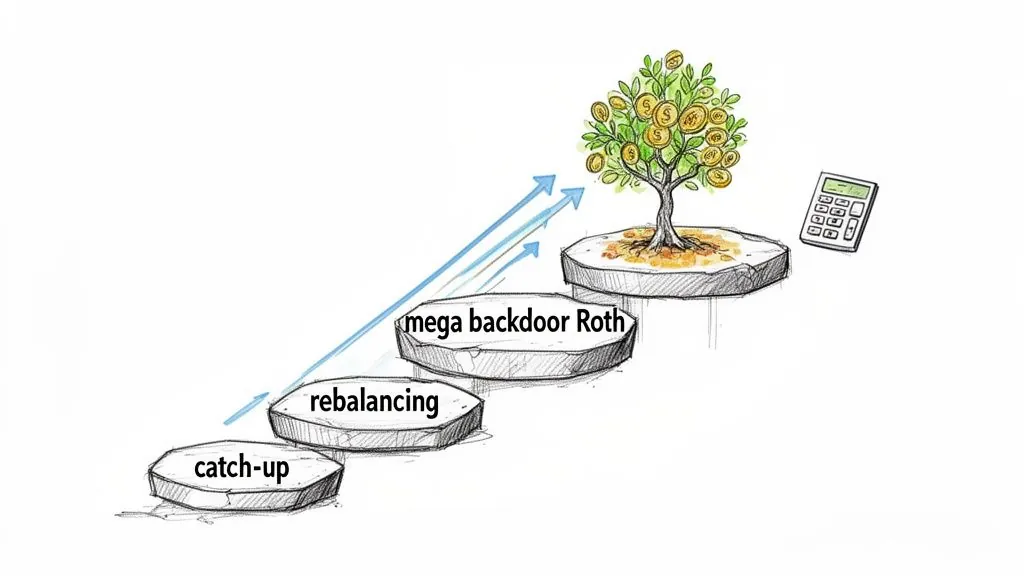
This isn’t about chasing risky returns. It’s about understanding and using the powerful features already built into the 401(k) system—features designed for people who are serious about building a massive nest egg. Let’s dig into a few of the most impactful strategies out there.
Supercharge Your Savings After Age 50
For anyone in the home stretch before retirement, the IRS gives you a powerful boost called catch-up contributions. If you’re age 50 or older, you can sock away extra cash above the standard annual limit. For 2025, that’s an additional $7,500 you can contribute, pushing your total potential savings to a whopping $31,000.
It gets even better. A newer rule lets those aged 60-63 contribute an even higher amount, potentially up to $11,250 extra in 2025. This “super catch-up” is a fantastic opportunity for anyone who started saving late or had career breaks. Plug these numbers into a 401(k) calculator, and you’ll see just how much this can turbocharge your balance in your final working years.
The Power of the Mega Backdoor Roth
If you’re a high earner already maxing out your standard 401(k) contributions, the mega backdoor Roth is a complete game-changer. The entire strategy boils down to one simple question: does your 401(k) plan allow for after-tax (non-Roth) contributions?
If the answer is yes, you might be able to funnel a ton of extra money into your retirement accounts. Here’s how it usually works:
- Max Out Your Normal 401(k): First, you hit the standard employee contribution limit for the year.
- Make After-Tax Contributions: Next, you contribute additional after-tax money, all the way up to the overall IRS limit for employee and employer contributions combined (which was $69,000 in 2024).
- Convert to Roth: Right after making that after-tax contribution, you convert it into a Roth IRA or a Roth 401(k).
This move lets you get a massive amount of extra cash into a Roth account, where it can then grow completely tax-free forever. Not every plan offers this, so you’ll need to check your plan documents or just ask your HR department.
The Self-Employed Advantage: The Solo 401(k)
Got a side hustle or run your own business? A Solo 401(k) is one of the most powerful retirement tools you can find. It lets you contribute as both the “employee” and the “employer,” which means you can save far more than you could with a traditional 401(k).
As the “employee,” you contribute up to the standard limit. As the “employer,” you can kick in up to 25% of your compensation. The combination of these two can hit the overall IRS limit, giving your retirement savings a huge boost.
This unique structure is why the Solo 401(k) is a favorite among entrepreneurs and freelancers. More savers are catching on to proactive strategies like these, pushing savings rates to new heights. The total 401(k) savings rate recently hit a record 14.3%—with employees contributing a peak of 9.5% and employers adding a record 4.8% match. This is exactly why we’re seeing average 401(k) balances climb. You can learn more about these record-breaking savings rates on asppa-net.org.
Common Questions About 401k Calculators
Even the best financial tools can leave you with a few questions. When you’re planning for something as big as retirement, you need to feel confident in the numbers and the strategy you’re building. A great 401(k) contribution calculator is pretty intuitive, but understanding the details is what really makes a difference.
Let’s walk through some of the most common questions that pop up. My goal here is to give you direct, clear answers to cut through any confusion and help you turn that uncertainty into decisive action for your savings plan.
How Often Should I Use a 401k Contribution Calculator?
Think of your 401(k) calculator as a financial GPS. You don’t need to stare at it every day, but you absolutely need to recalibrate your route from time to time to make sure you’re still on track.
Running the numbers at least once a year is a fantastic rhythm. An annual check-in lets you account for salary changes, track your progress, and make sure your assumptions still hold up.
That said, certain life events should trigger an immediate recalculation:
- You get a raise or promotion. This is the perfect time to model how a contribution bump will accelerate your savings, often without you even feeling the difference in your take-home pay.
- You switch jobs. Your new employer will have a different match formula. You need to run the numbers right away to ensure you’re capturing every penny of that free money.
- You turn 50. Welcome to catch-up contributions! This is a powerful way to supercharge your savings in your final working years, and you’ll want to see exactly how powerful it can be.
Regular check-ins keep your retirement plan in sync with your real life, allowing for those small, powerful adjustments that compound into massive results.
What Is a Realistic Rate of Return for My 401k Projections?
This is easily one of the most critical inputs, and it’s where optimism can get you into trouble. While no one has a crystal ball, most financial planners use a long-term average annual return of 6% to 8% for a well-diversified portfolio.
My advice? Stick to the conservative side. Using a figure like 6% is a smart, safe approach because it builds a buffer into your forecast. It means you’re much more likely to be pleasantly surprised by your actual returns than to be disappointed by a shortfall.
Don’t be tempted to plug in double-digit returns like 10% or 12%. Sure, those years happen, but they aren’t a sustainable average. Overly optimistic projections create a false sense of security and can lead you to drastically under-save.
The Calculator Shows I Am Behind My Goal What Is My First Step?
Seeing that you’re behind can feel like a punch to the gut, but don’t panic. This is exactly why you used the tool in the first place—to spot a problem while there’s still plenty of time to fix it. This is a moment for empowerment, not discouragement.
Your absolute first move is simple: contribute enough to get your full employer match.
Anything less is like turning down a pay raise. It’s walking away from a guaranteed 100% return on your money. No investment on earth can beat that.
Once you’ve secured the match, the next most effective (and painless) step is to increase your contribution rate by just 1% today. It’s an adjustment so small you likely won’t even notice it in your paycheck, but it will make a massive difference over time thanks to compounding. From there, commit to automating future increases, like dedicating half of every future raise directly to your 401(k).
Ready to see how all your financial accounts, including your 401(k), fit together? PopaDex gives you a complete, real-time view of your entire net worth, helping you track your progress and make smarter decisions. Sign up for free today and take control of your financial future at https://popadex.com.