
Our Marketing Team at PopaDex
Best Portfolio Management Software for Individuals
If you’re looking for the best portfolio management software, your main goal is simple: find a tool that pulls all your scattered assets into one clean dashboard. You need a clear, no-nonsense overview of your net worth. The right software gives you powerful asset aggregation, smart performance analytics, and a transparent look at your cost analysis. It’s time to ditch the messy spreadsheets for a single, real-time view of your financial life.
Why Smart Investors Use Portfolio Management Software
Let’s be honest, managing a modern investment portfolio is a headache. Your money is likely spread across brokerage accounts, retirement plans, real estate, and maybe even a crypto wallet or two. This kind of fragmentation makes getting a true, holistic picture of your financial health a tedious, manual chore.
This is exactly where dedicated portfolio management software steps in. Forget juggling a dozen logins and spreadsheets. These platforms act as a central command center for your entire financial world, automating the grind of tracking performance, spotting risks, and uncovering those sneaky hidden fees that eat away at your returns.
Unifying Your Financial World
The core job of this software is consolidation. By linking all your accounts, you get a live, all-encompassing picture of your assets and liabilities. This unified view is the bedrock for making smarter, more confident financial decisions.
A major reason investors turn to these tools is to effectively diversify their investment portfolio, which helps manage risk and chase better returns. A clear overview instantly shows you where you’re over- or under-exposed, allowing for quick, precise adjustments. This is more than a niche trend; the global market for this software is expected to jump from USD 8.859 billion in 2024 to USD 32.78 billion by 2035, showing a massive shift in how people manage their wealth.
The real power of portfolio management software goes beyond seeing all your assets in one place—it’s understanding how they work together. This holistic view is what transforms raw data into actionable financial strategy.
Core Features That Drive Value
When you’re sizing up the best portfolio management software for your needs, a few key features consistently deliver the biggest bang for your buck. Knowing what they do is the first step to picking the right platform. If you want a deeper dive, PopaDex has a great guide on the importance of comprehensive https://popadex.com/financial-data-aggregation/.
Below is a quick breakdown of the features that truly matter and what they mean for you as an investor.
Key Features in Top Portfolio Management Software
| Essential Feature | What It Does for You | Why It’s a Game-Changer |
|---|---|---|
| Asset Aggregation | Automatically connects to and syncs data from all your financial accounts—banks, brokerages, and crypto exchanges. | It kills manual data entry, giving you an always-accurate snapshot of your net worth without the hassle. |
| Performance Analytics | Calculates key metrics like rate of return, asset allocation, and performance against benchmarks. | You can move beyond simple account balances to see how your investments are really performing and where you need to make changes. |
| Cost & Fee Analysis | Scans your accounts to identify and categorize all investment-related fees, from fund expenses to advisor charges. | It shines a light on the hidden costs dragging down your returns, empowering you to find more cost-effective options. |
Ultimately, these features work together to give you a level of control and insight that was once only available to institutional investors. They turn a complex financial picture into a clear, manageable strategy.
What Truly Matters When Evaluating Portfolio Software
Picking the right portfolio management software is about more than just ticking off features on a list. Two platforms might both claim to offer “asset aggregation,” but how they do it makes all the difference in your actual experience. The devil is in the details, and it’s these nuances that separate a genuinely useful tool from just another dashboard full of data.
The first, and maybe most important, thing to look at is how a platform gets your financial data in the first place. Some tools still rely on you manually plugging in numbers—a tedious process that’s prone to error. Others use flimsy screen-scraping methods that break every time your bank updates its website. The gold standard here is direct API (Application Programming Interface) integration. This creates a secure, automatic, and stable link between the software and your financial accounts.
This is more than a technicality. An API-driven platform gives you a real-time, accurate view of your portfolio’s value without the hours of administrative headache. It’s the difference between looking at a static, outdated photo of your wealth and having a dynamic, live feed.
Decoding Your Performance Metrics
Once all your data is in one place, the next big question is: how does the software actually analyze it? Most tools will show you some performance numbers, but not all metrics are created equal. Knowing the difference between a Time-Weighted Return (TWR) and an Internal Rate of Return (IRR) is crucial if you want an honest picture of how you’re doing.
Here’s what that means in plain English:
- Time-Weighted Return (TWR): This one measures the performance of your investments alone, stripping out the effects of when you added or withdrew cash. It’s the best way to judge the quality of your investment choices, as if you’d put in a lump sum and never touched it.
- Internal Rate of Return (IRR): Also called a Money-Weighted Return (MWR), this metric factors in your own decisions—the timing and size of your deposits and withdrawals. It tells you your actual, personal return.
A high TWR but a low IRR might mean you’re great at picking investments but terrible at timing the market. The best software shows you both, so you can see what’s working (your strategy) and what isn’t (your behavior). PopaDex provides a full suite of these powerful evaluation methods in our portfolio analysis tools.
Beyond the Basics: Asset Nuance and Automation
For the modern investor, a portfolio is rarely just stocks and bonds. You might have international ETFs, crypto, real estate, or even collectibles. This is where multi-currency support and the ability to track diverse assets become non-negotiable. If a platform can’t properly convert your holdings in EUR, JPY, or GBP to your home currency, it’s giving you a dangerously incomplete picture of your net worth.
And it goes beyond that. Some investors are even turning to apps utilizing AI for asset valuation for unique items like antiques, showing a growing need for software that thinks beyond publicly traded securities.
The real goal is to find a platform that gives you genuine insight, not just a mountain of data. Automation shouldn’t just pull in numbers; it should proactively flag hidden management fees, alert you when your asset allocation has drifted off course, and benchmark your performance against the right indices.
This kind of intelligent analysis is what turns a simple portfolio tracker into a financial co-pilot you can’t live without. It gives you the power to make sharp, informed decisions that will actually help you grow and protect your wealth for the long haul.
How the Top Portfolio Management Platforms Compare
Choosing the right portfolio management software means looking past the flashy marketing and generic feature lists. To find a tool that actually works for you, you need to see how it handles the messy reality of a modern investment portfolio. It’s not just about what a platform can do, but how well it performs when you throw a complex, multi-currency mix of assets at it.
So, let’s put the leading options to the test with real-world scenarios. Instead of a bland rundown, we’ll focus on the questions that really matter. How does PopaDex handle tracking US stocks, European ETFs, and a little crypto all at once compared to Competitor A? Which platform gives you a clearer picture of performance when your portfolio is split between high-growth tech and steady dividend payers? This approach cuts through the noise and reveals where each tool truly shines—or falls short.
The demand for these tools is exploding for a reason. Individuals need smarter ways to manage their wealth. The market for stock portfolio management software is already a significant niche, estimated at around USD 2.5 billion and growing at 12% annually since 2019. These platforms are becoming indispensable for tracking holdings, analyzing risk, and pulling in live market data.
To see how these platforms differ at a glance, this infographic breaks down the three core pillars of any good portfolio management software.
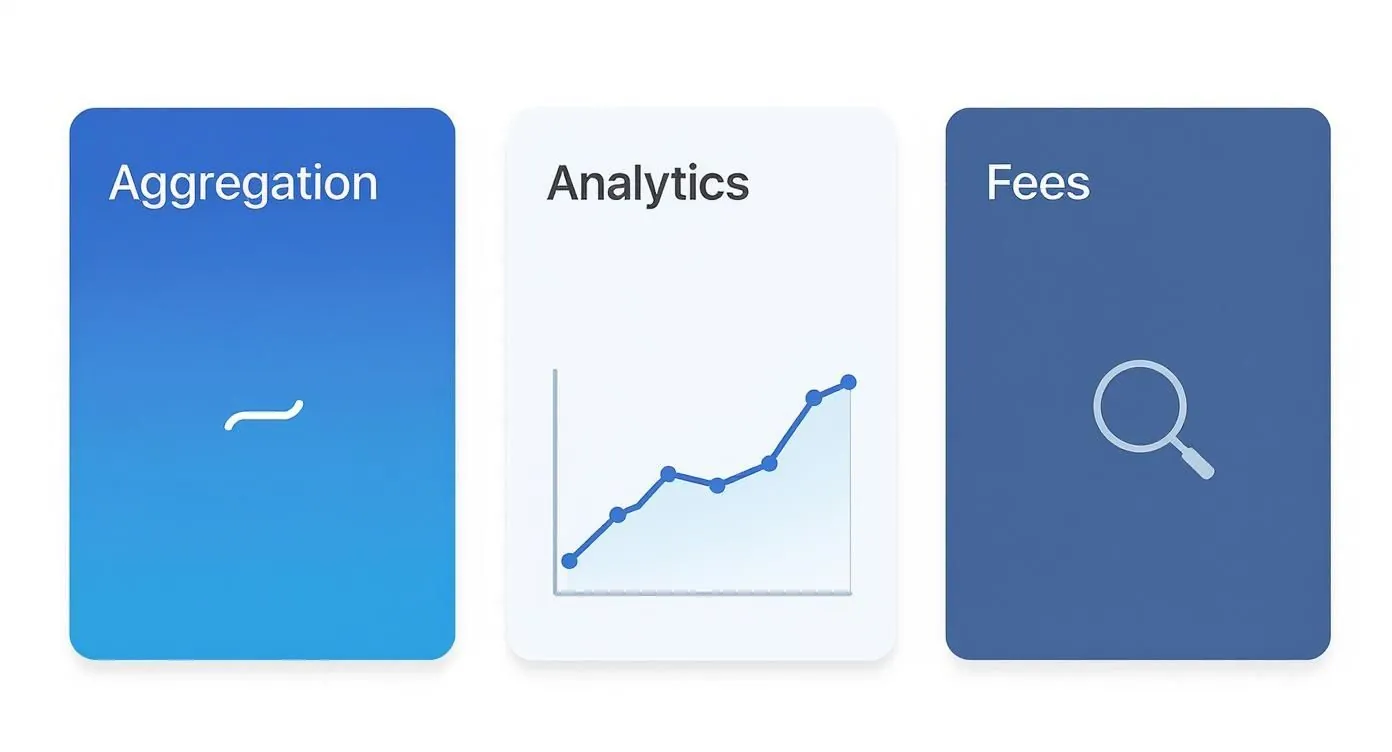
This visual makes it clear: while most tools offer some kind of data aggregation and analysis, their ability to find and manage hidden fees is often what sets them apart.
The Asset Aggregation Challenge
Here’s a classic investor setup: a Vanguard account for ETFs, a Coinbase account for crypto, and a Charles Schwab account for individual stocks. The biggest headache? Getting a single, real-time view of your total net worth without juggling three different browser tabs.
- PopaDex: This is where PopaDex pulls ahead. It offers direct API connections to over 15,000 institutions. That means your data from Vanguard, Coinbase, and Schwab syncs automatically and securely, giving you an up-to-the-minute portfolio value without lifting a finger.
- Competitor A (A Traditional Tracker): These tools often lean on third-party aggregators like Plaid. It works well for major US banks, but you’ll likely hit a wall with smaller institutions or international brokerages, forcing you back to manually entering transactions.
- Competitor B (A Brokerage-Centric Tool): Typically offered by a large brokerage, this kind of platform perfectly integrates its own accounts but treats everything else as an afterthought. You might link your Vanguard account, but that crypto on Coinbase? You’ll probably have to enter it by hand, which defeats the entire purpose of automation.
For anyone with a globally diverse portfolio, PopaDex’s wide net of integrations is a game-changer, saving you from the tedious workarounds other platforms require.
Performance Analytics and Reporting Nuances
Now, let’s think about a different user: a retiree focused on generating income. They need to track dividend payments, keep an eye on asset allocation to manage risk, and understand their portfolio’s true return after factoring in regular withdrawals. A simple account balance just won’t cut it; they need deep, usable insights.
The real difference between good and great portfolio software is its ability to turn raw data into a clear financial story. It needs to answer not just “What am I worth?” but “Why is my portfolio performing this way, and is it still on track to meet my goals?”
This is where the analytical depth of each platform really comes into focus.
- PopaDex: Delivers detailed performance reports that neatly separate capital gains from dividend income. Its tools calculate both Time-Weighted and Money-Weighted rates of return, giving our retiree a crystal-clear picture of how their investment choices are performing and how their withdrawals are affecting the bottom line.
- Competitor A: Provides decent high-level performance charts, but it often struggles with the granularity needed to easily isolate dividend income across all accounts. The reporting feels geared toward growth investors, with a heavy emphasis on overall percentage gains instead of income specifics.
- Competitor B: Offers fantastic analytics for assets held within its own system but gives you very basic reporting for any external accounts you link. This creates a fragmented view, making it nearly impossible for the retiree to accurately assess their total portfolio’s income stream.
In this scenario, PopaDex’s power to apply sophisticated analytics uniformly across all connected assets makes it the clear winner for investors who need a complete and detailed performance picture. You can see more about how a top-tier investment portfolio tracker provides these kinds of crucial insights.
Comparing Costs and Core Functionality
To cut through the marketing fluff, the table below provides a direct comparison of how PopaDex and its main competitors stack up on the features that matter most to individual investors. This is where you see the practical differences that impact your day-to-day experience.
Head-to-Head PopaDex vs The Competition
| Core Feature | PopaDex | Competitor A (Traditional Tracker) | Competitor B (Brokerage-Centric) |
|---|---|---|---|
| Multi-Currency Support | Seamlessly handles and converts 30+ currencies in real-time for a true global net worth calculation. | Basic support for major currencies like EUR and GBP, but may lag in updating exchange rates or supporting exotic currencies. | Primarily focused on the platform’s home currency (e.g., USD), with limited or no support for foreign assets. |
| Cryptocurrency Tracking | Direct API integrations with major exchanges and wallets for automated, real-time crypto portfolio updates. | Often requires manual entry or uses less reliable third-party connections that can break frequently. | Minimal to no native support for cryptocurrency, forcing users to track these assets completely separately. |
| Fee Analysis Tools | Actively scans for and categorizes hidden fees, including expense ratios and advisory fees, across all linked accounts. | Basic fee tracking that may identify transaction costs but often misses more subtle, recurring management fees. | Excellent fee transparency for its own products but provides no insight into the fees charged by external institutions. |
This head-to-head breakdown shows that while many platforms claim to offer portfolio management, the execution varies wildly. PopaDex was built from the ground up to handle the complexity and diversity of a modern investor’s portfolio, giving you a truly unified and insightful financial dashboard where others deliver a fragmented or limited experience.
Finding the Right Software for Your Investing Style
The best portfolio management software isn’t a one-size-fits-all product. The right tool for you depends entirely on your financial life—your goals, the assets you hold, and where you are on your journey.
A platform that’s perfect for a young professional chasing aggressive growth will almost certainly frustrate a retiree who just wants to protect their capital and track income. Choosing the right software is all about matching its core strengths to your specific needs. Instead of getting lost in endless feature lists, let’s look at this from a different angle. We’ll explore three common investor types, break down their biggest headaches, and see how the right features can solve their exact problems.
The Retiree Focused on Income and Preservation
Once you’re retired, the game changes completely. The goal shifts from aggressive growth to generating a steady, reliable income stream while protecting the capital you’ve spent a lifetime building. The main challenge? Tracking dividend payments, keeping an eye on asset allocation to avoid nasty surprises, and truly understanding your portfolio’s performance when you’re also making regular withdrawals.
A basic net worth tracker just won’t cut it. Retirees need specialized tools that bring absolute clarity to their income strategy.
- Granular Dividend Tracking: The software absolutely must be able to automatically identify and categorize every dividend and interest payment from all your accounts. This gives you a clean, consolidated view of your monthly and annual income.
- Robust Allocation Monitoring: Retirees need to know instantly if their portfolio is drifting too heavily into stocks or other volatile assets. A great tool will send alerts when your target stock-to-bond ratio is breached, letting you rebalance quickly.
- Sophisticated Performance Metrics: Calculating your real rate of return gets tricky when you’re regularly taking money out. The best software calculates both Time-Weighted and Money-Weighted Returns, showing you whether your investment choices are sound and how withdrawals are impacting your overall growth.
For a retiree, the most valuable feature is clarity. You need to know, without a doubt, that your portfolio can sustain your lifestyle without exposing you to unnecessary risk. The right software delivers that peace of mind.
The Expat Managing Multi-Currency Assets
Living and working abroad adds a layer of financial complexity most people never encounter. An expat might have a 401(k) in US dollars, a local salary in euros, and a rental property valued in British pounds. Their biggest challenge is getting an accurate, real-time picture of their total net worth without having to manually convert currencies every single day.
For this type of investor, multi-currency support isn’t just a nice feature—it’s the entire foundation of their financial picture. Without it, any net worth number is pure guesswork.
The right platform must deliver:
- Real-Time Currency Conversion: The tool needs to automatically convert all foreign assets and liabilities into your chosen base currency using up-to-the-minute exchange rates.
- Broad Institutional Support: Expats have accounts with banks and brokerages all over the globe. A platform with limited international connections is a non-starter. You need a tool that integrates with thousands of global financial institutions.
- Tax-Lot Accounting: Juggling investments across different tax jurisdictions is a massive headache. Software that can track the cost basis of assets you bought in different currencies is an invaluable tool for simplifying your tax reporting.
The Young Professional Building an Aggressive Growth Portfolio
Young professionals in their wealth-building years have a completely different set of priorities. With a long time horizon, their focus is on maximizing growth, often through a diverse mix of stocks, ETFs, and even alternative assets like cryptocurrency. Their biggest challenge is tracking performance across a dozen different platforms, understanding their true costs, and making sure their portfolio stays aligned with their high-growth goals.
This investor needs a tool that is fast, automated, and insightful, giving them the data they need to make quick, confident decisions.
- Seamless Asset Aggregation: They need a platform that connects effortlessly to everything from traditional brokerages like Schwab to crypto exchanges like Coinbase. Manual entry is a deal-breaker.
- Advanced Fee Analysis: In a growth portfolio, even tiny fees can create a massive drag on returns over decades. The software should automatically sniff out and categorize all hidden costs, like fund expense ratios and advisory fees, in every single account.
- Powerful Benchmarking Tools: It’s not enough to know your portfolio is growing; you need to know if it’s beating the market. The best tools let you compare your performance against relevant benchmarks like the S&P 500 or even a custom index you create yourself.
Why PopaDex Wins for Individual Investors
After sizing up the top platforms, one thing becomes clear. The best portfolio tool for an individual doesn’t just throw numbers at you; it delivers genuine clarity and control over your entire financial life. PopaDex really stands out here because it was built from the ground up to solve the modern investor’s biggest headaches: complexity, scattered accounts, and a total lack of actionable insights.
It brings together its best features into a single, intuitive experience. You get powerful multi-asset aggregation, a genuinely clean interface, and analytics that actually tell you something useful. These pieces work together seamlessly, turning the chore of tracking your portfolio into a source of confidence.
For a lot of investors, PopaDex is the tool that finally makes holistic wealth management feel achievable. It gets rid of the friction that keeps people stuck using clunky spreadsheets and jumping between disconnected accounts.
Unifying Your Entire Financial World
The bedrock of any great portfolio tool is its ability to pull everything into one place. PopaDex nails this, with direct connections to over 15,000 banks and brokerages across 30+ countries. This isn’t just about making life easier; it’s about getting an accurate picture.
Whether you have assets in a US brokerage, a European bank, or a crypto wallet, PopaDex brings it all together on one real-time dashboard. This powerful aggregation means you can finally stop guessing your true net worth and start making decisions based on a complete, up-to-the-minute view of your finances.
This move toward unified, smarter tools is happening everywhere. The demand for software that improves tracking and decision-making is booming, with the project and portfolio management software market expected to hit USD 12.25 billion by 2030. You can dig into the data on this market expansion to see why tools like PopaDex are becoming non-negotiable for personal finance.
From Data Overload to Actionable Insights
Just seeing your assets in one spot is only half the job. PopaDex is designed to translate all that raw data into insights you can actually act on. Its analytics engine helps you understand the why behind your portfolio’s performance.
PopaDex is designed to answer the questions that truly matter for an individual investor: “Am I on track for my goals?” “Are hidden fees eating into my returns?” and “Where is my portfolio most exposed to risk?” It moves you from passive tracking to active, informed management.
Instead of drowning you in financial jargon, the platform shows you key metrics in clean, interactive charts. You can see your asset allocation at a glance, spot your top performers and laggards, and track how you’re progressing toward your personal financial goals.
Transparent Pricing for Real Value
Finally, PopaDex delivers all this with a straightforward and accessible price tag, directly challenging the confusing or expensive models of its competitors. With a solid free plan and an affordable premium tier, it gives you exceptional value without hiding essential features behind a massive paywall.
This blend of comprehensive aggregation, smart analytics, and fair pricing makes PopaDex the smartest choice for anyone ready to take real control of their financial future. It’s a platform built not just to track your wealth, but to help you confidently grow and protect it.
Got Questions About Portfolio Software? We’ve Got Answers.
Choosing the right tool to manage your financial life is a big deal, and it’s smart to have questions. Let’s tackle some of the most common concerns investors have when they’re looking for the right portfolio management software. Our goal is to clear up any confusion so you can move forward with confidence.
How Secure Is It to Connect My Financial Accounts?
This is usually the first question people ask, and for good reason. Trust is everything when it comes to your financial data. Reputable platforms like PopaDex use bank-level security and, crucially, read-only access to protect your information.
What does that mean? It means the software can see your balances and transactions, but it cannot move money, make trades, or change any of your account details. Connections are almost always handled by trusted third-party aggregators like Plaid, which use heavy-duty encryption and tokenization to keep your login credentials safe. Your actual username and password are never stored on the software’s servers.
How Much Time Does the Setup Really Take?
You’ll probably be surprised at how fast it is. For any platform with automated connections, the process is pretty straightforward. Most of your time will be spent simply logging into each of your financial institutions through the software’s secure portal.
Let’s say you have 5-7 different accounts—maybe a 401(k), an IRA, a brokerage account, and a couple of bank accounts. You can realistically get everything connected in under 30 minutes. Once you’re linked up, the software takes over, automatically syncing your data from then on. Platforms that require manual entry, on the other hand, are a different story and demand a much bigger time commitment upfront.
Can This Software Actually Help with My Taxes?
Absolutely. While these tools aren’t tax preparation software, they are a lifesaver when tax season rolls around. They make the process so much simpler by gathering all your financial data in one spot.
Here’s where they really shine:
- Tracking Capital Gains: They can automatically monitor the cost basis, purchase dates, and sale dates for your investments. This makes calculating short-term and long-term capital gains a breeze.
- Consolidating Income: The software pulls together all your dividend and interest income from every single account, giving you one clean number to report.
- Organizing Your Data: Instead of scrambling to download a dozen different tax forms, you get a centralized report of all relevant activity. You or your accountant can then use this to file accurately and without the usual headache.
Think of portfolio software as your personal financial bookkeeper. It spends the whole year organizing and categorizing everything, so when tax time hits, all the information you need is already compiled and ready to go.
What’s the Real Difference Between Free and Paid Tools?
When you boil it down, the difference between free and paid portfolio software comes down to three things: automation, depth, and support. Free tools can be a decent place to start, but you’ll likely hit their limitations pretty quickly.
- Free Tools: These often depend on manual data entry, which is not only tedious but also leaves a lot of room for error. They might also cap the number of accounts you can link, lack sophisticated analytics, and will almost certainly serve you ads.
- Paid Tools: A premium platform invests in direct, automated API connections to thousands of financial institutions. This gives you real-time, accurate data without you having to lift a finger. You also unlock more powerful features like in-depth fee analysis, advanced performance metrics (like TWR vs. IRR), and get actual customer support when you need it.
Ultimately, paying for a tool is an investment in accuracy, saving time, and gaining deeper financial insight. For any serious investor, the small monthly cost is easily worth the value of having a complete, automated, and reliable picture of their wealth.
Ready to get that clear, unified view of your entire financial world? PopaDex offers a powerful, intuitive platform designed specifically for individual investors like you. Start your free trial today and see what a difference true financial clarity can make.