
Our Marketing Team at PopaDex
8 Best Retirement Accounts for Self Employed Entrepreneurs in 2026
Navigating retirement savings as a self-employed professional can feel like a complex puzzle. Unlike traditional employees with company-sponsored 401(k)s, you are the architect of your own financial future. This freedom is powerful but comes with the responsibility of choosing the right vehicle to grow your wealth. The good news? You have access to some of the most potent retirement accounts available, often with higher contribution limits and greater flexibility than standard W-2 employee plans.
This guide is designed to cut through the complexity and provide a clear, actionable roadmap. We will break down the absolute best retirement accounts for self employed individuals, moving beyond generic advice to detail specific strategies. You will learn not just what each account is, but who it’s for, why it works, and how to set it up for maximum benefit. Maximizing your financial potential as a business owner also involves understanding and utilizing the various Self Employed Tax Benefits Canada offers, which can indirectly boost your retirement savings.
We’ll explore the ideal use-case for each of these powerful tools:
- The high-contribution Solo 401(k) for maximizing savings.
- The simplified, high-limit SEP IRA for straightforward contributions.
- The SIMPLE IRA for business owners with a small team.
- The tax-free growth potential of a Roth IRA or Solo Roth 401(k).
- The often-overlooked power of a Health Savings Account (HSA) as a triple-tax-advantaged retirement vehicle.
By the end of this article, you will have a comprehensive understanding of your options, empowering you to select the perfect strategy to secure a prosperous retirement. Let’s build your retirement roadmap.
1. Solo 401(k) (Individual 401(k))
A Solo 401(k) is a specialized retirement plan designed for a business owner with no employees, other than a spouse. This powerful account is one of the best retirement accounts for self employed individuals because it allows you to contribute as both the “employee” and the “employer,” leading to exceptionally high contribution limits. This dual contribution structure is its key advantage over other plans.
For 2024, you can contribute up to $23,000 as an employee ($30,500 if you’re age 50 or older), plus an additional employer contribution of up to 25% of your compensation. The total combined contributions cannot exceed $69,000 ($76,500 if age 50 or over). This makes it an ideal vehicle for aggressively saving for retirement and significantly reducing your taxable income.
Who Should Use a Solo 401(k)?
This account is perfect for high-earning freelancers, consultants, and single-owner businesses who want to maximize their retirement savings. For example, a freelance software developer earning $200,000 could contribute the maximum employee amount and a substantial employer profit-sharing contribution, sheltering a large portion of their income from taxes. It is also an excellent choice for side-hustlers who already contribute to a 401(k) at a W-2 job; they can still make employer contributions from their self-employment income into a Solo 401(k).
Actionable Tips for Implementation
- Establish Your Plan: You must establish the plan by December 31st of the tax year you wish to contribute to, though you typically have until the tax filing deadline to fund it. Major custodians like Fidelity and Charles Schwab offer low-cost options.
- Maximize Contributions Strategically: In highly profitable years, maximize your employer contribution to reduce your tax burden. In leaner years, you can reduce or even skip the employer portion, offering valuable flexibility.
- Consider a Roth Option: Many Solo 401(k) plans now offer a Roth component. This allows you to make post-tax employee contributions, which then grow and can be withdrawn tax-free in retirement.
- Leverage Loan Provisions: Some plans allow you to borrow up to 50% of your account balance (up to $50,000). While this should be used cautiously, it provides a source of liquidity that most IRA-based plans lack.
- Track Your Progress: Use a tool like PopaDex to integrate your Solo 401(k) and monitor its performance alongside your other business and personal assets. This gives you a comprehensive view of your total net worth.
Key Insight: The Solo 401(k) stands out for its high contribution limits and the potential for a loan provision, offering a combination of aggressive savings and financial flexibility unmatched by most other self-employed retirement plans.
2. SEP-IRA (Simplified Employee Pension IRA)
A SEP-IRA (Simplified Employee Pension) is a straightforward retirement plan ideal for self-employed individuals and small business owners who prioritize simplicity and flexibility. Unlike the Solo 401(k), contributions are made only by the employer (that’s you, the business owner). This makes it one of the most accessible and easiest-to-administer retirement accounts for self employed professionals, requiring minimal paperwork to set up and maintain.
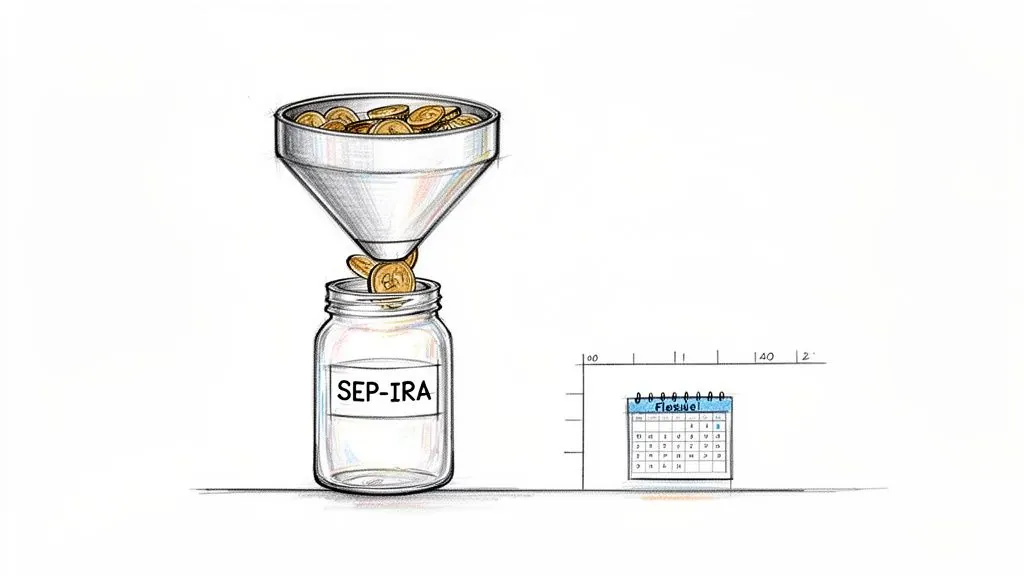
The contribution limits are generous, though calculated differently than a Solo 401(k). For 2024, you can contribute up to 25% of your net adjusted self-employment income, not to exceed $69,000. This single-source contribution structure simplifies the savings process, as you don’t need to track separate employee and employer deferrals. All contributions are tax-deductible for your business, lowering your overall tax liability.
Who Should Use a SEP-IRA?
The SEP-IRA is an excellent choice for freelancers, independent contractors, and sole proprietors with variable income streams. For example, a freelance writer or an independent plumber can easily adjust their contribution amount based on their annual earnings without being locked into a fixed deferral. It’s also a great starting point for those new to self-employment retirement planning due to its low administrative burden and easy setup process, which is a key part of effective financial planning for freelancers.
Actionable Tips for Implementation
- Easy Account Setup: You can open a SEP-IRA at most major brokerages and establish the plan by your tax filing deadline (including extensions) for a given year. Simply complete the IRS Form 5305-SEP for your records.
- Track Your Income: Your maximum contribution is directly tied to your net self-employment income. Use a tool like PopaDex to track your business income and expenses accurately throughout the year to project your potential contribution.
- Contribute Flexibly: You are not required to contribute every year. This is a significant advantage for those with unpredictable income; you can contribute heavily in profitable years and skip contributions in leaner ones.
- Plan for Employees: If you plan to hire, be aware that you must make contributions for eligible employees at the same percentage of compensation that you contribute for yourself. This is a critical factor to consider as your business grows.
- Annual Rebalancing: Just like any investment account, you should review and rebalance your SEP-IRA portfolio annually. PopaDex’s portfolio tracking tools can help you monitor your asset allocation and ensure it aligns with your retirement goals.
Key Insight: The SEP-IRA’s greatest strengths are its operational simplicity and contribution flexibility, making it the perfect “set it and forget it” retirement plan for self-employed individuals who value ease of use over complex features like loans.
3. SIMPLE IRA (Savings Incentive Match Plan for Employees)
A SIMPLE IRA is a low-cost, easy-to-administer retirement plan designed for small businesses and self-employed individuals with 100 or fewer employees. It functions as a straightforward way to offer retirement benefits, combining features of traditional IRAs with a mandatory employer contribution. For a self-employed person, you contribute both as the “employee” and as the “employer,” similar to other plans.
For 2024, you can contribute up to $16,000 as the employee ($19,500 if you’re age 50 or older). As the employer, you are required to make a contribution. You can either make a matching contribution of up to 3% of your compensation or a non-elective contribution of 2% for yourself (and any employees). This mandatory employer contribution makes it a structured, yet simple, retirement savings tool.
Who Should Use a SIMPLE IRA?
This account is ideal for sole proprietors, freelancers, and small business owners who plan to hire employees in the near future or already have a small team. It’s less complex to administer than a 401(k) but still offers a powerful way to save. For example, a small digital agency or a family-run business can use a SIMPLE IRA to attract and retain talent by offering a retirement benefit without the high administrative burden or costs of a traditional 401(k).
Actionable Tips for Implementation
- Meet the Deadline: You must establish a SIMPLE IRA plan by October 1st of the tax year you wish to contribute for, which is an earlier deadline than most other self-employed plans.
- Choose Your Contribution Method: Decide between the 3% match or the 2% non-elective contribution. The 2% non-elective contribution is often simpler for a sole proprietor, as it doesn’t depend on your own “employee” contribution level.
- Plan for Mandatory Contributions: Unlike a SEP IRA where employer contributions are optional, the employer portion of a SIMPLE IRA is required. You must factor this into your business’s annual cash flow projections.
- Communicate Clearly: If you have employees, clearly communicate the matching benefit to encourage participation. This maximizes the value of the plan as an employee retention tool.
- Monitor Your Business Finances: Use a platform like PopaDex to model how your mandatory employer contributions will impact your overall business net worth and profitability, ensuring the plan remains sustainable.
Key Insight: The SIMPLE IRA is one of the best retirement accounts for self employed individuals who anticipate growing a small team, as it provides an accessible, low-maintenance way to offer retirement benefits while still allowing for significant personal savings.
4. Solo Roth 401(k)
A Solo Roth 401(k) is a powerful variant of the standard Solo 401(k) that allows the business owner to make after-tax employee contributions. While traditional pre-tax contributions lower your current taxable income, Roth contributions do not. The trade-off is that qualified withdrawals in retirement are completely tax-free, making it one of the best retirement accounts for self employed individuals who anticipate being in a higher tax bracket in the future.
This account retains the dual contribution structure of a standard Solo 401(k). For 2024, you can make after-tax employee contributions up to $23,000 ($30,500 if age 50 or older). The employer contribution portion, up to 25% of your compensation, remains pre-tax. This unique blend allows you to secure tax-free growth on your employee savings while still getting a current-year tax deduction on the employer side. The total combined contributions cannot exceed $69,000 ($76,500 if age 50 or over).
Who Should Use a Solo Roth 401(k)?
This account is ideal for young, self-employed professionals, early-career freelancers, or tech entrepreneurs who are currently in a lower tax bracket but expect their income to grow significantly. For instance, a digital creator in the early stages of their business can maximize Roth contributions, locking in tax-free growth for decades. It is also an excellent tool for those who simply want to create a source of tax-diverse income in retirement, hedging against future tax rate increases.
Actionable Tips for Implementation
- Establish Before Year-End: Just like a standard Solo 401(k), you must establish the plan by December 31st of the tax year you want to contribute for. You can then fund the account up until your business tax filing deadline.
- Model Future Tax Scenarios: Work with a financial advisor to model your potential retirement income and tax liabilities. This can help you determine the optimal balance between pre-tax (employer) and post-tax (Roth employee) contributions for your situation.
- Maintain Clear Records: It’s crucial to keep meticulous records that distinguish your Roth employee contributions from your pre-tax employer contributions within the same plan. Your custodian will typically track this for you, but you should verify it.
- Prioritize Roth in Lower-Income Years: If you are in the early stages of your business or experiencing a leaner year, prioritize funding the Roth portion. This capitalizes on your lower current tax rate, allowing you to pay taxes now and enjoy tax-free withdrawals later when you may need the money most.
- Track Your Tax-Free Growth: Use a tool like PopaDex to track your Solo Roth 401(k) assets separately. This helps you visualize your long-term tax-free nest egg and reinforces the value of your savings strategy.
Key Insight: The Solo Roth 401(k) offers a unique hybrid approach, allowing you to build a substantial tax-free retirement fund with your employee contributions while simultaneously reducing your current tax bill with pre-tax employer contributions, a feature unavailable in any IRA.
5. Traditional IRA with Catch-Up Contributions
A Traditional IRA is a fundamental retirement savings account available to anyone with earned income, making it highly accessible for self-employed individuals. While its contribution limits are lower than business-specific plans, its simplicity and universal availability make it a valuable component of a retirement strategy. Its key feature is the tax-deductible contribution, which lowers your immediate taxable income, with taxes paid upon withdrawal in retirement.
For 2024, you can contribute up to $7,000 to a Traditional IRA. What makes this particularly powerful for those starting late or looking to accelerate savings is the catch-up contribution. If you are age 50 or older, you can contribute an additional $1,000, bringing your total possible contribution to $8,000. This makes it a great foundational or supplementary account for those saving for retirement.
Who Should Use a Traditional IRA?
This account is ideal for self-employed individuals who are just starting out, have modest self-employment income, or want a simple way to supplement another retirement plan. For instance, a part-time freelance writer can easily open and contribute to a Traditional IRA without the administrative steps of a business plan. It’s also perfect for older self-employed workers who want to take full advantage of the catch-up provision to boost their savings in their final working years before retirement.
Actionable Tips for Implementation
- Contribute Early: Fund your IRA as early in the tax year as possible. This gives your investments more time to benefit from tax-deferred compound growth.
- Aggressively Use Catch-Up: If you are age 50 or over, make it a priority to contribute the extra $1,000. This small boost can make a significant difference over a decade.
- Mind the Income Limits: The tax deductibility of Traditional IRA contributions phases out at higher income levels if you or your spouse are covered by a workplace retirement plan. Be sure to check the current IRS income phase-out ranges.
- Track Your Basis: If you make non-deductible contributions because your income is too high, you must track this “basis” using IRS Form 8606. This ensures you aren’t taxed twice on that money when you withdraw it.
- Integrate Your View: Use a tool like PopaDex to track your Traditional IRA’s performance. Seeing it alongside your other business accounts and assets provides a complete picture of your financial health and retirement readiness.
Key Insight: The Traditional IRA’s strength lies in its simplicity and accessibility. For the self-employed, it serves as an excellent starting point or a supplemental account, with the catch-up provision offering a crucial boost for those saving later in life.
6. Roth IRA (with Backdoor Roth Strategy)
A Roth IRA is a powerful retirement account that offers tax-free growth and tax-free qualified withdrawals, making it an excellent addition to a self-employed person’s financial plan. While not exclusively for the self-employed, its unique tax advantages complement other business-focused retirement accounts. The key benefit is paying taxes now so you can enjoy tax-free income in retirement, a valuable hedge against future tax rate increases.
For 2024, direct contributions are capped at $7,000 ($8,000 if age 50 or older), but there are income limitations. This is where the backdoor Roth strategy becomes crucial. It allows high-earning self-employed individuals to bypass these income limits by contributing to a Traditional IRA and then converting those funds to a Roth IRA. This makes the Roth IRA one of the best retirement accounts for self employed professionals at any income level.
Who Should Use a Roth IRA?
This account is ideal for young self-employed workers who anticipate being in a higher tax bracket in the future. It’s also a must-have for high-income consultants and digital entrepreneurs who are phased out of direct contributions but still want to build a bucket of tax-free retirement money. For example, a successful freelance graphic designer earning $180,000 can use the backdoor Roth strategy to add to their tax-diversified retirement portfolio, even while maximizing contributions to a SEP IRA or Solo 401(k).
Actionable Tips for Implementation
- Execute the Backdoor Roth: Contribute to a non-deductible Traditional IRA and then promptly convert the entire balance to a Roth IRA. Completing both steps within the same tax year can simplify reporting.
- Beware the Pro-Rata Rule: This is critical. The IRS aggregates all of your Traditional, SEP, and SIMPLE IRAs when calculating taxes on a conversion. If you have existing pre-tax IRA funds, a portion of your conversion will be taxable. Consider rolling old IRA funds into a workplace 401(k) if possible to avoid this.
- Keep Meticulous Records: Document all non-deductible contributions (Form 8606) and conversions. Proper record-keeping is essential to prove to the IRS that you’ve already paid taxes on the principal and shouldn’t be taxed again.
- Time Your Conversions: While a clean backdoor Roth involves a quick conversion, some people with existing pre-tax IRAs may strategically convert funds in a lower-income year or during a market downturn to minimize the tax impact.
- Integrate and Track: Use a tool like PopaDex to monitor your Roth IRA alongside your other retirement accounts. A comprehensive retirement planning checklist is essential to ensure all your accounts are working together towards your goals. Find a helpful guide and learn more about creating a retirement planning checklist on popadex.com.
Key Insight: The Roth IRA, especially when accessed via the backdoor strategy, provides high-income self-employed individuals with a path to tax-free retirement income, offering a crucial layer of tax diversification that other pre-tax plans cannot match.
7. Individual 401(k) with Self-Directed Brokerage Account
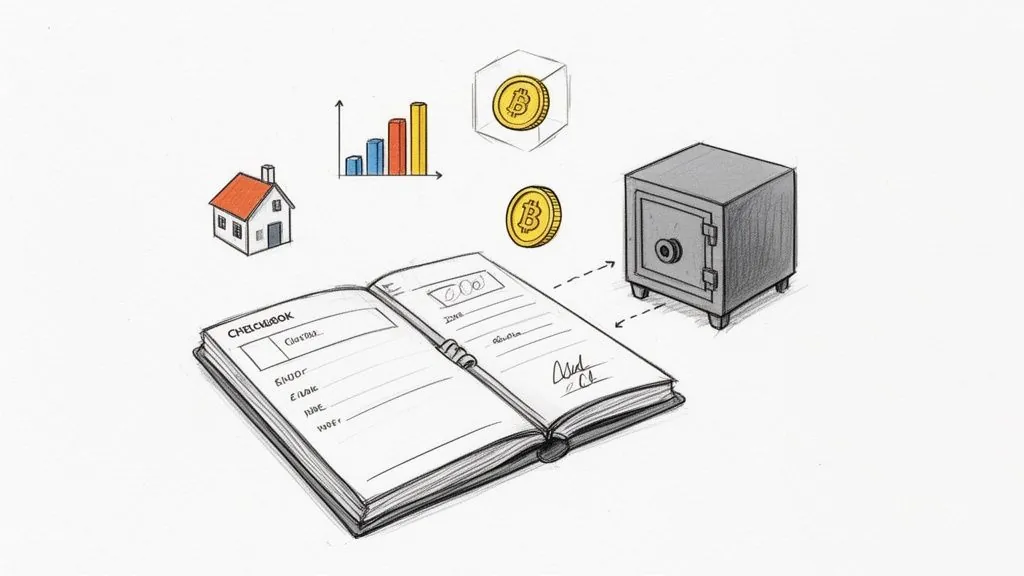
A Self-Directed Individual 401(k) takes the powerful, high-contribution framework of a Solo 401(k) and combines it with the expansive investment universe of a self-directed brokerage account. This option empowers self-employed individuals to invest their retirement funds in alternative assets that go far beyond traditional stocks, bonds, and mutual funds. It offers unparalleled control for sophisticated investors looking to diversify into real estate, private equity, precious metals, or even cryptocurrencies.
The core benefit is the ability to use your specialized knowledge to build wealth within a tax-advantaged account. While contribution limits mirror a standard Solo 401(k), the key difference is what you can do with the funds once they are in the account. This structure is a cornerstone for many of the best retirement accounts for self employed entrepreneurs who operate in alternative investment spaces.
Who Should Use a Self-Directed Individual 401(k)?
This account is ideal for sophisticated, self-employed investors who are experts in non-traditional asset classes. For instance, a real estate professional could use their self-directed account to purchase a rental property, with all rental income and appreciation growing tax-deferred. Similarly, a cryptocurrency expert could allocate a portion of their retirement funds to promising blockchain projects. It’s built for those who want direct control over their investments and have a high tolerance for the risks and due diligence associated with alternative assets.
Actionable Tips for Implementation
- Choose a Specialized Custodian: Work with a custodian that specializes in self-directed accounts and alternative assets, such as Directed IRA or Rocket Dollar. Their expertise in compliance is critical.
- Understand Prohibited Transactions: You must strictly follow IRS rules. You cannot personally benefit from an investment owned by your retirement plan (for example, you cannot live in a rental property owned by your 401(k)). Violating these rules can have severe tax consequences.
- Maintain Meticulous Records: Document every transaction, valuation, and expense related to your alternative assets. This is crucial for IRS compliance and accurate reporting.
- Consider “Checkbook Control”: Some plans allow you to set up a special LLC owned by your 401(k). This gives you “checkbook control,” allowing you to make investments more quickly and with fewer transaction fees by simply writing a check from the LLC’s bank account.
- Track Alternative Assets: Use a platform like PopaDex to manually track the value of your alternative investments like real estate or private equity alongside your traditional assets. This gives you a complete picture of your retirement portfolio allocation and overall net worth.
Key Insight: The Self-Directed Individual 401(k) offers the ultimate investment control, allowing you to leverage your unique expertise in areas like real estate or private placements to build retirement wealth. However, this power comes with significant responsibility for compliance and due diligence.
8. Health Savings Account (HSA) as a Retirement Vehicle
While primarily designed for healthcare costs, a Health Savings Account (HSA) is a secret weapon among the best retirement accounts for self employed individuals. To be eligible, you must be enrolled in a high-deductible health plan (HDHP). Its power lies in a unique triple-tax advantage: your contributions are tax-deductible, the funds grow tax-free, and withdrawals for qualified medical expenses are also tax-free.

For 2024, you can contribute up to $4,150 for self-only coverage or $8,300 for family coverage, with an additional $1,000 catch-up contribution for those age 55 and older. Unlike other accounts, funds can be withdrawn penalty-free at any age for medical costs, and after age 65, non-medical withdrawals are simply taxed as ordinary income, similar to a traditional IRA.
Who Should Use an HSA?
An HSA is ideal for any self-employed individual with an HDHP who wants to leverage unmatched tax efficiency. It is especially powerful for younger, healthier freelancers who can let their funds grow for decades by paying for minor medical costs out-of-pocket. For example, a digital marketing consultant with family HDHP coverage can contribute the maximum, invest the funds in a low-cost index fund, and treat it purely as a long-term growth vehicle, creating a tax-free fund for future healthcare needs in retirement. For those considering this account, understanding an HSA vs. FSA comparison is a great starting point, as HSAs offer portability and investment options that FSAs do not.
Actionable Tips for Implementation
- Prioritize Contributions: If eligible, consider maxing out your HSA contributions before other retirement accounts. Its triple-tax advantage is unparalleled.
- Invest, Don’t Just Save: To unlock its full potential, invest your HSA funds in stocks or ETFs instead of letting them sit in cash. Choose a custodian like Fidelity or Lively that offers robust, low-cost investment options.
- Document Everything: Keep detailed records and receipts of all qualified medical expenses you pay out-of-pocket. You can reimburse yourself for these expenses tax-free from your HSA years, or even decades, later.
- Integrate Your Tracking: Use a comprehensive tool like PopaDex to monitor your HSA investments alongside your Solo 401(k) and other assets. This holistic view is crucial for effective retirement planning.
- Plan for Age 65: Remember that after age 65, your HSA essentially functions like a traditional IRA for non-medical withdrawals. This provides an additional source of retirement income beyond healthcare.
Key Insight: The HSA offers a “stealth” retirement account with a triple-tax advantage that no other vehicle can match, making it an incredibly powerful tool for self-employed individuals with high-deductible health plans.
Top 8 Retirement Accounts for the Self-Employed — Comparison
| Plan | Implementation Complexity | Resource & Admin | Expected Outcomes | Ideal Use Cases | Key Advantages |
|---|---|---|---|---|---|
| Solo 401(k) (Individual 401(k)) | High — formal setup, annual filings possible (Form 5500) | Moderate–High admin & custodian costs; recordkeeping, loan admin | High retirement savings potential; | High-earning self-employed with no employees | Highest contribution limits, dual employee+employer contributions, loan option |
| SEP-IRA | Low — simple IRS Form 5305-SEP setup | Low ongoing admin, employer-funded contributions, flexible year-to-year | Moderate savings (percentage-based); | Self-employed seeking minimal paperwork or planning to hire later | Easy to establish, low cost, flexible contributions |
| SIMPLE IRA | Low–Medium — simple plan but employer match required | Low cost, payroll integration required; mandatory employer contributions affect cash flow | Moderate savings with employer match; | Small businesses (≤100 employees) or owners about to hire | Low admin burden, built-in employer match to encourage participation |
| Solo Roth 401(k) | High — similar to Solo 401(k) plus Roth recordkeeping | Moderate–High admin; after-tax funding reduces immediate tax savings | Long-term tax-free growth, no RMDs; | Younger self-employed anticipating higher future taxes | Tax-free qualified distributions, RMD avoidance, Roth+traditional flexibility |
| Traditional IRA with Catch-Up Contributions | Very Low — simple individual account setup | Minimal cost and admin; quick online setup | Limited annual savings (low limits), tax-deferral; | Part-time freelancers, supplement to other plans, 50+ savers | Very easy access, catch-up contributions for age 50+, tax deduction potential |
| Roth IRA (with Backdoor Roth Strategy) | Low–Medium — account simple; backdoor requires tax coordination | Low custodian costs but needs tax planning to avoid pro‑rata issues | Tax-free growth & no RMDs; limited base limits but backdoor enables access; | High-income self-employed seeking tax-free retirement | Tax-free withdrawals, backdoor workaround for high earners, estate advantages |
| Individual 401(k) with Self-Directed Brokerage Account | Very High — custodian rules, prohibited‑transaction risk, UBIT considerations | High fees, specialized custodians, complex compliance & valuation | Potentially superior returns via alternatives; higher risk/illiquidity; | Sophisticated investors (real estate, private equity, crypto) | Access to alternative assets, checkbook control options, max contributions |
| Health Savings Account (HSA) as Retirement Vehicle | Low–Medium — requires HDHP eligibility | Low ongoing costs, small annual limits; strong tax efficiency | Triple tax advantage, excellent long-term tax efficiency; | Self-employed on HDHPs prioritizing tax‑efficient retirement savings | Triple tax benefit (deductible, tax‑free growth, tax‑free qualified withdrawals), no RMDs |
Choosing Your Path and Taking the Next Step
Navigating the landscape of retirement planning as a self-employed individual can feel like charting a complex course. However, by understanding the distinct advantages of each account type, you are now equipped to make a powerful, informed decision that aligns perfectly with your unique financial journey. This guide has broken down the best retirement accounts for self employed individuals, moving beyond generic advice to provide a clear roadmap for your future.
We’ve explored the aggressive saving potential of the Solo 401(k), a top-tier choice for high-earning freelancers and single-owner businesses looking to maximize their contributions. We contrasted this with the streamlined simplicity of the SEP-IRA, an ideal starting point for those who value ease of setup and flexible funding. For entrepreneurs with growth on the horizon, the SIMPLE IRA emerged as a scalable solution that accommodates a small team without overwhelming administrative burdens.
The key takeaway is that your choice is not merely about picking an account; it’s about selecting a strategic tool tailored to your business income, tax situation, and long-term vision for financial independence.
From Knowledge to Action: Your Next Steps
Analysis paralysis is the enemy of progress. The most critical step you can take right now is to move from consideration to implementation. Your future self will thank you for the decisive action you take today.
Here is a practical, step-by-step plan to get started:
- Identify Your Top Contender: Based on the detailed comparisons in this article, which account resonates most with your current business structure and savings goals? Is it the high contribution limit of the Solo 401(k), the employer-matching feature of a SIMPLE IRA, or the tax-free growth potential of a Roth account? Pinpoint the one that feels like the best fit.
- Consult a Professional: Before finalizing your decision, a brief consultation with a financial advisor or a CPA specializing in small businesses is invaluable. They can validate your choice based on the nuances of your financial situation, confirm your eligibility, and help you understand the specific tax implications for your business. This step ensures you avoid costly mistakes and optimize your strategy from day one.
- Open Your Account: The process of opening one of these accounts is more straightforward than you might think. Most major brokerage firms offer dedicated platforms for self-employed retirement plans. Gather your business information, such as your Employer Identification Number (EIN), and follow their guided online setup process.
- Automate Your Contributions: The secret to consistent saving is automation. Once your account is open, set up a recurring transfer from your business checking account. Even a small, consistent contribution is more powerful than sporadic, large deposits. This “pay yourself first” mentality is the cornerstone of building substantial retirement wealth.
The Bigger Picture: Integrating Your Retirement Strategy
Choosing and funding one of the best retirement accounts for self employed professionals is a monumental step, but it’s only one piece of your complete financial puzzle. True financial clarity and control come from seeing how this powerful new asset fits within your entire net worth. You need a holistic view that connects your business income, personal investments, real estate, and now, your dedicated retirement fund.
By taking decisive action now, you are not just saving money; you are architecting a future of freedom and security. You are taking control of your financial destiny in a way that traditional employment structures often cannot offer. This proactive approach is the ultimate advantage of being self-employed, allowing you to build a legacy of wealth on your own terms.
Ready to see your new retirement account as part of your total financial picture? PopaDex provides a consolidated dashboard to track all your assets in one place, giving you the clarity needed to make smarter financial decisions and accelerate your journey to retirement. Sign up today and gain a true, holistic view of your growing net worth at PopaDex.