
Our Marketing Team at PopaDex
Your Guide to Financial Data Security
Financial data security is just a formal way of describing all the practices and tech used to keep your sensitive financial information safe. Think of it as the digital version of locking your bank statements in a safe—it’s all about making sure only the right people can see things like account numbers, transaction histories, and personal details.
The whole point is to shield your financial life from theft, fraud, and anyone trying to snoop where they shouldn’t.
Protecting Your Digital Vault
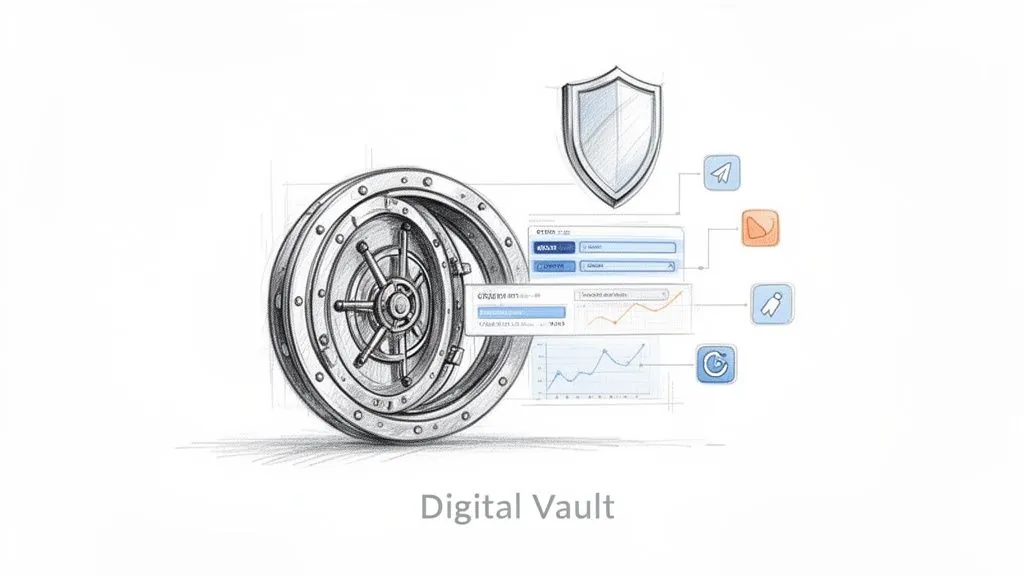
It helps to think of your financial life as a digital vault. This vault doesn’t just hold cash; it contains a treasure trove of information that could cause way more damage than a simple theft if it fell into the wrong hands. We’re talking about everything from bank logins and credit card numbers to your investment history and Social Security number.
Financial data security is the entire defense system built around that vault. It’s a layered approach, combining digital locks (encryption), armored walls (firewalls), and vigilant surveillance cameras (threat monitoring). The goal is to keep your information safe, accurate, and accessible to you at all times.
The Four Pillars of Financial Data Security
At its core, solid financial data security is built on a few fundamental principles. Think of them as the pillars holding up the entire structure. They work together to create a secure environment where your information stays protected, whether it’s sitting on a server, flying across the internet, or being processed by an app like PopaDex.
These pillars are based on the classic “CIA Triad” of information security, a model used to guide security policies for organizations worldwide. We’ve added a fourth, crucial pillar that’s especially relevant today.
| Principle | What It Means for Your Data | Real-World Example |
|---|---|---|
| Confidentiality | Only authorized people can access your information. | Your bank app requires a password and two-factor authentication before showing your account balance. |
| Integrity | Your data remains accurate and can’t be secretly changed. | When you pay a bill for $50, this principle ensures a hacker can’t intercept it and alter the amount to $5,000. |
| Availability | You can get to your information whenever you need it. | The servers hosting your financial app are protected from attacks that could take them offline, so you can always log in. |
| Accountability | There’s a clear record of who accessed your data and when. | If a change is made to your account, there’s a digital trail leading back to the specific user who made it. |
Every security measure you encounter, from multi-factor authentication to data encryption, is designed to support one or more of these pillars. Understanding them helps you see the “why” behind the security features you use every day.
Beyond the Basics of Security
But great security doesn’t just stop there. It covers the entire lifecycle of your data, right down to how it’s thrown away.
When you close an account or a company gets rid of old computers, the data on them must be permanently destroyed so it can’t be recovered. This is a bigger deal than just hitting “delete.” For a deep dive into what this involves professionally, it’s worth checking out standards like NIST SP 800-88, the authoritative guide to secure data sanitization.
This is why getting a handle on the fundamentals is so important. It empowers you to ask the right questions, pick secure tools for your finances, and build safer habits for yourself.
Common Threats to Your Financial Data
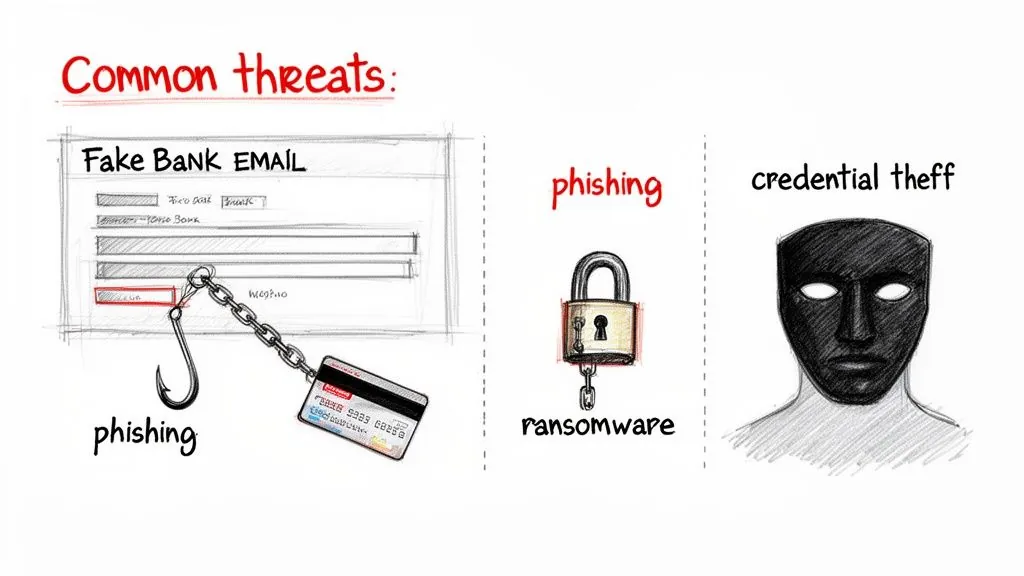
To protect your digital wallet, you first have to know what you’re up against. The dangers to your financial data aren’t just vague warnings; they are specific, constantly evolving tactics that attackers use every single day. Getting familiar with these real-world threats is the first step toward locking down your information.
This isn’t about creating fear. It’s about building recognition. When you can spot the tell-tale signs of an attack, you shift from being a potential target to being an active defender of your own finances.
The Deception of Phishing Scams
Picture this: you open your email and find an urgent message from your bank. It looks totally legit—right logo, serious tone—warning you about “unauthorized activity” on your account. The email demands you click a link right now to verify your identity and secure your money.
That’s a classic phishing attack. These scams are a form of social engineering, cleverly designed to trick you into just handing over your login credentials, credit card numbers, or other sensitive details. The link doesn’t go to your bank’s real website, but to a perfect fake. The second you enter your info, the attacker has it.
Phishing attempts have become incredibly sophisticated. They often manufacture a sense of panic, pushing you to react before you have a chance to think. The best defense is a healthy dose of skepticism—always question unsolicited requests for your data, no matter how official they seem.
When Your Data Is Held Hostage by Ransomware
Another nasty threat is ransomware, which is basically the digital kidnapping of your data. Think of it like a thief breaking into your house, locking all your valuables in a safe they brought with them, and leaving a note demanding cash for the combination.
In the digital world, attackers use malicious software to encrypt your files, making them completely unreadable. For an individual, that could mean losing access to years of personal documents and photos. For a bank, it could freeze their entire operation.
The financial sector is a top target for these attacks. Industry analysis shows ransomware was a factor in 44% of analyzed breaches, and financial firms have seen a 65% spike in attacks against their web applications. You can discover more insights about these cybersecurity statistics on vikingcloud.com.
These numbers show exactly why robust defenses aren’t just a “nice-to-have” for financial platforms. The threat is real, constant, and pointed directly at the institutions that hold your money.
The Silent Threat of Credential Theft
Credential theft is exactly what it sounds like: the outright stealing of your usernames and passwords. While phishing is one common method, attackers have plenty of other tools they can use. They might deploy spyware that secretly records everything you type or exploit known network security vulnerabilities on other websites where you’ve used the same password.
This is what makes reusing passwords so incredibly dangerous. A data breach at some random online store you barely remember can give attackers the keys to your most important financial accounts if you use the same credentials everywhere.
Protecting yourself requires a two-pronged approach:
- Your Vigilance: Using unique, strong passwords for every single account and turning on multi-factor authentication whenever it’s offered.
- Platform Security: Choosing financial tools like PopaDex that are built from the ground up with a security architecture designed to shield your credentials from outside attacks.
Ultimately, securing your financial data is a partnership. By understanding these common threats, you can make smarter choices and demand a higher standard of protection from the services you trust with your financial life.
How Modern Financial Apps Protect You
It’s natural to feel a little wary after seeing all the potential threats to your financial data. But here’s the good news: the best financial apps today are built from the ground up with a deep understanding of these risks. They use multiple, overlapping layers of defense that work together like a high-tech security detail to keep your information locked down.
Let’s pull back the curtain on the core technologies that leading platforms use to guard your sensitive data. Knowing how these features work will give you the confidence to evaluate any financial tool you’re thinking about using.
The Power of Encryption
At the very heart of financial data security is encryption. The easiest way to think about it is as a digital shredder. It scrambles your information into an unreadable secret code before it ever leaves your device, and only you and the platform you’re talking to have the special keys to put it back together.
This process protects your data in two critical states:
- Data in Transit: When your information travels across the internet from your device to an app’s servers, encryption ensures that even if a hacker managed to intercept it, all they’d see is a meaningless jumble of characters.
- Data at Rest: Once your information is stored on a server, it’s also kept in an encrypted state. This means that even in the incredibly unlikely event someone physically broke into the data center, the files they stole would be completely useless.
The gold standard here is end-to-end encryption (E2EE), a method so secure that it makes it impossible for even the service provider to decrypt certain sensitive pieces of your information. To really get into the weeds on this, check out PopaDex’s detailed guide on its E2EE security model.
Multi-Factor Authentication: The Digital Bouncer
If encryption is the secret code, Multi-Factor Authentication (MFA) is the strict bouncer at the door of your account. It’s built on a simple but incredibly effective idea: proving your identity should take more than just something you know (like a password).
MFA demands a second, and sometimes a third, piece of evidence to confirm it’s really you. It’s like needing both your house key and a secret handshake to get inside.
This extra step is a powerhouse, blocking a reported 99.9% of automated cyberattacks that rely on stolen passwords. It is one of the single most important security features you can turn on.
This second “factor” is usually one of two things:
- Something you have: A one-time code sent to your phone or generated by an authenticator app.
- Something you are: A biometric scan, like your fingerprint or face.
By demanding this extra proof, MFA makes it exponentially harder for an attacker to get in, even if they’ve already stolen your password.
Secure APIs: The Armored Trucks of Data
When you connect a personal finance app like PopaDex to your bank, you aren’t just handing over your login details. The connection is actually made through a Secure Application Programming Interface (API).
Think of an API as an armored truck that moves information between your bank and the app. This truck follows a very specific, secure route. Crucially, it’s only allowed to carry certain types of information (like transaction histories and account balances) and is physically unable to access anything else.
This gives you two massive security wins. First, your actual bank login credentials are never stored by the app. Second, the connection is typically “read-only,” meaning the app can see your data but has zero permission to move money or change anything in your accounts. It’s a secure, one-way street for information.
The Principle of Least Privilege
Finally, there’s a foundational concept that underpins all strong security design: the principle of least privilege. It’s a straightforward but powerful rule: any user or system should only have the absolute minimum level of access—or privileges—needed to do its job, and nothing more.
In the real world, this means an app designed to track your net worth has no business asking for permission to change your account password or initiate a wire transfer. By strictly limiting what’s possible from the start, platforms dramatically shrink the potential damage if an account were ever compromised. It’s a core tenet of responsible financial data security that protects you by building walls around your data.
Understanding Your Financial Ecosystem’s Hidden Risks
Protecting your financial data isn’t just about how secure a single app is. It’s about securing an entire interconnected web of services where a single weak link can put everything at risk. Real security means looking beyond the front door and checking every possible entry point.
Think of it like living in a high-security apartment building. You might have a great lock on your own door, but what about the cleaning crew, the delivery drivers, or the maintenance staff who all have access? If just one of them has sloppy security habits, the whole building is vulnerable.
The exact same principle applies to your digital finances. The apps you rely on partner with a network of other companies to get the job done, and their security is your security.
The Interconnected Supply Chain of Your Data
Modern financial tools don’t operate in a silo. To give you powerful features, they team up with specialized services that handle different parts of the process. This creates a “supply chain” for your data, and every single link in that chain has to be rock-solid.
Key partners in this ecosystem often include:
- Data Aggregators: These are the services that build the secure bridges between your bank and your finance app. To see how this works behind the scenes, check out our guide on the role of financial data aggregation.
- Cloud Providers: These are the companies providing the server space and storage where your data is processed and kept. Their physical and digital security is absolutely critical.
- Analytics Services: Third-party tools might be brought in to spot trends or offer insights, which requires bulletproof data handling at every turn.
A security breach at any one of these partners can create a massive ripple effect. That’s why it’s so important for platforms like PopaDex to run tough, continuous security audits on every single vendor they work with. Their diligence is what directly protects your information.
This concept map shows how core security features—like encryption, multi-factor authentication, and secure APIs—all work together to protect your data.
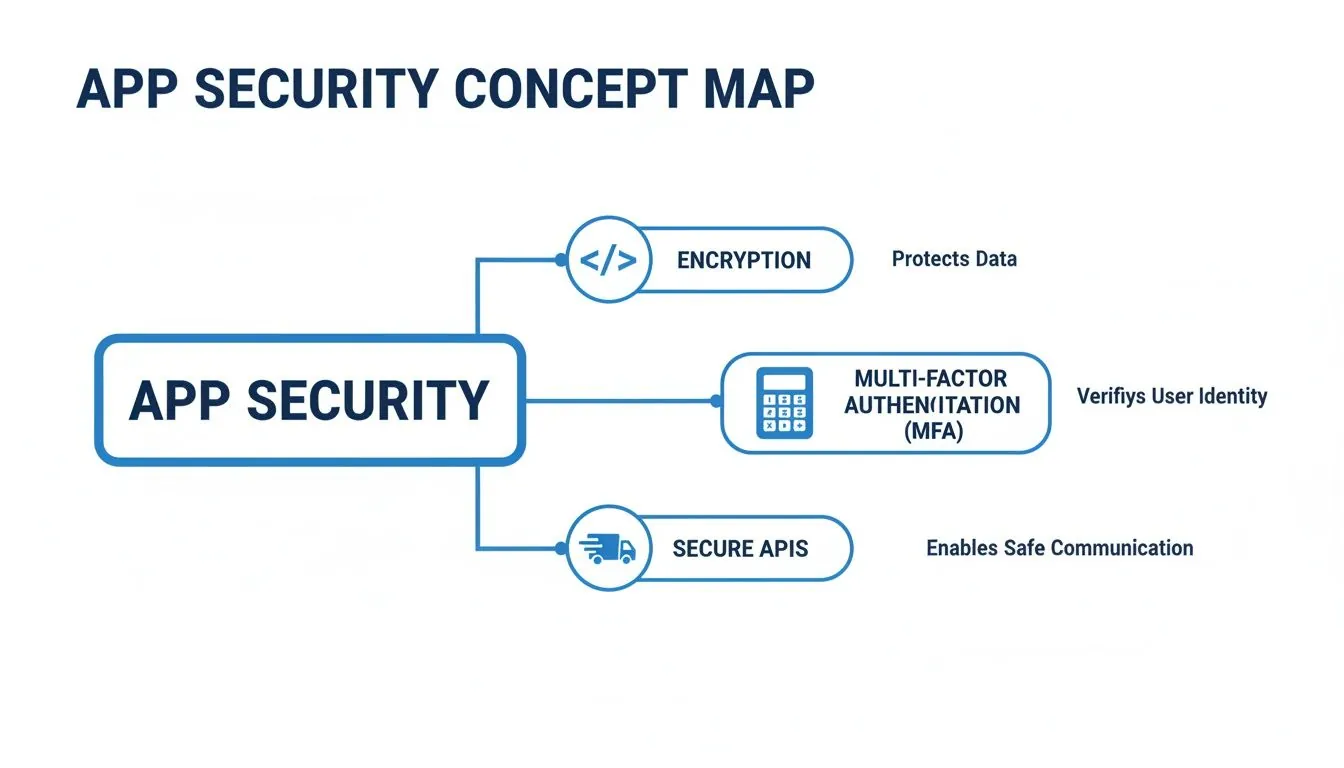
Each piece of this puzzle tackles a different vulnerability, creating a layered defense that’s far stronger than any single measure could be on its own.
Third-Party Risk Is a Major Factor
The danger posed by interconnected systems isn’t just some abstract theory—it’s a real and growing threat. Attackers are increasingly targeting smaller, less-secure vendors to find a backdoor into larger, more valuable company networks.
The SecurityScorecard Global Third‑Party Breach Report found that a staggering 35.5% of all data breaches involved a third-party connection. That number is climbing, with some areas seeing third-party involvement jump above 70%, showing a very clear trend.
This statistic hammers home the need for a truly comprehensive approach to financial data security. It’s not enough for a company to lock down its own systems; it has to demand that every partner and vendor meets the exact same high standards. The simple truth is that your data is only as safe as the weakest link in the entire chain.
A truly secure platform will be open about its commitment to managing vendor risk. This means doing deep security audits, having contractual obligations for data protection, and constantly monitoring partners to make sure they stay compliant over time.
This ecosystem-wide security is a core responsibility. When you’re choosing a tool to manage your finances, look for one that understands its security perimeter extends far beyond its own servers. The best platforms take ownership of the entire data journey, treating their partners’ security with the same gravity as they treat their own. This holistic view is the hallmark of a truly trustworthy service.
Actionable Steps for Protecting Your Own Data
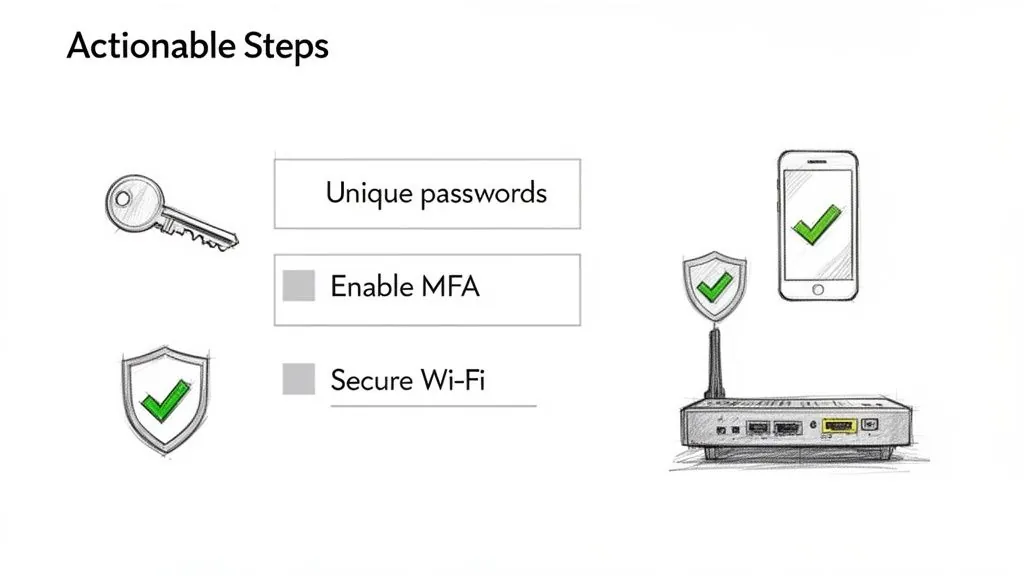
While top-tier financial platforms build digital fortresses to guard your information, true financial data security is really a partnership. Your own habits and attention to detail make up the other half of that critical alliance. The good news is that a few high-impact practices can dramatically boost your personal defenses.
Think of it as a playbook for your digital life. These aren’t just tedious rules; they are proactive moves that put you in the driver’s seat. When your actions work in tandem with a platform’s built-in security, you create a powerful, layered defense that shuts down threats.
Build a Better Digital Front Door
Your first line of defense—and the most important one—starts with your login details. Weak or reused passwords are the digital equivalent of leaving your front door wide open. It’s the simplest yet most effective step you can take.
Imagine using the same physical key for your house, your car, and your office safe. If a thief gets that one key, your whole world is compromised. That’s exactly what happens when you reuse passwords. A data breach at some random website you signed up for years ago could hand attackers the key to your most sensitive financial accounts.
Key Takeaway: Always use a unique, complex password for every single online account, especially for financial services. A password manager is an indispensable tool here, generating and storing everything securely so you only have to remember one master password.
On top of that, always enable Multi-Factor Authentication (MFA) whenever you see the option. This one move is like adding a deadbolt and a security camera to your front door. Even if someone steals your password, they’re stopped cold.
Practice Smart Digital Awareness
Beyond strong credentials, a healthy dose of skepticism is your best shield against the most common scams. Attackers often try to create a false sense of urgency, hoping you’ll panic and make a mistake. Learning to spot these psychological tricks is a crucial skill.
Be extremely wary of any unsolicited email, text message, or phone call asking for your personal info or demanding you take immediate action. Scammers are masters of disguise, creating convincing fakes that look just like communications from your bank or other trusted services.
Here are a few practical habits to build:
- Never Click Strange Links: Instead of clicking a link in an unexpected email, open your browser and manually type in the website address or use a bookmark you trust.
- Verify Unexpected Requests: If you get an urgent “security alert,” contact the company yourself through their official website or phone number to confirm it’s legit. Don’t use the contact info in the message.
- Secure Your Connections: Avoid logging into your bank or financial apps while on public Wi-Fi. These networks are often unsecured, making it easy for others on the network to spy on your activity.
This kind of consistent vigilance is a cornerstone of solid personal financial data security.
Maintain Your Digital and Physical Environment
Your security posture extends beyond your passwords to the very devices and networks you use every day. An unsecured home network or an out-of-date phone can create an opening for attackers to slip through.
Start with your home Wi-Fi network. Make sure it’s protected with a strong, unique password and uses the latest security protocol (WPA3 is best, but WPA2 is a must). Just as important, you need to change the default admin password on your router itself.
For developers and the more tech-savvy folks, understanding how these secure connections are built can offer a deeper appreciation for this process. For instance, seeing how to go about adding Plaid to a Rails app reveals the intricate security handshakes that happen behind the scenes to protect data as it moves. It’s a great reminder of why every single layer, from your home network to the app’s internal code, truly matters.
Why Top-Tier Security Is a Non-Negotiable Investment
After diving into the complex world of financial threats and defenses, one thing becomes crystal clear: world-class financial data security isn’t just another line item on a budget. It’s the bedrock investment in trust, stability, and the simple peace of mind that everyone deserves. Anything less is a gamble you can’t afford to take.
The sheer scale of the threat is staggering. Cybercrime has morphed into a global, highly organized enterprise with a devastating economic footprint. Attackers are constantly hammering away at financial institutions and fintech platforms because that’s where the high-value data—and direct access to money—lives. This isn’t a niche problem; it’s a multi-trillion-dollar drag on the entire global economy.
The Staggering Cost of Getting It Wrong
The numbers tell a story that’s hard to ignore. Right now, the global average cost of a single data breach hovers around $4.4 million. For a large bank or financial firm, that number can balloon to catastrophic levels, triggering massive operational meltdowns and eye-watering regulatory fines.
Multiple global studies now project that the total cost of cybercrime could hit an almost unbelievable $10.5 trillion a year by 2025. A huge chunk of that comes directly from attacks on the financial sector. You can get more details from these global financial crime projections.
This isn’t just a wake-up call; it’s a fundamental shift in how we have to think about security. Pouring resources into advanced defenses, like AI-powered threat detection and wall-to-wall encryption, isn’t just about protecting data. It’s about protecting the future of the business and honoring the trust customers place in it. For a company like PopaDex, that’s not up for debate.
Your Path to Financial Confidence
All this talk about digital threats shouldn’t leave you feeling anxious. It should leave you feeling empowered. You now have the insight to tell the difference between platforms that just offer a slick interface and those that are fundamentally built on a foundation of security.
Real confidence is a two-way street:
- Choose Your Tools Wisely: Work with platforms that are completely transparent about how they protect you—from the end-to-end encryption they use to how carefully they vet their third-party partners.
- Adopt Smart Personal Habits: Never underestimate your own role. Using strong, unique passwords, turning on multi-factor authentication everywhere you can, and treating unsolicited emails with a healthy dose of skepticism are your personal superpowers.
When you combine your own vigilance with the robust security of a platform you trust, you create a defense that’s incredibly tough to break. This partnership is what lets you get back to what actually matters: tracking your progress, making smart financial moves, and hitting your goals without a shred of doubt. Your financial future is worth nothing less than the best protection available.
Frequently Asked Questions
When it comes to your money, questions about security are always the right ones to ask. Let’s clear up a few common concerns you might have about keeping your financial data safe in the digital world.
How Safe Are Modern Financial Apps, Really?
It’s a fair question. The truth is, a reputable financial app is often far more secure than traditional ways of managing money. These apps are built from the ground up with multiple, overlapping layers of security designed to fend off modern threats. Think of it less like a simple lock and key, and more like a digital fortress.
These layers aren’t just buzzwords; they’re powerful technologies working in concert to protect you:
- End-to-end encryption turns your data into unreadable code that only you and the platform can decipher.
- Multi-factor authentication (MFA) is like having a bouncer at the door of your account, demanding more than just a password for entry.
- Secure APIs act like armored trucks, moving information between your bank and the app without ever exposing your actual bank login details.
When you pick an app that takes these features seriously, you’re choosing a system designed for resilience from the start.
Can I Trust an App With My Bank Login Details?
This is a big one, and the answer comes down to how an app connects to your accounts. Modern, secure platforms like PopaDex will never ask for or store your bank username and password. Instead, they use trusted third-party services like Plaid.
These services act as a secure go-between. You log in directly with your bank once through their secure portal, and the app is given a special “token” that grants it read-only access. Your actual credentials are never seen, touched, or stored by the app itself. This is a non-negotiable principle of strong financial data security.
What Is The Single Most Important Security Step I Can Take?
If you do only one thing, do this: turn on multi-factor authentication (MFA) for every single financial account that offers it. While a strong, unique password is a great start, MFA is the nearly impenetrable second line of defense that truly keeps intruders out.
Industry data consistently shows that enabling MFA can block over 99% of automated cyberattacks that rely on stolen passwords. It is the single most effective way to protect your accounts from unauthorized access.
Even if a thief somehow gets their hands on your password from a data breach elsewhere, they’ll be stopped cold without that second piece of the puzzle—like a code sent to your phone or a fingerprint scan. It’s what turns a potential catastrophe into a non-event.
Ready to manage your finances with a tool that puts security first? Take control of your net worth with PopaDex and experience the confidence that comes from a platform built on trust and transparency. Start your free trial today.