
Our Marketing Team at PopaDex
Your Ultimate Financial Planning Checklist: 10 Steps for 2026

Financial planning can feel overwhelming, like assembling a complex puzzle without the picture on the box. Whether you’re a young professional starting to build wealth, a freelancer managing irregular income streams, or an expat navigating multi-currency assets, a structured approach is the key to clarity and control. This is where a comprehensive financial planning checklist becomes your most valuable tool, acting as a clear roadmap to guide your decisions.
This is not a list of vague suggestions. Instead, we’ve compiled a detailed guide with ten specific, actionable steps designed to transform your financial health from the ground up. Each item on this list serves as a critical building block for a resilient financial future. You will learn how to accurately assess your current financial standing, set meaningful goals that align with your life, and implement strategies to protect and grow your wealth efficiently.
We’ll move beyond the basics, offering practical implementation details for everything from optimizing your debt and investments to planning for tax efficiency and ensuring your assets are protected. Think of this checklist as the blueprint for building lasting financial security and peace of mind. Let’s get started.
1. Assess Your Complete Financial Situation
Before you can map out your financial future, you need a crystal-clear picture of where you stand today. This foundational step in any effective financial planning checklist involves a comprehensive audit of your complete financial life. It means gathering every piece of your financial puzzle, from assets and income to liabilities and debts, into one cohesive view. This isn’t just about knowing your bank balance; it’s about creating a detailed inventory that serves as the baseline for every decision that follows.
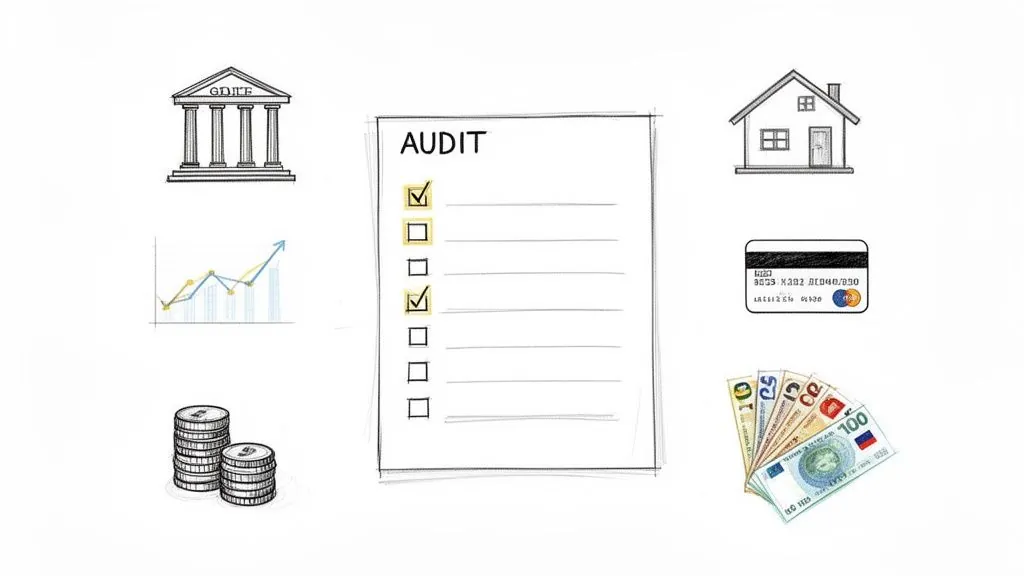
This process is critical for everyone, from an expat in Germany tracking US investments and a home-country mortgage to a freelancer consolidating income from multiple platforms. One couple, for instance, uncovered nearly $50,000 in forgotten 401(k) accounts from previous jobs simply by going through this exercise.
How to Conduct a Financial Audit
A thorough assessment provides the data needed for accurate net worth calculation, cash flow analysis, and realistic goal setting.
- List All Assets: Document every savings account, investment portfolio (stocks, bonds, crypto), retirement fund (401k, IRA), real estate holding, and valuable personal property.
- Itemize All Liabilities: Record all outstanding debts, including mortgages, student loans, auto loans, credit card balances, and personal loans.
- Track All Income: Consolidate every income stream, such as your primary salary, freelance gigs, rental income, and investment dividends.
Pro Tip: Set aside a dedicated 2-3 hour block to gather all your statements, logins, and financial documents. For added security and organization, document everything in a password-protected spreadsheet as a backup while you connect your accounts to a digital platform like PopaDex, which supports over 15,000 institutions globally.
2. Calculate Your Net Worth
Once you’ve audited your finances, the next critical step in your financial planning checklist is to calculate your net worth. This single figure, found by subtracting your total liabilities from your total assets, represents your true financial position at a specific moment. It acts as your financial scorecard, offering a clear, high-level metric to track your progress over time. This isn’t just a number for the wealthy; it’s a vital benchmark for anyone serious about building a secure financial future.
Calculating your net worth regularly transforms an abstract goal into a tangible, measurable objective. For example, a young professional can watch their net worth grow from $50,000 to $250,000 over five years, providing powerful motivation. Similarly, a self-employed individual can monitor their net worth to understand the impact of seasonal income, ensuring they stay on track during leaner months.
How to Track and Grow Your Net Worth
Consistent tracking reveals whether your financial strategies are effective and helps you make informed adjustments along the way.
- Establish a Baseline: Your first calculation is your starting point. Don’t be discouraged if it’s low or even negative; the goal is to see it improve.
- Set Regular Check-ins: Calculate your net worth monthly or quarterly to maintain momentum and hold yourself accountable to your financial plan.
- Analyze the Components: Track your net worth by category (e.g., retirement accounts, real estate equity, student loans) to identify which areas are driving growth and which need more attention.
Pro Tip: Manually updating spreadsheets can be tedious and prone to error. Use a platform that automates the process by syncing with your accounts. Explore a comprehensive net worth calculator on popadex.com to see your complete financial picture update in real-time and celebrate key milestones as you achieve them.
3. Set Specific Financial Goals
Once you have a clear financial snapshot, the next step in your financial planning checklist is to define where you want to go. Setting specific, measurable goals transforms vague aspirations into an actionable roadmap. This process provides the direction and motivation needed to allocate your resources effectively, turning abstract dreams like “financial freedom” into tangible targets with deadlines. This clarity is what propels you forward, ensuring every financial decision serves a greater purpose.
This step is crucial for anyone trying to build momentum. Consider a young professional aiming to reach a €100,000 net worth by age 30, or an expat planning to save $50,000 for a down payment on a home upon their return. By quantifying their objectives and setting a timeline, they can calculate exactly how much they need to save and invest each month, making the goal achievable rather than just a wish.
How to Set SMART Financial Goals
Using the SMART (Specific, Measurable, Achievable, Relevant, Time-bound) framework ensures your objectives are well-defined and realistic.
- Make Them Specific: Instead of “save more,” define the exact amount. For example, “save €10,000 for a new car by December 2025.”
- Align with Your Life Stage: Ensure your goals are relevant to your current priorities, whether that’s building a six-month emergency fund as a gig worker or contributing to a retirement portfolio.
- Break Down Large Goals: A goal to save $500,000 for retirement can seem daunting. Break it down into smaller, annual or monthly savings targets to make it manageable.
Pro Tip: Start by identifying your top 3-5 primary financial goals to avoid feeling overwhelmed. Use a tool to track your progress automatically against these targets, which helps maintain focus and allows you to adjust your strategy quarterly or as your life circumstances change.
4. Build and Maintain an Emergency Fund
Before you invest a single dollar, you need a financial safety net. A core element of any financial planning checklist is establishing a dedicated cash reserve to cover 3-6 months of essential living expenses. This fund acts as a firewall between you and financial disaster, protecting you from unexpected events like job loss, medical emergencies, or urgent repairs without forcing you to liquidate long-term investments or accumulate high-interest debt.

This principle is universally applicable. A freelancer in Lisbon, for example, might maintain a €15,000 fund to cover five months of expenses during a slow period. Similarly, an expat in Singapore might keep their six-month fund in SGD to avoid currency risk on immediate local needs. A crucial component of any robust financial plan is ensuring you have a safety net for unforeseen events, and understanding how to effectively manage unexpected costs through preparing a household fund for emergency home repairs can safeguard your financial stability.
How to Establish Your Emergency Fund
An emergency fund provides peace of mind and is the bedrock of financial security. It should be liquid, accessible, and separate from your daily spending and investment accounts.
- Calculate Your Target: Tally your essential monthly expenses: housing, utilities, food, insurance, and minimum debt payments. Multiply this total by 3-6 to find your savings goal.
- Choose the Right Account: Open a high-yield savings account (HYSA) to allow your fund to grow modestly while remaining easily accessible. These accounts often offer significantly better interest rates than traditional savings accounts.
- Automate Your Savings: Set up automatic weekly or bi-weekly transfers from your checking account to your HYSA. Making savings automatic is the most effective way to build the fund consistently.
Pro Tip: Track your emergency fund as a distinct goal within your financial overview. Use a dedicated tool to monitor its growth and ensure it remains separate from your investment portfolio, reinforcing its purpose as a pure safety net. For a deeper dive, explore our guide on how to build an emergency fund.
5. Create a Realistic Budget and Track Spending
Once you know your net worth, the next crucial step in your financial planning checklist is to direct where your money goes. This involves creating a realistic spending plan aligned with your income and goals, then consistently monitoring your actual spending against it. A budget is more than a restrictive spreadsheet; it’s a powerful tool that reveals your spending habits, pinpoints opportunities for savings, and ensures your money is actively working toward your most important priorities.
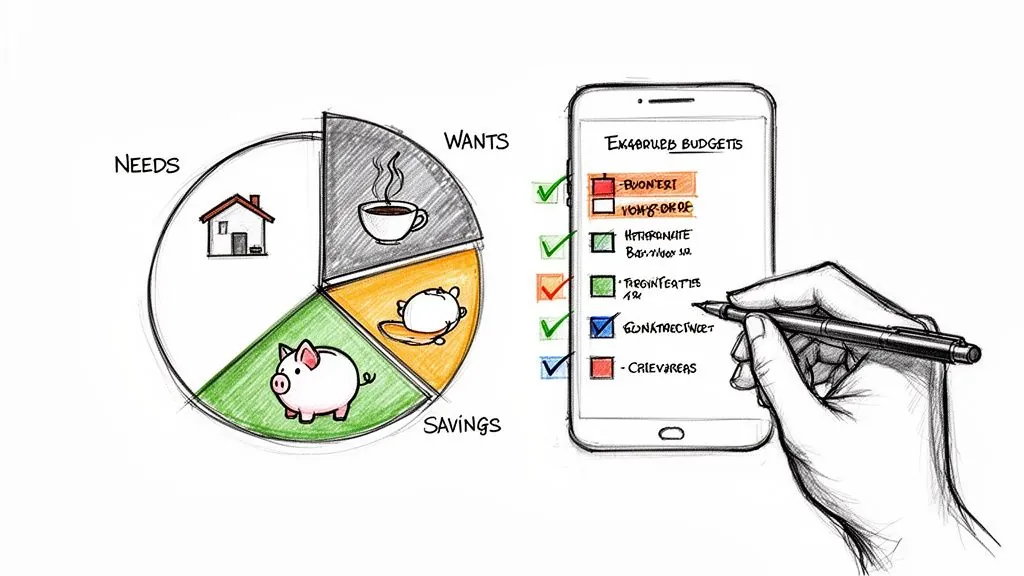
This practice is universally beneficial. For instance, a young professional reviewing their expenses might discover an extra €500 a month in discretionary spending that could be redirected to investments. Similarly, an expat can use budgeting tools to track spending in multiple currencies and adjust for seasonal cost-of-living changes, maintaining financial control across borders.
How to Build and Maintain Your Budget
Effective budgeting provides clarity and empowers you to make intentional financial choices, turning abstract goals into achievable targets.
- Start with a Framework: Use a simple model like the 50/30/20 rule, which allocates 50% of your after-tax income to needs, 30% to wants, and 20% to savings and debt repayment.
- Automate Your Tracking: Manually logging every expense is tedious. Use a platform that automates the process by connecting to your bank accounts and credit cards to categorize transactions for you. Learn more about how to set up an easy expense tracker on popadex.com.
- Review and Adjust Regularly: A budget is a living document. Schedule a monthly review to compare your planned spending with your actual habits and make adjustments as needed.
Pro Tip: For those with fluctuating income, such as freelancers or gig workers, the zero-based budgeting method is highly effective. At the start of each month, you assign every dollar of your anticipated income to a specific category, ensuring no money is left unaccounted for.
6. Optimize Debt Management Strategy
Effectively managing debt is a crucial component of any robust financial planning checklist. This step involves more than just making monthly payments; it’s about creating a strategic plan to reduce and eventually eliminate high-cost debt, freeing up your cash flow for wealth-building activities. A well-optimized strategy transforms debt from a financial anchor into a manageable obligation with a clear end date, putting you firmly in control of your financial destiny.
This process is vital for anyone, from a young professional tackling a €25,000 student loan while building an investment portfolio to an expat consolidating multi-currency debt. One individual, for example, successfully used the “debt avalanche” method to eliminate over €50,000 in high-interest credit card and personal loan debt in just five years, saving thousands in interest payments.
How to Implement a Debt Repayment Strategy
A strategic approach ensures you pay the least amount of interest possible and accelerate your journey to becoming debt-free.
- List and Analyze All Debts: Create a master list of every debt, detailing the current balance, interest rate, and minimum monthly payment.
- Choose Your Method: Decide between the debt snowball (paying off the smallest balance first for psychological wins) or the debt avalanche (tackling the highest-interest debt first to save the most money).
- Automate Payments: Set up automatic payments for at least the minimum on all debts to avoid late fees, then direct any extra funds toward your target debt.
Pro Tip: Use a financial dashboard like PopaDex to link all your liability accounts. This allows you to track your debt reduction progress visually, keeping you motivated as you see your balances shrink and your net worth grow over time.
7. Diversify Investments According to Your Risk Profile
Building a robust investment portfolio is a cornerstone of any long-term financial planning checklist, but simply buying assets is not enough. You must strategically diversify them to align with your personal risk tolerance, time horizon, and financial goals. This means spreading your investments across different asset classes like stocks, bonds, real estate, and commodities to mitigate risk while optimizing for potential long-term returns. The core idea, popularized by Harry Markowitz’s Modern Portfolio Theory, is that you shouldn’t put all your eggs in one basket.

This strategy looks different for everyone. A 25-year-old with a long career ahead might hold 80% in stocks, while a retiree will lean towards an income-focused portfolio heavy with bonds and dividend stocks. An expat might balance investments in their home country with international holdings to manage currency and market risks. The goal is to create a mix that can weather market volatility and grow steadily over time.
How to Build a Diversified Portfolio
Proper asset allocation is your defense against market downturns and your engine for growth, ensuring one poor-performing asset doesn’t derail your entire plan.
- Determine Your Asset Allocation: A common rule of thumb is subtracting your age from 100 or 110 to find your target stock percentage. For example, a 30-year-old might aim for 70-80% stocks and 20-30% bonds.
- Use Low-Cost Index Funds: Gain broad exposure to entire markets with minimal fees. Aim for expense ratios below 0.5% to maximize your returns.
- Rebalance Periodically: Review your portfolio annually or when an asset class drifts more than 5% from its target allocation. This forces you to buy low and sell high.
Pro Tip: For those managing investments across multiple countries and currencies, such as expats, maintaining a clear overview is crucial. Use a platform like PopaDex to track all your diversified holdings in one place, ensuring your global asset allocation stays aligned with your financial plan.
8. Plan for Taxes and Optimize Tax Efficiency
Effective tax planning is not about evasion; it’s about legally and strategically minimizing your tax burden to keep more of your hard-earned money. This crucial step in any financial planning checklist involves understanding your obligations and using available deductions, credits, and tax-advantaged accounts to your benefit. Proactive tax management can save you thousands of dollars annually, freeing up capital to accelerate your financial goals.
This process is especially vital for individuals with complex financial lives. For example, a self-employed freelancer must manage quarterly estimated taxes and track deductible expenses, while an expat in Spain must navigate tax treaties to avoid double taxation on their US-based investments. An investor who actively manages their portfolio can use tax-loss harvesting to offset capital gains, significantly reducing their overall liability.
How to Implement Tax-Efficient Strategies
A smart tax strategy provides a direct boost to your net income and investment returns, making it an essential part of your financial plan.
- Identify All Tax Jurisdictions: Determine every location where you have a tax obligation, which could be based on residency, employment, or investment holdings.
- Maximize Tax-Advantaged Accounts: Fully contribute to retirement accounts like a 401(k) or an IRA to defer taxes on growth and potentially receive a deduction.
- Track and Claim All Deductions: Meticulously record all eligible expenses, such as home office costs for remote workers, business-related travel for freelancers, or student loan interest.
- Consider Tax-Loss Harvesting: Strategically sell investments at a loss to offset gains realized in other parts of your portfolio.
Pro Tip: For gig workers or the self-employed, create a separate savings account and automatically transfer 25-30% of every payment into it. This ensures you have the cash ready for quarterly estimated tax payments and avoids a surprise bill at year-end.
9. Establish Insurance Coverage and Protect Assets
A robust financial plan isn’t just about accumulating wealth; it’s also about protecting what you’ve built. This essential step in your financial planning checklist involves securing the right insurance to shield your assets from catastrophic loss. Insurance acts as a critical risk management tool, transferring the financial burden of unexpected events like disability, health crises, or death to an insurer, preventing your long-term goals from being derailed.
Proper coverage is the safety net that supports your entire financial structure. For instance, a self-employed freelancer could protect their livelihood by securing a disability insurance policy that covers 60-70% of their income. Similarly, a young professional with a new mortgage might purchase a term life insurance policy large enough to cover the loan and provide for their family, ensuring their loved ones aren’t left with unmanageable debt.
How to Secure Your Financial Foundation
A strategic insurance review ensures you are neither underinsured nor overpaying for unnecessary coverage.
- Life Insurance: Calculate needs based on income replacement, outstanding debts (like a mortgage), and future expenses such as children’s education. Term life insurance is often the most cost-effective option.
- Disability Insurance: Protect your most valuable asset: your ability to earn an income. Aim for a policy that replaces 60-70% of your pre-tax income.
- Liability Insurance: If you have significant assets, an umbrella policy provides extra liability coverage beyond your standard home and auto policies, protecting you from lawsuits.
- Long-Term Care: Beyond traditional insurance, explore specific strategies to protect assets from nursing home costs, ensuring your financial plan accounts for these potential needs.
Pro Tip: Review your insurance policies annually or after any major life event, such as marriage, a new child, or a home purchase. Bundle policies with one provider for potential discounts, and keep digital copies of all your policies organized for easy access.
10. Monitor Progress and Adjust Plan Regularly
A financial plan is not a “set it and forget it” document; it’s a living roadmap that requires regular attention. This crucial step in your financial planning checklist involves establishing a consistent cadence to review your progress, assess life changes, and make necessary adjustments. Without periodic check-ins, even the most well-crafted plan can become obsolete and ineffective, failing to reflect your current reality and future ambitions.
This process is vital for ensuring your plan remains relevant and powerful. For example, a young professional conducting quarterly reviews might discover that recent income growth allows them to accelerate their retirement savings timeline. Similarly, an expat can reassess their multi-currency asset allocation after a significant shift in exchange rates, protecting their net worth from volatility.
How to Implement Regular Reviews
Consistent monitoring keeps you accountable, allows for timely course corrections, and ensures your financial strategy evolves with you.
- Schedule Review Sessions: Block out a 1-2 hour review on your calendar every quarter. This non-negotiable appointment is an investment in your financial future.
- Compare Key Metrics: Analyze the change in your net worth, spending patterns, and progress toward specific goals compared to the previous quarter.
- Document Life Changes: Note any significant shifts, such as a new job, a change in income, a growing family, or a relocation, and assess their financial impact.
- Adjust and Rebalance: Use your findings to tweak your budget, adjust your investment contributions, or rebalance your portfolio if asset allocations have drifted significantly.
Pro Tip: Use a dashboard like PopaDex to get a quick, real-time snapshot of your net worth, goals, and spending. During your annual review, make larger strategic adjustments, but use quarterly check-ins to celebrate milestones and ensure you remain on track without overreacting to short-term market fluctuations.
10-Point Financial Planning Checklist Comparison
| Item | Implementation Complexity | Resource Requirements | Expected Outcomes () | Ideal Use Cases | Key Advantages / Tips |
|---|---|---|---|---|---|
| Assess Your Complete Financial Situation | High — detailed multi-account, multi-currency audit | High time & documentation; may need platform connections | Clear baseline; uncovers hidden debts/gaps — | Expats, complex portfolios, multi-income households | Foundation step — set 2–3 hrs, use bank integrations |
| Calculate Your Net Worth | Low — automated math once accounts connected | Low ongoing; initial aggregation required | Snapshot + trend tracking for progress — | Anyone tracking financial progress regularly | Calculate monthly; use visual dashboards |
| Set Specific Financial Goals | Medium — requires SMART definitions and prioritization | Low ongoing; time to review/adjust quarterly | Direction and measurable milestones — | Goal-oriented planners, life-stage changes | Limit to 3–5 goals; set amounts and target dates |
| Build and Maintain an Emergency Fund | Low–Medium — setup then discipline to maintain | Medium capital requirement; automated transfers help | Liquidity buffer preventing debt — | Self-employed, gig workers, those without savings | Aim 3–6 months; keep funds liquid and separate |
| Create a Realistic Budget and Track Spending | Medium — initial setup + regular transaction tracking | Medium ongoing effort (automation reduces time) | Reveals spending leaks; increases savings — | Irregular income earners, anyone optimizing cash flow | Start with 50/30/20; automate categorization |
| Optimize Debt Management Strategy | Medium — inventory + strategy selection (snowball/avalanche) | Medium (redirect payments; possible consolidation costs) | Lower interest costs & improved cash flow — | High-interest borrowers, those improving net worth | List rates/balances; choose avalanche for interest savings |
| Diversify Investments According to Your Risk Profile | Medium–High — asset allocation and ongoing rebalancing | Medium capital & monitoring; consider fees | Reduced volatility, better long-term returns — | Long-term investors, expats, retirement planners | Use low-cost index funds; rebalance annually or at >5% drift |
| Plan for Taxes and Optimize Tax Efficiency | High — jurisdiction-specific rules and timing | High (professional advice + recordkeeping) | Lower tax liability and penalties — | Self-employed, expats, investors with gains | Track taxable events, consult a tax pro, use tax-advantaged accounts |
| Establish Insurance Coverage and Protect Assets | Medium — assess risks and choose appropriate policies | Medium–High ongoing (premiums) | Protection from catastrophic loss — | Families, homeowners, high-liability individuals, self-employed | Review annually; favor term life and adequate disability cover |
| Monitor Progress and Adjust Plan Regularly | Low–Medium — routine reviews (quarterly recommended) | Low ongoing with automation; time for periodic reviews | Keeps plan current and effective — | Everyone with a financial plan; those with changing circumstances | Schedule quarterly reviews; use dashboards; avoid knee-jerk changes |
From Checklist to Confident Action
Navigating your financial future can feel like an overwhelming journey, but the comprehensive financial planning checklist we’ve outlined provides a clear and structured roadmap. Moving through each step, from calculating your net worth and setting specific, tangible goals to optimizing your debt and diversifying your investments, is about more than just ticking boxes. It’s about building a dynamic system for financial wellness. You’ve learned not just what to do, but how to do it with actionable strategies and real-world applications.
The true power of this checklist isn’t in its completion but in its continuous application. Think of it less as a one-time project and more as a recurring cycle of assessment and adjustment. Your financial life is not static; your income will change, your goals will evolve, and market conditions will shift. A static plan will quickly become obsolete. The most crucial takeaway is to transform these ten pillars into a sustainable habit, creating a framework that adapts with you.
Turning Knowledge into Lasting Habits
The difference between a wish and a goal is a plan, and the difference between a plan and a reality is consistent action. Here are the immediate next steps to bring your financial planning checklist to life:
- Schedule Your First Review: Block out 2-3 hours on your calendar within the next week to work through items 1-5. This initial deep dive is crucial for establishing your baseline.
- Automate What You Can: Set up automatic transfers to your emergency fund and investment accounts. Automation is your most powerful ally in building consistent financial habits and removing the friction of manual decision-making.
- Commit to a Cadence: Decide on a review schedule now. A quarterly check-in is ideal for most people. Put these appointments on your calendar for the entire year ahead. Treat them with the same importance as a doctor’s appointment or a critical work meeting.
The True Value of a Proactive Plan
Mastering these concepts is about gaining agency over your life. It’s the confidence to handle unexpected expenses without derailing your goals, the clarity to make major life decisions like buying a home or changing careers, and the peace of mind that comes from knowing you are prepared for the future. You are building a foundation not just for wealth, but for resilience, freedom, and opportunity. This financial planning checklist is your blueprint for turning abstract financial aspirations into your lived reality. By embracing this process, you are actively choosing to build a more secure and prosperous future for yourself and your loved ones.
Ready to transform your checklist into a clear, consolidated view of your wealth? PopaDex is the all-in-one portfolio tracker that brings your entire financial life into focus. Connect everything from your bank accounts and stocks to international assets and crypto, and watch your financial plan come to life with powerful analytics and automated insights. Start making smarter, more confident decisions today at PopaDex.