
Our Marketing Team at PopaDex
Your Free Net Worth Calculator Guide

Think of your net worth as the ultimate bottom line for your personal finances. It’s a simple, powerful number that tells you where you stand by subtracting everything you owe (liabilities) from everything you own (assets). Honestly, it’s the single most important metric for tracking your journey toward your financial goals.
Your Financial GPS for Building Wealth

Let’s be real—the term “net worth” can sound a bit stuffy, like it’s reserved for tycoons and Wall Street wizards. But what if you saw it as your own financial GPS? It pinpoints your exact location today, giving you the clarity to map out the best route to your destination, whether that’s early retirement, buying a home, or just achieving financial peace of mind.
A big paycheck doesn’t automatically equal wealth. That’s one of the biggest myths in personal finance, and it’s where a lot of people get tripped up.
Why Your Paycheck is Only Half the Story
Picture two colleagues, Maria and Ben. Both pull in a solid $80,000 per year. On paper, they look identical. But a quick look at their net worth tells two completely different stories:
- Maria owns her condo and has built up some equity. She contributes to her retirement account every month and keeps her credit card debt to a minimum. Her assets are growing faster than her liabilities, so her net worth is positive and climbing.
- Ben rents a pricey apartment downtown, is still chipping away at a mountain of student loans, and has a high-interest car payment. Despite his great income, his liabilities are much larger than his assets, putting him at a negative net worth.
This little scenario drives home a critical point: it’s not just about what you earn. It’s about what you keep and what you owe. Our free net worth calculator is designed to cut through that noise and give you that essential, honest number.
Your net worth is your financial scorecard. It’s not a judgment of your self-worth, but a brutally honest tool that shows if you’re actually winning the game of building wealth. When you start tracking it, abstract goals suddenly become real, tangible progress you can see.
Using a free net worth calculator has become a go-to move for millions of people who want to get a handle on their finances. These tools do the simple but powerful math of subtracting your total liabilities from your total assets. Even better, some can project how your net worth might change over the next 10 years, giving you a glimpse into your future financial health. If you want to dive deeper into the mechanics, Bankrate’s detailed guide is a fantastic resource.
Assembling Your Financial Snapshot
Before you can plug your numbers into a net worth calculator and see the big picture, you need to gather all the pieces. Think of it like getting your ingredients ready before you start cooking—a little prep work makes the whole process go smoothly. This is your no-nonsense guide to rounding up your financial info without the usual headache.
The whole point here is to get an honest, clear snapshot of where you stand financially right now. Let’s kick things off with the good stuff: your assets.
Cataloging Your Assets
Assets aren’t just the cash in your bank account. To get a complete picture, you’ll need to pull statements from a few different places. The good news is, most of this is just a few clicks away in your online banking and investment portals.
Here’s a quick rundown of what you’re looking for:
- Cash and Equivalents: This is the easy part. Grab the current balances from your checking accounts, savings accounts, and any money market funds you have.
- Investments: Log into your retirement accounts (like a 401(k) or IRA) and any brokerage accounts. You’ll need the current market value of your stocks, bonds, and mutual funds.
- Real Estate: Hop onto a site like Zillow or Redfin for a quick, reasonable estimate of your home’s current market value. Don’t forget any other properties you own.
- Vehicles: Kelley Blue Book (KBB) is the go-to for finding the private party sale value of your car, truck, or motorcycle. Be honest about its condition to get an accurate number.
- Valuable Personal Property: This one can be a little tricky. Stick to high-value items you could realistically sell, like fine jewelry, art, or collectibles. Don’t bother listing your IKEA couch or old laptop.
Identifying Your Liabilities
Next up: liabilities. This is everything you owe. It’s just as important to be thorough here as it was with your assets. Forgetting a debt can paint a misleadingly rosy picture of your finances.
Don’t shy away from this part of the process. Facing your debts head-on is the first step toward conquering them. An accurate list of liabilities gives you a clear target for debt-reduction strategies later on.
Compile the current outstanding balance for each of your debts:
- Mortgage: Your primary home loan, plus any second mortgages or home equity lines of credit (HELOCs).
- Student Loans: The total balance for both your federal and private student loans.
- Auto Loans: What you still owe on any car loans.
- Credit Card Debt: The current balance across all your credit cards combined.
- Other Loans: This is a catch-all for personal loans, lingering medical debt, and any “buy now, pay later” plans.
This process used to be a pain, involving stacks of paper statements and manual calculations. Today, it’s a different story. A 2023 report found that over 60% of adults in the UK and US now use financial apps, many of which track net worth automatically. As our financial lives have gotten more complex with equities, real estate, and different kinds of debt, people just need simpler ways to see where they stand. You can read more about the growth of net worth apps at MyAssets.com.
Once you have these two lists—your total assets and total liabilities—you are officially ready to go. If you want a bit more guidance on the specific calculations and what counts, check out our detailed article on how to calculate your net worth.
How to Use the Net Worth Calculator
Alright, this is where the magic happens. We’re going to take those lists of assets and liabilities you’ve put together and turn them into a single, powerful number. Forget wrestling with complex spreadsheets or trying to remember half-forgotten formulas from a high school math class. A dedicated free net worth calculator is the cleanest, simplest way to get that financial snapshot.
To make this real, let’s walk through it with a fictional character, Alex, who’s using our calculator for the very first time. Alex has gathered all the necessary statements and is ready to plug in the numbers to see exactly where they stand. Following along will show you just how straightforward this is.
Entering Your Financial Data
The PopaDex calculator is designed to be dead simple. It has clear fields for every piece of your financial puzzle, neatly separating what you own from what you owe. This layout keeps things from getting confusing and helps ensure you don’t miss anything important.
Alex decides to tackle assets first, entering them one by one.
- Checking Account: $2,500
- Savings Account: $10,000
- 401(k) Retirement Fund: $45,000
- Car Value (from KBB): $18,000
- Home Value (from Zillow): $300,000
See how Alex is using current, realistic market values? That’s a pro move. It helps you avoid the common pitfall of over-inflating your assets, which only gives you a false sense of security.
This simple infographic really nails the core workflow.
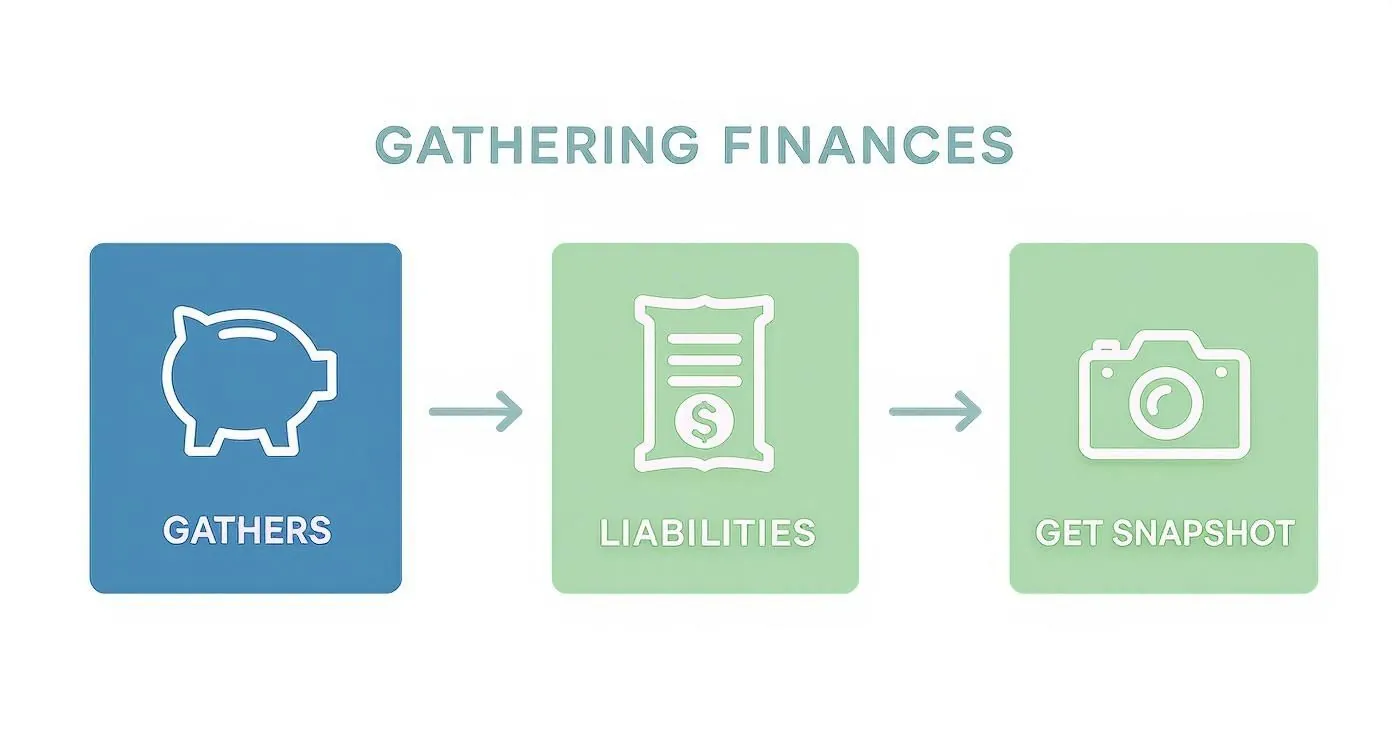
As you can see, the whole process just boils down to those three fundamental actions. It’s all about turning a bit of financial chaos into an organized, understandable picture.
Next up, Alex moves over to the liabilities section of the calculator. I get it—this is where a little anxiety can creep in for a lot of people. But just remember, this number is a tool for empowerment, not a reason for judgment. Alex carefully punches in each outstanding debt.
The liabilities side looks like this:
- Mortgage Balance: $220,000
- Student Loan Balance: $35,000
- Auto Loan Balance: $12,000
- Credit Card Debt: $4,000
- Small Personal Loan: $1,500
The absolute key to an accurate calculation is being thorough. Double-check your lists. Did you include everything, from the big loans down to those smaller, lingering debts? An honest assessment is the only way to create a reliable starting point for your financial plan.
Getting Your Instant Result
With all the fields filled out, Alex hits the “Calculate” button. No waiting, no software to download, no complicated math to do by hand. The tool instantly crunches the numbers.
It spits out an immediate summary, showing total assets, total liabilities, and the final net worth number in a clean, easy-to-read format.
In this scenario, Alex’s total assets add up to $375,500 and total liabilities are $272,500. The calculator reveals their net worth is $103,000. Just like that, for the first time ever, Alex has a single, powerful metric that sums up their entire financial life.
While our guide is focused squarely on net worth, it’s worth noting that exploring other valuable financial tools can add even more layers to your financial planning.
For those of you who prefer a more hands-on approach or want to see your progress over time, a dedicated net worth tracking spreadsheet is a great way to complement the calculator’s instant snapshot. It lets you log your figures monthly or quarterly, creating a historical record of your financial journey.
Now that Alex has their number, the next step is turning this insight into a concrete plan.
Turning Your Number into a Plan

You’ve done the work, punched in the numbers, and now you have it: your net worth. It’s a powerful moment of clarity, but it’s just the beginning. This number isn’t a grade on a report card or some final score. Think of it as your financial starting line.
So, what’s next? The most important step is turning that single data point into a concrete, actionable plan for your future.
Whether your result was a pleasant surprise or a bit of a wake-up call, resist the urge to compare it to vague online benchmarks. A recent grad juggling student loans will have a vastly different starting point than someone who’s been investing for decades. Your journey is yours alone. What truly matters is the direction your net worth is heading over time. The goal is simple: make it go up.
This is where a free net worth calculator becomes more than a one-time tool; it’s your personal progress tracker. You now have a baseline to measure every future financial decision against.
Strategies for Growing Your Assets
Increasing the “assets” side of your net worth equation is all about making your money work for you. This doesn’t require a six-figure salary or risky stock picks; it starts with building consistent habits. The key is to put your savings and investments on autopilot.
Consider these powerful, easy-to-implement actions:
- Automate Your 401(k) Contributions: If your employer offers a match, contribute at least enough to get the full amount. It’s free money—the best return on investment you’ll ever get.
- Set Up Recurring Brokerage Transfers: Even $50 a week transferred automatically into a low-cost index fund can build substantial wealth over time through the magic of compounding.
- Use a High-Yield Savings Account (HYSA): Don’t let your emergency fund languish in a traditional savings account earning practically nothing. An HYSA keeps your cash safe while actually helping it grow.
This proactive approach is essential for long-term goals. In fact, according to a study by Ameriprise Financial, about 55% of retirees in the U.S. now use net worth as a key factor in deciding if they’re ready to retire. It gives a much fuller picture than income alone.
Tactics for Shrinking Your Liabilities
At the same time, you need a game plan to attack the “liabilities” side. Reducing debt is one of the most effective ways to boost your net worth because it provides a guaranteed return on your money—every dollar you pay off is a dollar you’re not paying interest on.
Two of the most popular strategies are the snowball and avalanche methods.
- The Debt Snowball: You focus on paying off your smallest debt first, no matter the interest rate. Scoring that quick win gives you a psychological boost to keep going.
- The Debt Avalanche: You prioritize paying off your highest-interest debt first. This method saves you the most money over the long haul.
Choose the strategy you’re most likely to stick with. Consistency is far more important than picking the “perfect” method. Your net worth calculation is the first step, but a solid action plan is what builds real momentum.
As you begin mapping out these next steps, remember that a detailed budget is your best friend. For more in-depth guidance, check out our guide on creating a financial plan that works for you. And as you plan, don’t forget to account for future fun, like travel. Factoring in potential trip costs and using a travel insurance cost calculator can help you budget accurately without derailing your goals.
Common Mistakes in Calculating Net Worth
A net worth calculation is only as reliable as the numbers you plug into it. It’s surprisingly easy to make small, honest mistakes that can paint a skewed picture of your finances. Getting this number right is the foundation for any solid financial plan, so let’s walk through the most common pitfalls people hit when using a free net worth calculator.
One of the most frequent errors is getting sentimental about the value of your personal stuff. It’s tempting to list your furniture, electronics, or other household items as big-ticket assets, but their resale value is often just a fraction of what you paid.
Think about it: that $3,000 designer sofa you love might only fetch $300 on Facebook Marketplace. The goal isn’t to remember what you spent; it’s to figure out what your assets are worth in cash today. This reality check creates a much more accurate starting point.
Forgetting About the Small Debts
In a world of one-click credit, small liabilities have a knack for flying under the radar. Most of us remember our mortgage or car loan, but we often completely forget about the smaller, nagging debts that add up over time. This is a critical blind spot that can artificially inflate your final number.
These “forgotten” liabilities often include things like:
- “Buy Now, Pay Later” Plans: Services like Klarna or Afterpay are incredibly convenient, but every single plan is a small loan that needs to be on your list.
- Retail Store Cards: Remember that department store credit card you only use for the holiday discounts? If it has a balance, it’s a liability.
- Personal Loans from Family: Even informal “I’ll pay you back later” loans should be included if you want a truly honest financial picture.
An easy fix for this is to pull your credit report. It gives you a comprehensive list of all your open accounts, making sure nothing gets missed.
Your net worth calculation is for your eyes only. Be brutally honest with yourself about every single asset and liability. An accurate starting point is the most powerful tool you have for measuring future progress.
Miscalculating Your Home Equity
For most people, their home is their biggest asset—but it’s also tied to their biggest liability. A classic mistake is listing the full market value of your home as an asset without correctly subtracting the outstanding mortgage balance.
What you actually own is your home equity. For example, if your home’s current market value is $400,000 but you still owe $250,000 on the mortgage, your home’s contribution to your net worth is $150,000, not the full $400,000.
Always use your current outstanding loan balance, not the original amount you borrowed. This simple step ensures you’re only counting the portion of the home you truly own right now.
Net Worth Calculation Pitfalls and Fixes
Mistakes are common, but they’re also easy to fix. We’ve seen thousands of users work through these exact issues. Here’s a quick summary of the most frequent errors and how to get them right.
| Common Mistake | Why It’s a Problem | How to Fix It |
|---|---|---|
| Overvaluing Personal Items | Inflates your assets with sentimental value, not real cash value. | Use the current resale value (what it would sell for today), not the purchase price. |
| Ignoring “Buy Now, Pay Later” | Understates your total liabilities, making your net worth appear higher. | List every active plan from services like Klarna or Afterpay as a separate debt. |
| Forgetting Store Credit Cards | Small, forgotten debts add up and create an inaccurate liability total. | Pull a free credit report to get a complete list of all open credit accounts. |
| Listing Full Home Value | Fails to account for the mortgage, drastically overstating your biggest asset. | Subtract your current outstanding mortgage balance from the home’s market value. |
By dodging these simple traps, you can be confident that your net worth calculation is accurate, reliable, and ready to guide your financial decisions.
Got Questions About Net Worth? We’ve Got Answers.
Jumping into tracking your net worth for the first time naturally brings up a few questions. That’s completely normal. Think of this as your quick-start guide, designed to give you clear, straightforward answers so you can get started with confidence.
We’ll tackle the most common things people ask, from how often you should run the numbers to how to handle seeing a negative result. The goal here is simple: clear up any confusion and get you ready to use this powerful financial tool.
How Often Should I Calculate My Net Worth?
For most people, a quarterly check-in is the sweet spot.
Calculating your net worth every three months is frequent enough to spot meaningful progress and make smart adjustments, but not so often that you get bogged down in daily market noise. This rhythm helps you see the bigger picture and the real trends in your financial life.
If you’re in a more intense financial season—like aggressively crushing debt or making big moves with your investments—a monthly calculation can be a fantastic motivator. The true power isn’t in a single snapshot; it’s in watching that number change over time. Consistency is what really counts.
Are Free Online Net Worth Calculators Safe?
Yes, but only the reputable ones. A trustworthy free net worth calculator is built with your privacy as the top priority.
A good tool, like the one we built at PopaDex, is completely anonymous. It never asks for, and certainly doesn’t store, any personally identifiable information. That means no names, no addresses, and definitely no bank account numbers.
Think of it as a simple calculation engine. You plug in the numbers, and it does the math. Stick with calculators from financial sources you trust and back out immediately if any tool asks for sensitive login details or personal data. That’s a huge red flag.
A negative net worth isn’t a report card on your financial worth as a person—it’s just a starting point. It’s incredibly common for recent grads buried in student loans or anyone just kicking off their career. Think of it as ‘financial sea level’; your job is to start swimming up.
What Should I Do If My Net Worth Is Negative?
First off, take a deep breath and don’t panic. A negative net worth just means your liabilities are currently bigger than your assets. It’s a math problem, not a moral failing.
Your first move is to build a budget that ensures you’re not spending more than you earn. You need to stop the “hole” from getting any deeper before you can start filling it in.
Next, you’ll want to build a focused plan to attack high-interest debt, like credit cards. Proven strategies like the debt snowball or debt avalanche can give you a clear roadmap. Watching that negative number shrink and eventually cross into positive territory can be one of the most powerful motivators you’ll ever experience.
What Is a Good Net Worth for My Age?
You can find endless charts online showing the “average” net worth by age, but honestly, a “good” number is deeply personal.
It depends entirely on your career path, your income, where you live, and what your life goals are. Trying to measure yourself against a generic national average is often more discouraging than it is helpful. It’s like comparing your running time to an Olympic athlete’s—the context is completely different.
Here’s a much better benchmark: your own progress. Is your net worth higher this year than it was last year? If you are consistently paying down debt and putting more into your savings and investments, you are absolutely winning. That upward trend is the only number that truly matters.
Ready to stop guessing and start knowing where you stand? The PopaDex net worth tracker gives you the clarity to see your full financial picture in one place. Start tracking your net worth for free today.