
Our Marketing Team at PopaDex
Herfindahl-Hirschman Index Your Guide to Market Power

The Herfindahl-Hirschman Index (HHI) is a tool that answers a simple but critical question: Is an industry dominated by a few giants, or is it a free-for-all with lots of smaller players competing? Think of it as a ‘market power meter’ that gives you a quick score to gauge how intense the competition really is. This number is a big deal for regulators trying to head off monopolies, and it’s just as important for investors who want to understand the competitive battlefield their stocks are fighting on.
What Is the Herfindahl-Hirschman Index

At its heart, the Herfindahl-Hirschman Index is a calculation that tells a story about the structure of a market. Picture a small town with just two pizza shops—they pretty much own the local market. Now, contrast that with a big city where dozens of pizzerias, cafes, and food trucks are all fighting for your business. The HHI puts a number on that difference, giving us a clear, standard way to measure market concentration.
This single score is incredibly powerful. For government agencies like the Department of Justice (DOJ) and the Federal Trade Commission (FTC), it’s one of the first tools they reach for in antitrust cases. When two massive companies announce a merger, regulators immediately run the numbers to see what the post-merger HHI would be. Their goal is to figure out if the combined company would have too much power, potentially leading to higher prices and less innovation for consumers.
Why HHI Matters Beyond Regulation
But the HHI is more than a tool for economists and government lawyers. If you’re a serious investor, getting a handle on an industry’s competitive dynamics is non-negotiable. A high HHI might signal that a company has a powerful “moat”—a sustainable competitive advantage—simply because there are so few real competitors. On the flip side, it could also be a red flag for regulatory risk if that dominance starts attracting unwanted government attention.
The index’s reach even extends to the global economy. The IMF’s 2023 Coordinated Direct Investment Survey noted that the average HHI for investing economies in host countries dropped from 0.40 in 2014 to 0.39 in 2023. That tiny shift actually points to a massive trend: global investment is becoming more diversified.
The real value of the Herfindahl-Hirschman Index lies in its simplicity. It boils down the complex web of market competition into a single, understandable score that can inform high-stakes decisions.
From Market Analysis to Personal Finance
This is where it gets really practical for you. The same logic used to measure competition in an entire industry can be applied directly to your investment portfolio. By calculating your portfolio’s HHI, you can get a hard number on its concentration and spot hidden risks. A surprisingly high score is a wake-up call that your financial future might be riding too heavily on just a handful of assets.
This makes the HHI a vital tool in any solid financial strategy. It gives you a data-driven way to check your diversification and pushes you to make adjustments before a downturn in one stock or sector can do serious damage. Understanding concepts like this is the bedrock of strong financial risk management.
When you start looking at markets and your own portfolio through the HHI lens, you move from guesswork to smart, informed analysis. That’s how you make better decisions.
How to Calculate the Herfindahl-Hirschman Index
Despite its mouthful of a name, calculating the Herfindahl-Hirschman Index is surprisingly simple. It’s a clean, two-step process that boils down market share data into a single score that tells you how concentrated a market—or your own portfolio—really is.
The whole point is to give more weight to the biggest players, and the formula does exactly that. You just take the market share of each firm as a whole number, square it, and add up all the squared figures.
HHI = (S1)² + (S2)² + (S3)² + … + (Sn)²
In this formula, ‘S’ is simply the market share percentage of each company. The magic is in the squaring. This mathematical trick dramatically magnifies the influence of firms with a larger slice of the pie, which is precisely what you want when you’re measuring dominance.
Calculating HHI for a Market
Let’s make this tangible with a real-world example. Imagine a cloud computing market dominated by five companies. Here’s how you’d calculate its HHI score, step by step.
- List the Players: First, identify every major competitor in the market.
- Find Their Market Share: Figure out the market share percentage for each one. This is usually where you’ll do the most digging.
- Square Every Share: Take each market share percentage and multiply it by itself.
- Add It All Up: Sum the squared numbers to get your final HHI score.
For our hypothetical cloud market, the numbers might look like this:
- CloudCo A: 40% market share (40² = 1600)
- ServerStack B: 25% market share (25² = 625)
- DataWave C: 15% market share (15² = 225)
- InfraHost D: 10% market share (10² = 100)
- NetSphere E: 10% market share (10² = 100)
Now, we just add those squared values together: 1600 + 625 + 225 + 100 + 100 = 2650.
The HHI for this market is 2650. As we’ll see in the next section, that number screams “highly concentrated market.”
Applying HHI to Your Investment Portfolio
This exact same logic can be a game-changer for your personal finances. You can use it to measure the concentration risk hiding in your own investment portfolio. Instead of company market shares, you just plug in the percentage weight of each individual asset you own.
A high HHI for your portfolio is a major red flag. It’s a data-driven warning that your financial future is hitched too tightly to the fate of just a handful of investments, leaving you dangerously exposed if one of them stumbles.
Think of it this way: Applying the HHI to your portfolio is like running a personal antitrust review on your own assets. It helps you spot the monopolies in your holdings before they can do any real damage.
Let’s run the numbers for a sample investment portfolio. The process is identical: list each asset’s weight, square it, and sum the results. A basic spreadsheet can handle this easily, but for a more integrated approach, a dedicated investment tracking spreadsheet can automate this and other crucial portfolio health checks.
The table below walks through a sample calculation.
Step-by-Step HHI Calculation for a Sample Portfolio
This table breaks down how to calculate the HHI for an investment portfolio, starting with each asset’s weight and ending with the final squared value needed for the index score.
| Asset (Stock/ETF) | Portfolio Weight (%) | Weight Squared (for HHI) |
|---|---|---|
| Stock A | 50% | 2500 |
| Stock B | 20% | 400 |
| ETF C | 15% | 225 |
| Stock D | 10% | 100 |
| Bond E | 5% | 25 |
Adding up the final column gives us the portfolio’s HHI: 2500 + 400 + 225 + 100 + 25 = 3250.
An HHI of 3250 is extremely high, revealing a dangerously concentrated portfolio where everything hinges on the performance of Stock A. By mastering this simple calculation, you arm yourself with a powerful way to understand both industry structures and your own financial diversification.
How to Interpret HHI Scores
Calculating a Herfindahl-Hirschman Index score is just the start. The real magic happens when you understand what that number is telling you about the balance of power in a market. An HHI score is like a snapshot, revealing whether an industry is a bustling bazaar full of vendors or a quiet street with just a couple of giant superstores.
To make sense of it all, regulators and economists use a simple framework to classify markets. Think of these HHI ranges as different temperature readings for market competition—from cool and competitive to dangerously hot and concentrated.
The Three Tiers of Market Concentration
When regulators at the U.S. Department of Justice (DOJ) and the Federal Trade Commission (FTC) review a potential merger, they turn to HHI scores to gauge its impact. These agencies have established three clear tiers that act as official benchmarks.
-
Unconcentrated Markets (HHI below 1,500): A score in this range signals a healthy, competitive environment. It means there are plenty of firms duking it out for your business, giving consumers lots of choices. Picture the local restaurant scene in a major city—that’s a classic unconcentrated market.
-
Moderately Concentrated Markets (HHI between 1,500 and 2,500): This is the middle ground. The market has several significant players, but it isn’t completely dominated by a select few. Regulators start paying close attention to mergers in this zone.
-
Highly Concentrated Markets (HHI above 2,500): A score this high is a major red flag. It suggests an industry is controlled by a tiny number of firms, or maybe even a single monopoly, creating a high risk of anti-competitive behavior.
This screenshot from Wikipedia offers a great visual for these official concentration levels as defined by the U.S. Department of Justice.
As the graphic shows, an HHI below 1,500 is generally considered safe territory. But once a market’s score climbs past 2,500, antitrust alarms start ringing loudly.
Putting the Numbers in Context
To bring these tiers to life, let’s compare two completely different industries. The U.S. restaurant industry, with its hundreds of thousands of independent businesses and chains, would have an incredibly low HHI, landing it squarely in the “unconcentrated” camp.
Now, contrast that with the global market for smartphone operating systems. It’s essentially a two-horse race between Google’s Android and Apple’s iOS. Its HHI score would soar well above 2,500, making it a textbook example of a highly concentrated market.
The Herfindahl-Hirschman Index doesn’t just provide a static snapshot; it measures the change in concentration. A merger that causes the HHI to jump significantly is what truly sets off regulatory alarms.
Why the Change in HHI Matters Most
For antitrust regulators, it’s not just the final HHI score that matters—it’s how much that score increases after a merger. A small bump in an already competitive market usually isn’t a problem.
But a big jump, especially in an already concentrated market, is a different story. It suggests the merger could seriously harm competition. According to widely accepted economic benchmarks, an HHI below 100 points to a fiercely competitive industry. As long as the HHI stays below 1,500, a market is seen as unconcentrated. But once it crosses 2,500, it’s considered highly concentrated and demands much closer scrutiny. You can dig deeper into these economic benchmarks for market concentration on Wikipedia.
For example, studies on the mobile telecom industry have found that when a new operator enters the market, the HHI can drop by 10–12%. This surge in competition often forces existing players to lower their prices, showing a direct benefit to consumers. This framework gives you the power to look at any HHI score and immediately grasp the competitive dynamics at play.
Using HHI for Portfolio Risk Management
The Herfindahl-Hirschman Index isn’t just some abstract tool for antitrust regulators; it’s a powerful lens you can turn inward on your own investments. This is where HHI transforms from an economic concept into a vital part of your personal finance toolkit, helping you measure and manage one of the biggest—and most overlooked—dangers: portfolio concentration risk.
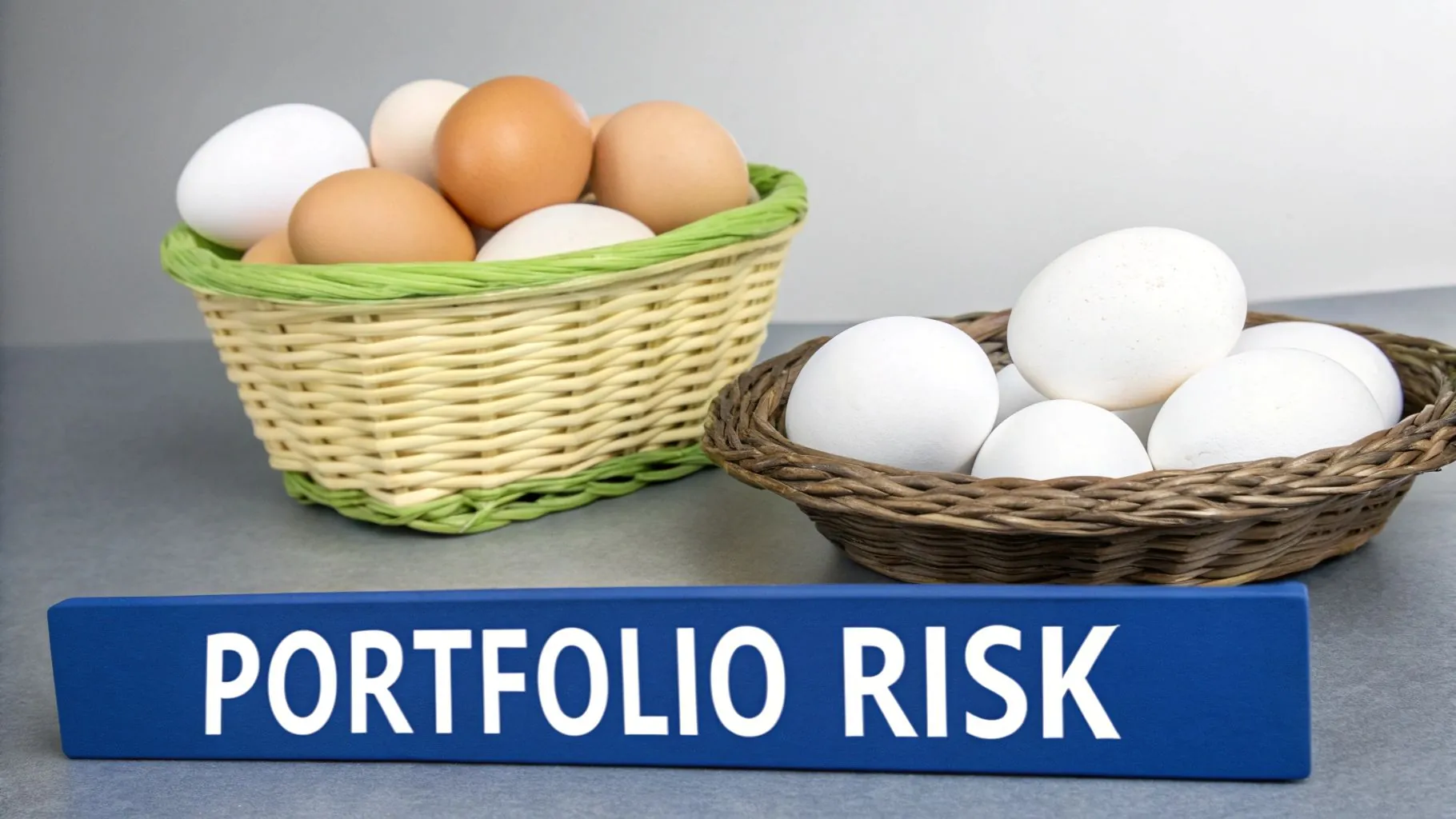
We’re talking about the classic “too many eggs in one basket” problem, but now with a precise number attached. A high HHI in your portfolio acts as a flashing red light, warning you that your financial well-being is dangerously reliant on the performance of just one or two assets.
Defining Your Portfolio’s Risk Level
Unlike the rigid thresholds governments use for market regulation, the “right” HHI for your portfolio is personal. It depends on your risk tolerance, investment timeline, and financial goals. Still, we can set up some practical benchmarks to help you translate that HHI score into action.
-
Low Concentration (HHI below 1,000) Your portfolio is in great shape from a diversification standpoint. No single asset has enough weight to sink the ship if it performs poorly, giving you a solid buffer against volatility.
-
Moderate Concentration (HHI 1,000 - 1,800) You’ve got some conviction in a few key positions, but the overall risk is generally manageable. This is a common zone for investors who hold a few core beliefs but still value broad diversification.
-
High Concentration (HHI 1,800 - 2,500) Warning bells should be going off. Your portfolio is heavily weighted toward a handful of assets. A significant downturn in one of these holdings could deliver a major blow to your net worth. It’s time for a serious review.
-
Extreme Concentration (HHI above 2,500) This is the danger zone. Your portfolio’s performance is almost entirely dictated by one or two positions. This level of concentration carries extreme risk and demands immediate attention to rebalance your holdings.
These benchmarks give you a structured way to think about your asset allocation. A solid grasp of how to diversify an investment portfolio is mission-critical for long-term success, and the HHI provides a concrete metric to guide your strategy.
Think of your portfolio’s HHI as a diversification stress test. A low score means your portfolio is resilient and can absorb shocks to individual assets. A high score reveals a critical point of failure waiting to happen.
To give you a clearer picture, this table breaks down the HHI levels and what you should consider doing at each stage.
HHI Portfolio Concentration Levels and Suggested Actions
| Portfolio HHI Score | Concentration Level | Potential Risk | Recommended Action |
|---|---|---|---|
| Below 1,000 | Low | Minimal risk from single-asset failure. Well-cushioned against volatility. | Maintain your strategy. Continue monitoring and rebalancing as needed to stay diversified. |
| 1,000 - 1,800 | Moderate | Manageable risk. Some positions have a notable impact on overall performance. | Review your key holdings. Ensure you still have high conviction and that they align with your long-term goals. |
| 1,800 - 2,500 | High | Significant. A downturn in a key asset could cause substantial losses. | Actively consider rebalancing. Trim overweight positions and reallocate capital to underweight asset classes. |
| Above 2,500 | Extreme | Critical. Your entire portfolio’s fate is tied to one or two assets. | Immediate action is required. Develop a plan to systematically sell down concentrated positions and diversify. |
This framework helps turn an abstract number into a clear, actionable plan for managing your investment risk.
A Tale of Two Portfolios
Let’s see how this plays out with a real-world comparison. Meet Alex and Ben, two investors who each have a $100,000 portfolio. Their approaches to building wealth, however, couldn’t be more different.
Portfolio 1: Alex the Concentrated Investor
Alex is a huge fan of a single tech company and has decided to go all-in, betting big on its success.
- TechGiant Inc. Stock: $60,000 (60%)
- Broad Market ETF: $20,000 (20%)
- International ETF: $10,000 (10%)
- Corporate Bond Fund: $10,000 (10%)
Let’s run the HHI calculation for Alex: (60²) + (20²) + (10²) + (10²) = 3,600 + 400 + 100 + 100 = 4,200
With an HHI of 4,200, Alex is deep in the “Extreme Concentration” zone. His financial future is overwhelmingly tethered to the fate of a single stock.
Portfolio 2: Ben the Diversified Investor
Ben, on the other hand, prefers a more balanced approach, spreading his capital across different asset classes and sectors.
- Broad Market ETF: $30,000 (30%)
- International ETF: $20,000 (20%)
- Tech Sector ETF: $20,000 (20%)
- Corporate Bond Fund: $20,000 (20%)
- Real Estate ETF (REIT): $10,000 (10%)
Now for Ben’s HHI score: (30²) + (20²) + (20²) + (20²) + (10²) = 900 + 400 + 400 + 400 + 100 = 2,200
Ben’s HHI of 2,200 lands him in the “High Concentration” range, which is still something to watch, but it’s a world away from Alex’s risky bet. His risk is spread out, making him far less vulnerable to a single point of failure. The contrast couldn’t be clearer, showing how HHI instantly quantifies hidden portfolio risk. For a wider view, you can explore new developments in excellence in portfolio monitoring and risk technology to see how advanced platforms are tackling this exact challenge.
Real-World Examples of HHI in Action

The theory behind the Herfindahl-Hirschman Index is one thing, but seeing it applied to actual markets is where its power really clicks. The HHI is more than an academic exercise—it’s a dynamic tool that takes the competitive pulse of an industry, whether it’s a volatile new sector or a traditional, established one.
By digging into a couple of real-world cases, we can see how this single number tells a compelling story about market power, competition, and regulatory red flags. These examples show just how versatile the index is for analyzing everything from technology to transportation.
The Ever-Changing Crypto Market
Few markets illustrate dramatic shifts in concentration better than cryptocurrency. Its breakneck evolution provides a perfect showcase for the HHI’s ability to track rapid changes in who holds the power. The crypto landscape is a story of intense concentration followed by fierce waves of competition.
Back in January 2016, the crypto market’s HHI was around 8,000, signaling extreme concentration dominated by just a handful of major players. But by January 2018, that score had plummeted to below 2,000 as new projects exploded onto the scene, creating a far more competitive environment. The index remained at a similarly competitive level through 2021, showing a more diversified and mature market.
This volatility highlights the HHI’s value in emerging industries. It quantifies the shift from a market dominated by a single pioneer to a more diverse ecosystem, providing a clear metric for tracking an industry’s maturation.
For a practical perspective on how these market dynamics are measured, you can get a better handle on the mechanics by understanding marketmaking activities.
Consolidation in the Airline Industry
In sharp contrast to the fast-moving crypto space, the U.S. airline industry offers a classic example of how mergers drive up HHI scores and attract regulatory attention. Over the last few decades, a series of major mergers has transformed a once-fragmented market into a highly concentrated one.
Every time a major merger was announced, like the combination of American Airlines and US Airways, you can bet the Department of Justice (DOJ) was running a thorough HHI analysis. Regulators use the index to model what the market will look like after the merger to gauge the potential harm to consumers.
- Pre-Merger Analysis: The DOJ first calculates the existing HHI to get a baseline for market concentration.
- Post-Merger Projection: They then figure out what the HHI would become after the merger, paying close attention to specific flight routes where the two airlines were the main competitors.
- The Change Matters: A key focus is the delta, or the increase in the HHI score. A jump of more than 100 points in an already concentrated market (HHI above 1,800) is a huge red flag for regulators.
These analyses often forced airlines to make concessions, like giving up landing and takeoff slots at major airports to smaller, low-cost carriers. This was a direct attempt to offset the anti-competitive effects flagged by the HHI, ensuring that even after consolidation, a degree of competition would survive. The airline industry serves as a textbook case of the HHI in its primary regulatory role: safeguarding market fairness.
Common Pitfalls When Using the HHI
While the Herfindahl-Hirschman Index is a fantastic tool for measuring concentration, it’s not a magic wand. Like any metric, its true power comes from understanding its limits. A sharp analyst knows the final HHI score can be misleading if you aren’t aware of the common traps that can distort the picture of a market’s competitive health.
The single biggest weakness of the HHI is its complete reliance on a clear market definition. The boundaries you draw around a market can completely flip the final score. This is more than some academic footnote; it’s often the central point of debate in massive, real-world antitrust cases.
The Problem of Defining the Market
Define a market too narrowly, and you’ll create a false alarm, making an industry seem far more concentrated than it really is. Imagine calculating the HHI for “premium electric sedans” in a single city. The score would probably be sky-high, but it completely ignores the brutal competition from gas-powered sedans, SUVs of all types, and other electric vehicle models.
On the other hand, a market definition that’s too broad can hide a genuine monopoly right under your nose. If you calculated the HHI for the “entire beverage market,” you might get a comfortably low score. But this would mask the fact that a single company might have a near-total stranglehold on a specific sub-market, like energy drinks.
The Herfindahl-Hirschman Index is a powerful camera, but the analyst is the one who decides where to point the lens. A poorly framed shot will always produce a misleading image of the competitive landscape.
Getting the market definition right is both a science and an art. It demands a hard look at what products consumers see as reasonable substitutes for one another.
What the HHI Fails to Measure
Beyond the tricky business of market definition, the HHI is just a snapshot of the current market structure. It doesn’t capture several dynamic forces that can keep even highly concentrated markets on their toes.
- Potential Competition: The HHI ignores the “threat of entry.” A market might be dominated by two firms, but if the barriers to entry are low, those firms have every reason to keep prices competitive to stop new rivals from jumping in.
- Global Competition: In so many industries today, domestic market share isn’t the whole story. A company might look like it dominates its home turf, but it could be facing intense pressure from international competitors who import similar goods.
- Qualitative Factors: The index is purely quantitative—it’s all about the numbers. It can’t measure things like the pace of innovation, the quality of customer service, or the intensity of non-price competition, such as brand loyalty and marketing wars.
Because of these blind spots, the HHI should never be used in a vacuum. It provides a crucial piece of the puzzle, but it’s most powerful when you combine it with qualitative insights and good old-fashioned business sense. A truly comprehensive analysis uses the HHI as a starting point, not a final verdict, to build a complete picture of an industry’s competitive dynamics.
Common Questions About HHI
As you start working with the Herfindahl-Hirschman Index, a few questions almost always pop up. Let’s tackle them head-on to make sure you can use this metric confidently, whether you’re sizing up a market or checking your own portfolio.
What Is a Good HHI Score for a Portfolio?
This is a bit of a trick question. Unlike the hard-and-fast rules regulators use for markets, there’s no universal “good” HHI score for an investment portfolio. The right number for you is deeply personal—it all comes down to your financial goals, your timeline, and, most importantly, your stomach for risk.
A younger investor playing the long game might be perfectly fine with a higher HHI, say around 2,000, because they have a strong belief in a handful of high-growth stocks and decades to recover from any bumps. On the other hand, someone getting close to retirement will probably want to see a much lower score, maybe under 1,200, because their main goal is protecting what they’ve built, not shooting for the moon.
Your ideal HHI isn’t a target to hit; it’s a mirror reflecting your risk profile. The goal is to make sure your portfolio’s concentration level is one you can sleep with at night, no matter what the market is doing.
How Is HHI Different From a Concentration Ratio?
Both the HHI and a standard concentration ratio (like the CR4, which just adds up the market share of the top four companies) are trying to answer the same question: “How concentrated is this market?” But they go about it in very different ways, and the HHI gives a much smarter answer.
A simple concentration ratio treats a giant and a smaller player as equals. In a CR4 calculation, a company with 40% of the market gets lumped in with one that has just 10%, and their distinct impact is lost. The HHI, however, has a secret weapon: it squares the market share of each company before adding them up.
This simple bit of math gives exponentially more weight to the big dogs. It makes the HHI far more sensitive to a market dominated by a single, massive company, giving you a much truer sense of who really holds the power.
Can I Calculate HHI for Industries with Private Companies?
Yes, but you’ll have to do some detective work. Calculating HHI is a breeze when you’re dealing with public companies that have to report their financials. With private firms, that data is often locked away, making a precise calculation nearly impossible.
When you can’t get official numbers, you have to get creative. Here are a few workarounds, though none are perfect:
- Industry Reports: Market research firms often sell detailed reports with estimated market shares. They can be pricey, but they’re usually your best bet for reliable data.
- Proxy Metrics: If you can’t find revenue data, look for other clues. You can often estimate a company’s relative size by looking at things like employee numbers, website traffic, or production output.
- Qualitative Gut Check: When all else fails and hard data is nowhere to be found, switch gears. A deep qualitative analysis of the competitive landscape can still give you a solid feel for the market dynamics.
It’s definitely a challenge, but a well-researched estimate is almost always more useful than throwing your hands up and analyzing nothing at all.
Ready to stop guessing and start tracking your portfolio’s concentration with precision? PopaDex provides the tools you need to monitor your net worth, visualize your asset allocation, and gain the clarity required to make smarter financial decisions. Start managing your wealth more effectively today at PopaDex.com.