
Our Marketing Team at PopaDex
How to Build Wealth in Your 40s A Practical Guide

Building wealth in your 40s comes down to four powerful moves: skyrocketing your savings rate, investing for real growth, crushing high-interest debt, and boosting your income. With your peak earning years in full swing, this decade is an incredible window to make serious financial headway before retirement.
Why Your 40s Are a Financial Turning Point
If your 20s were for learning the ropes and your 30s were for getting established, your 40s are all about one thing: execution. Think of this decade as a unique financial crossroads. Your income potential is often at its peak, major expenses like a down payment are likely behind you, and retirement is close enough to feel real—but still far enough away to let compound growth work its magic.
The vibe just changes in your 40s, doesn’t it? That abstract idea of a far-off retirement suddenly has a much sharper timeline. This shift from a “someday” goal to a tangible deadline is often the exact motivation we need to get serious about financial strategy.
Facing the Financial Realities
The numbers don’t lie—this is the decade to make big moves. Your 40s are your peak earning years, giving you both the income and the time to make a massive financial impact. Many financial experts suggest that by age 45, you should aim to have three times your annual income saved for retirement. You can read more about these retirement planning benchmarks to see how you stack up.
That’s not meant to be scary; it’s meant to be a clear, actionable target. Knowing where you stand is the essential first step to building a plan that actually gets you where you want to go.
Your 40s aren’t about making up for lost time. They’re about leveraging the experience, wisdom, and earning power you’ve built to make the most impactful financial decisions of your life.
The Four Pillars of Wealth in Your 40s
Success at this stage is all about focusing your energy where it counts. Forget the complicated schemes. The blueprint is surprisingly simple and built on four core actions:
- Maximize Your Savings Rate: With a higher income, your ability to stash away a significant chunk—think 15-20% or more—is greater than ever.
- Invest for Growth: Your portfolio should still be positioned for growth. With 20+ years until you might need the money, you have time to ride out market bumps.
- Eliminate High-Interest Debt: Credit card balances and personal loans are an anchor on your net worth. Wiping them out frees up cash flow to pour into investments.
- Boost Your Income: Use your professional expertise to chase a promotion, start a side hustle, or do some consulting. It’s the fastest way to accelerate your goals.
To help you get a sense of where you stand, here are some common retirement savings benchmarks.
Retirement Savings Benchmarks for Your 40s and Beyond
This table provides a clear snapshot of recommended retirement savings goals as a multiple of your annual salary at different ages, helping you quickly assess your progress.
| Age | Recommended Savings (Multiple of Annual Salary) |
|---|---|
| 40 | 3x |
| 45 | 4x |
| 50 | 6x |
| 55 | 8x |
Seeing these numbers gives you a clear target to aim for. If you’re on track, fantastic. If you feel you’re behind, don’t panic. This guide is designed to give you the exact steps you need to catch up and build the future you want.
Conducting a No-Nonsense Financial Audit
Before you can build a roadmap to wealth, you have to know exactly where you’re starting. Think of it like a GPS: you can’t get directions to your destination without first pinpointing your current location. In your financial life, that starting point is your net worth.
It’s the single most important number for understanding your financial health, and the formula is dead simple: Assets - Liabilities = Net Worth. This equation cuts through all the noise and gives you a brutally honest look at where you stand today.
Tallying Up Your Assets
First, let’s get a handle on everything you own. Assets are anything with real monetary value. Don’t stress about getting the numbers perfect down to the last cent on this first pass; the goal is just to get a complete list.
Your assets will likely include:
- Cash and Equivalents: This is your checking account, savings, money market funds, and any high-yield savings accounts.
- Investments: Pull the latest numbers from your 401(k), IRAs (both Roth and Traditional), and any taxable brokerage accounts.
- Real Estate: Grab the current market value for your primary home and any other properties you own.
- Other Valuables: Think about your cars, valuable collectibles, or anything else significant you could realistically sell for cash.
This list represents the positive side of your financial ledger. It’s the part we all like to look at, but it’s only half the story.
Facing Your Liabilities
Next up, it’s time to list everything you owe. Your liabilities are all of your debts, and being completely honest here is non-negotiable for an accurate picture. This is how you find the financial leaks that might be sinking your wealth-building ship.
This is all part of a proven process. First you save and invest, then you attack your debt to free up capital, and finally, you focus on expanding your income streams.
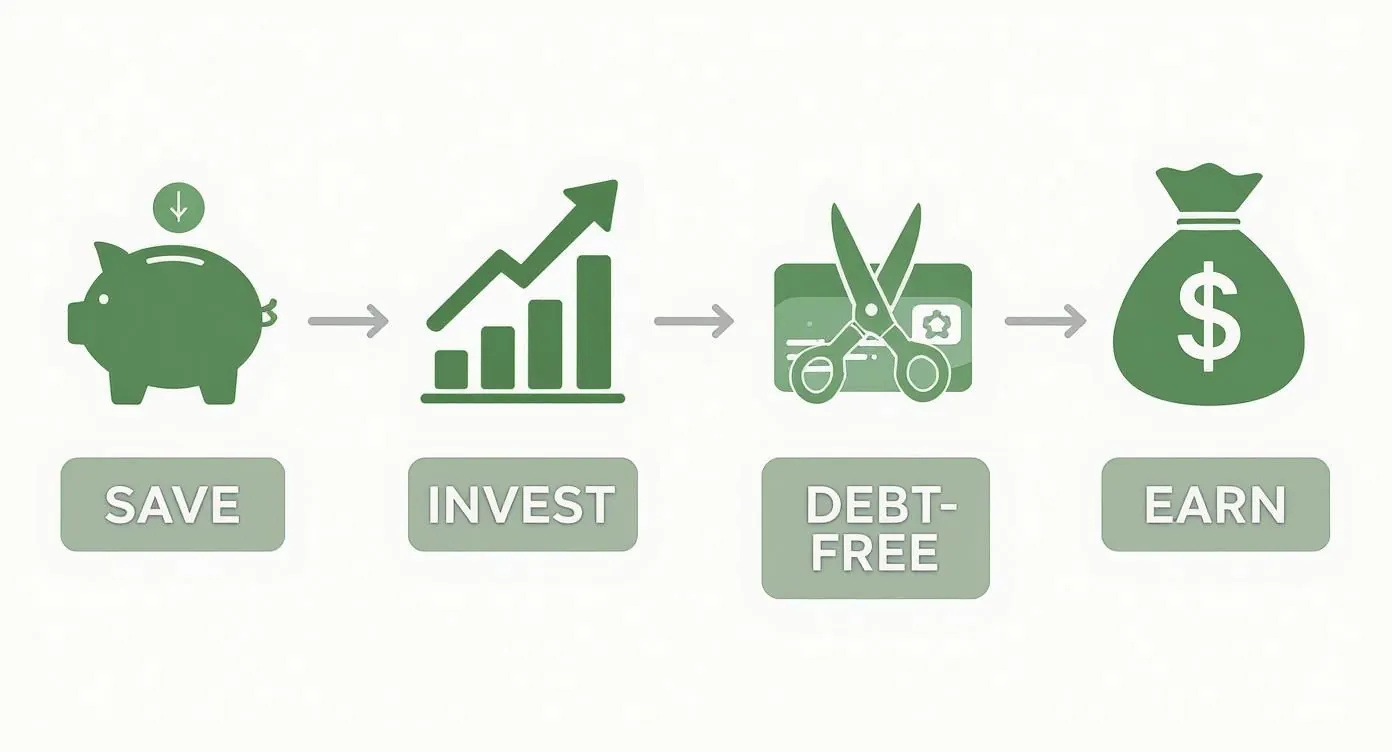
Each step builds on the last, creating a powerful cycle of financial growth that really picks up steam in your 40s.
For most people in this decade, liabilities usually include:
- Mortgage balances
- Student loan debt
- Car loans
- Credit card debt
- Personal loans
This part of the exercise can feel a little sobering, but it’s also where the power lies. Once you see the numbers in black and white, you can build a targeted plan to knock out the high-interest debts that are actively working against your goals.
A financial audit isn’t about judging past decisions. It’s about gathering objective data to make smarter, more powerful decisions for your future.
Putting It All Together: A Real-World Example
Let’s look at a quick example. Sarah and Tom, both 42, decide it’s time to get serious and do their first real financial audit. They always felt like they were doing okay, but they never had a concrete number to track their progress.
By pulling all their accounts into one place, they discovered their net worth was $275,000. Not a bad starting point!
But the audit also uncovered something critical: they were paying over $400 a month in interest alone on credit card debt they’d racked up over the years. That was a massive leak in their financial boat. This one insight gave them their first clear mission: attack that high-interest debt with everything they had.
If you’re just starting out, you can learn more about how to track net worth in our detailed guide.
This baseline figure is your new starting line. With an accurate net worth calculation in hand, you finally have the clarity you need to set meaningful goals and actually measure your progress as you start building serious wealth.
How to Invest for Growth in Your 40s
If you’re in your 40s, you still have a solid 20-25 year runway until the traditional retirement age. This is absolutely not the time to slam on the brakes and get overly conservative with your investments. I see it happen all the time—people hit 40 and think they need to shift into preservation mode. That’s a huge mistake.
Shifting into low-growth assets too early means you’re leaving a massive amount of potential gains on the table. Even worse, you risk falling behind inflation. The goal here is simple: make your money work as hard as you do. For that to happen, you need to stay heavily weighted in equities (stocks) and let the power of compounding do its thing. Volatility is part of the game, but your long time horizon is your biggest advantage—it gives your portfolio plenty of time to recover from downturns and ride the market’s historical upward trend.

Maximize Your Tax-Advantaged Accounts
Your first and most powerful move is to get aggressive with your tax-advantaged retirement accounts. Think of your 401(k) and Individual Retirement Accounts (IRAs) as wealth-building cheat codes. Their tax benefits are designed to accelerate your growth, and you need to squeeze every drop of value out of them.
If your employer offers a 401(k) match, contributing enough to get the full amount is more than a good idea—it’s non-negotiable. It’s free money. A 100% guaranteed return on your investment. After that, your goal should be to get as close to the annual maximum as you possibly can.
Don’t forget about IRAs, either. Both Roth and Traditional IRAs give you another powerful lane for tax-advantaged growth. It’s no surprise that around 67% of American adults use accounts like these to build their future. They are the cornerstone of modern wealth-building, and prioritizing them is a must.
Here’s a pro tip: Don’t forget about “catch-up” contributions. The moment you turn 50, the government lets you contribute extra to your retirement accounts. This is an incredible tool for supercharging your savings in that final decade before retirement.
Beyond the Basics: Putting Idle Cash to Work
Okay, so you’re consistently maxing out your tax-advantaged accounts. What’s next? Letting any extra cash just sit in a standard checking or savings account is a classic mistake. Inflation will quietly eat away at its purchasing power year after year.
You’ve got to put that idle cash to work. A few solid options come to mind:
- High-Yield Savings Accounts (HYSAs): These are perfect for your emergency fund. HYSAs offer much higher interest rates than your neighborhood bank but keep your money liquid and safe.
- Money Market Funds: Another low-risk option, usually available through your brokerage, that can give you a better return than a standard savings account.
- Taxable Brokerage Accounts: This is your growth engine beyond retirement plans. Open one up and keep investing in low-cost index funds, ETFs, or individual stocks.
For those who want to build wealth outside of Wall Street, exploring different real estate investment strategies can be a fantastic way to diversify and grow your net worth.
The key is to have a job for every dollar. When you direct surplus cash into accounts where it can actually grow, you’re optimizing your entire financial picture. If you want to dive deeper into this, check out our guide on how to diversify an investment portfolio.
Rebalancing for Long-Term Growth: A Case Study
Let’s look at a real-world scenario. Meet Mark, a 45-year-old professional who’s been a great saver but hasn’t really looked under the hood of his investment accounts for years. When he finally does, he realizes his portfolio has drifted and is now far too conservative for his goals.
Mark’s Old Portfolio Allocation:
- 40% U.S. Stocks
- 15% International Stocks
- 35% Bonds
- 10% Cash
With a 20-year horizon until retirement, Mark knows this setup won’t get him where he needs to be. He decides it’s time to rebalance for growth, without being reckless.
Mark’s New Growth-Oriented Allocation:
- 60% U.S. Stocks (via a low-cost S&P 500 index fund)
- 25% International Stocks (to capture global growth)
- 15% Bonds (for a bit of stability)
Just by making this adjustment, Mark repositions his portfolio to capture significantly higher potential returns over the next two decades. This is exactly how you should be thinking in your 40s: stay engaged, understand your risk tolerance, and make sure your investments align with your timeline. Using a tool to actually see your portfolio’s allocation makes this process way less intimidating.
Expanding Income and Eliminating Debt
Building real wealth is a two-front battle. On one side, you have your offense—growing your income. On the other, you have your defense—crushing the debts that slowly bleed your finances dry. To make a serious dent in your financial goals in your 40s, you absolutely have to play both sides of the ball.
The financial moves you make right now have a disproportionate impact on where you’ll be in 10, 20, or 30 years. When you tackle both your income and your debts with a clear strategy, you kickstart a powerful flywheel. Every dollar you earn works harder, and every dollar you don’t pay in interest becomes fuel for your investments.

A Strategic Approach to Eliminating Debt
Let’s get one thing straight: not all debt is the enemy. A low-interest mortgage on your primary home is what many consider “good debt.” But high-interest, non-deductible debt—we’re looking at you, credit cards and personal loans—is a certified wealth killer.
This kind of “bad debt” is like trying to run a marathon with a weighted vest on. Those double-digit interest rates are actively working against you, often costing you far more in interest than you can reliably earn in the stock market. Wiping it out needs to be a top priority.
Two of the most popular and effective debt-payoff strategies are the avalanche and snowball methods.
- The Debt Avalanche: With this method, you throw every extra penny at the debt with the highest interest rate while making minimum payments on everything else. From a pure math perspective, this saves you the most money over the long haul.
- The Debt Snowball: Here, you focus on paying off the smallest debt balance first, no matter the interest rate. The power of this approach is psychological; those quick wins build momentum and keep you motivated to stick with it.
Which one is right for you? It’s a personal call. If you’re a spreadsheet nerd driven by optimization, the avalanche is your game. If you need those early victories to stay in the fight, the snowball is a fantastic choice.
The most important part isn’t which method you pick, but that you actually pick one and commit. Consistency is what demolishes debt and frees up your cash flow to build wealth.
Leveraging Your Experience to Boost Income
Once you have a debt-elimination plan running, it’s time to flip the coin and focus on your income. By your 40s, you’re sitting on a goldmine: 20+ years of professional experience, skills, and industry knowledge. This is your single greatest asset for generating more cash.
Boosting your income is about more than just asking for a raise (though you should definitely do that). It’s about starting to think like an entrepreneur and finding ways to monetize your expertise outside of your 9-to-5. Research consistently shows that inadequate income is a huge barrier to saving. That’s why a recent study found that a majority of people—between 49% and 60%—see increasing income as a vital part of their wealth-building strategy, while 43% to 52% cite getting out of debt as essential. You can discover more insights about these wealth-building perspectives and how they shape financial outcomes.
This is the mindset shift that truly accelerates wealth creation—understanding that you need a strong offense (income) and a strong defense (debt reduction).
From Employee to Consultant: A Real-World Example
Let’s look at Maria, a 46-year-old marketing director. She’s a wizard with digital ad campaigns but felt like her salary had hit a ceiling. Instead of just jumping to another company for a small bump, she decided to leverage her very specific skill set.
She started small by offering freelance consulting to small businesses in industries that didn’t compete with her day job. She put up a simple website, polished her LinkedIn profile to advertise her new services, and started tapping into her professional network.
Within six months, she had three steady clients, bringing in an extra $2,500 per month. Maria immediately aimed that new firehose of cash at her remaining student loan debt and wiped it out in a single year—a goal that previously felt five years away. Now, that entire $2,500 goes directly into her brokerage account each month, supercharging her retirement savings.
This is the perfect playbook for building wealth in your 40s. Maria didn’t have to quit her stable job; she simply found a way to monetize the skills she’d spent two decades building.
Actionable Ideas for New Income Streams
Think about the expertise you’ve developed. How could you package that for someone else?
- Consulting or Freelancing: Offer your professional skills on a project basis. Are you an HR manager? Help small businesses write their employee handbooks.
- Coaching or Mentoring: Guide younger professionals in your field. They’ll pay for your roadmap to avoid the mistakes you made.
- Create a Digital Product: Write an ebook or build a short online course on a topic you’ve completely mastered.
- Start a Niche Service Business: Turn a hobby or specialized skill—like grant writing, home organization, or even crafting custom furniture—into a side business.
The goal here is income diversification. Relying on a single paycheck leaves you vulnerable. By adding even one or two additional income streams, you build a much more resilient and powerful financial foundation.
Protecting Your Assets for the Long Haul
As you work to grow your net worth, a crucial pivot happens in your 40s. The focus shifts from pure accumulation to a dual strategy of growth and preservation. Suddenly, protecting what you’ve built becomes just as important as building more.
Without a solid defense, even the most impressive financial portfolio is vulnerable. A sudden illness, an accident, or an unexpected death can derail decades of hard work in an instant. This is where insurance and estate planning move from the “nice-to-have” list to the “non-negotiable” column.
Building Your Financial Moat with Insurance
Think of insurance as the moat around your financial castle. It’s not there to make you rich; it’s there to stop you from becoming poor overnight. In your 40s, with growing responsibilities and assets, a few types of insurance become absolutely vital.
-
Life Insurance: If anyone depends on your income—a spouse, kids, even aging parents—term life insurance is a must. A common rule of thumb suggests a policy worth at least 10 times your annual salary. This ensures your family can cover the mortgage, pay for college, and maintain their standard of living without your income.
-
Disability Insurance: Your ability to earn an income is your single greatest financial asset, period. Disability insurance protects that asset. If an illness or injury stops you from working, this coverage replaces a significant chunk of your paycheck, keeping your entire wealth-building plan from grinding to a halt.
-
Umbrella Insurance: This is an extra layer of liability coverage that kicks in when the limits on your auto or homeowners policies are maxed out. A single major lawsuit could wipe you out; for a few hundred dollars a year, an umbrella policy adds $1 million or more in protection. It’s one of the best bargains in the insurance world.
These policies create a safety net, making sure one piece of bad luck doesn’t topple your entire financial structure. If you want to go deeper, our guide on asset protection planning lays out more detailed strategies.
The Non-Negotiables of Estate Planning
A lot of people think estate planning is just for the ultra-wealthy, but that’s a dangerously wrong assumption. If you have any assets or minor children, you need a basic estate plan. Without one, you’re leaving the most critical decisions about your assets and your family’s future up to the courts.
An estate plan is one of the most profound ways to show your family you care. It removes uncertainty and chaos during what would already be an incredibly difficult time.
Getting your essential documents in order gives you peace of mind and ensures your wishes are actually followed. As you protect your hard-earned assets for the long haul, it’s vital to be aware of and avoid the common estate planning mistakes people make in their 30s and 40s.
Your Core Estate Planning Documents
While you should always consult with an attorney, there are a few foundational documents every person in their 40s should have in place.
- A Will: This legal document outlines who gets your assets and, just as importantly, names a guardian for your minor children. If you don’t have a will, the state decides both.
- Durable Power of Attorney for Finances: This lets you designate someone you trust to manage your financial affairs if you become incapacitated and can’t do it yourself.
- Advance Healthcare Directive (Living Will): This document details your wishes for medical treatment if you can’t communicate them and names a healthcare proxy to make decisions on your behalf.
Creating these documents isn’t about planning for death; it’s about taking responsible control of your life and assets. It’s a foundational step in securing the wealth you’re working so hard to build.
Common Questions About Building Wealth in Your 40s
Even with a detailed roadmap, it’s natural for questions to pop up. This is more than normal; it’s a sign you’re engaged with your financial future. Making smart moves in your 40s means constantly adapting to your unique situation.
Let’s tackle some of the most frequent questions we hear. These are the things that keep people up at night, and getting clear, direct answers can help you stay confident and on track.
Is It Too Late to Start Investing Seriously in My 40s?
Not a chance. While it’s true that starting in your 20s gives your money more time to grow, your 40s often bring a powerful advantage: higher income. With roughly 20-25 years until a traditional retirement age, you still have a solid runway for compound growth to do its heavy lifting.
The trick is to be deliberate. Get aggressive. Focus on maxing out your retirement accounts and building a diversified portfolio that’s geared for growth. Think about it: a 45-year-old who starts putting away $1,000 per month can still build a very respectable nest egg by 65. The biggest mistake isn’t starting late—it’s not starting at all.
How Much of My Income Should I Be Saving?
That old “save 10% of your income” rule? It’s a decent starting point, but it’s rarely enough for someone in their 40s who feels like they’re playing catch-up. A much more effective target for this stage of life is 15-20% or more of your gross income.
These are your peak earning years, which means it’s your best shot to ramp up your savings rate without having to slash your lifestyle. The easiest way to do this is to automate it. Set up contributions to happen the day you get paid. This “pay yourself first” approach ensures you hit your goals before that money can be spent elsewhere.
Your savings rate is one of the few dials you have complete and immediate control over. In the short term, it’s a more powerful wealth-building tool than your investment returns.
Should I Pay Off My Mortgage Early or Invest Extra Money?
This is the classic debate, and honestly, the right answer is a mix of math and emotion. It really depends on your numbers and your personal comfort with debt.
From a pure numbers perspective, if your mortgage rate is low (say, 3-4%), you’re likely to get a better long-term return by investing extra cash in the stock market, which has historically averaged 7-10%.
But don’t discount the psychological win of being completely debt-free. Wiping out your mortgage frees up a massive chunk of your cash flow for retirement and gives you a guaranteed “return” equal to your interest rate. There’s real power in that peace of mind.
- Consider investing if: Your mortgage rate is low, you’re comfortable with market risk, and you’re disciplined enough to actually invest the extra money every month.
- Consider paying off the mortgage if: You hate debt, your interest rate is on the higher side, or the thought of owning your home free and clear is your top priority.
How Do I Balance Saving for Retirement and My Kids’ College?
This is one of the toughest financial tightropes for parents in their 40s. The advice you’ll hear from almost every financial planner is unwavering: prioritize your own retirement.
Here’s the simple logic: your kids can find ways to pay for college—loans, scholarships, grants, work-study—but nobody offers a loan for retirement. By securing your own financial future first, you avoid becoming a financial burden on your children down the road. That’s a gift in itself.
You can absolutely still help with their education. Open up a dedicated savings vehicle like a 529 plan, which lets the money grow tax-free for educational expenses. The key is to have an honest conversation with your kids about what you can realistically contribute. The goal isn’t to sacrifice your security for their education but to find a healthy balance that supports both.
Ready to stop guessing and start tracking your financial progress with real clarity? PopaDex gives you a single, intuitive dashboard to monitor your net worth, track your investments, and see your entire financial picture in real-time. Take control of your wealth-building journey today.