
Our Marketing Team at PopaDex
Your Personal Financial Statement Template Guide

A personal financial statement template is really just a structured way to get all your financial details—assets, liabilities, income, and expenses—organized in one place. It’s the tool that gives you a crystal-clear snapshot of your financial health.
Think of it as the foundation for making smarter money moves, whether that’s trying to get a loan or just tracking your net worth over time. Ready to jump in? We’ve got free, ready-to-use templates for both Excel and Google Sheets waiting for you.
Why This Statement Is Your Financial North Star
Most people think of a personal financial statement (PFS) as just another tedious form you fill out for a loan. But that’s a pretty limited view. It’s much more than that—it’s your financial North Star.
This single document gives you an honest, unfiltered look at where you actually stand. It cuts through the noise of daily transactions to answer one simple, but incredibly important, question: What is your net worth?

Whether your goal is buying a house, mapping out retirement, or just finally feeling in control of your money, this statement is the real starting point for genuine financial clarity.
Understanding the Core Components
At its heart, a PFS boils down to a simple formula: Assets - Liabilities = Net Worth. It’s not complicated, but understanding what goes into each bucket is key.
This table breaks down the essentials of what you’ll be tracking.
Core Components of a Personal Financial Statement
| Component | What It Includes | Why It Matters |
|---|---|---|
| Assets | Everything you own with monetary value: cash, investments, retirement accounts, real estate, vehicles. | Represents the “own” side of your financial equation. These are resources you can use to build wealth. |
| Liabilities | Everything you owe: mortgages, car loans, student debt, credit card balances, personal loans. | Represents the “owe” side. Keeping liabilities in check is crucial for financial stability. |
By listing and totaling up each side, you get a clear picture of your financial position at a single point in time. This isn’t just some accounting exercise; it’s a way to empower yourself with real data. In fact, consumer finance surveys show that in the United States, around 36% of adults already maintain some version of this for budgeting or loan applications. That number alone shows how vital this is, especially for small business owners and anyone needing to prove their creditworthiness.
A well-prepared financial statement is your financial handshake before you even enter the room. It communicates your financial health, discipline, and ability to follow through on your goals.
Beyond the Loan Application
Sure, lenders almost always ask for a PFS to see if you can handle repaying a debt. But its true value goes way beyond that. When you get into the habit of updating your statement regularly, you unlock some powerful benefits.
- Track Your Progress: There’s nothing more motivating than actually watching your net worth grow over time.
- Make Informed Decisions: You’ll know exactly how a major purchase or a new investment will impact your overall financial picture.
- Identify Opportunities: You can easily spot where you could be cutting debt faster or shifting assets to better match your long-term goals.
This simple document turns abstract financial ideas into concrete, actionable numbers. It gives you the clarity you need to navigate your financial journey with a lot more confidence.
Gathering Your Financial Puzzle Pieces
Before you can tackle the template, you need to pull together all your financial info. Think of it as gathering the pieces for a puzzle—having everything ready beforehand makes the whole process smoother and, more importantly, accurate. This is where the real clarity begins.
The goal here isn’t about perfect accounting. It’s about collecting the documents that give you a clear, current value for everything you own and everything you owe. You’re creating an honest snapshot of your financial life as it stands right now.
Your Asset Documentation Checklist
First up, let’s round up everything related to your assets—the stuff you own. You’ll want the most recent statements or reliable estimates you can get your hands on to make sure your numbers are truly current.
- Bank Statements: Grab the latest statements for all your checking and savings accounts. The closing balance is the number you need.
- Investment Summaries: Pull up your most recent brokerage account statements. This covers your stocks, bonds, mutual funds, and any other investments you can easily sell.
- Retirement Accounts: Find the current balance for your 401(k), IRA, or whatever retirement plans you have. Most provider websites have this right on the main dashboard when you log in.
- Property Value Estimates: For your home, a recent appraisal is the gold standard, but a conservative estimate from a site like Zillow or Redfin works in a pinch. For your car, check a trusted source like Kelley Blue Book for its current private-party sale value.
A classic mistake is using old data. A stock portfolio’s value can swing dramatically in just a month. Always use the most recent statement date you can find to keep your financial statement accurate.
Your Liability Documentation Checklist
Next, it’s time to collect the documents for your liabilities, which is just a fancy word for what you owe. Getting these numbers right is just as important as getting your assets right.
You’re looking for the current outstanding balance on all your debts. This info is usually front and center on your latest bill or your online account summary. Be sure to track down:
- Mortgage Statements: You need the total remaining principal on your home loan.
- Credit Card Bills: Find the statement balance for every single credit card you have.
- Student Loan Balances: The total amount you still owe on your education loans.
- Auto Loan Details: The remaining principal on any car financing.
As you’re compiling all this, it’s also smart to have your income and deduction figures handy. These are often found in official tax documents like the 1040 Form Template. Having all these puzzle pieces laid out makes filling out the statement a breeze and is foundational to truly understanding your money. If you want to see how this all comes together in the final calculation, our guide on how to calculate net worth breaks it down step-by-step.
A Guided Tour of the Template
Okay, you’ve gathered up all your financial paperwork. Now it’s time to plug those numbers into the personal financial statement template and see what story they tell. Don’t worry, this isn’t about complex accounting; it’s about painting a clear picture of your finances.
To make it real, let’s walk through this with a fictional character, Alex, as they fill out their own statement.
We’ll kick things off with the Assets section. Think of this as everything Alex owns that has a dollar value attached to it. This is the “what you have” side of the financial coin.
Detailing Your Assets Like Alex
Alex starts with the most straightforward numbers: their liquid assets, or the cash they can access easily. Getting these down first builds a solid foundation for the rest of the statement.
- Cash and Equivalents: Alex pulls up their banking app. They have $4,500 in their checking account for bills and daily spending, plus $15,000 stashed in a high-yield savings account as an emergency fund.
- Investments: Next, they log into their brokerage account. Their index funds are currently valued at $28,000, and a smaller portfolio of individual stocks is sitting at $7,200.
- Retirement Funds: Alex adds their work 401(k), which has a balance of $55,000, and a separate Roth IRA with $18,000. It’s crucial to include these, even if you can’t touch the money for years without a penalty.
The whole point of a personal financial statement is to collect asset details from places like bank statements and then contrast them with liabilities from loan and credit card documents.
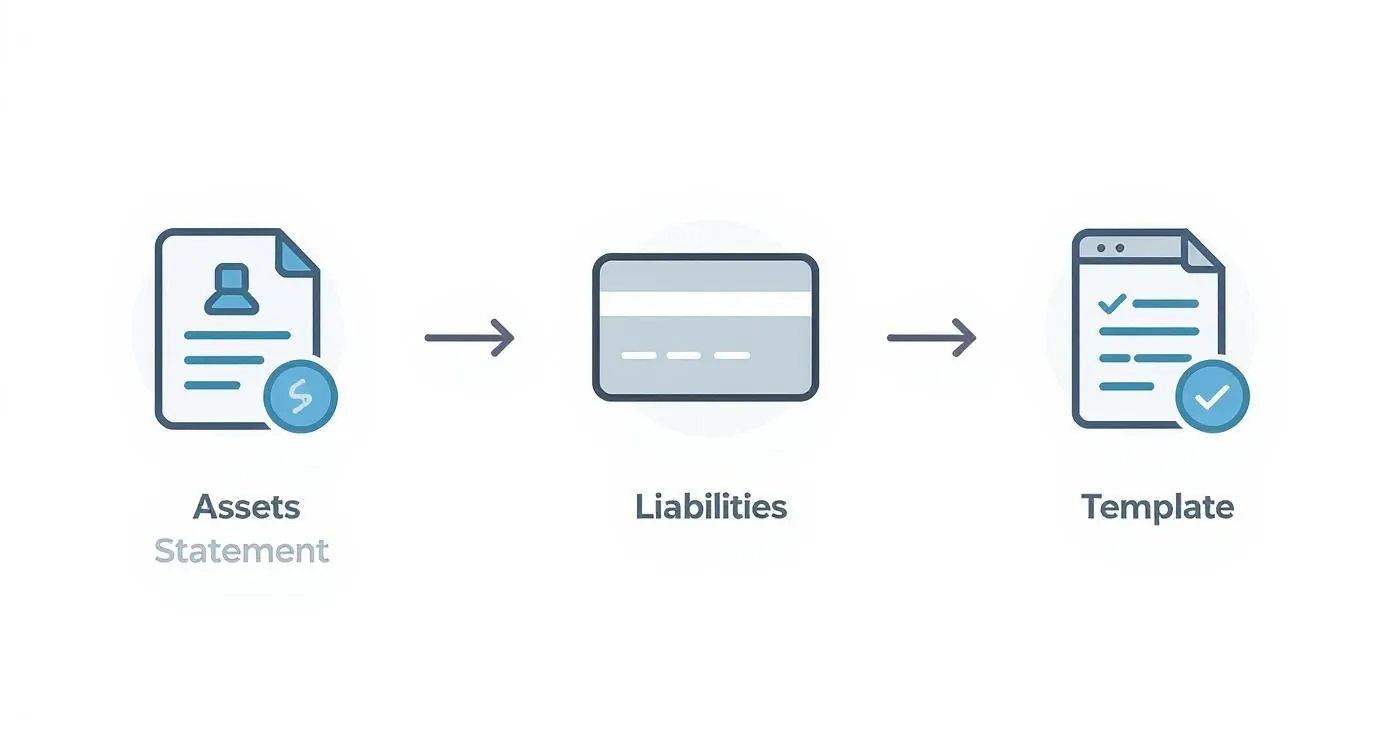
As the visual shows, you only get the full financial picture when you combine both sides of your balance sheet into one organized template.
Itemizing Your Liabilities
With the asset side filled out, Alex flips over to the liabilities—everything they owe. Getting this part right is absolutely critical for calculating an honest net worth. For a more detailed breakdown, you can see our personal balance sheet example.
Alex makes a careful list of every single debt, leaving no stone unturned.
- Mortgage: Their biggest liability is the house, with a remaining mortgage principal of $220,000.
- Auto Loan: The car loan has an outstanding balance of $12,500.
- Credit Card Debt: Alex totals up the balances on their two credit cards, which comes to $3,800.
- Student Loans: Finally, that old federal student loan is still hanging around with a $21,000 balance.
By listing every single debt, no matter how small, you prevent unpleasant surprises and ensure your net worth calculation is honest and reliable. This step transforms financial ambiguity into absolute clarity.
This practice of detailing personal finances isn’t new; it’s been a cornerstone of the lending industry for ages. Historically, around 72% of loan approvals in major markets like the US and UK have hinged on these detailed disclosures, where applicants itemize assets and liabilities just like Alex did. The jump from simple paper forms to dynamic spreadsheets just shows how essential this tool has become.
Once both sides are complete, the template automatically crunches the numbers and calculates Alex’s net worth. In a single glance, they can see their entire financial situation, turning a jumble of figures into a powerful tool for making smarter decisions.
Handling Complex and Unique Assets
Let’s be real—not everyone’s financial life fits into neat little boxes like “checking account” or “401(k).” What do you do when you own assets that are a bit more… complicated? A truly useful personal financial statement template needs to be flexible enough to handle these unique situations, so you get a financial snapshot that’s actually accurate.
Many people, especially expats and global professionals, find themselves juggling money in multiple currencies. The golden rule here is consistency. Pick one “base” currency for your statement—this is usually your home currency or the one you operate in most—and convert everything else to that currency. Use the current exchange rate on the day you prepare the statement.
This simple step prevents your net worth from getting warped by currency swings and gives you a true apples-to-apples view of where you stand.
Valuing Your Business and Collectibles
Putting a dollar value on a small business you own can feel more like an art than a science. For a formal statement you might show a lender, a professional valuation is the way to go. But for your own tracking, a conservative estimate based on annual revenue or a multiple of your net profit is a solid starting point. Just be realistic and jot down how you came up with the number.
The same goes for unique collectibles, which need a bit of homework to value properly.
- Art and Antiques: For high-value pieces, it’s worth getting a professional appraisal. For everything else, look up recent auction results for similar works to find a realistic baseline.
- Classic Cars: Don’t just guess. Use a reputable source like Hagerty’s Valuation Tools, which is the industry standard for figuring out the fair market value of collector cars.
- Jewelry and Watches: An appraisal from a certified gemologist or jeweler is non-negotiable. You’ll need it for insurance anyway, and it ensures your financial statement is accurate.
And don’t forget your everyday tech. When you’re tallying up personal property, you’ll need to figure out how much your phone is worth and other electronics to include an accurate number. The goal is always to use defensible, third-party data whenever you can.
Your financial statement is only as credible as the numbers you put into it. For unique assets, relying on verifiable, external valuation sources is more than a best practice—it’s essential for building a document that lenders and partners can trust.
Customizing the Template for Your Needs
The real magic of a spreadsheet template is how easily you can adapt it. Don’t be afraid to make it your own. If the default categories don’t cover your entire financial world, just add new rows.
For example, you might need to add specific lines for things like:
- Cryptocurrency holdings
- Intellectual property (think patents or book royalties)
- Loans you’ve made to others (often called notes receivable)
By simply inserting new rows and labeling them clearly, you turn a generic document into a personalized financial dashboard. This is how you ensure every single asset and liability gets counted, giving you the most complete and honest picture of your financial health. It’s a crucial step in making the template work for you.
Making Your Statement a Dynamic Financial Tool
A personal financial statement shouldn’t be a document you create once and then file away forever. Its real power comes alive when you turn it from a static snapshot into a living tool that tracks your financial journey over time. This simple shift in mindset transforms a boring report into a dynamic dashboard for your life.
The easiest way to get started is by making a new copy of your personal financial statement template at regular intervals. Saving a new version each quarter is a fantastic rhythm to get into. This simple habit lets you see exactly how your net worth is evolving, drawing a clear line between your daily financial habits and your long-term wealth.

This periodic check-in does more than just update your numbers; it creates a powerful feedback loop. You can actually see the impact of paying down your credit card debt, the growth of your 401(k), or how that long-awaited raise affects your bottom line. Honestly, it’s incredibly motivating.
From Static Data to Visual Progress
Once you have a few of these statements saved, you can easily create a simple chart to visualize your progress. In either Google Sheets or Excel, just highlight the dates and their corresponding net worth figures to generate a line graph. Seeing that line climb is far more impactful than staring at numbers on a page.
A financial statement is a snapshot of where you are. A series of them becomes a map showing you where you’ve been and helps you chart a course for where you want to go.
This approach turns your template into a powerful progress tracker. It’s no longer just a form for a loan application; it’s your personal scoreboard. For those who really want to nerd out on this, our guide on building a dedicated net worth tracker in Google Sheets takes these techniques even further.
Automating the Process for Real-Time Insight
While updating your statement quarterly is a great habit, modern tools can supplement this by doing the heavy lifting for you. Platforms like PopaDex connect directly to your financial accounts, pulling in real-time balances for your bank accounts, investments, and loans automatically.
This automated approach offers a few key advantages:
- Time Savings: No more hunting down every single number from different websites. It saves a surprising amount of time.
- Constant Clarity: You get an up-to-the-minute view of your finances, rather than waiting for your quarterly check-in.
- Reduced Errors: Automation minimizes the risk of typos or other manual data entry mistakes, so you know your numbers are always accurate.
The impact of actively using a personal financial statement is huge. Surveys show that about 48% of adults who use them report a much clearer understanding of their finances. It gets even more dramatic for small business owners, where a staggering 85% say a PFS was critical for securing funding. Smartsheet has more great insights on this. It’s clear that this simple document can dramatically improve both personal financial clarity and business success.
By combining the deliberate, reflective practice of quarterly updates with the convenience of automated tools, you create a truly robust system for managing and growing your wealth.
Common Questions About Your Financial Statement
As you start plugging numbers into your personal financial statement template, it’s totally normal for a few questions to come up. Let’s tackle the most common ones I hear, so you can move forward with confidence and make sure your financial snapshot is as accurate—and useful—as possible.
How Often Should I Update My Statement?
For most folks, updating your financial statement quarterly hits the sweet spot. It’s frequent enough to track real progress without turning into a weekly chore. This rhythm lets you see how your net worth is trending, reflecting your recent savings, investment performance, or how quickly you’re chipping away at debt.
But there’s a big exception to this rule. You should always prepare a fresh, up-to-the-minute statement right before any major financial move. Think of it as essential prep work for moments like:
- Applying for a mortgage or another significant loan.
- Making a big investment that could shift your portfolio.
- Kicking off a new business venture.
- Planning for a major life event, like retirement or a big move.
In these situations, an outdated statement just won’t cut it.
What Is the Difference Between a Statement and a Budget?
This is a classic point of confusion, but the distinction is actually pretty simple—and powerful. They’re two totally different tools that work together beautifully.
A financial statement is a snapshot of your net worth on one specific day. It’s your current financial score. A budget, on the other hand, is a forward-looking plan for your money. It’s your game plan for the coming weeks or months.
Simply put, your statement shows you where you stand right now. Your budget is the roadmap to get you where you want to go.
How Do I Value Assets Like My Car or Home?
Getting the valuation right is key, and the goal here is realism, not wishful thinking.
For your home, the gold standard is a recent professional appraisal. If you don’t have one handy, you can pull a conservative estimate from a reputable real estate site like Zillow, but be ready to explain where that number came from if you’re showing it to a lender.
When it comes to your car, check a trusted source like Kelley Blue Book for its private party sale value. This is what another person would likely pay you for it today—a much more realistic figure than the lower trade-in value a dealership would offer.
Is It Safe to Share This Document Digitally?
Yes, it is, as long as you make security your top priority. When you need to send your completed personal financial statement template to a lender or financial advisor, just take a few simple precautions to keep your sensitive info locked down.
- If you’re using Google Sheets, share a “view-only” link, never full editing access.
- For an Excel file, always save it as a PDF before you attach it to an email. This locks the document and prevents any accidental changes.
- Always, always double-check the recipient’s email address and try to avoid sending sensitive documents while connected to public Wi-Fi.
Tired of manually updating spreadsheets? PopaDex automates the entire process by connecting to your accounts, giving you a live, accurate view of your net worth without the grunt work. Get started for free today and take control of your financial future.