
Our Marketing Team at PopaDex
Retirement Savings Calculator By Age Guide

So, what exactly is a retirement savings calculator by age? Think of it less like a crystal ball and more like a financial GPS. It takes a few key details—your age, current savings, and income—to see if you’re on the right road to your retirement goals. It’s a quick diagnostic that gives you a clear snapshot of where you stand.
Are Your Retirement Savings on Track for Your Age?

We’ve all had that nagging thought: is my nest egg growing fast enough? A good age-based calculator cuts through the anxiety by turning your current habits into a long-term projection. It’s like a financial check-up. It takes your vitals—age, income, savings—and compares them to where you should be to retire without a hitch.
The real goal here is to give you a personalized benchmark. General advice is fine, but seeing your own numbers in black and white makes the goal real and motivates you to act. It helps you finally answer that big question: “Am I actually doing enough right now?”
Retirement Savings Milestones by Age (Salary Multiplier)
Financial planners love using a simple rule of thumb to give you a quick reality check: aim to save a certain multiple of your annual salary by key ages. This method is a fantastic way to gauge your progress without getting bogged down in complicated spreadsheets.
Here’s a quick look at those widely accepted milestones.
| Age | Recommended Savings Target (Multiple of Salary) |
|---|---|
| 30 | 1x your annual salary |
| 40 | 3x your annual salary |
| 50 | 6x your annual salary |
| 60 | 8x your annual salary |
| 67 | 10x your annual salary |
Let’s make this real. If you earn $70,000 a year, the goal would be to have $210,000 saved by the time you hit your 40th birthday.
If you look at the table and feel a little behind, don’t panic. This isn’t a final grade; it’s a guidepost. Its job is to show you the scale of the goal and get you moving in the right direction.
Why Benchmarks Matter for Planning
These age-based targets aren’t just arbitrary numbers. They’re built around the incredible power of compound growth. When you hit these milestones, you’re giving your money the maximum amount of time to work for you, steadily snowballing into the kind of nest egg you’ll need for a comfortable retirement.
By using these benchmarks, you can turn a vague, distant goal into a series of manageable, short-term objectives. It’s about building momentum one decade at a time.
Of course, these are just guidelines. Your personal situation—your lifestyle, health, and when you actually want to retire—will ultimately determine your unique savings number. To get a more accurate picture, it helps to incorporate insights from data-driven longevity planning to better estimate how long your money needs to last.
For a bit more context on how you stack up, our guide on the average retirement savings by age 65 is a great read. In the next sections, we’ll dive into how to use a calculator to fine-tune these estimates and build a plan that truly works for you.
Why Your Starting Age Is Your Greatest Asset
When you fire up a retirement savings calculator, one number trumps all others: your age. It’s the most powerful financial advantage you have, all thanks to a quiet, unstoppable force called compound interest.
Imagine your savings as a small snowball at the top of a very long hill.
If you give that snowball a nudge in your 20s, it has decades to roll, gathering more snow on its way down. The bigger it gets, the more surface area it has, picking up even more snow with every turn. By the time it reaches the bottom at retirement, it’s a massive boulder—all because it had a long runway.
Starting in your 40s? That’s like starting halfway down the hill. You can still build a respectable snowball, but you have to work a lot harder and push faster to make up for lost time. The momentum just isn’t the same. This is why starting early goes beyond how much you save, but how long you save for.
The Power of Time in Action
This is more than a nice theory; it’s a mathematical certainty. Small, consistent contributions made early on can easily outperform much larger sums saved later. This is the exact principle that age-based calculators are built on.
They show you, in plain numbers, that the very first dollars you invest are your most productive. A dollar invested at age 25 has 40 years to grow before a typical retirement at 65. A dollar invested at age 45? It only has 20 years. Because of compounding, that first dollar could be worth several times more than the second, even though they’re both just a dollar.
This is what makes a retirement savings calculator by age so motivating. It draws a direct line from the actions you take today to the security your future self will enjoy.
Where Do You Stand Compared to Your Peers?
Knowing how time works is one thing. Seeing where you fit into the bigger picture is another—it adds crucial context and a bit of a motivational kick. National savings data shows a clear, predictable pattern: savings balances climb with each decade as careers advance and contributions continue.
When you look at retirement savings by age, you see a big difference between the median (the midpoint saver) and the mean (pulled higher by top earners). The median retirement savings for Americans under 35 is just $18,800. This number grows to $45,000 for the 35 to 44 age group, then jumps to $115,000 for those between 45 and 54. These figures prove how critical those mid-career years are for accumulation. You can dig into these benchmarks and see how you stack up by exploring the latest retirement savings statistics.
Don’t let this data cause alarm if you feel you’re behind. Instead, see it as proof of the snowball effect in action. The huge jumps between age brackets show that consistent saving really works. Your efforts today will compound into real wealth tomorrow.
Whether you’re ahead of the curve or just getting started, these figures highlight a universal truth. Your age is more than a number on a form; it’s the engine of your retirement plan. Every year you wait is a year of compound growth you can never get back. The sooner you start, the less heavy lifting you’ll have to do later, letting time become your most valuable ally on the path to a secure retirement.
How to Use a Retirement Savings Calculator
Jumping into a retirement savings calculator by age can feel a bit like stepping into a cockpit for the first time—a dizzying array of dials and inputs, all promising to get you to your destination. But once you know what each control does, it becomes less intimidating and a lot more empowering. Think of it as your personal financial control panel, where every little adjustment helps steer your future.
At its core, the calculator takes a snapshot of your finances today and projects it forward, year after year, until you hit your target retirement age. It’s not magic; it’s just math, fueled by the incredible power of compound growth. Let’s break down the essential inputs you’ll need to get a handle on.
Decoding the Control Panel Inputs
To get a projection that’s actually useful, you’ll need to plug in a few key pieces of information. Each one plays a specific role in shaping the final number, much like ingredients in a recipe.
-
Current Age & Target Retirement Age: This is the big one. This simple pairing defines your investment horizon—the total amount of time your money has to grow. The longer you have, the more compounding can work its magic.
-
Current Savings: This is your starting line, the financial snowball you’ve already managed to build. A bigger starting number gives you a serious head start on the journey.
-
Annual Salary & Contribution Rate: Your salary sets your potential to save, but your contribution rate—the percentage you actually set aside—is the fuel for your retirement engine. Bumping up your contribution rate by just 1% can add tens of thousands of dollars to your nest egg over a long career. It’s a small change with a huge impact.
-
Expected Rate of Return: This is your best guess for how much your investments will grow each year, on average. A conservative and widely-used estimate is between 5% and 7%, which accounts for long-term market growth after inflation. Getting too optimistic here can give you a dangerously rosy picture.
This infographic really drives home how a small snowball of savings in your 20s can grow into an avalanche over time, all thanks to compounding.
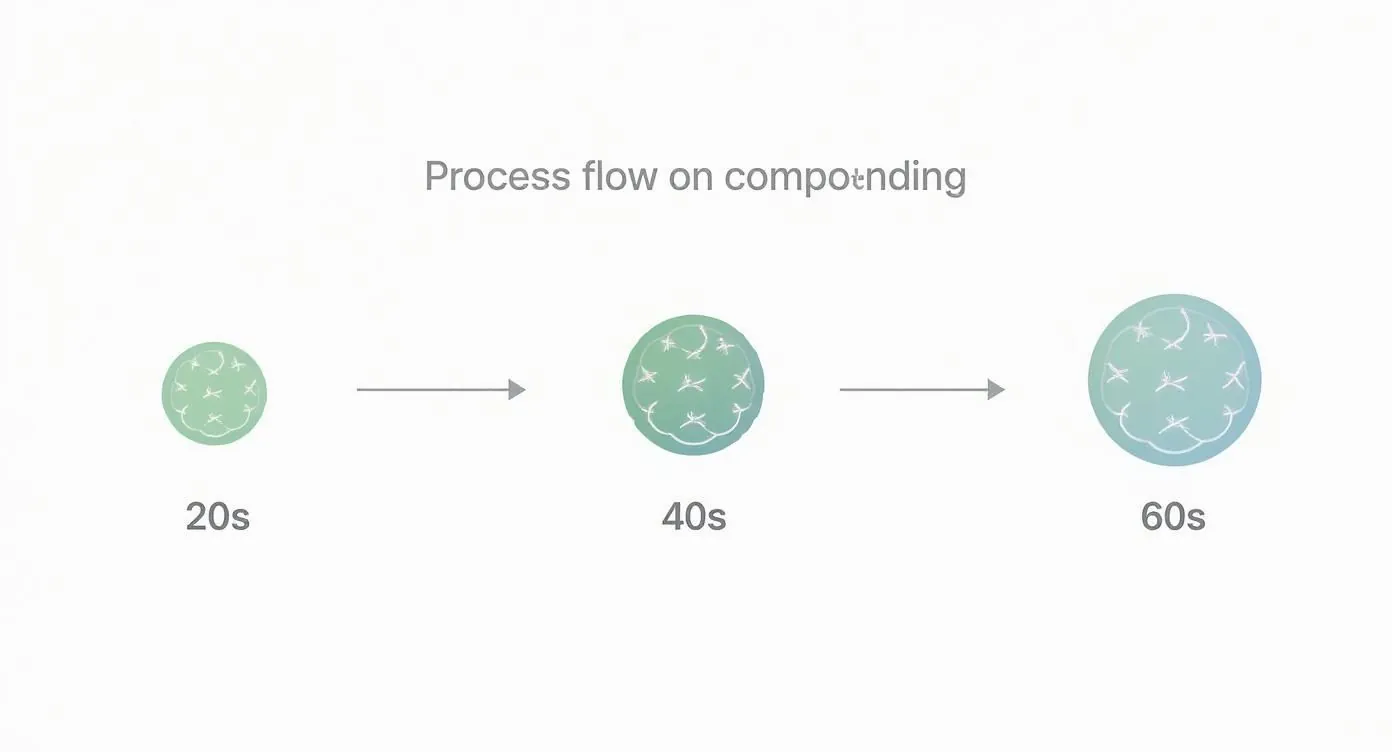
As you can see, the growth isn’t a straight line. It accelerates like crazy in the later decades, which is exactly why starting early is the closest thing to a financial superpower.
Understanding the Hidden Assumptions
Every retirement calculator runs on a set of assumptions working behind the scenes. Knowing what they are helps you plug in more realistic numbers and, ultimately, trust the results you get back.
Most calculators will automatically factor in a few things:
- Inflation: They assume the cost of living will creep up over time, usually around 2-3% per year. This means your future savings goal is shown in today’s dollars, which is much more helpful.
- Salary Growth: Many tools will also assume your salary gets a small bump each year. If you’re a freelancer or your career path is less predictable, you might need to tweak this manually.
By understanding both the inputs you control and the assumptions the calculator makes, you go from being a passive passenger to an active pilot of your own financial future. Once you have a solid projection, you can check out more advanced tools, like a retirement income calculator, to see how that big nest egg actually translates into monthly income.
Remember, a calculator is a forecasting tool, not a crystal ball. Its job is to show you the likely outcome of your current habits, giving you the clarity to make smart adjustments today for a better tomorrow.
The real power here goes beyond seeing a big number. It’s the ability to play “what if.” What happens if I bump my savings rate by 2%? What if I decide to work three more years? Each tweak on the control panel shows you a different potential future, putting you firmly in command.
Putting the Calculator into Practice with Real Scenarios

Theory is one thing, but seeing a retirement savings calculator by age work its magic with real numbers is where the lightbulbs really go off. Abstract ideas like compound interest suddenly become concrete when you apply them to actual people.
To bring this to life, let’s walk through the financial stories of three different people. Each person is at a unique point in their career, with different goals and challenges. By plugging their details into a calculator, we can see just how much today’s decisions can shape their futures.
Meet Maya, The Early Starter
Maya is 25 years old and a few years into her graphic design career. Retirement feels a million miles away, but after seeing some friends get serious about saving, she decides to see where she stands.
Here are Maya’s inputs:
- Current Age: 25
- Annual Salary: $60,000
- Current Savings: $10,000 in a 401(k)
- Monthly Contribution: $500 (10% of her salary)
- Expected Return: 7%
- Retirement Age: 65
The calculator projects that by age 65, Maya will have around $1.8 million. The number is a pleasant shock. It proves that even with a modest start, her greatest asset—four decades of time—is doing all the heavy lifting for her. The snowball effect is well and truly on her side.
Meet Ben, The Mid-Career Catch-Up
Ben is 40, works in logistics management, and has a family and a mortgage. He saved a bit here and there in his 20s and 30s but now feels a real sense of urgency to get his retirement plan on track.
Let’s plug in Ben’s numbers:
- Current Age: 40
- Annual Salary: $90,000
- Current Savings: $75,000
- Monthly Contribution: $750 (10% of his salary)
- Expected Return: 7%
- Retirement Age: 65
For Ben, the calculator shows a projected nest egg of about $995,000. It’s a solid amount, but it’s a lot less than Maya’s, even though he’s earning more and saving more each month. His story is a classic example of the high cost of waiting; with less time on his side, he has to contribute more just to catch up.
The difference between starting at 25 versus 40 goes beyond savings; it’s about lost time. Maya’s investments have an extra 15 years to grow, a period when compounding has its most dramatic effect.
Meet Chloe, The Pre-Retirement Maximizer
Chloe, a seasoned marketing director, is 55. She’s been a diligent saver, but now that her kids are grown, she wants to maximize her final decade of work. This means she can finally funnel a much larger chunk of her income into her retirement accounts.
Here’s what Chloe is working with:
- Current Age: 55
- Annual Salary: $120,000
- Current Savings: $450,000
- Monthly Contribution: $2,250 (a hefty 22.5% of her salary, including catch-up contributions)
- Expected Return: 6% (she’s dialed back the risk as she gets closer to retirement)
- Retirement Age: 65
Chloe’s final projection comes in at just over $1.1 million. Her aggressive savings rate makes a huge impact in these final years. But even with her high income and massive contributions, she barely edges past Ben’s projected total because she only has 10 years left for that money to grow.
Comparing the Scenarios Side-by-Side
Putting these three stories together paints a powerful picture of how age, savings, and time are all tangled together. A quick look at the numbers makes it crystal clear.
Sample Retirement Projections by Age Profile
| Profile | Age | Annual Salary | Current Savings | Monthly Contribution | Projected Savings at 65 | | :— | :-: | :—: | :—: | :—: | :—: | | Maya | 25 | $60,000 | $10,000 | $500 | ~$1,800,000 | | Ben | 40 | $90,000 | $75,000 | $750 | ~$995,000 | | Chloe | 55 | $120,000 | $450,000 | $2,250 | ~$1,100,000 |
These examples prove a timeless piece of advice: the best time to start saving was yesterday, but the next best time is right now. Maya’s story shows the incredible power of an early start. Ben’s journey is a reminder that it’s never too late to get serious, and Chloe’s plan demonstrates how to finish strong. No matter your age, a retirement calculator gives you the roadmap you need to move forward with confidence.
Of course. Here is the rewritten section, crafted to sound completely human-written and natural, following your specific guidelines and examples.
Planning for Real Life Financial Curveballs
Retirement calculators are fantastic tools, but they thrive on clean, predictable numbers. The problem? Life is anything but. Real careers have messy incomes, cross-border moves, and financial surprises that don’t fit neatly into a spreadsheet.
To make your projections genuinely useful, you have to know how to translate your complex reality into the simple inputs a calculator can understand.
A standard calculator loves a steady salary that ticks up a little each year. But for the millions of us who are freelancers, gig workers, or live on commission, that model is a fantasy. Planning with an income that swings up and down requires a totally different mindset.
Don’t just plug in your best month’s earnings—that’s a recipe for overly optimistic, and frankly dangerous, projections. Instead, you need to find a conservative baseline income. Look back over the last year or two and figure out your average monthly take-home pay during your leanest months. Using that lower, more dependable number as your “salary” in the calculator builds in a vital margin of safety.
Managing a Global Nest Egg
Another modern challenge comes from living and working internationally. If you have savings and investments scattered across multiple currencies, a calculator looking at only one account is flying blind. Getting a clear picture means you have to bring it all together.
To get a true reading from a retirement calculator when you have international assets, you’ll need to do a little prep work:
- Standardize Your Currency: Pick one currency to be your home base—usually the one you’ll retire in—and convert all your foreign account balances into it.
- Aggregate Your Contributions: Add up all the money you’re saving across different countries and turn it into a single monthly contribution number, also in your chosen currency.
- Use a Blended Rate of Return: Your assets are likely invested differently from one country to the next. Estimate a weighted average rate of return that reflects how your entire global portfolio is performing.
This bit of homework gives you a unified snapshot of your global net worth, which lets the calculator do its job with far greater accuracy.
By translating your complex financial life into the simple inputs a calculator understands, you transform it from a generic tool into a personalized planning dashboard that reflects your actual circumstances.
Modeling Major Life Events
Your financial journey isn’t a straight line; it’s punctuated by big moments that can either throw you off track or launch you forward. A typical projection doesn’t know what to do with an inheritance, a multi-year break to raise kids, or a massive unexpected medical bill.
The good news is you can still model these scenarios by manually tweaking the calculator’s inputs.
- For an Inheritance or Windfall: Add the lump sum right into your “Current Savings.” You’ll instantly see how it changes your long-term picture for the better.
- For a Planned Career Break: Run a second projection where you set your monthly contributions to zero for the length of the break. This reveals the true cost of that lost time and compounding.
- For a Large Expense: If you have to pull money from your retirement funds, just subtract that amount from your “Current Savings” and rerun the numbers. It will show you the real, long-term impact on your final nest egg.
Life is dynamic, so your financial plan has to be, too. When you learn how to account for fluctuating income, global assets, and major life changes, you turn a simple calculator into a powerful tool that can navigate the real world, keeping your plan resilient and realistic no matter what curveballs come your way.
What to Do If Your Projections Fall Short
Seeing a gap between what you have and what you need in your retirement savings calculator by age can be a jarring moment. It’s easy to feel overwhelmed, but that number isn’t a final grade—it’s a call to action.
Think of it as a financial GPS recalculating your route. Maybe you hit some unexpected detours or traffic. Instead of giving up, you just need to find a new path. A savings shortfall simply means it’s time to adjust your strategy.
The key is to remember that even small, consistent changes can create a massive positive impact over time. It’s never too late to take control and improve your financial trajectory.
The Power of Incremental Increases
One of the most effective ways to get back on track is by increasing your contribution rate, even by just 1% or 2%. It might feel minor in your monthly budget, but the long-term effect of compounding is profound.
Another immediate step? Make sure you’re capturing every dollar of your employer’s 401(k) match. Not contributing enough to get the full match is like turning down a guaranteed return on your investment. It’s the lowest-hanging fruit in retirement planning and should be your first priority.
Leveraging Tax-Advantaged Accounts and Catch-Up Contributions
Beyond your workplace plan, tax-advantaged accounts like a Traditional or Roth IRA can supercharge your savings. These accounts offer significant tax benefits that allow your money to grow more efficiently, helping you make up for lost ground faster.
If you’re over age 50, the government offers a powerful tool called catch-up contributions. This allows you to contribute thousands more to your 401(k) and IRA each year above the standard limits. It’s a fantastic opportunity to make a big dent in your savings gap during your peak earning years.
For a deeper dive, check out our guide on how to catch up on your retirement savings.
A retirement projection shortfall isn’t a sign of failure; it’s a diagnostic tool that reveals exactly where you need to focus your efforts. By taking deliberate action now, you can rewrite your financial future.
It also helps to have some context. In 2025, the average 401(k) balance for Americans is about $134,128, with savers in their 60s holding nearly $239,900. While these numbers show the power of long-term saving, they also hide disparities—for example, women often have significantly lower balances due to wage gaps and career breaks.
Understanding these national trends can help contextualize your own position and reinforce the importance of a solid plan.
If your projections show you might fall short, seeking guidance from professional retirement planning services can provide tailored strategies and support. They can analyze your situation, identify opportunities, and build a realistic roadmap to get you where you need to be.
Common Questions About Retirement Savings Calculators
Using a retirement savings calculator often brings up a few good questions. While these tools are incredibly helpful, it’s smart to understand their assumptions and limitations before you start making big financial moves. Let’s clear up some of the most common uncertainties.
How Accurate Are These Calculators?
Think of a retirement calculator as a compass, not a GPS. It points you in the right general direction but doesn’t map out every single turn of the road ahead.
Its accuracy is only as good as the numbers you put in and the assumptions it makes about things like future market returns and inflation. At its core, a calculator is a powerful estimation tool designed to model your financial future based on your habits today.
What Is a Safe Rate of Return to Assume?
This is a big one, and it dramatically influences your final projection. While no one can predict the future, assuming an average annual return between 5% and 7% for a diversified portfolio is a common—and reasonably conservative—approach.
This range gives you a shot at long-term growth while still accounting for inflation. Plugging in a lower number builds a bigger safety net, while a higher one might be too optimistic and leave you with a shortfall down the line.
Remember, the goal isn’t to perfectly time the market but to build a realistic plan. A conservative estimate forces you to save more diligently, creating a buffer against inevitable market swings.
Should I Include My Home Equity?
It’s tempting to lump your home’s value into your nest egg, but it’s usually best to leave your primary residence out of the equation.
Why? Your home isn’t a liquid asset—you can’t easily spend it—and you’ll always need a place to live. Calculating your retirement savings without it gives you a much clearer picture of the actual funds you’ll have available to cover day-to-day living expenses.
How Often Should I Re-evaluate My Plan?
Life is anything but static, and your retirement plan shouldn’t be either. Make it a habit to check in on your plan and run the numbers through a calculator at least once a year.
You should also recalculate anytime a major life event happens, like a big promotion, a job change, or getting married. This keeps your plan grounded in reality and aligned with where you are right now.
Ready to stop guessing and start tracking your progress with precision? PopaDex gives you a complete, real-time view of your entire financial world in one simple dashboard. Take control of your retirement plan today by visiting https://popadex.com.