
Our Marketing Team at PopaDex
A Guide to Savings Account Interest Rate Comparison
A real savings account interest rate comparison goes way beyond the flashy number on the homepage. To find the best account, you need to dig into the Annual Percentage Yield (APY), see how often the interest compounds, and sniff out any hidden fees. It’s all about balancing a high APY with low (or no) fees to make sure your money is actually growing.
Decoding Savings Account Interest Rates
Jumping into a savings account comparison is one of the smartest moves you can make for your money. That headline rate is a great starting point, but it never tells the whole story. A proper comparison means getting into the weeds of how your interest is actually calculated and what could chip away at your returns.
This is more critical than ever, with interest rates constantly on the move. Big economic shifts and central bank decisions can change things fast. For example, between June 2020 and June 2021, the average one-year CD rate bottomed out at just 0.17% APY thanks to the Federal Reserve’s pandemic policies. Fast forward to January 2026, and after a series of rate hikes, that average shot up to 1.9% APY, with the top banks offering over 4.25% APY. That massive gap proves why shopping around is so essential.
Key Metrics for a Real Comparison
To do a meaningful analysis, you have to look past the marketing. A tiny difference in how interest is calculated or what fees are charged can make a huge difference to your long-term growth.
Here are the non-negotiables to check:
- Annual Percentage Yield (APY): This is your most important number. APY shows the total interest you’ll earn in a year, including the effect of compounding. It’s the true measure of your potential earnings.
- Compounding Frequency: This is how often interest is calculated and added back into your account. More frequent compounding—say, daily instead of monthly—means your money grows faster because you start earning interest on your interest sooner. We dive deep into this concept in our guide to understanding compound interest.
- Account Fees: Monthly maintenance fees, penalties for dropping below a minimum balance, or charges for too many withdrawals can completely wipe out your interest gains. An account with a slightly lower APY but zero fees often ends up being the better deal.
APY vs. APR: The Critical Difference
It’s easy to mix up APY and Annual Percentage Rate (APR), but they’re worlds apart. APR is for borrowing—it’s the annual cost of a loan. APY is for saving—it represents what you earn.
When you’re looking at savings accounts, APY is the only metric that matters. It’s the universal standard that lets you make a true apples-to-apples comparison between banks because it already has the power of compounding baked in.
This table breaks it down.
| Metric | Primary Use | Includes Compounding? | Best For |
|---|---|---|---|
| APY | Savings & Investments | Yes | Comparing how much you’ll earn |
| APR | Loans & Credit | No | Comparing how much you’ll pay |
When you’re shopping around for a savings account, that big, bold interest rate is designed to grab your attention. But to figure out which account will actually make your money grow the fastest, you need to look past the headline number.
It really comes down to three things that work together: the Annual Percentage Yield (APY), how often that interest compounds, and the sneaky fees that can eat away at your returns. Getting a handle on these will show you the real rate of return you can expect.
First things first, let’s clear up a common mix-up: APR vs. APY. Think of APR (Annual Percentage Rate) as the simple, flat interest rate. But APY is what you actually earn in a year because it accounts for compounding—the interest you earn on your interest. This makes APY the only number that matters for an apples-to-apples comparison.
For instance, two banks might offer a 4.00% rate (APR). But if one compounds your interest daily and the other only does it monthly, their APYs will be slightly different. The account with daily compounding gives you a tiny edge because your money starts earning more, sooner.
APY vs APR Impact of Compounding Frequency
The magic of compounding is all about frequency. The more often interest is calculated and added to your balance, the harder your money works for you. This table shows exactly why looking at the APY, not just the APR, is so crucial. A 5.00% APR can lead to different outcomes depending on how often the bank runs the numbers.
| Principal Amount | Nominal APR | Compounding Frequency | End-of-Year APY | Total Interest Earned |
|---|---|---|---|---|
| $10,000 | 5.00% | Annually | 5.000% | $500.00 |
| $10,000 | 5.00% | Quarterly | 5.095% | $509.45 |
| $10,000 | 5.00% | Monthly | 5.116% | $511.62 |
| $10,000 | 5.00% | Daily | 5.127% | $512.67 |
As you can see, daily compounding squeezes out the most earnings from the same initial APR. While the difference might look small over one year, it adds up significantly over time, especially with a larger balance.
How Compounding Frequency Accelerates Growth
Let’s zoom in on a real-world example to see why this matters. The difference between daily and monthly compounding might not seem like a big deal, but it’s a subtle advantage that costs you nothing.
Imagine you have $10,000 to deposit:
- Account A: 4.5% APR, compounded monthly.
- Account B: 4.5% APR, compounded daily.
After a year, Account A gives you an APY of 4.59%, earning $459.40. Meanwhile, Account B’s daily compounding results in a slightly higher APY of 4.60%, putting $460.25 in your pocket. A difference of less than a dollar might feel trivial, but why leave money on the table? This gap only gets wider with bigger deposits and over longer periods.
The takeaway is simple: When comparing accounts with identical rates, always go for the one with more frequent compounding. You’re just letting math do the heavy lifting for you.
The Hidden Impact of Account Fees
A fantastic APY is worthless if it’s being quietly drained by fees. A great savings account comparison isn’t complete until you’ve checked the fine print for any charges that could sabotage your earnings. That flashy 5.00% APY won’t do you much good if you’re paying a $10 monthly fee on a modest balance.
Keep an eye out for these common culprits:
- Monthly Maintenance Fees: Often waived if you keep your balance above a certain threshold, but not always.
- Excessive Withdrawal Fees: Penalties for taking your money out too many times in a month.
- Overdraft Fees: Charges for transactions that push your balance into the negative.
- Account Closure Fees: Some banks charge you for closing an account too soon after opening it.
Let’s run the numbers. Say you put $5,000 into an account with a 4.80% APY. You’d expect to make about $240 in interest for the year. But if there’s a $10 monthly fee you can’t avoid, that’s $120 gone. Your effective return just got cut in half, leaving you with only $120, or a real yield of just 2.40%.
In that scenario, you would have been much better off with a fee-free account offering a lower 3.50% APY. To find options that blend high rates with zero monthly fees, check out our guide to the best high-yield savings accounts.
The final step is always to calculate your true return: subtract the total annual fees from your expected interest. That final number is the only one that really matters.
Navigating Global Interest Rates and Multi-Currency Accounts
Taking your savings strategy beyond your home country can open up some serious opportunities. This is especially true for expats, global investors, or really anyone looking to add some diversification to their portfolio. A huge part of comparing global savings accounts is realizing that central bank policies create massive differences in interest rates from one country to the next. If you know where to look, this gap offers a clear path to higher returns.
But jumping into multi-currency savings isn’t just about chasing the highest rate you can find. It’s a balancing act. You have to weigh the potential rewards against the very real risks, like currency swings and local inflation, which can eat away at your gains before you even notice. This is where having a single, unified view of your finances becomes absolutely essential.
Understanding Global Rate Differentials
A country’s economic climate directly shapes its central bank’s interest rate policy, which leads to some pretty stark contrasts across the globe. For example, as of late 2025 and early 2026, you’d see developing markets setting much higher rates to fight inflation. Turkey’s policy rate was a massive 38.00%, while Brazil and Russia held strong at 15.00% and 16.50%.
Meanwhile, developed economies were playing a different game. The U.S. was at 3.50-3.75%, the UK at 3.75%, and the European Central Bank was hovering at just 2.00%. These numbers show just how much your potential earnings can vary depending on which currency you’re holding.
This infographic breaks down the core ideas that drive savings growth, showing how APY, compounding, and fees all play their part.
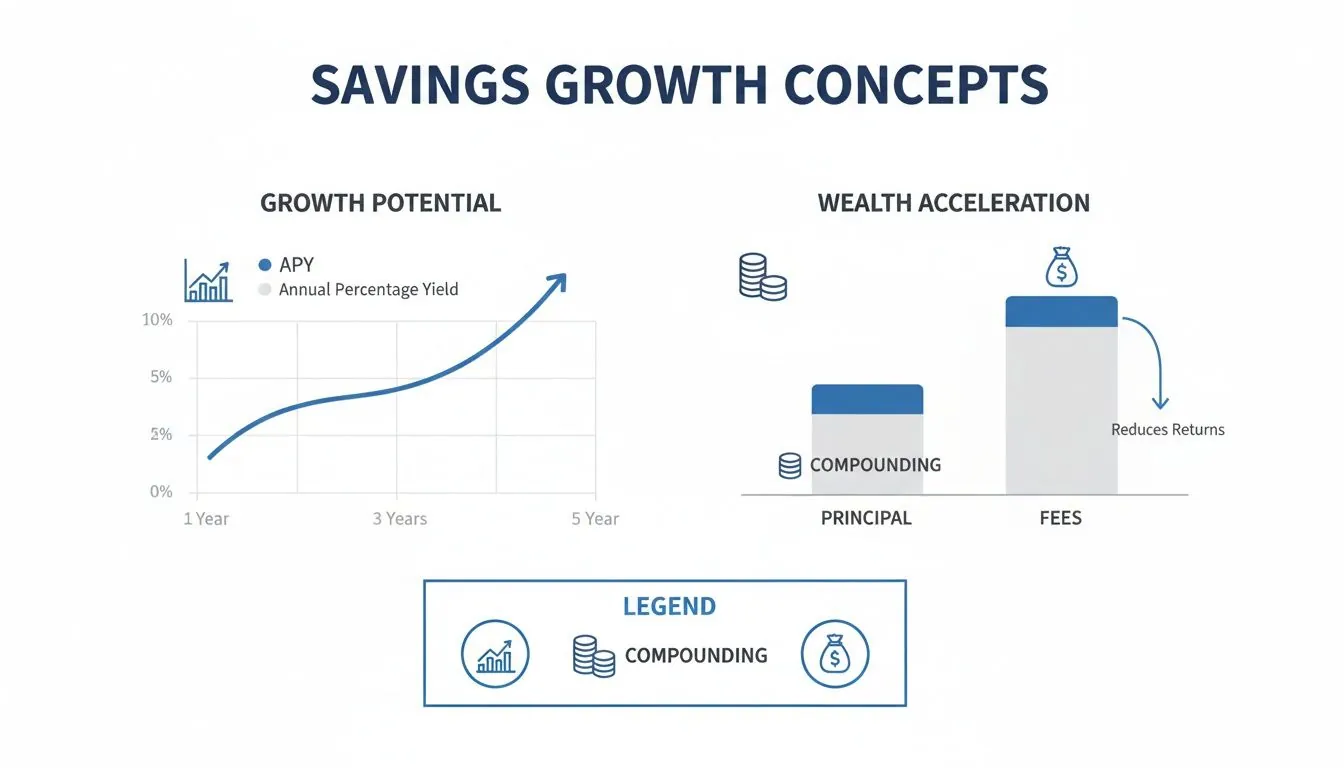
As you can see, a high APY and frequent compounding are a powerful duo for accelerating wealth. On the flip side, fees are a direct drag on your progress.
The Risk and Reward of Multi-Currency Savings
Parking your savings in a high-interest currency sounds great on paper, but it comes with one major catch: currency risk. If the foreign currency you’re holding weakens against your home currency, it could completely wipe out all the interest you earned when you decide to convert it back.
A sky-high interest rate in another country is often a red flag for high inflation or economic instability. Your real return—the interest you earn minus inflation and currency depreciation—is the only number that truly matters for growing your wealth.
Let’s walk through a quick example:
- Scenario: You deposit the equivalent of $10,000 into a Turkish Lira (TRY) account that’s offering a hypothetical 30% APY.
- Potential Gain: You stand to earn 3,000 TRY in interest. Looks good so far.
- Potential Risk: But what if the Lira drops 25% against the US Dollar that year? Your original deposit plus the interest you earned would actually be worth less in USD than what you started with.
This is exactly why seeing the whole picture is so important. For anyone looking to hold funds in a more stable foreign currency to hedge against local volatility, it’s worth learning about options like how to open a dollar account in South Africa.
Centralizing Your Global Financial View
Juggling different accounts in different currencies—each with its own interest rate, fee structure, and performance—gets messy, fast. Without a central dashboard, it’s almost impossible to compare global savings accounts effectively or get an accurate read on your true net worth.
A platform like PopaDex cuts through the chaos by pulling all your assets, including multi-currency bank accounts, into a single view. When you can see your entire portfolio in one place, you instantly know which accounts are pulling their weight and which are falling behind, all while factoring in currency conversions. This kind of clarity is what you need to make smart decisions about where to put your money for the best risk-adjusted returns. To get a better handle on managing diverse financial holdings, check out our guide on multi-currency accounting.
Choosing the Right Account for Your Financial Goals
Picking a savings account isn’t just about chasing the highest interest rate. It’s about matching an account to your real life. The perfect account for a young professional stashing away an emergency fund is almost never the right fit for a retiree who needs stable income, or an expat juggling finances across different countries. Your personal goals should be the filter you use to decide what really matters.
Forget generic advice. The key is to think in scenarios. Once you know which financial “persona” you are right now, you can zero in on the features that count—whether that’s instant access to your cash, a fixed rate you can depend on, or the ability to hold multiple currencies. This is how you make a choice that actually works for you, not just one that looks good on a comparison chart.
The Emergency Fund Builder: Young Professional
If you’re a young professional building your first real emergency fund, two things matter above all else: liquidity and a competitive interest rate with zero funny business. You’re growing a safety net, and it needs to be ready the moment you need it, without any penalties.
A high-yield savings account (HYSA) is your best friend here. These accounts, mostly offered by online banks, deliver strong APYs and let you pull out your money whenever life throws a curveball. Unlike a Certificate of Deposit (CD), your cash isn’t locked up.
Here’s what to look for:
- No monthly maintenance fees: Fees will eat up your interest earnings fast, especially when your balance is still growing.
- Low or no minimum balance requirements: You should be able to start saving with whatever you have, no questions asked.
- Slick digital access: A good mobile app is non-negotiable. When an emergency strikes, you need to be able to transfer funds to your checking account instantly.
In this case, a slightly lower APY at a bank with no fees and a great app is a much smarter move than the absolute highest rate that comes with a bunch of strings attached. Your goal is to build a buffer, and easy access is everything.
The Income-Focused Retiree
A retiree’s priorities are completely different. The game shifts from aggressive growth to stability and predictable income. The goal is to make your savings work for you, generating a reliable return to supplement your retirement income without exposing your hard-earned principal to market swings.
For this stage of life, the focus should be on products with fixed rates and guaranteed returns. While an HYSA is great for holding cash for day-to-day expenses, Certificates of Deposit (CDs) usually take center stage.
A retiree’s ideal account provides a locked-in interest rate that won’t fluctuate with market conditions. This predictability is crucial for budgeting and ensures a steady stream of income, making CDs or fixed-rate savings products a cornerstone of their financial plan.
CDs let you lock in an interest rate for a specific term, from a few months to several years. You trade liquidity for certainty—something a variable-rate HYSA can’t offer. Many retirees build a “CD ladder,” staggering the maturity dates of several CDs to make sure a portion of their savings becomes available at regular intervals.
The Global Expat
Expats and global citizens operate in a different world. They’re managing money in multiple currencies, dealing with international banks, and trying to avoid getting crushed by fees. Their savings strategy has to be built around multi-currency support and a clear, consolidated view of their finances.
The best account for an expat is often one that can hold balances in several major currencies. This helps minimize conversion fees and provides a hedge against wild swings in exchange rates. Finding one bank that pays high interest on all currencies is next to impossible, so the real goal is finding a platform that makes it easy to manage everything in one place.
This is where a net worth aggregator like PopaDex becomes essential. It lets you pull all your disparate accounts into a single dashboard, giving you a true apples-to-apples comparison of how your money is performing, no matter where in the world it is.
Putting Your Savings Strategy into Action with PopaDex
Theory is great, but actually putting your money where it will grow is what counts. A tool like PopaDex is designed to bridge that gap, turning a jumble of data from different accounts into a single, clear dashboard. This is how you shift from just saving money to actively managing its growth.
By pulling all your domestic and international accounts into one place, you can finally run a real side-by-side comparison. It’s not just about chasing the highest APY—it’s about seeing your entire financial world in real time, from the interest you’re earning to how your net worth is trending.
Get All Your Finances in One Place
Getting set up is simple. PopaDex gives you two ways to start, designed for different financial setups, so anyone can get a handle on their money.
- The Manual Plan: Perfect if you’re just starting or have a handful of accounts. You can manually enter the data from your savings accounts to get a centralized view without connecting any bank credentials.
- The Automated Plan: Built for people with more complex, multi-currency finances. This plan securely syncs with over 15,000 banks to automatically pull in your balances and performance data. It saves time and keeps everything perfectly up to date.
No matter which path you take, the result is the same: clarity. Forget switching between five different banking apps or trying to recall which account has the best rate. It’s all right there, ready for you to analyze.
This preview of the PopaDex dashboard shows how a consolidated view can organize your financial life, laying out your assets, liabilities, and net worth.
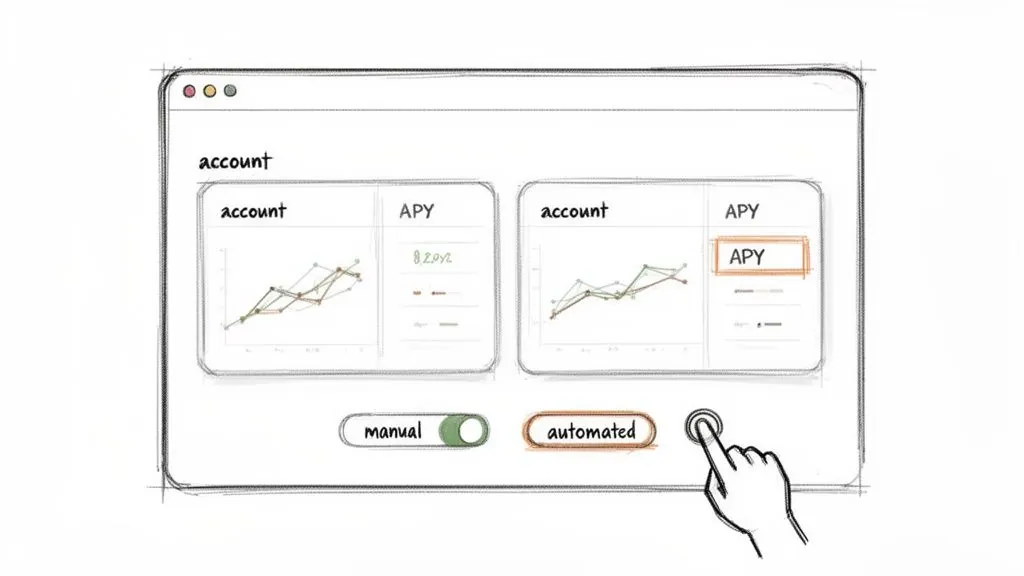
The real magic here is being able to instantly see how each account is contributing to your overall wealth. Underperformers have nowhere to hide.
Turn That Insight into Action
A consolidated dashboard is more than just a nice-looking chart; it’s a tool for making decisions. Once your accounts are all in one spot, you can run a much more effective savings account interest rate comparison.
With all your accounts displayed together, you can quickly identify which ones are lagging behind current market rates. This visibility empowers you to act decisively—whether that means moving funds to a higher-yield account or renegotiating terms with your current bank.
Let’s say you glance at your dashboard and notice your primary savings account is still plodding along at 1.5% APY, while a secondary one you opened last year is hitting 4.5% APY. Without a unified view, you could miss that difference for months, leaving money on the table. With PopaDex, that insight is instant.
This kind of proactive management makes your savings strategy a living, breathing process. You can track your interest earned each month, see how rate changes impact your bottom line, and make smart moves based on hard data. It’s the difference between letting your money sit and making it work for you.
Reading the Tea Leaves: Historical and Future Rate Trends
To really get the upper hand when comparing savings accounts, you have to look beyond today’s numbers. Interest rates aren’t set in stone; they breathe with the global economy, rising and falling based on decisions made by central banks. Peeking at the past gives you critical context for why rates are what they are now—and where they might be headed.
The old strategy of just stashing cash in a local bank and expecting it to grow is a relic of the past. Today, you need to be an active participant in managing your money, and that starts with understanding these larger economic currents.
The Long Winter of Low Returns
For anyone saving in a developed economy over the past couple of decades, it’s been a tough slog. If you look at the data, you’ll see a steady, grinding decline in interest rates, mostly a reaction to major financial crises.
The aftermath of the 2008 financial meltdown is the perfect example. In 2009, the average savings account APY was a paltry 0.21%. By 2011, it had dropped even further to just 0.11%. This wasn’t an accident; central banks deliberately kept rates near zero to get people borrowing and spending again. But for savers, it meant your money was essentially sitting stagnant. You can dig into the history of savings account rates on Nasdaq.com to see the full picture.
This wasn’t just a blip on the radar. Over the last 25 years, real interest rates across the globe sank to lows we hadn’t seen since the 1960s. This signals a deep shift in how savings and investment work, making it clear that a hands-off approach just doesn’t cut it anymore.
Gearing Up for the Next Shift
History teaches us one thing loud and clear: what goes down must eventually come up (and vice versa). After a long stretch of low rates, central banks will hike them to fight inflation—a cycle we’ve seen play out recently. When the economy sputters, they’ll cut them again to kickstart growth. Getting a feel for this rhythm is your secret weapon.
Once you accept that interest rates are always in motion, you can stop being a passive saver and start being a strategic one. It’s about being ready to move your money when a better opportunity pops up.
This is where a tool like a PopaDex net worth aggregator becomes indispensable. That historical perspective proves that a “set it and forget it” mindset will actively cost you money, eroding your purchasing power over time. When you can see all your accounts in one dashboard, you can spot rate changes instantly and act fast, ensuring your cash is always pulling its weight in an ever-changing economy.
Common Questions Answered
Even after getting the hang of comparing savings accounts, some specific questions always seem to pop up. Let’s tackle them head-on. Think of this as a quick-fire round to clear up any lingering doubts before you put your money to work.
How Often Should I Compare Savings Account Rates?
For your high-yield savings accounts, a quarterly check-in is a great rhythm to get into. Rates on these accounts, especially from online banks, can change pretty quickly in response to central bank moves. A quick savings account interest rate comparison every three months ensures you’re not missing out on a better return somewhere else.
When it comes to fixed-rate products like CDs, you only need to shop around as they near their maturity date. This is where a good financial tracker really helps—it puts all your account performances on one screen, making it dead simple to spot an underperformer and decide what to do next.
Are Online-Only Banks Safe for High-Yield Savings?
Absolutely, as long as they are properly insured. In the United States, you should never put your money in an account that isn’t covered by FDIC insurance. This protects your deposits up to $250,000 per person, per bank. In Europe, the equivalent is a national Deposit Guarantee Scheme (DGS), which typically covers up to €100,000.
The reason online banks can offer such great rates is simple: they don’t have the massive overhead of brick-and-mortar branches. As long as you confirm they’re insured, their safety is right on par with the big traditional banks.
They pass those operational savings on to you in the form of higher APYs. It’s a win-win.
High-Yield Savings vs. Money Market Account
Both are solid, safe options for earning interest, but they’re designed for slightly different jobs. Your best choice really boils down to what you need the money for.
- High-Yield Savings Accounts (HYSAs): These are pure savings vehicles. They’re built for one thing: growing your money. You’ll usually find the best interest rates here, but with limited ways to access your cash.
- Money Market Accounts (MMAs): Think of these as a hybrid between a savings and a checking account. They often come with a debit card or check-writing privileges, giving you much easier access to your funds.
If your main goal is to get the highest possible return on cash you won’t need to touch often, the HYSA is almost always the winner. But if you’re building a large emergency fund and want the flexibility to access it quickly without transferring it first, an MMA can be the smarter play, even if it means sacrificing a fraction of a percentage point in interest.
Ready to see all your accounts in one place and make smarter financial decisions? PopaDex provides the clarity you need to track your net worth, compare account performance, and take control of your savings strategy. Start your free trial today.