
Our Marketing Team at PopaDex
10 Tax Efficient Investing Strategies to Build Wealth in 2026
Investing is about growing your wealth, but it’s the wealth you keep that truly matters. Taxes are one of the most significant, yet often overlooked, drags on investment returns. Without a clear plan, they can silently erode your hard-earned gains year after year, significantly slowing your progress toward long-term financial goals.
Fortunately, you can take control. By adopting a proactive approach, you can transform your portfolio from a tax liability into a tax-optimized engine for growth. This is where mastering tax efficient investing strategies becomes a critical component of any successful financial plan. A well-structured strategy doesn’t just save you money in the short term; it compounds those savings over decades, potentially adding tens or even hundreds of thousands of dollars to your net worth.
This guide moves beyond generic advice to provide a comprehensive roundup of 10 powerful techniques. We will break down each strategy with actionable steps, real-world examples, and specific calculations to show you exactly how to implement them.
You will learn how to:
- Harvest losses to offset gains and reduce your taxable income.
- Strategically locate assets across different account types to shelter growth.
- Manage capital gains and optimize withdrawal sequences in retirement.
Whether you’re a seasoned investor in the US or an expat managing finances across borders, these strategies will equip you to minimize your tax burden and accelerate your journey to financial independence. We’ll also explore how a consolidated tracking tool like PopaDex can be your secret weapon in executing these plans with precision and confidence.
1. Tax-Loss Harvesting
Tax-loss harvesting is a powerful technique for lowering your tax bill by strategically selling investments that have decreased in value. This process allows you to realize a capital loss, which can then be used to offset capital gains from other, more profitable investments in your portfolio. It’s a proactive way to turn market downturns into tax-saving opportunities.
The core principle is simple: if you have a stock that has lost value, selling it creates a “realized loss.” This loss can cancel out an equivalent amount of realized gains, effectively reducing your taxable income. This is one of the most direct and impactful tax efficient investing strategies available to investors.
When and Why to Use This Strategy
Tax-loss harvesting is most effective in non-retirement brokerage accounts where capital gains are taxed annually. It is particularly valuable during periods of market volatility or when rebalancing your portfolio. If you have realized significant gains in a given year, harvesting losses can be a crucial step to manage your tax liability.
In the U.S., you can use losses to offset an unlimited amount of capital gains. If your losses exceed your gains, you can use up to $3,000 of the excess loss to offset your ordinary income, with any remainder carried forward to future tax years.
Real-World Example
Imagine an investor sells a profitable real estate investment trust (REIT) and realizes a $10,000 capital gain. In the same year, their technology stock portfolio has an unrealized loss of $8,000. By selling the declining tech stocks, they can “harvest” that $8,000 loss.
- Capital Gains: +$10,000
- Harvested Losses: -$8,000
- Net Taxable Gain: $2,000
The investor now only pays capital gains tax on $2,000 instead of the full $10,000.
Actionable Implementation Steps
- Identify Losses: Regularly review your portfolio to identify assets trading below your purchase price.
- Sell the Asset: Execute the sale to “realize” the loss for tax purposes.
- Avoid the Wash Sale Rule: Do not purchase the same or a “substantially identical” security within 30 days before or after the sale. To maintain market exposure, consider buying a similar but not identical investment, such as a different ETF that tracks the same index.
- Track and Report: Keep meticulous records of all transactions. Report the gains and losses on your tax return (e.g., Schedule D in the U.S.).
For international investors, PopaDex can be invaluable. Its multi-currency support helps you track unrealized gains and losses across different countries, making it easier to identify global harvesting opportunities.
2. Tax-Advantaged Retirement Account Maximization
Maximizing contributions to tax-advantaged retirement accounts is one of the most foundational and powerful tax efficient investing strategies available. Accounts like a 401(k), Traditional IRA, Roth IRA, or international equivalents such as Canada’s RRSP or the UK’s ISA, are specifically designed by governments to offer significant tax breaks. These benefits typically include tax-deductible contributions, tax-deferred growth, or entirely tax-free withdrawals in retirement.
By consistently contributing the maximum amount allowed, you significantly lower your lifetime tax burden. For example, contributions to a traditional 401(k) or IRA reduce your taxable income in the present, while the investments within grow without being taxed annually on dividends or capital gains. This allows your wealth to compound more rapidly over time.
When and Why to Use This Strategy
This strategy is essential for anyone saving for retirement, regardless of age or income level. It is most impactful when started early in your career, as the long-term effects of tax-free or tax-deferred compounding are immense. At a minimum, you should contribute enough to your employer-sponsored plan, like a 401(k), to receive the full employer match, which is effectively a guaranteed return on your investment.
These accounts are the first place you should allocate savings before investing in a standard taxable brokerage account. For 2024, the U.S. contribution limits are $23,000 for 401(k)s and $7,000 for IRAs, with catch-up contributions available for those over 50.
Real-World Example
A young professional with a 25% marginal tax rate contributes the maximum $23,000 to their 401(k). This contribution directly reduces their taxable income for the year.
- Taxable Income Reduction: $23,000
- Marginal Tax Rate: 25%
- Immediate Tax Savings: $23,000 * 0.25 = $5,750
This investor instantly saves $5,750 on their annual tax bill, all while building a nest egg that grows tax-deferred until retirement.
Actionable Implementation Steps
- Prioritize the Employer Match: If your employer offers a 401(k) match, contribute at least enough to capture the full amount.
- Automate Contributions: Set up automatic contributions from your paycheck to ensure you consistently invest without having to think about it.
- Aim for the Max: After securing the match, work toward maxing out your annual contribution limits if your budget allows.
- Choose the Right Account: Decide between pre-tax (Traditional) and post-tax (Roth) accounts based on your current versus expected future income. To understand the key differences, you can explore the pros and cons of Roth vs. Traditional IRAs.
- Leverage Self-Employed Options: If you are self-employed, open a SEP-IRA or Solo 401(k) to save significantly more than standard IRA limits.
For international investors, PopaDex helps you track contribution limits and balances across accounts in different countries, such as an RRSP in Canada and an IRA in the U.S., providing a unified view for comprehensive global tax planning.
3. Strategic Asset Location (Asset Placement Strategy)
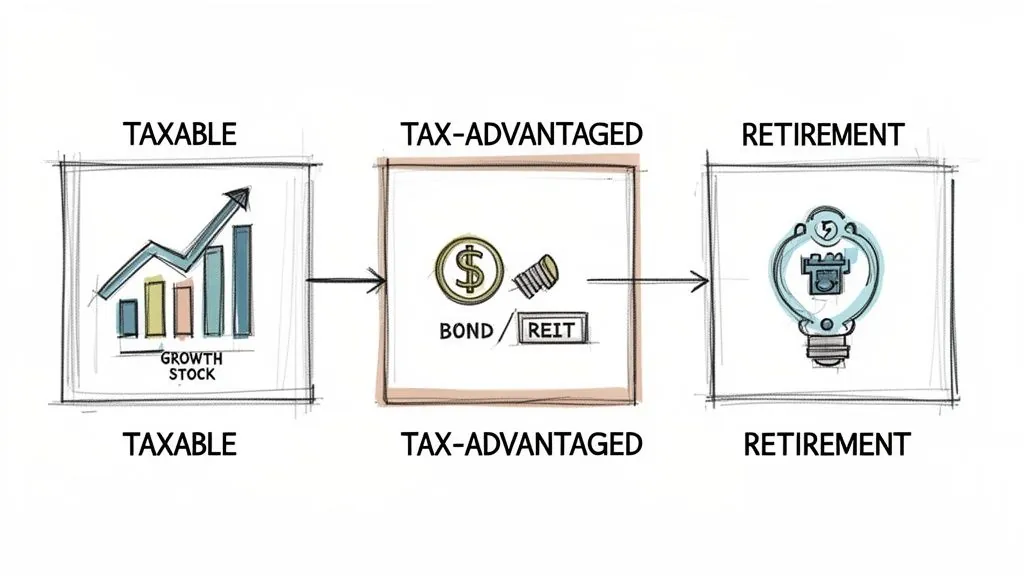
Strategic asset location is the practice of placing specific types of investments into the accounts that offer the best tax treatment for them. Instead of holding the same asset mix in every account, you optimize your portfolio’s after-tax returns by placing tax-inefficient assets in tax-advantaged accounts and tax-efficient assets in taxable accounts. This is one of the most powerful long-term tax efficient investing strategies for maximizing your net worth.
The core principle is to shield assets that generate high annual taxes, like bonds and REITs, inside retirement or tax-free accounts (like a 401(k) or Roth IRA). Meanwhile, assets that generate low or no annual taxes, such as growth stocks or low-turnover index funds, are better suited for taxable brokerage accounts, where you can control when gains are realized and benefit from lower long-term capital gains rates.
When and Why to Use This Strategy
This strategy is essential for any investor with multiple account types, such as a taxable brokerage account, a 401(k), and a Roth IRA. It becomes increasingly impactful as your portfolio grows and your tax-inefficient holdings, like bonds, make up a larger portion of your allocation. The goal is to minimize the annual tax drag on your portfolio’s overall growth, which can improve returns by 0.5-1% annually over the long term.
By correctly placing assets, you ensure that income-producing investments grow tax-deferred or tax-free, while capital-appreciation investments in taxable accounts can benefit from the step-up in basis for heirs, a significant estate planning advantage.
Real-World Example
An investor aims for a 90% stock and 10% bond allocation across their $500,000 portfolio. They have a $450,000 taxable brokerage account and a $50,000 Roth IRA.
- Inefficient Location: Holding a 90/10 split in both accounts. The bonds in the taxable account would generate taxable interest income each year.
- Strategic Location: The investor places their entire $50,000 bond allocation (10%) in their Roth IRA. They hold the entire $450,000 stock allocation (90%) in their taxable account.
Now, all bond interest grows completely tax-free inside the Roth IRA, while the stocks in the taxable account only generate taxes when sold.
Actionable Implementation Steps
- Map Your Accounts: Get a complete overview of all your investments across all accounts (taxable, 401(k), IRA, ISA, etc.).
- Categorize Your Assets: Classify each investment by its tax efficiency. Bonds, REITs, and high-dividend funds are tax-inefficient. Growth stocks and broad-market index funds are tax-efficient.
- Place Inefficient Assets First: Prioritize moving your most tax-inefficient assets into your tax-advantaged accounts like your 401(k) or IRA until they are full.
- Place Efficient Assets Last: Hold your most tax-efficient assets in your taxable brokerage accounts.
- Review Annually: Revisit your asset location during your annual portfolio rebalancing to ensure it remains optimized.
For international investors, PopaDex is an ideal tool. Its consolidated view helps you map and optimize asset location across accounts in different countries and currencies, like placing high-dividend UK stocks in an ISA while holding U.S. growth stocks in a taxable account.
4. Dividend Tax Management and Qualified Dividend Strategy
Managing the tax impact of dividend income is a crucial component of tax efficient investing strategies. This approach focuses on ensuring your dividend income is classified as “qualified,” which allows it to be taxed at the more favorable long-term capital gains rates (0%, 15%, or 20%) instead of at your higher ordinary income tax rates (which can be as high as 37% in the U.S.).
The core principle involves meeting specific holding period requirements for dividend-paying stocks. By strategically timing your purchases and sales around key dividend dates, you can significantly reduce the tax paid on your investment income. This is especially impactful for investors who rely on dividend-paying stocks for a steady income stream.
When and Why to Use This Strategy
This strategy is essential for investors holding dividend-paying stocks or ETFs in taxable brokerage accounts. The goal is to avoid having your dividends taxed as ordinary income, which can dramatically erode your net returns. It’s particularly relevant for high-income earners who would otherwise face the highest marginal tax rates on their investment income.
To qualify for the lower tax rates in the U.S., you must hold the stock for more than 60 days during the 121-day period that begins 60 days before the ex-dividend date. Meeting this requirement transforms potentially high-tax income into a much more manageable liability.
Real-World Example
Imagine an investor in the 32% tax bracket receives $10,000 in dividends. If these dividends are non-qualified, they would owe $3,200 in taxes. However, by ensuring the holding period requirements are met, the dividends become qualified.
- Non-Qualified Dividend Tax (32%): $10,000 x 0.32 = $3,200
- Qualified Dividend Tax (15%): $10,000 x 0.15 = $1,500
- Tax Savings: $1,700
By simply managing the purchase and holding timeline, the investor saves $1,700.
Actionable Implementation Steps
- Identify Key Dates: Before purchasing a dividend stock, note its ex-dividend date. This is the cutoff date for being entitled to the next dividend payment.
- Plan Your Holding Period: Ensure you purchase the stock at least 61 days before the ex-dividend date or hold it long enough to satisfy the 60-day requirement within the 121-day window.
- Avoid Short-Term Trading: Refrain from buying a stock just before its ex-dividend date and selling it immediately after. This short-term activity will likely result in non-qualified dividends.
- Track and Document: Keep detailed records of purchase dates, sale dates, and ex-dividend dates for all your dividend-paying assets to verify their qualified status.
For expats managing global portfolios, PopaDex simplifies this process by allowing you to track purchase dates and dividend information across different countries, helping you manage qualified dividend requirements in multiple jurisdictions.
5. Index Fund and Low-Turnover Strategy
Adopting a low-turnover strategy through index fund investing is a foundational element of tax-efficient portfolio management. Unlike actively managed funds that frequently buy and sell securities, index funds passively track a market benchmark, such as the S&P 500. This minimal trading activity, known as low turnover, results in far fewer taxable events and capital gains distributions for investors.
The core principle is to reduce the “tax drag” on your returns. Actively managed funds often have portfolio turnover rates exceeding 50% annually, which generates frequent capital gains that are passed on to you. In contrast, broad-market index funds typically have turnover rates below 5%. This difference makes them a cornerstone of long-term, tax efficient investing strategies.
When and Why to Use This Strategy
This strategy is ideal for the core of any long-term investor’s portfolio, especially within taxable brokerage accounts where capital gains distributions are taxed annually. It is particularly effective for young professionals building wealth and anyone seeking a simple, low-cost, and hands-off approach to growing their investments over decades.
By minimizing taxable events, you allow your capital to compound more effectively over time. The combination of lower taxes and significantly lower expense ratios (often below 0.10% for index funds versus 1-2% for active funds) creates a powerful advantage for wealth accumulation.
Real-World Example
Consider an investor who shifts $100,000 from an active fund to an index fund. The active fund has a 2% expense ratio and generates $5,000 in short-term capital gains distributions annually. The index fund has a 0.05% expense ratio and generates only $100 in long-term gains.
- Active Fund Tax (at 24% rate): $5,000 * 0.24 = $1,200
- Index Fund Tax (at 15% rate): $100 * 0.15 = $15
- Annual Tax Savings: $1,185
When combined with the lower expense ratio, the investor saves thousands each year, dramatically boosting their net returns.
Actionable Implementation Steps
- Build a Core Portfolio: Allocate 70-80% of your taxable investments to broad-market, low-cost index funds or ETFs.
- Choose Tax-Efficient Providers: Favor funds from providers known for their low-cost, tax-efficient structures, such as Vanguard, Schwab, or iShares.
- Automate and Hold: Set up automatic contributions to your index funds and resist the urge to trade. A buy-and-hold approach is key to minimizing taxable events.
- Rebalance Mindfully: Limit portfolio rebalancing to once per year or only when your allocation drifts significantly, as rebalancing can trigger capital gains.
For a deeper analysis of how these fund types impact your bottom line, explore our guide on actively managed funds versus index funds.
6. Section 529 Education Savings Plans
Section 529 plans are state-sponsored investment accounts that offer powerful tax advantages for education savings. Contributions grow on a tax-deferred basis, and withdrawals are entirely tax-free at the federal level when used for qualified education expenses, such as tuition, fees, books, and room and board. This makes them one of the most effective tax efficient investing strategies for families planning for future education costs.
The core benefit is this double tax advantage: tax-deferred growth and tax-free withdrawals. Many states also offer a state income tax deduction or credit for contributions made to their specific plan, adding another layer of tax savings. These plans are incredibly flexible, with no income limitations for contributors and high contribution limits.
When and Why to Use This Strategy
A 529 plan is an ideal savings vehicle for parents, grandparents, or anyone who wants to save for a beneficiary’s education, from K-12 private school to college and graduate programs. The earlier you start, the more time your investments have to compound tax-free.
The SECURE 2.0 Act added even more flexibility. Beginning in 2024, unused funds in a 529 plan can be rolled over to the beneficiary’s Roth IRA tax-free, subject to certain conditions. This feature helps alleviate concerns about over-funding an account and provides a tax-advantaged way to kick-start retirement savings.
Real-World Example
Imagine a couple opens a 529 plan for their newborn. They use a strategy called “superfunding,” where they contribute five years’ worth of annual gift tax exclusions at once. Each parent contributes $90,000 (5 x $18,000 for 2024), for a total of $180,000, without triggering gift taxes.
- Initial Contribution: $180,000
- Value after 18 years (at 6% average annual return): ~$513,700
- Tax-Free Withdrawals: All $513,700 can be used for qualified education expenses without any federal income tax.
Without the 529 plan, the $333,700 in growth would have been subject to capital gains taxes, costing them tens of thousands of dollars.
Actionable Implementation Steps
- Choose a Plan: Research your home state’s 529 plan to see if it offers a tax deduction. You can also choose any other state’s plan if it has better investment options or lower fees.
- Open an Account: Select a beneficiary (e.g., your child) and open the account, which is a straightforward online process.
- Select Investments: Most plans offer age-based portfolios that automatically become more conservative as the beneficiary nears college age. You can also build a custom portfolio.
- Automate Contributions: Set up recurring contributions to ensure consistent saving and benefit from dollar-cost averaging.
With PopaDex, you can effectively track your 529 plan’s growth alongside your broader educational savings goals, ensuring your strategy remains aligned with your family’s financial future.
7. Charitable Giving and Donor-Advised Funds (DAF)
A Donor-Advised Fund (DAF) is a powerful tool for philanthropic individuals looking to maximize their charitable impact and tax benefits. It functions like a charitable investment account. You contribute cash, securities, or other assets, receive an immediate tax deduction for the full fair market value, and then recommend grants to your favorite charities over time.
This approach combines strategic giving with tax-efficient investing strategies, allowing you to be generous while optimizing your financial situation. The assets contributed to the DAF can be invested and grow tax-free, potentially increasing the total amount available for charity.

When and Why to Use This Strategy
A DAF is especially advantageous when you have highly appreciated assets, such as stocks or mutual funds. By donating these directly to the DAF, you can avoid paying capital gains tax on the appreciation. This strategy is also ideal for “bunching” charitable contributions. If your annual giving doesn’t exceed the standard deduction, you can contribute several years’ worth of donations into a DAF in a single high-income year to itemize and maximize your deduction.
This is particularly useful during windfall events like a large bonus, the sale of a business, or an inheritance. You get a large, immediate deduction while maintaining the flexibility to support charities on your own timeline.
Real-World Example
An investor wants to donate to charity and holds stock worth $100,000, which they originally purchased for $30,000. They have an unrealized capital gain of $70,000.
- Option 1 (Sell then Donate): Selling the stock triggers a long-term capital gains tax. Assuming a 15% rate, this would be $10,500 ($70,000 * 0.15). They are left with $89,500 to donate in cash, for which they get a deduction.
- Option 2 (Donate to DAF): They contribute the $100,000 of stock directly to a DAF. They avoid the $10,500 capital gains tax and can take a tax deduction for the full fair market value of $100,000.
By using the DAF, the investor increases their tax savings and provides a larger ultimate gift to charity.
Actionable Implementation Steps
- Choose a DAF Sponsor: Select a provider like Fidelity Charitable, Schwab Charitable, or a community foundation. Compare their investment options, fees, and minimum contribution requirements.
- Fund the Account: Open your DAF and contribute assets. Donating long-term appreciated securities is often the most tax-efficient method.
- Receive Your Tax Deduction: You are eligible for an immediate tax deduction in the year you make the contribution, subject to AGI limits.
- Recommend Grants: At any time, you can log into your DAF account and recommend grants to qualified public charities. The DAF sponsor handles the verification and distribution.
For investors with global assets, PopaDex can help track the cost basis and appreciation of securities across different currencies, making it easier to identify the most tax-advantageous assets to donate to your DAF.
8. Capital Gains Management and Step-Up in Basis
Capital gains management through a “step-up in basis” is a powerful, long-term estate planning tool. This provision allows heirs to inherit assets, such as stocks or real estate, at their fair market value on the date of the original owner’s death. This completely eliminates the capital gains tax liability on any appreciation that occurred during the original owner’s lifetime.
The core principle is to transfer wealth with maximum tax efficiency by holding highly appreciated assets until death rather than selling them. This strategy avoids triggering capital gains tax for the original owner and gives the beneficiaries a “stepped-up” cost basis, reducing or eliminating their future tax burden if they decide to sell the inherited assets.
When and Why to Use This Strategy
This strategy is fundamental for high-net-worth individuals and anyone with significant unrealized gains in their non-retirement brokerage accounts. It is a cornerstone of effective estate planning, designed to preserve and transfer generational wealth. By strategically holding assets, you can bypass a significant tax event that would otherwise diminish the value passed on to your heirs.
For married couples in the U.S., assets can often pass to a surviving spouse tax-free, and portability provisions may allow the surviving spouse to use the deceased spouse’s unused estate tax exemption. This makes it one of the most impactful long-term tax efficient investing strategies available.
Real-World Example
Imagine an investor purchased a commercial property for $500,000 decades ago. At the time of their death, the property is valued at $2 million. Their heirs inherit the property with a new, stepped-up basis of $2 million.
- Original Cost Basis: $500,000
- Value at Death (New Basis): $2,000,000
- Unrealized Gain Forgiven: $1,500,000
If the heirs immediately sell the property for $2 million, they owe zero capital gains tax. Without the step-up in basis, they would have faced a tax bill on the $1.5 million gain.
Actionable Implementation Steps
- Identify Appreciated Assets: Review your portfolio to pinpoint assets with substantial unrealized gains.
- Hold Strategically: Plan to hold these highly appreciated assets for your lifetime to allow them to qualify for the step-up in basis.
- Coordinate with Professionals: Work closely with an estate planning attorney and a tax advisor to integrate this strategy into your overall financial and estate plan.
- Document Everything: Keep meticulous records of the original purchase price and date for all assets. This documentation is crucial for your heirs and executor.
You can use PopaDex to track the cost basis and market value of all your assets, including real estate and securities. This creates a centralized record that simplifies the process for your heirs to establish the stepped-up basis and manage the estate efficiently.
9. Tax-Efficient Withdrawal Sequencing in Retirement
Tax-efficient withdrawal sequencing is a retirement income strategy focused on the order in which you draw down assets from different account types. By carefully planning withdrawals from taxable, tax-deferred (like traditional IRAs), and tax-free (like Roth IRAs) accounts, retirees can significantly reduce their lifetime tax burden and extend the longevity of their portfolio.
The core principle is to manage your taxable income each year to stay in lower tax brackets and avoid triggering higher taxes on Social Security benefits or increased Medicare premiums. This is one of the most crucial tax efficient investing strategies for those entering or living in retirement, as it can save thousands of dollars annually.
When and Why to Use This Strategy
This strategy is essential for anyone with savings in multiple account types (taxable, traditional IRA/401(k), Roth IRA) who is nearing or in retirement. It becomes particularly critical between the ages of 62 and 73, when decisions about Social Security, Medicare, and Required Minimum Distributions (RMDs) converge.
A common approach is to withdraw from taxable accounts first, followed by tax-deferred accounts, and finally tax-free Roth accounts. This allows tax-deferred and tax-free investments to continue growing without tax drag for as long as possible. However, the optimal sequence can vary based on your income needs, tax bracket, and other financial circumstances.
Real-World Example
Imagine a 68-year-old retiree with a $2 million portfolio needs $80,000 for annual living expenses. They have funds in a taxable brokerage account, a traditional IRA, and a Roth IRA.
By withdrawing the full $80,000 from their taxable brokerage account, they only pay long-term capital gains tax on the growth portion of the withdrawal, keeping their ordinary income low. This defers withdrawals from their traditional IRA, allowing it to grow and delaying the income tax hit until RMDs begin at age 73. This strategy could keep them below key income thresholds for Medicare surcharges (IRMAA), saving over $10,000 a year in combined taxes and premiums.
Actionable Implementation Steps
- Map Your Accounts: Categorize all investment accounts as taxable, tax-deferred, or tax-free.
- Project Income Needs: Estimate your annual spending requirements in retirement.
- Model Withdrawal Scenarios: A common sequence is taxable first, then tax-deferred, then tax-free. However, consider strategic Roth conversions or small traditional IRA withdrawals in low-income years before RMDs begin.
- Coordinate with Other Income: Factor in the timing of Social Security benefits and any pension income to manage your overall taxable income.
- Review Annually: Tax laws, income needs, and market performance change. Revisit your withdrawal strategy each year to ensure it remains optimal.
For global retirees, PopaDex helps model these complex scenarios. By tracking assets across different jurisdictions and currencies, you can project the tax impact of various withdrawal sequences on your global net worth.
10. Tax-Efficient International Investing and Currency Management
For expats and global investors, tax-efficient investing involves navigating a complex web of international tax laws, treaties, and currency fluctuations. This strategy focuses on using country-specific tax-advantaged accounts, claiming foreign tax credits, and managing currency gains to minimize your global tax burden. It’s an essential approach for anyone with assets spread across multiple jurisdictions.
The core principle is to align your investment decisions with the tax regulations of both your country of residence and your country of citizenship. By strategically structuring your portfolio and utilizing available tax treaties, you can avoid double taxation and shield investment growth, making it one of the most crucial tax efficient investing strategies for international citizens.
When and Why to Use This Strategy
This strategy is non-negotiable for expatriates, digital nomads, or anyone holding investments in more than one country. It is particularly critical when you receive income like dividends or capital gains from foreign sources, as these are often subject to taxation in multiple places. The goal is to coordinate your financial plan across borders to prevent tax inefficiencies from eroding your returns.
Properly managing international investments prevents costly mistakes like paying taxes twice on the same income. By leveraging foreign tax credits and tax-advantaged accounts in your country of residence (like an ISA in the UK or an RRSP in Canada), you can significantly enhance your after-tax returns.
Real-World Example
Imagine a U.S. citizen living in the UK. They can contribute up to £20,000 annually to a UK-based Stocks and Shares ISA. All capital gains, dividends, and interest earned within the ISA are completely free from UK tax.
- Action: Invests £20,000 in an ISA and realizes a £5,000 gain.
- UK Tax: £0 on the gain.
- US Tax: While the U.S. taxes its citizens on worldwide income, the U.S.-UK tax treaty provides favorable terms. By also using U.S. foreign tax credits from other UK-sourced income, they can often offset any potential U.S. tax liability on their ISA earnings.
This dual-country approach allows the investor to benefit from the best tax advantages available in each location.
Actionable Implementation Steps
- Prioritize Tax-Advantaged Accounts: Maximize contributions to accounts in your country of residence, like an ISA (UK), RRSP/TFSA (Canada), or similar local vehicles.
- Understand Tax Treaties: Research the tax treaty between your home country and country of residence to understand how different investment incomes are treated.
- Track Foreign Tax Credits: Keep meticulous records of all foreign taxes paid on investment income. These credits can directly reduce your tax bill in your home country.
- Manage Currency Exposure: Track your cost basis in both the local currency and your home currency to accurately calculate capital gains or losses resulting from currency fluctuations.
For those navigating these complexities, PopaDex is an indispensable tool. Its multi-currency dashboard consolidates your global portfolio, helping you track basis, gains, and currency impacts across all your international accounts. If you need more guidance, you can explore our detailed expat tax advice for further insights.
10-Strategy Tax-Efficient Investing Comparison
| Strategy | Implementation complexity 🔄 | Resource requirements ⚡ | Expected outcomes 📊 | Ideal use cases 💡 | Key advantages ⭐ |
|---|---|---|---|---|---|
| Tax-Loss Harvesting | High — ongoing monitoring, wash-sale rules | Medium — brokerage actions & tracking tools | Moderate–high annual tax offsets; carryforwards possible | Active taxable portfolios, volatile markets | Converts losses into tax benefits; defers taxes |
| Tax-Advantaged Retirement Account Maximization | Low–Medium — contribution rules & limits | Low — payroll/transfer setup, routine tracking | High long-term tax savings (tax-deferred or tax-free growth) | Workers with 401(k)/IRA access; those with employer match | Immediate deductions / tax-free growth; employer match |
| Strategic Asset Location | Medium — map investments to account tax treatment | Medium — consolidated tracking, periodic rebalancing | Small–moderate after-tax improvement (~0.5–1% annually) | Large, diversified portfolios spanning taxable & tax-advantaged accounts | Improves after‑tax returns without frequent trading |
| Dividend Tax Management (Qualified Dividends) | Medium — hold-period tracking around ex-dividend dates | Low–Medium — calendar and record-keeping | Significant tax savings on dividend income when qualified | Income-focused investors and high-dividend portfolios | Preferential long-term rates on qualified dividends |
| Index Fund & Low-Turnover Strategy | Low — buy-and-hold approach | Low — minimal trading and oversight | Low taxable events and lower long-term taxes; lower fees | Passive investors, long-term wealth builders | Lowest expense ratios; simple tax reporting |
| Section 529 Education Savings Plans | Low — account setup; state rule review | Low — contributions; limited investment options | High tax-free growth for qualified education withdrawals | Families saving for K–12 through higher education | Tax-free withdrawals for qualified education; superfunding |
| Charitable Giving & Donor-Advised Funds (DAF) | Low–Medium — set up DAF and transfer assets | Medium — minimums, advisory fees, recordkeeping | High immediate deduction; avoid capital gains on donated assets | High-income donors with appreciated assets; bunching strategies | Immediate deduction + avoid capital gains; tax-free growth in fund |
| Capital Gains Management & Step-Up in Basis | Medium — long-term holding + estate coordination | Low–Medium — estate planning and documentation | Potentially very large elimination of capital gains for heirs | Owners of highly appreciated assets planning wealth transfer | Step-up eliminates unrealized capital gains at death |
| Tax-Efficient Withdrawal Sequencing in Retirement | High — coordinates RMDs, IRMAA, Social Security | High — modeling tools and professional advice | Large lifetime tax & benefit optimization (can be tens of thousands) | Near- or in-retirement with multiple account types | Minimizes lifetime taxes; manages Medicare/SS benefits |
| Tax-Efficient International Investing & Currency Management | Very high — treaties, PFIC, multi-jurisdiction rules | Very high — international tax specialists & compliance tools | Significant global tax optimization if executed correctly | Expats and globally diversified investors | Avoids double taxation; leverages country-specific accounts and credits |
From Strategy to Action: Integrating Tax Efficiency into Your Financial Plan
You have navigated through ten powerful tax efficient investing strategies, each a distinct tool capable of significantly enhancing your long-term wealth. From the tactical precision of tax-loss harvesting and strategic asset location to the forward-thinking nature of maximizing retirement accounts and planning for tax-efficient withdrawals, these methods are far more than financial jargon. They represent the critical pivot from being a passive investor, subject to market whims and tax drains, to becoming an active, strategic architect of your financial destiny.
The core message is simple yet profound: the money you keep is just as important as the money you earn. Every dollar saved from taxes is a dollar that can be reinvested, compounding its value over time and accelerating your journey toward your financial goals, whether that’s a comfortable retirement, funding an education, or building a lasting legacy.
Key Takeaways for Immediate Application
Reviewing these strategies can feel overwhelming, but the goal is progress, not perfection. The most impactful takeaway is that tax efficiency is not a one-time fix but an ongoing, integrated process. It requires a holistic view of your entire financial landscape, from your taxable brokerage accounts and retirement funds to your international holdings and even specific asset classes. This comprehensive approach is essential. For instance, many investors expand into real estate and must also consider the nuances of Rental Income Taxation and Tax Planning for Landlords as part of their broader wealth-building plan.
To translate these concepts into tangible results, consider these immediate, actionable next steps:
- Start Small and Build Momentum: You don’t need to implement all ten strategies at once. Identify one or two that are most relevant to your current situation. For a young professional, this might be maximizing a 401(k) or Roth IRA. For a seasoned investor with a large taxable portfolio, tax-loss harvesting and managing qualified dividends could be the priority.
- Create a Unified View: The effectiveness of strategies like asset location and tax-loss harvesting depends on seeing your entire portfolio as a single entity. Consolidate your various accounts (brokerage, retirement, international) into a single dashboard. This unified view is non-negotiable for making informed, coordinated decisions.
- Automate Where Possible: Leverage technology to do the heavy lifting. Set up automatic contributions to your retirement and savings accounts. Use tools that can help identify tax-loss harvesting opportunities or track your asset allocation across different account types, ensuring you stay on course with minimal manual effort.
- Schedule an Annual Review: Just as you would visit a doctor for an annual check-up, schedule a yearly review of your investment tax strategy. Life events like a marriage, a new job, or a change in income can significantly alter which strategies are most beneficial.
The True Value of Tax-Smart Investing
Mastering these tax efficient investing strategies is about more than just lowering your tax bill; it’s about gaining control, clarity, and confidence. It empowers you to make proactive choices that align your investments with your long-term vision. By understanding the tax implications of each decision, you can optimize your portfolio’s structure, improve your after-tax returns, and build wealth with greater speed and certainty. This proactive stance transforms investing from a source of anxiety into a powerful engine for achieving your life’s ambitions. The effort you invest today in understanding and applying these principles will pay dividends for decades to come, proving to be one of the most valuable investments you ever make.
Ready to stop guessing and start optimizing? PopaDex provides the unified dashboard you need to implement these advanced strategies with confidence, tracking all your accounts and currencies in one place. Take control of your financial future by signing up for PopaDex today.