
Our Marketing Team at PopaDex
Understanding Compound Interest A Beginner's Guide
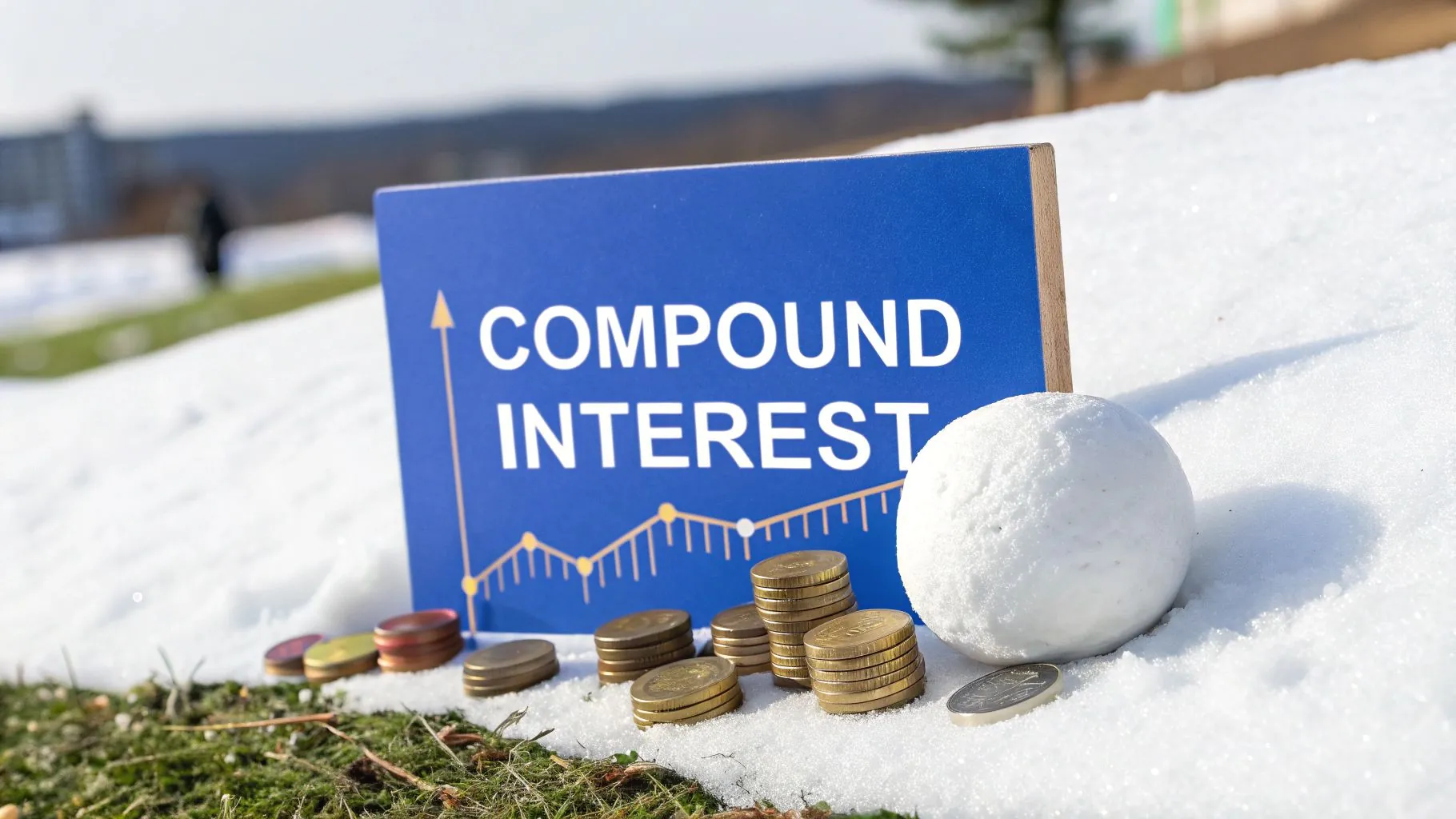
Have you ever heard that compound interest is the eighth wonder of the world? It might sound like an exaggeration, but understanding this one concept is like being handed the keys to building long-term wealth.
Think of it like a tiny snowball at the top of a very long, snowy hill. As it starts rolling, it picks up more snow, getting a little bigger. With each turn, its larger size allows it to pick up even more snow, making it grow faster and faster. That’s compound interest in a nutshell: your money starts earning returns, and then those returns start earning their own returns. It’s this “interest on interest” feedback loop that creates incredible momentum over time.
The Snowball Effect of Compound Interest
At its core, compounding is what happens when the earnings from your investments are put back to work. This is a world away from simple interest, where you only earn a return on your original investment—the principal.
Simple interest is predictable, but slow. It’s a straight line. If you invest $1,000 at a 5% simple annual interest rate, you’ll earn $50 every year. No more, no less. After 20 years, you’d have your original $1,000 back plus another $1,000 in interest ($50 x 20 years), for a grand total of $2,000.
Compound interest, on the other hand, builds on itself. The first year looks the same—you earn $50 on your $1,000, bringing your total to $1,050. But here’s where the magic starts. In year two, you earn 5% on the new total of $1,050, which comes out to $52.50. It doesn’t seem like much at first, but this is the beginning of an exponential curve.
“Compound interest is the process where your money earns interest, and then the interest that has already been added also starts earning interest. It’s like getting paid extra on money you didn’t even have to begin with.”
Simple vs Compound Growth in Action
This difference really comes alive when you see the numbers side-by-side. The gap between simple and compound growth might look tiny at first, but given enough time, it becomes a chasm. Time is the secret fuel for the compounding engine.
To see what I mean, let’s look at how a $1,000 investment grows at a 5% annual rate using both methods.
Simple Interest vs Compound Interest at a Glance
This quick comparison shows how an initial investment grows differently over five years with simple versus compound interest, highlighting the accelerating growth of compounding.
| Year | Simple Interest Growth ($1,000 at 5%) | Compound Interest Growth ($1,000 at 5% Annually) |
|---|---|---|
| Year 1 | $1,050.00 | $1,050.00 |
| Year 2 | $1,100.00 | $1,102.50 |
| Year 3 | $1,150.00 | $1,157.63 |
| Year 4 | $1,200.00 | $1,215.51 |
| Year 5 | $1,250.00 | $1,276.28 |
As you can see, the compound interest account is already pulling ahead after just a few years. While the simple interest account plods along adding a predictable $50 each year, the compound interest account adds a little more each time. This accelerating growth is precisely why grasping compound interest is a cornerstone of smart financial planning. It’s what turns your money from a static resource into an active, self-growing asset.
How the Math Behind Compounding Really Works
To really get why compounding is such a big deal, it helps to peek under the hood and see what’s driving the growth. It might look intimidating, but the math is actually built on a few simple, powerful ideas that work together over time. Once you understand these variables, you have the power to map out your own financial future.
At its core, the compound interest formula just brings four key elements together. Think of them as the ingredients in your wealth-building recipe.
- Principal (P): This is your starting money. It’s the initial lump sum you save or invest, and it’s the foundation for everything that comes next.
- Interest Rate (r): This is the percentage your money grows by in a given period. It’s the fuel for your compounding engine.
- Time (t): This is how long your money stays invested, usually measured in years. Time is arguably the most critical ingredient because it gives compounding the room it needs to really take off.
- Compounding Frequency (n): This is all about how often the interest gets calculated and added back to your principal. It could be annually (once a year), quarterly (four times), monthly (12 times), or even daily (365 times).
These pieces fit into a straightforward formula that calculates the Future Value (A) of your investment. You don’t need a math degree to get it, but seeing it written out makes the whole process click: A = P(1 + r/n)^(nt). To really get the hang of it, it’s worth understanding what compound interest is and how it works in more detail.
A Practical Example of Compounding
Let’s make this real. Imagine you invest $1,000 (your Principal) into an account with a 5% annual interest rate (your Rate). For simplicity, let’s say it compounds annually (so, n=1).
After year one, the math is easy: $1,000 x 1.05 = $1,050. You’ve earned $50. But in year two, things get interesting. You now earn interest on your bigger balance: $1,050 x 1.05 = $1,102.50. That extra $2.50 might not seem like much, but it’s your first taste of interest earning its own interest. This is the effect that snowballs over time.
This chart shows just how fast that gap widens between simple interest and the accelerating power of compounding over five years.
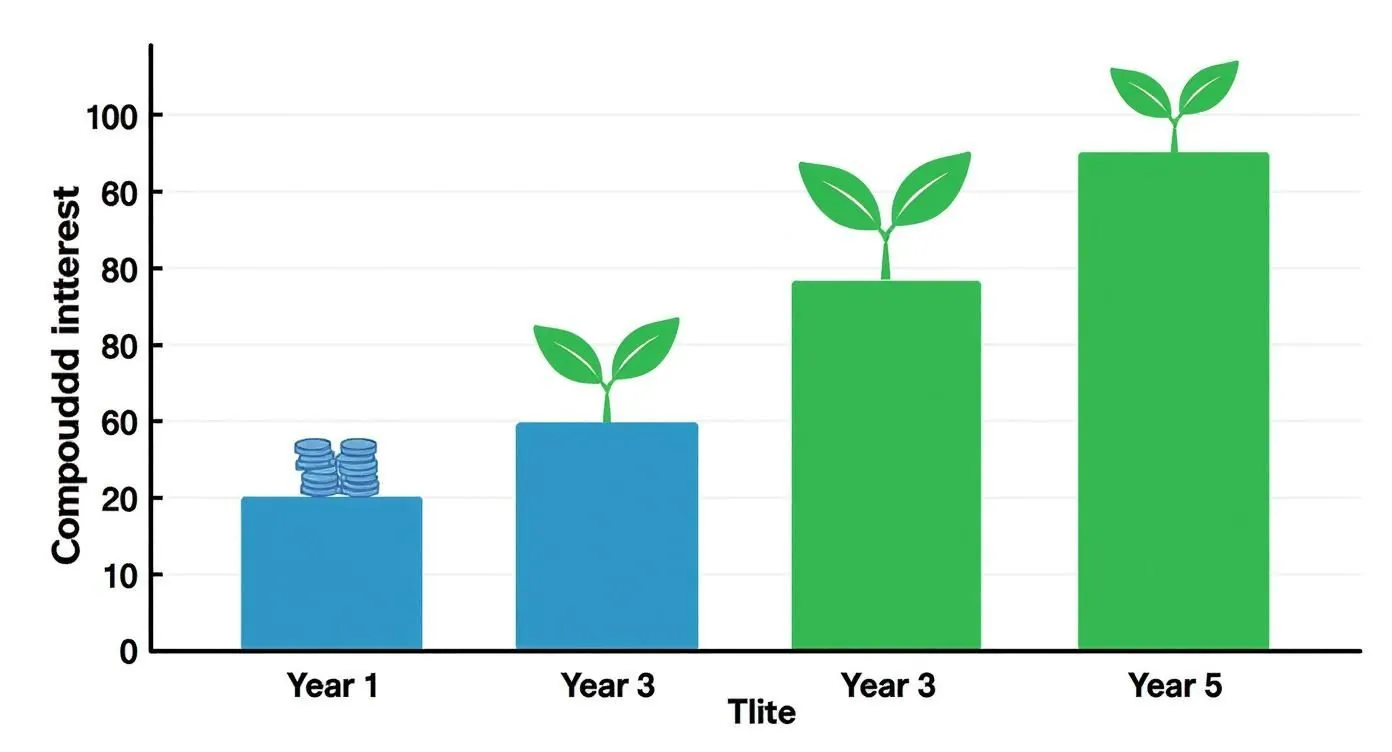
As you can see, both paths start out the same, but the compounding line quickly starts to curve upward, showing off its exponential power.
The Ultimate Growth Scenario: Continuous Compounding
So, what if you could compound your interest an infinite number of times? That’s the idea behind continuous compounding. It’s the theoretical ceiling—the absolute maximum growth your money could achieve if interest were being calculated and added back at every possible instant.
While most real-world accounts compound on a set schedule (like daily or monthly), the concept of continuous compounding is a cornerstone in finance for modeling growth and understanding the future value of money.
The formula for this is A = Pe^(rt), where ‘e’ is a special mathematical constant (around 2.718). It sounds abstract, but it perfectly illustrates how more frequency leads to more growth. For our $1,000 at 5% over one year, continuous compounding would give you $1,051.27—just a bit more than the $1,050 from annual compounding.
That small difference highlights the ultimate potential of the compounding machine when it’s pushed to its theoretical limit. It reinforces the core lesson: the more frequently you compound, the better your returns.
Putting Compound Interest to Work in the Real World
Knowing the theory behind compound interest is one thing, but seeing it in action is what really builds financial confidence. This is more than some dusty concept from a textbook; it’s the quiet engine humming behind the scenes of many financial tools you might already use, from a savings account to your investment portfolio. The trick is knowing where to find it and how to put it on your side.
Most people get their first taste of compounding in a high-yield savings account. The rates might seem small, but the mechanics are identical. The bank pays you interest, that interest is added to your balance, and next month, you earn interest on the slightly larger amount. It’s a slow burn, but it’s the start of your compounding journey.
But where this principle really flexes its muscles is in long-term investments, especially within the stock market. This is where the snowball truly starts picking up speed.
The Magic of Reinvesting Dividends
When you own stocks or funds, many companies share their profits with you in the form of dividends. You have a choice: take the cash and run, or automatically reinvest it through a Dividend Reinvestment Plan (DRIP). Choosing to reinvest is like pouring gasoline back into your compounding engine.
Instead of a small cash deposit in your account, those dividends are used to buy more shares of the very same stock or fund. This sets off a powerful, self-sustaining loop:
- More Shares: Your reinvested dividends buy you more ownership.
- Bigger Payouts: Because you own more shares, your next dividend payment is larger.
- Accelerated Growth: Those larger payments then buy even more shares, speeding up your investment’s growth without you lifting a finger or adding another dollar.
This simple, automated step is one of the most powerful ways to supercharge your portfolio’s growth over decades. It makes sure every penny your money earns gets put right back to work. To get the most out of this, it needs to be part of smart, long-term retirement planning strategies.
A Century of Compounding in Action
One of the clearest real-world examples is the historical performance of the S&P 500 index. Over the last 100 years, the index has delivered an average annualized return of around 10.48%, but that number includes reinvested dividends. A $1,000 investment back in 1925 would be worth over $1.5 million by 2025—assuming every dividend was put back to work. The vast majority of that incredible growth didn’t come from the initial $1,000; it came from the relentless reinvestment of earnings, year after year.
The most important lesson from market history is that time in the market is far more important than timing the market. Patiently allowing your investments to compound is the most reliable path to building significant wealth.
It’s not about being a genius stock picker. It’s about the patient, boring, and incredibly powerful act of letting your money grow on itself.
Your Biggest Advantage: An Early Start
Time is the single most powerful ingredient in the compounding recipe. The earlier you start, the more cycles of growth your money gets to experience, creating a much bigger financial snowball down the road. This is why even small, consistent investments in your 20s can crush larger contributions made later in life.
Let’s look at two investors:
- The Early Starter: She invests $200 a month from age 25 to 35 (a total contribution of $24,000) and then stops completely, just letting the money grow.
- The Late Starter: He starts at 35 and invests $200 a month all the way to age 65 (a total contribution of $72,000).
Assuming an average 7% annual return, the Early Starter will actually have a larger portfolio by age 65, despite having invested only a third of the money. That initial decade gave her money an unstoppable head start, allowing compounding to do the heavy lifting for the next 30 years. It proves that when it comes to investing, how long you invest is often more important than how much you invest. If you’re just getting started, our guide on how to start investing money can help you build a solid foundation.
Navigating the Language of Financial Growth
To really get the hang of compound interest, you have to speak its language. Financial terms often sound complicated, but they’re usually just labels for simple ideas. Once you break them down, you can stop feeling uncertain and start making much sharper decisions with your money.
Two of the most common—and most frequently confused—terms you’ll run into are APR (Annual Percentage Rate) and APY (Annual Percentage Yield). They sound almost the same, but the difference between them gets to the very heart of compounding.
APR vs. APY: The Real Difference
Think of APR as the simple, sticker-price interest rate. It’s the base rate you’re charged for borrowing or paid for saving over a year, before any compounding kicks in. It gives you a baseline but doesn’t tell the whole story.
APY, on the other hand, shows you the full picture. It represents the actual return you’ll earn (or pay) in a year once the effects of compounding are baked in. Because it accounts for interest earning interest on itself, the APY will always be a bit higher than the APR if compounding happens more than once a year.
Let’s make this concrete with examples from your own financial life:
- Credit Cards Use APR: When a credit card company advertises a 19.99% APR, that’s the starting point. But since most cards compound interest daily, the actual cost of carrying a balance is higher. That’s the compounding snowball working against you.
- Savings Accounts Use APY: A high-yield savings account might boast a 4.50% APY. That number is your true annual return because it already includes the power of daily or monthly compounding. The bank is showing you the full benefit you’ll receive.
Getting this distinction is critical. When you borrow, the APR is your baseline cost, but remember compounding will make the real cost higher. When you save, the APY is your true north—it shows what your money is actually earning.
Nominal vs. Real Returns: The Inflation Factor
Just as APY gives you a clearer picture than APR, understanding your real return is vital for measuring your true financial progress. When you see an investment return of 8%, that’s the nominal return—it’s the straightforward, on-paper growth of your money.
But that number doesn’t exist in a vacuum. It’s constantly fighting against inflation, which is the rate at which the cost of everything goes up, shrinking the purchasing power of your dollars.
Your real rate of return is what’s left after you subtract inflation. The math is simple: Real Return = Nominal Return – Inflation Rate.
Imagine your investment portfolio earns a nominal return of 7% for the year. Sounds pretty good! But if inflation that year was 3%, your real return is only 4%. This means your actual ability to buy stuff with that money only grew by 4%, not the full 7%.
This concept is everything for long-term goals. To build genuine wealth, your investments have to consistently beat inflation. If your returns are just keeping pace with inflation, you might be gaining money, but you’re losing purchasing power—a silent but powerful setback. Knowing the difference is the first step to building a strategy that delivers real, tangible growth.
To bring these ideas together, here’s a quick reference table to help you keep these key financial rates straight.
Understanding Financial Rates
This table breaks down the most important financial terms you’ll encounter, what they measure, and where they typically show up.
| Term | What It Measures | Includes Compounding? | Common Use Case |
|---|---|---|---|
| APR | The simple, annual interest rate without compounding. | No | Credit Cards, Mortgages, Auto Loans |
| APY | The effective annual rate with the effect of compounding. | Yes | Savings Accounts, Certificates of Deposit (CDs) |
| Nominal Rate | The stated interest rate or return, before inflation. | N/A | Investment Returns, Bond Yields |
| Real Rate | The rate of return after accounting for inflation. | N/A | Evaluating True Investment Growth |
Think of this as your financial decoder ring. When you see these terms on a loan application or a savings account ad, you’ll know exactly what they mean for your money and can make a much more informed decision.
The Two Forces That Can Slow Your Growth
While compound interest is a powerful engine for building wealth, it doesn’t operate in a vacuum. Two persistent economic forces—taxes and inflation—can act like powerful brakes on your financial momentum if you let them. Understanding how they work is just as critical as knowing the growth formula itself.
Think of your investment portfolio as a high-performance vehicle. Taxes are like a constant drag on its speed, while inflation is a perpetual headwind you have to drive against. To reach your destination on time, you have to account for both.
How Taxes Impact Your Compounding Engine
Every time your investments spin off a return, whether through capital gains or dividends, those earnings can get hit with taxes. When you pay those taxes, that money is pulled right out of your portfolio, meaning it can no longer compound and work for you.
This creates a subtle but significant drag on your growth over time. A seemingly small tax bill each year chips away at the principal available for the next cycle of compounding. Over decades, this can result in a much smaller snowball than you were hoping for.
The key to minimizing this drag is to use tax-advantaged accounts. Vehicles like a 401(k) or an IRA (Individual Retirement Account) are specifically designed to shield your investments from annual taxes, letting them grow unimpeded. This allows your money to compound at its full potential for years, or even decades.
These accounts don’t eliminate taxes forever—you typically pay them when you withdraw money in retirement—but they delay the process. That delay is incredibly valuable because it lets every single dollar of your earnings get reinvested and continue compounding for a much, much longer time.
Inflation: The Silent Hurdle for Your Investments
The second force, inflation, works differently but is just as important to understand. Inflation is simply the gradual increase in the cost of goods and services over time, which quietly erodes the purchasing power of your money. A 5% investment return feels great, but if inflation is running at 3%, your real gain in buying power is only 2%.
For your wealth to truly grow, your investment returns must consistently outpace the rate of inflation. If your returns just match inflation, you’re only treading water. Your money is growing, sure, but so is the cost of everything you want to buy with it. You aren’t actually getting any richer in real terms.
Historical data shows just how crucial clearing this hurdle is. Research on global equity markets revealed that the United States maintained the highest uninterrupted real rate of return—that’s growth after inflation—at 4.73% per year for most of the 20th century. In contrast, the median real return for other countries was just 1.5%. This gap highlights why your investments absolutely must beat inflation to achieve substantial growth. You can explore more about these global stock market findings from the last century.
Ultimately, any successful strategy for understanding compound interest has to include a game plan for both taxes and inflation. By using tax-advantaged accounts to protect your growth and aiming for returns that comfortably beat inflation, you can ensure your financial engine is running as efficiently as possible on the road to your goals.
Practical Strategies to Put Compounding to Work for You
Knowing how compound interest works is one thing, but actually putting it into practice is what builds real, lasting wealth. The best part? The most powerful strategies aren’t complicated. They’re built on simple, repeatable habits, not some complex financial wizardry. If you can master a few key principles, you’ll get the compounding engine running at full speed for your future.

It all comes down to three moves. First, give your money the longest possible runway by starting as early as you can. Second, build unstoppable momentum by making consistent contributions. And finally, put every dollar your money earns back to work by reinvesting all your returns.
Start As Early As You Possibly Can
Time is, without a doubt, the most critical ingredient in the compounding recipe. Every year you put off investing is a year of growth you can never reclaim. An investment made in your 20s has four decades to work its magic before retirement; one made in your 40s has only two. The difference is staggering.
Even small, seemingly insignificant amounts can mushroom into huge sums when given enough time. Imagine investing just $100 a month starting at 25. By age 65, assuming a 7% average annual return, that modest contribution could balloon into a portfolio worth over $190,000. That’s the power of giving compounding decades to do the heavy lifting for you.
The best time to start investing was yesterday. The second-best time is today. Don’t worry if you feel like you’re getting a late start—just begin now and let time become your greatest ally.
Getting an early start is a cornerstone of smart financial planning. To see how this fits into the bigger picture, check out our guide on retirement planning basics to build a solid foundation.
Contribute Consistently and Automate Everything
Consistency is what transforms small habits into massive outcomes. Making sporadic investments here and there just slows your momentum. But regular, predictable contributions steadily build your principal, giving compound interest an ever-growing base to work from.
The simplest way to stay consistent? Automate it.
Set up automatic transfers from your checking account to your investment accounts. This takes emotion, decision fatigue, and plain old forgetfulness out of the equation. This strategy, known as dollar-cost averaging, ensures you’re buying in regularly, whether the market is soaring or dipping.
Here’s how to make it happen:
- Automate Your 401(k): Have contributions deducted directly from your paycheck before you can even miss the money.
- Schedule IRA Transfers: Set up a recurring monthly or bi-weekly transfer to your Individual Retirement Account.
- Set Up Automatic Brokerage Investments: Most platforms let you create a regular investment plan for your favorite funds or ETFs.
By making your contributions automatic, you turn wealth-building into a background habit. It just happens, keeping you on track without a second thought.
Always Reinvest Your Earnings
To truly squeeze every drop of value out of compounding, every dividend, interest payment, and capital gain needs to be put right back to work. Cashing out your earnings is like stopping a snowball halfway down the hill to admire its size—you kill all its momentum.
Thankfully, most brokerage platforms offer a simple feature called a Dividend Reinvestment Plan (DRIP). When you turn on DRIP, any dividends your stocks or funds pay out are automatically used to buy more shares of that same investment.
This creates a powerful, self-fueling cycle: more shares generate bigger dividends, which in turn buy even more shares. The long-term impact is huge.
Consider the MSCI World Index, a major benchmark for global stocks. Between 1978 and 2025, it delivered a compound annual growth rate of 10.49%. An initial €10,000 investment would have grown to over €1.1 million in that time—but only if every single return was diligently reinvested. You can see the data for yourself and explore the long-term performance of the index.
Common Questions About Compound Interest
Once you start to really see what compounding can do, a few questions always seem to come up. Getting straight answers to these is the key to feeling confident enough to put these ideas to work in your own financial life.
Let’s break down some of the most common ones.
How Often Is Interest Usually Compounded?
The compounding frequency—how often your earnings are calculated and rolled back into your principal—can vary a lot depending on the financial product you’re using. This schedule is a big deal because it directly affects how fast your money grows.
Here are a few common setups you’ll run into:
- Daily: A lot of high-yield savings accounts do this, giving them a slight edge over accounts that compound less often.
- Monthly: This is also a popular schedule for savings accounts and certain types of investment interest.
- Quarterly or Semi-Annually: If you own stocks or bonds, the dividends are often paid out on this schedule, giving you a regular opportunity to reinvest them.
The takeaway is simple: the more frequently your interest is compounded, the faster your money grows. Even a tiny difference in frequency can lead to a surprisingly large difference in your balance over a long timeline.
Can Compound Interest Work Against Me?
Oh, absolutely. Compound interest is a double-edged sword. It’s an incredibly powerful force, but it’s completely impartial—it will build your debt with the same relentless energy it uses to build your savings. When you’re dealing with high-interest debt like credit card balances or payday loans, it can be downright destructive, making what you owe balloon at a frightening pace.
Think of it as the snowball effect, but rolling downhill in the wrong direction. Every interest charge gets tacked onto your balance, and the next round of interest is calculated on that new, bigger total. It’s exactly why hammering down high-interest debt should be at the very top of your financial to-do list.
What Is the Rule of 72?
The Rule of 72 is one of the best mental shortcuts in finance. It’s a quick-and-dirty way to estimate how long it will take for an investment to double in value, purely from the magic of compound interest. No complex calculator needed.
Just divide the number 72 by your expected annual rate of return.
For instance, if you’re aiming for an average annual return of 8% on your portfolio, you can figure your money will double in about 9 years (because 72 / 8 = 9). It’s a simple trick that helps you visualize the long-term power of your investments and gives you a tangible sense of the timeline for your financial goals.
Ready to see how all your assets and liabilities stack up? PopaDex provides a clear, consolidated view of your entire financial picture, helping you track your progress and make smarter decisions. See your net worth in real-time and take control of your financial journey today at https://popadex.com.