
Our Marketing Team at PopaDex
What is Financial Risk Management? A Practical Guide
Financial risk management is the game plan for identifying, analyzing, and dealing with potential financial threats to protect what you’ve built. It’s not about hiding from risk altogether—that’s impossible. Instead, it’s about making smart, calculated decisions to manage uncertainty so you can still hit your financial goals.
The Mission Behind Managing Financial Risk

Think of it like being a sailor navigating unpredictable seas. The aim isn’t to avoid every storm, but to have the right ship, crew, and strategy to sail through them without sinking.
At its heart, financial risk management is about spotting potential financial icebergs, figuring out how big they are, and building a plan to steer clear or minimize the damage. This is more than corporate-speak; it’s a practical approach that helps everyone, from big companies to individuals, make smarter decisions. It turns potential chaos into manageable, predictable outcomes.
From Reactive Fear to Proactive Strategy
The real magic of risk management is the shift it creates—moving from reacting to financial shocks after they happen to proactively preparing for them before they hit. It’s about asking “what if?” and building that resilience right into your financial foundation. This forward-thinking stance is what separates long-term stability and growth from constant worry. Our guide on scenario forecasting and financial planning dives deeper into how to apply this approach.
This proactive mindset is big business. The risk management market was valued at around USD 15.40 billion and is expected to grow at a compound annual rate of 14.6%, hitting nearly USD 52 billion by 2033. This boom shows just how vital this practice has become in our interconnected world.
The Four Pillars of Financial Risk Management
To make this process less intimidating, we can break it down into four core pillars. Each step logically follows the next, creating a repeatable cycle for handling whatever the market throws at you.
Here’s a quick look at the framework that guides all sound risk management.
| Pillar | Description | Example Action |
|---|---|---|
| Identification | Spotting and flagging potential risks before they become problems. | Noticing that a huge chunk of your portfolio is tied up in a single stock. |
| Analysis | Sizing up the likelihood and potential impact of each risk you’ve identified. | Figuring out how much you’d lose if that one stock suddenly dropped by 20%. |
| Mitigation | Taking action to reduce the chances of the risk happening or lessen its impact. | Selling some of that stock and using the money to buy into other assets (diversification). |
| Monitoring | Keeping a constant eye on your risks and how well your strategies are working. | Regularly reviewing your portfolio’s performance and staying up-to-date with market news. |
This systematic approach makes the concept tangible for everyone, whether you’re a CFO at a Fortune 500 company or just an individual investor tracking your net worth with PopaDex.
To really get a handle on this, diving into mastering risk management in investing can offer some fantastic insights. Ultimately, the goal isn’t to eliminate risk, but to understand it. This ensures every risk you take is a calculated one that lines up perfectly with your goals for stability and growth.
The Evolving Role of a Financial Risk Manager

Forget the old image of a financial risk manager tucked away in a back office, drowning in spreadsheets. That stereotype is dead. Today’s risk manager has moved from a purely numbers-based function to a central strategic advisor, playing a direct role in shaping a company’s future. They are the strategists behind the curtain, guiding businesses through an increasingly tricky financial world.
This evolution calls for a rare mix of skills. A top-tier risk manager now needs to be a quantitative whiz and a master communicator. They’re the translators who can turn dense statistical models into clear, actionable advice that the C-suite can actually use to make critical decisions.
From Analyst to Strategic Partner
Think of the old-school risk analyst as a historian, meticulously studying past market crashes to figure out what went wrong. The modern financial risk manager? They’re more like a futurist and a diplomat rolled into one. They use predictive modeling to spot threats that haven’t even happened yet and have the persuasive power to get leadership to prepare for them.
Their job description has exploded far beyond just crunching numbers. A modern risk professional is expected to have a deep, practical understanding of:
- Emerging Technologies: How will AI advancements impact investment strategies or operational stability?
- Geopolitical Shifts: What’s the financial fallout from a trade war or a conflict halfway around the world?
- Climate-Related Risks: How will rising sea levels or extreme weather events affect physical assets and supply chains?
- Cybersecurity Threats: What’s the potential financial damage from a single, sophisticated data breach?
This wider scope turns risk management from a defensive, box-ticking exercise into a real source of competitive advantage.
A risk manager’s value isn’t just in the accuracy of their reports anymore. It’s measured by the quality of the decisions their insights inspire. It’s about foresight, influence, and the strategic leadership to navigate constant change.
The New Skillset for Modern Risk Management
The tools of the trade are transforming, too. While a solid grounding in finance and statistics is still table stakes, today’s risk pros must be fluent in entirely new disciplines. Technology, especially, has become a core part of their arsenal.
Almost half (42%) of financial risk managers now see artificial intelligence and machine learning as critical for their own professional growth. On top of that, 40% of these pros now have responsibilities tied to climate risk—a category that barely registered on the corporate radar a decade ago. You can dive deeper into these trends in the full 2025 global practice analysis report from GARP.
This points to a massive shift. The ability to use technology for predictive modeling, automate risk monitoring, and analyze huge, messy datasets is no longer a “nice-to-have.” The modern risk manager is part data scientist, part strategist, and part communicator, guiding their organization with a clear-eyed view of both the dangers and the opportunities ahead. Their role goes beyond protecting the company from harm; it’s about empowering it to take smarter, more calculated risks to win.
Breaking Down the Main Categories of Financial Risk
To get a real handle on financial risk management, you have to accept that not all risks are created equal. It’s like being a sailor. You face different dangers out on the water, from sudden storms to a critical equipment failure, and you can’t use the same strategy for both.
It’s the same with your money. Investors and businesses face distinct categories of financial threats, and each one demands its own playbook.
Breaking these down turns that vague feeling of financial worry into a clear-eyed action plan. Once you learn to spot these specific risks in your own life, you can start building the right defenses to protect what you’ve worked for.
Market Risk: The Broad Economic Tides
Market risk is the big one. It’s the danger that your investments will lose value simply because the entire financial market takes a nosedive. This isn’t about one specific company or industry failing; it’s about the whole system being affected.
Think of it as being caught in a powerful tide. It doesn’t matter how well-built your boat is if the whole sea is dropping. It’s the macro-level threat that nobody can fully escape.
These risks are usually driven by huge economic events or major shifts in investor confidence. The main culprits include:
- Interest Rate Changes: When central banks hike interest rates to combat inflation, borrowing gets more expensive, the economy cools off, and the value of existing bonds can drop.
- Recessions: A full-blown economic downturn hammers corporate profits and consumer spending, which almost always leads to broad declines in the stock market.
- Geopolitical Events: Things like wars, trade disputes, or political instability can send shockwaves through global markets, creating massive uncertainty and volatility.
For example, a retiree with a portfolio heavy in stocks could see their net worth shrink dramatically during a recession, even if they own shares in great companies. The classic way to manage market risk is through diversification—spreading your money across different asset classes like stocks, bonds, and real estate to soften the blow when any single market turns sour.
Credit Risk: The Danger of Default
Credit risk is much more straightforward: it’s the threat that someone who owes you money won’t pay it back.
If you’ve ever lent a friend twenty bucks and never saw it again, you’ve experienced credit risk on a small scale. For banks, investors, and businesses, the stakes are obviously much, much higher.
This risk pops up everywhere. A bank takes on credit risk every time it approves a mortgage. An investor faces it when they buy a corporate bond, essentially betting the company will make its interest payments and return the principal. Even a small business that lets a customer pay an invoice in 30 days is taking on credit risk.
The heart of managing credit risk is figuring out a borrower’s ability—and willingness—to pay you back. This is exactly why credit scores, financial statements, and payment histories are so important in any lending decision.
To counter this risk, lenders might charge higher interest rates for riskier borrowers, demand collateral (an asset they can seize if you default), or even buy complex financial products that act like insurance against non-payment.
Liquidity Risk: The Inability to Sell Quickly
Liquidity risk is a sneakier but equally dangerous threat. It’s the risk that you can’t sell an asset quickly enough to avoid a loss or cover an urgent financial need. Imagine you own a valuable painting but need cash tomorrow for a medical emergency. You might have to sell it for a fraction of its worth just to get the money in time.
This risk perfectly illustrates the difference between an asset’s value and its cash-worthiness.
Things like real estate or a stake in a private company might be incredibly valuable on paper, but they are highly illiquid. You simply can’t turn them into cash in an afternoon. Even stocks, which are usually liquid, can run into this problem during a market panic when everyone is rushing to sell at the same time, overwhelming the buyers.
A classic personal finance example is not having an emergency fund. If an unexpected bill pops up, you’re forced to sell your long-term investments at the worst possible time, turning a temporary cash crunch into a permanent loss.
Operational Risk: The Threats from Within
Finally, there’s operational risk. Unlike the other risks that come from external forces, these are the self-inflicted wounds. They stem from failures inside an organization—or your own personal financial system—due to bad processes, human mistakes, or technology breakdowns.
This category is incredibly broad. It could be anything from a simple accounting error to a massive system failure.
A data breach that exposes customer information is a perfect example, often leading to millions in fines and reputational damage. Employee fraud, a broken supply chain, or a natural disaster that shuts down a key facility all fall under this umbrella.
For an individual, this could be as simple as falling for a phishing scam and losing access to your brokerage account. The way to fight operational risk is by building strong systems, using good security practices (like two-factor authentication), and having backup plans. It’s all about making sure the day-to-day machinery of your finances runs smoothly and securely.
Essential Frameworks for Managing Financial Risk
How do professionals systematically tame financial risk instead of just reacting to it? They use proven blueprints, known as risk management frameworks. These aren’t abstract theories; they are structured, logical processes that turn reactive fear into a proactive, repeatable strategy.
Think of it like building a fortress to protect your financial well-being. You wouldn’t just start stacking stones randomly. You’d follow a plan. This same disciplined approach is what makes professional financial risk management so effective.
The Four Stages of Building Your Financial Fortress
At the core, most professional frameworks—whether for a multinational corporation or a savvy individual—boil down to a four-stage cycle. This process provides a clear, reliable method for identifying and neutralizing threats before they can cause serious damage. Let’s walk through it.
-
Risk Identification (Scouting the Terrain): This is the first and most critical step. You can’t defend against a threat you don’t see coming. This stage involves systematically scanning your financial landscape to pinpoint potential vulnerabilities. It’s about asking, “What could go wrong here?”
-
Risk Analysis (Assessing the Threat): Once you’ve spotted a potential risk, you need to size it up. How likely is it to happen, and how much damage would it do if it did? This analysis helps you prioritize, focusing your energy on the biggest and most probable threats first.
-
Risk Mitigation (Building Your Defenses): This is the action phase. Based on your analysis, you implement strategies to either reduce the likelihood of the risk occurring or minimize its impact. This could involve anything from diversifying investments to buying insurance.
-
Risk Monitoring (Posting Sentinels): Risk is never static; the financial world is always shifting. This final stage involves continuously watching your identified risks and the effectiveness of your defenses, ready to adapt your strategy as new threats emerge.
For a deeper dive into concrete methods, these 7 Unbreakable Trading Risk Management Strategies are a great resource for seeing how professional traders protect their capital.
Comparing Professional Blueprints: COSO vs. ISO 31000
While that four-stage cycle is universal, large organizations often adopt formal frameworks to standardize their approach across the board. Two of the biggest names in the game are COSO and ISO 31000. Each offers a slightly different lens for viewing and managing risk.
Adopting these frameworks is a serious business. Among global banks, a staggering 74% cite risk measurement and stress testing as critical capabilities, while 67% lean heavily on solid risk data and reporting. These priorities are the very heart of modern frameworks.
To see how they differ, let’s break them down.
Comparing Risk Management Frameworks COSO vs ISO 31000
| Feature | COSO Framework | ISO 31000 Framework |
|---|---|---|
| Primary Focus | Internal controls, governance, and preventing fraud and errors. | Creating and protecting value through universal risk principles. |
| Approach | More prescriptive, with detailed components for implementation. | More flexible and principles-based, adaptable to any organization. |
| Best For | Organizations needing strong internal financial and operational controls. | Any organization seeking a broad, adaptable risk management culture. |
The key takeaway isn’t about which one is “better,” but recognizing that a structured, intentional process is what truly matters.
Whether you’re a CEO or an individual investor, having a system transforms risk management from pure guesswork into a strategic discipline.
This structured thinking is especially crucial when dealing with specific, complex risks. For instance, companies operating internationally must have a solid framework for handling currency fluctuations. Our guide offers more detail on managing foreign exchange risk and the strategies involved.
Ultimately, these frameworks provide a reliable roadmap. They ensure that all necessary steps are taken, from initial identification to ongoing monitoring, giving organizations and individuals a clear and defensible plan for protecting their financial future.
Applying Risk Management to Your Personal Finances
Those powerful concepts of financial risk management aren’t just for Wall Street firms. They’re practical tools you can use right now to protect and grow your own net worth. This is where the theory hits the pavement, turning the passive hope for your financial future into an active, strategic defense.
By applying a structured process to your own life, you can pinpoint the specific threats to your financial health. Maybe it’s a portfolio too heavy in one stock, or a complete reliance on a single paycheck. It’s all about building a financial life that can take a punch and keep on ticking.
Conducting Your Personal Risk Audit
First things first: you need to perform a personal risk audit, just like a professional would. This means taking an honest look at your complete financial picture to spot vulnerabilities before they blow up into full-blown crises. It sounds intimidating, but the process is surprisingly straightforward.
This simple infographic breaks down the four-step cycle for managing financial risk.
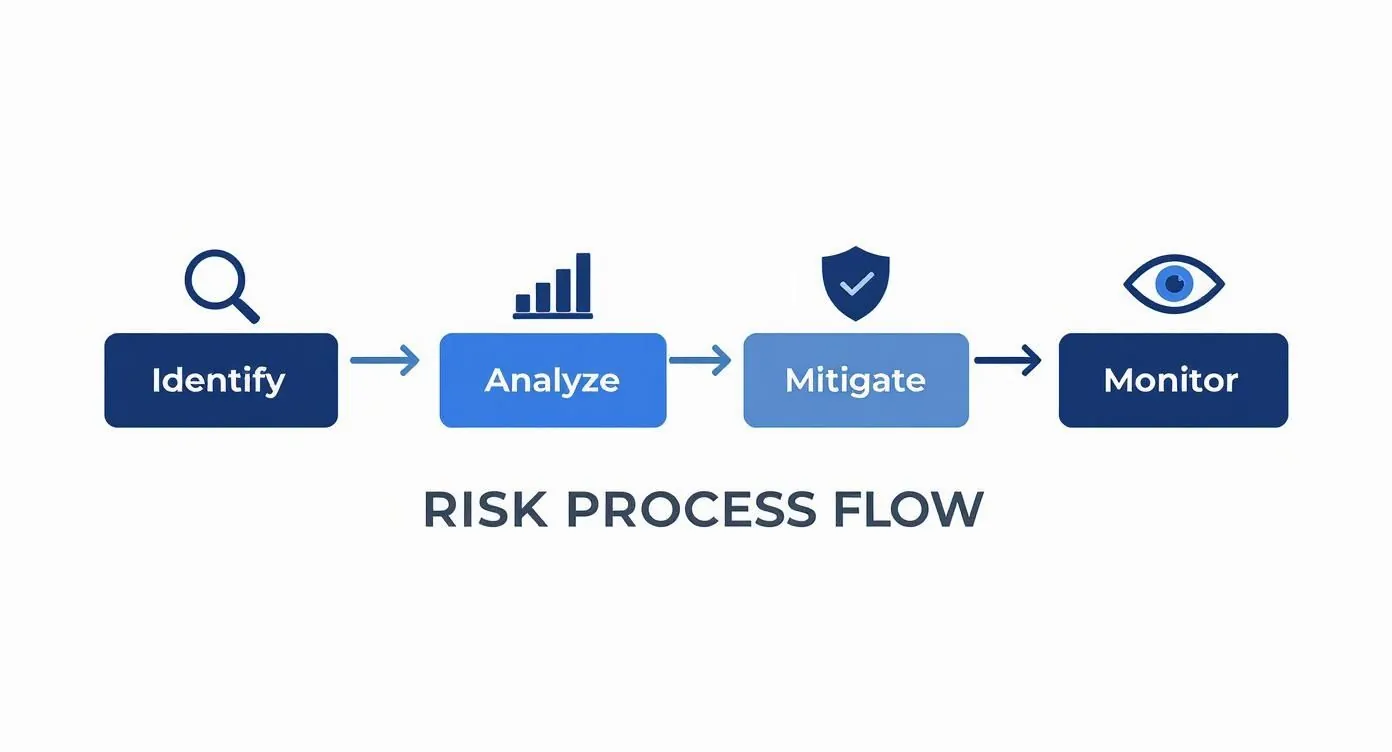
This flow—Identify, Analyze, Mitigate, and Monitor—is your playbook for safeguarding your personal bottom line. It’s a clear and repeatable process.
To kick off your own audit, grab a notebook or fire up a spreadsheet. Start asking yourself some pointed “what if” questions across the main risk categories:
- Market Risk: What happens to my retirement savings if the stock market tanks by 30% next month? Is way too much of my net worth tied up in a single, volatile asset like crypto or my company’s stock?
- Credit Risk: Did I loan money to a friend that I might never see again? It’s a small-scale version of what banks face, but for an individual, it’s a real risk.
- Liquidity Risk: If I lost my job tomorrow, how long could I cover my bills without having to sell my long-term investments at a loss? Is there enough cash on hand for a surprise medical bill or major car repair?
- Operational Risk: Is my financial information locked down? Am I using strong, unique passwords and two-factor authentication on my banking apps to shut the door on fraudsters?
The goal here isn’t to spark anxiety. It’s to build a clear-eyed awareness of your unique risk profile. That awareness is the foundation of any solid financial defense.
Building Your Mitigation Strategy
Once you’ve identified your biggest risks, it’s time to build your financial fortress. This is the active part where you implement practical strategies to counter the threats you’ve uncovered. Every defense you put in place makes your entire financial structure stronger and more stable.
These strategies don’t need to be complex. In fact, the most effective defenses are often the simplest ones you can stick with. A few powerful tactics include:
- Countering Liquidity Risk with an Emergency Fund: This is your absolute first line of defense. Having three to six months’ worth of essential living expenses parked in an accessible, high-yield savings account is what keeps a crisis from becoming a catastrophe. For a step-by-step walkthrough, check out our guide on how to build an emergency fund.
- Managing Market Risk Through Diversification: We’ve all heard it: don’t put all your eggs in one basket. Spreading investments across different asset classes (stocks, bonds, real estate) and geographies cushions the blow if any single area takes a hit.
- Transferring Risk with Proper Insurance: Insurance is the classic way to hand off risk. Health, life, disability, and property insurance are all designed to shield your net worth from catastrophic events that would be impossible to cover out of pocket.
- Addressing Income Risk: If you depend on a single job, you’re facing a huge income risk. You can mitigate this by developing new skills, starting a side hustle, or building a professional network that can help you land on your feet quickly if needed.
Finally, remember that managing risk isn’t a “set it and forget it” task. It’s a continuous cycle. You have to regularly monitor your risks and review your strategies, especially after major life events like a marriage, a new job, or a big shift in your portfolio. This ongoing vigilance ensures your financial defenses stay aligned with your life, ready for whatever comes next.
Putting It All Together: Your Financial Future Awaits
So, where do we go from here? We’ve covered a lot of ground—demystifying financial risk management, breaking down the major risk categories, and walking through the frameworks that pros use to make smart, defensive decisions.
The big idea is that managing risk isn’t about playing defense out of fear. It’s about empowerment. It’s the difference between being a passenger on your financial journey and confidently taking the controls as the pilot. You’re building a financial foundation that can handle a bit of turbulence without falling apart.
From Ideas to Action
This is all about building resilience. When you have a solid plan, market dips and surprise expenses become manageable hurdles, not catastrophic events that completely derail your life goals. Adopting this proactive mindset is the single most valuable asset you have for building a secure and prosperous future.
And you don’t have to boil the ocean. Real, lasting progress comes from taking small, consistent steps that build on each other over time. The only secret is to start today.
A proactive mindset is your greatest asset for building a secure financial future. It transforms risk from a source of anxiety into a series of calculated decisions that put you in control.
Ready to take that first step? Here’s a simple, actionable way to get started:
- Pinpoint one single risk: Take a hard look at your finances and find just one weak spot. Is it not having an emergency fund? Holding way too much of a single stock?
- Come up with one solution: What’s one concrete thing you can do about it? Maybe it’s setting up a tiny automatic transfer to a savings account. Or maybe it’s selling just a small portion of that concentrated investment to diversify.
- Take that one step: Do it. Pull the trigger. The momentum you get from this one small win will make the next step feel so much easier.
This simple loop—identify, analyze, act—is the heart and soul of financial risk management. By making this approach a habit, you stop just hoping for the best and start actively building the future you want. Now that’s confidence.
Common Questions About Financial Risk
Dipping your toes into financial risk management can feel like opening a Pandora’s box of questions. To cut through the noise, here are some straightforward answers to the questions we hear most often.
What’s the Real Goal of Financial Risk Management?
The main point isn’t to avoid risk entirely—that’s just not possible if you want to grow your money. The real mission is to understand the risks you’re taking and shrink the uncertainty down to a level you’re comfortable with.
It’s about spotting potential threats, figuring out how bad the damage could be, and then putting a smart plan in place to soften the blow. Good risk management is what protects your hard-earned capital and helps you stay on track toward your goals, even when the market decides to throw a tantrum.
How Can I Start Managing My Own Financial Risk?
A great starting point is a quick personal financial check-up. Just list out your assets (what you own) and your liabilities (what you owe) to get a clear snapshot of your net worth. That alone will show you where you might be exposed.
Then, ask yourself a few honest questions:
- Is my entire income riding on a single job?
- Are all my investments piled into one or two types of assets?
- Do I have enough cash in an emergency fund to cover at least three to six months of non-negotiable expenses?
The answers will immediately highlight your biggest weak spots. From there, you can take practical steps like diversifying your investments, beefing up your savings, or making sure your insurance coverage is actually adequate for your needs.
How Has Technology Changed the Game in Financial Risk Management?
Technology, especially AI and machine learning, has completely reshaped the field. Professionals can now crunch massive amounts of data in real-time, letting them spot potential problems faster and more accurately than ever before.
For example, today’s algorithms can predict market swings by analyzing the sentiment in news articles, instantly flag suspicious transactions to prevent fraud, and run thousands of complex “what-if” scenarios to see how a portfolio would hold up during a recession.
It’s shifted risk management from a discipline that was always looking in the rearview mirror at old data to one that’s constantly looking ahead to anticipate what’s next.
Is Financial Risk Just About Playing Defense?
Not at all. While protecting what you have is obviously a huge part of it, smart risk management is just as much about identifying and seizing the right opportunities. Think of it as enabling a smart offense, not just playing defense.
When you truly understand the potential downside of an investment, you’re in a much better position to decide if the potential reward is worth the gamble. In the end, managing risk gives you the confidence and the framework to chase strategic opportunities that can lead to serious long-term growth. It’s about making sure the bets you place are the ones that are most likely to pay off.
Ready to stop guessing and start seeing your full financial picture? PopaDex provides the clarity you need to identify risks and track your net worth with confidence. Take control of your financial future today by visiting https://popadex.com.