
Our Marketing Team at PopaDex
Understanding Average Retirement Savings by Age 65

So, what’s the magic number for retirement savings by age 65? The truth is, the “average” can be a bit of a moving target. If you look at the median savings, it’s about $200,000. But the mean (or simple average) is a much higher $609,230.
It’s a big gap, and understanding the difference is key to figuring out where you really stand.
Why The “Average” Isn’t Always Average
Think of it this way: the median is the true middle ground. If you lined up every 65-year-old in America from poorest to richest, the person in the exact middle would have $200,000 saved. It’s a realistic snapshot of what a typical person has.
The mean, on the other hand, gets skewed by the ultra-wealthy. A handful of billionaires at the top can pull the average way up, making it seem like everyone has more saved than they actually do.
The median shows you where the crowd is, while the mean shows you where the outliers are. For most of us, the median is a far more useful benchmark.
Data from the Federal Reserve’s latest Survey of Consumer Finances backs this up. It shows the median for Americans aged 65 to 74 is indeed around $200,000, a far cry from the $1.26 million some experts suggest for a comfortable retirement. The mean, influenced by those high earners, sits at that $609,230 figure. You can dig deeper into these numbers over at Kiplinger.
To put these numbers into context, here’s a quick breakdown.
Retirement Savings Snapshot at Age 65
This table clarifies the different figures you’ll encounter and what they really mean for your financial planning.
| Metric | Amount | Key Insight |
|---|---|---|
| Median Savings | $200,000 | This is the most realistic figure for the typical saver. |
| Mean Savings | $609,230 | A less helpful number, heavily skewed by very high earners. |
| Recommended Target | $1.26M | An aspirational goal for a comfortable, worry-free retirement. |
Comparing your own savings to these benchmarks helps you see if you’re on track, ahead of the curve, or need to make some adjustments.
Want to see how your own numbers stack up? Our retirement nest egg calculator can give you a personalized look.
Turning Data Into a Real Plan
So, what do you do with this information? Use it as your “you are here” marker on the financial map.
- Check in regularly. A quick review every quarter helps you see your progress and decide if you need to bump up your contributions.
- Don’t be afraid to ask for help. If you’re falling behind the median, talking to a financial professional can help you find ways to catch up.
The goal is to set small, achievable goals to close any gaps you see.
A small adjustment to your savings strategy today can compound into tens of thousands of dollars by the time you hit 65.
With these benchmarks in mind, you can confidently tweak your contributions and investment strategy to stay on course. PopaDex is designed to help you visualize these goals against your real-time progress, making it simple to map out your journey to retirement.
Why the National Average Can Be Deceiving
Whenever you see a headline about the “average retirement savings by age 65,” take it with a huge grain of salt. A single number rarely tells the whole story, and in this case, it can be incredibly misleading. To understand why, we need to talk about two different kinds of averages: the mean and the median.
Imagine a small town with 100 people getting ready to retire. Every single one of them has exactly $100,000 saved up. In this simple scenario, the average is clearly $100,000. It’s a straightforward number that accurately reflects the financial reality of the community.
But now, let’s say a billionaire with $1 billion stashed away for retirement moves into town. Things get weird fast.
The Billionaire Effect on Averages
If we recalculate the average (the mean) by adding the billionaire’s money to the pot, the town’s total savings jumps from $10 million to $1.01 billion. When we divide that new total by the 101 residents, the mean average skyrockets to roughly $10 million per person.
Suddenly, news outlets could claim the average retirement savings in this town is a whopping $10 million. But did anything actually change for the original 100 residents? Not one bit. They all still have their $100,000.
This is exactly why the median is a much more realistic benchmark. The median simply finds the middle number in a set of data. In our new scenario, the median would still be $100,000, because it ignores the extreme outlier and gives you a true picture of what a typical person has.
Key Takeaway: The mean is easily skewed by a few ultra-wealthy individuals, making it seem like everyone has more saved than they actually do. The median, on the other hand, represents the person right in the middle, offering a much more grounded and relatable figure for your own financial planning.
This is more than a hypothetical problem. The Federal Reserve’s Survey of Consumer Finances shows this exact gap in the real world. The data below highlights the massive difference between mean and median retirement savings for families approaching retirement.

As you can see, the mean retirement savings for the 55-64 age group is over $537,000. But the median is just $185,000. That huge gap shows how a small number of very large accounts pulls the “average” way up, hiding the more modest reality for the typical American household.
Factors That Create the Savings Spectrum
Beyond the whole mean-versus-median debate, a wide range of personal factors means a single national average just doesn’t work. It can’t possibly account for these crucial differences in people’s lives.
- Income Level: It’s no surprise that higher earners have a greater capacity to save and invest more over their careers.
- Cost of Living: Someone living in San Francisco or New York faces much higher daily costs, which can seriously limit how much they can set aside compared to someone in a lower-cost area.
- Access to Workplace Plans: Having a 401(k) with an employer match is a massive advantage that not everyone gets. It can dramatically accelerate long-term growth.
When you boil it all down, the average retirement savings by age 65 isn’t one number—it’s a wide and varied spectrum. By understanding the difference between mean and median and taking a hard look at your own circumstances, you can tune out the confusing headlines and start building a retirement plan that actually works for you.
How Your Story Shapes Your Savings Number

Your retirement savings balance is more than a number on a quarterly statement; it’s the financial summary of your life’s unique journey. While national averages offer a useful map, they don’t show the hills you’ve climbed or the valleys you’ve navigated. Factors like gender, career path, and education create massive differences in the average retirement savings by age 65.
Understanding these influences is crucial. It helps put your own savings into context, shifting the focus from a simple, often demoralizing, comparison to a smarter understanding of what shaped your financial reality. This acknowledgment is the first step toward setting goals that are both ambitious and actually achievable for you.
The Persistent Gender Gap in Retirement Savings
Gender is one of the most powerful forces shaping retirement outcomes. The savings gap goes beyond paychecks—it’s the result of a lifetime of real-world challenges that still hit women harder.
Systemic pay gaps mean women, on average, earn less than men over their careers, which directly shrinks the pool of money available for savings. On top of that, women are far more likely to take career breaks or cut back their hours for caregiving, whether for kids or aging parents. These breaks don’t just pause income; they halt years of potential compound growth and employer 401(k) matches.
By retirement age, the result is a significant deficit. While the average 401(k) for someone in their 60s is around $239,900, a closer look reveals a stark divide. Women often have about 30% less saved for retirement than men, and the median figures tell an even tougher story. You can dig deeper into these retirement statistics and the reasons behind them at NRMLA online.
By age 65, the financial consequences of lower pay and career interruptions have compounded, creating a retirement savings gap that can be difficult to overcome without proactive planning.
Career, Education, and Systemic Hurdles
Beyond gender, your profession and education level play a massive role in your ability to save. A surgeon with a high salary and a robust retirement plan has a completely different savings runway than a freelance artist or a retail worker juggling a fluctuating income with no employer match.
These factors often intersect, creating layers of advantage or disadvantage:
- Industry and Benefits: High-paying fields like tech and finance usually come with generous 401(k) matching programs, which essentially act as a savings accelerator.
- Educational Attainment: Generally, higher education leads to higher lifetime earnings, creating more opportunities to build a substantial nest egg.
- Systemic Barriers: We can’t ignore the racial wealth gap. Stemming from historical and ongoing inequities, these systemic hurdles have a profound impact on a family’s ability to build retirement savings across generations.
All of these personal and systemic factors weave together to create a huge spectrum of savings outcomes. Figuring out where you fall on this spectrum isn’t about making excuses—it’s about gaining clarity. It empowers you to build a personalized financial strategy that honors your past while you actively build a more secure future, a process that platforms like PopaDex are designed to simplify.
The Levers You Can Pull to Grow Your Nest Egg
While it’s good to know the national averages, your financial future isn’t built on statistics. It’s built on action. The most powerful move you can make is to stop comparing and start planning. The good news? You have direct control over a few key “levers” that can make a massive difference in your retirement savings by age 65.
Think of it like rolling a snowball down a hill. The two things that matter most are the size of the snowball you start with and how long it gets to roll. In finance, this is the magic of compound interest—where your money starts earning its own money, creating a powerful growth cycle over time.
The Power of an Early Start
The single most important lever you can pull is time. When you start saving early, you give your money more years to compound, which does a lot of the heavy lifting for you. Even small, steady contributions can balloon into a huge nest egg if they have enough runway.
Just look at the difference between two savers, both shooting for a 65 retirement:
- Saver A (Starts at 25): She puts away $300 a month. Assuming a 7% average annual return, she could have over $795,000 by the time she’s 65.
- Saver B (Starts at 45): He tries to catch up by investing double the amount—$600 a month. By age 65, he’ll only have around $315,000.
Even though he saved twice as much every month, Saver B ends up with less than half of what Saver A built up. This is the stark reality of compound interest: starting small and early beats starting big and late, almost every time.
This chart really drives the point home, showing how savings balances tend to grow over a lifetime.
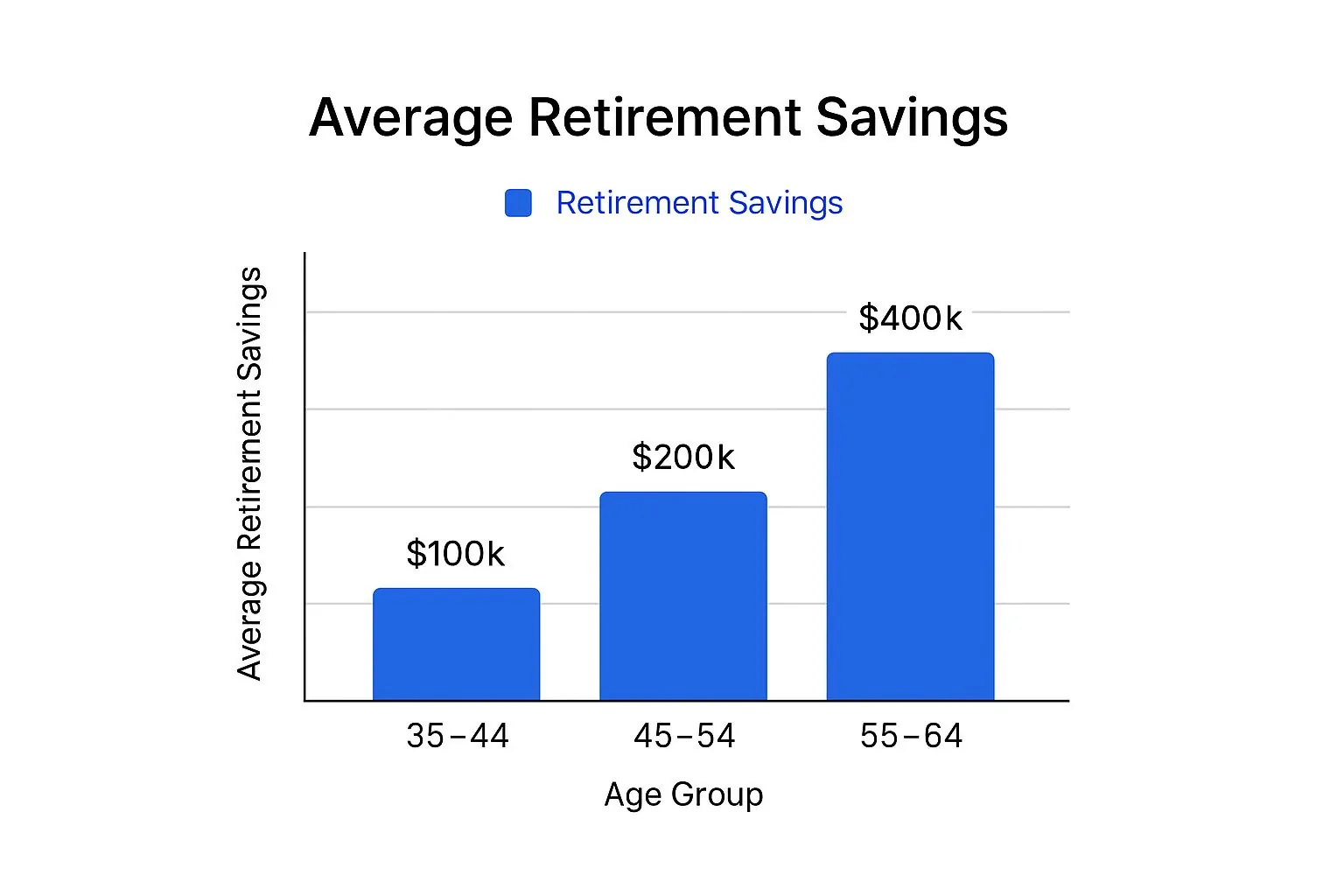
You can see a clear upward curve. Savings balances often double every decade, which is a perfect illustration of compounding in action.
Crafting Your Financial Recipe
Another crucial lever is your asset allocation. That’s just a fancy way of saying “the mix of investments you own.” Think of it like a recipe. To get the right outcome, you need the right balance of ingredients—in this case, stocks and bonds are the main ones.
Asset allocation is your strategy for balancing risk and reward. Stocks offer higher growth potential but come with more volatility, while bonds are generally safer but provide lower returns.
A younger investor might go with a more aggressive recipe, maybe an 80/20 mix (80% stocks, 20% bonds), since they have decades to ride out any market dips. Someone closer to retirement, on the other hand, might shift to a more conservative 50/50 mix to protect what they’ve built.
As you figure out your own mix, don’t forget that understanding how taxes will affect your retirement savings is another key ingredient in your financial recipe.
Impact of Savings Rate on Your Final Balance
It’s not just when you start, but also how much you consistently save that shapes your outcome. Even a small increase in your savings rate can lead to a dramatically larger nest egg down the road.
| Annual Savings Rate | Projected Balance at 65 (Started at 30) | Projected Balance at 65 (Started at 40) |
|---|---|---|
| 5% of $60k Salary | $473,500 | $216,700 |
| 10% of $60k Salary | $947,000 | $433,400 |
| 15% of $60k Salary | $1,420,500 | $650,100 |
(Note: Projections assume a 7% average annual return on a $60,000 salary with no increases.)
As you can see, doubling your savings rate from 5% to 10% literally doubles your final balance. This shows that your choices today have a direct and powerful impact on your financial freedom tomorrow.
By pulling these levers—starting early, saving consistently, and investing wisely—you move from being a passenger to being the pilot of your own financial destiny. To get all these moving parts organized, our comprehensive retirement planning checklist is a great tool to map out your entire journey.
Actionable Strategies to Catch Up on Savings

Realizing your savings aren’t where they need to be can feel pretty discouraging, especially with retirement getting closer. But it’s a spot many people find themselves in, and it’s far from a lost cause. The real key is to pivot from worrying to acting with targeted strategies that can make a real difference, even on a tighter timeline.
It’s never too late to make some serious headway. By zeroing in on a few powerful tactics, you can put your savings into a higher gear and brighten your financial picture for your post-work years.
Maximize Your Catch-Up Contributions
One of the most direct ways to give your retirement funds a shot in the arm is by taking full advantage of catch-up contributions. The IRS specifically allows people aged 50 and over to put extra money into their retirement accounts, above and beyond the standard annual limits. Think of it as a dedicated express lane for your savings.
For 2024, this means you can sock away an extra $7,500 into your 401(k), 403(b), or similar work plan. On top of that, you can contribute an additional $1,000 to a traditional or Roth IRA. It might not sound like a fortune, but consistently maxing these out can add tens of thousands of dollars to your nest egg over a decade.
Making catch-up contributions is one of the simplest and most effective ways to supercharge your savings. It’s a clear, government-approved path to help you close the gap faster.
This one move alone can dramatically change your final balance. For anyone looking to go deeper on this and other wealth-building techniques, exploring a range of options is key. You can find more actionable financial advice and investment strategies for growing your nest egg to help you hit your targets.
Re-Evaluate and Restructure Your Budget
To find the cash for these bigger contributions, a deep dive into your budget is non-negotiable. This isn’t about extreme penny-pinching; it’s about smart, strategic optimization. Hunt for those “financial leaks”—small, regular expenses that add up over time, like forgotten subscriptions or that daily coffee shop run.
Consider these high-impact areas for potential savings:
- Downsizing: Moving to a smaller home or a more affordable area can unlock a ton of equity and slash your monthly expenses on things like property taxes, insurance, and utilities.
- Phased Retirement: Instead of going from full-time work to zero overnight, think about shifting to part-time hours. This keeps an income flowing, lets you delay tapping into your savings, and might even let you keep your benefits.
- Debt Elimination: High-interest debt, especially from credit cards, is a massive anchor dragging down your savings potential. Creating an aggressive payoff plan frees up that money to work for you in your retirement accounts instead of for the credit card companies.
Putting even one or two of these strategies into play can create the financial breathing room you need to accelerate your journey. For more specific ideas, check out our guide on how to catch up on retirement savings. These steps empower you to take control today for a much more secure tomorrow.
Your Retirement Savings Questions Answered
Navigating the world of retirement planning opens up a flood of questions. Beyond just staring at a big number like the average retirement savings by age 65, you’re probably wrestling with the practical details that will actually shape your future.
Let’s cut through the noise. Here are some of the most common questions we hear, answered in plain English to give you a clearer path forward.
How Much Do I Really Need to Retire Comfortably?
This is the million-dollar question, sometimes literally. There’s no single magic number because “comfortable” is deeply personal.
A popular rule of thumb is the 4% rule. The idea is that you can safely withdraw 4% of your savings in your first year of retirement, then adjust that amount for inflation each year after. To work backward, figure out your ideal annual expenses in retirement. If you think you’ll need $60,000 a year, multiply that by 25 to get your target nest egg: $1.5 million.
Another quick benchmark is aiming to have 8 to 12 times your final salary saved up. But don’t forget to account for other income streams like Social Security or a pension, which will reduce the burden on your personal savings.
Is My 401(k) the Only Retirement Account I Need?
A 401(k) is a powerhouse, especially with an employer match—that’s free money you should never leave on the table. But treating it as your only savings tool can be a mistake. Diversifying your accounts gives you more flexibility and control down the road.
Consider adding these accounts to your strategy:
- Roth IRA: A fantastic partner to a 401(k). You contribute with after-tax money, which means your investments grow tax-free, and qualified withdrawals in retirement are also 100% tax-free.
- Health Savings Account (HSA): If you have a high-deductible health plan, an HSA is a secret weapon. It’s the only account with a triple tax advantage: your contributions are tax-deductible, the money grows tax-free, and withdrawals for qualified medical costs are tax-free.
Spreading your savings across different account types gives you the power to manage your taxable income when you’re no longer earning a paycheck.
What Is the Biggest Mistake People Make When Saving for Retirement?
Hands down, the most common and costly mistake is starting too late. The power of compound interest is the closest thing we have to financial magic, and every year you wait to start saving makes the climb exponentially steeper.
A 25-year-old who saves just $300 a month can potentially end up with a larger nest egg than a 40-year-old who diligently saves $600 a month. That’s the staggering power of giving your money more time to grow.
Another major misstep is being too conservative with investments, especially when you’re young. It might feel safe to keep your cash in a low-yield savings account, but inflation will silently chip away at its value over the decades. A smart, age-appropriate investment mix is crucial for real growth.
Should I Pay Off My Mortgage Before I Retire?
This is a classic debate with good arguments on both sides. On one hand, paying off your mortgage offers incredible peace of mind. Wiping out your single largest monthly expense frees up a huge amount of cash flow and delivers a powerful psychological win.
On the other hand, the math might tell a different story. If you have a rock-bottom mortgage rate—say, under 4%—you could potentially earn a higher return by investing that extra cash in the market instead. It’s a riskier play, but it also has greater growth potential. The right choice really boils down to your personal risk tolerance and financial situation.
Ready to get a clear, consolidated view of your entire financial portfolio? PopaDex helps you track all your accounts—from savings and investments to property—in one simple dashboard. Take control of your net worth and start making smarter decisions for your retirement today. Discover how PopaDex can simplify your financial life.