
Our Marketing Team at PopaDex
best personal finance software: top picks & reviews
Picking the right personal finance software is a lot like hiring a personal financial assistant. The best personal finance software for you is the one that actually fits your life—whether you’re trying to get a death grip on your budget, keep an eye on your investments, or just finally figure out where all your money is going.
Your Guide to Choosing Personal Finance Software

Let’s be honest: managing money can feel like juggling chainsaws. You’ve got different accounts, bills popping up, and maybe some investments scattered around. Personal finance tools are designed to stop the chaos by giving you a single, clear dashboard for your entire financial world. It’s like the dashboard in your car—you get your speed, fuel, and engine status all in one glance so you can drive without guessing.
These tools are a massive upgrade from clunky spreadsheets. They’re smart systems built to make budgeting, investing, and planning for the future genuinely easier. And people are catching on. The global market for these tools hit USD 1.39 billion in 2024 and is expected to rocket to USD 2.39 billion by 2033.
This guide is your roadmap to finding a tool that doesn’t just count your money but helps you make smarter decisions with it.
Understanding the Main Software Categories
Before you jump in, it helps to know what you’re looking for. Not all financial tools are created equal—they’re built for different jobs. For a great side-by-side look at some popular options, check out the Top 10 Best Financial Planning Software for Individuals in 2025. Getting familiar with the various financial management tools out there is the first real step toward getting organized.
The real point of any financial software is to shift you from reacting to your money to proactively directing it. It’s about turning a pile of numbers into a clear plan for your future.
Quick Guide to Personal Finance Software Types
To help you get your bearings right away, this table breaks down the main categories of software you’ll run into. It’s a simple way to see which type aligns with what you need to accomplish.
| Software Type | Primary Focus | Best For |
|---|---|---|
| Budgeting Apps | Expense tracking and cash flow | Individuals who want to control spending and stick to a budget. |
| Investment Trackers | Portfolio monitoring and growth | Investors who need to see all their assets and liabilities in one place. |
| All-in-One Platforms | Comprehensive financial management | Users seeking a single solution for budgeting, bills, and investments. |
| Spreadsheet Tools | Manual control and customization | DIY enthusiasts who prefer total control over their financial data. |
Think of this as your starting point. By identifying the right category, you can narrow your search and focus on the tools that will actually make a difference for you.
Understanding the Core Features of Modern Financial Tools
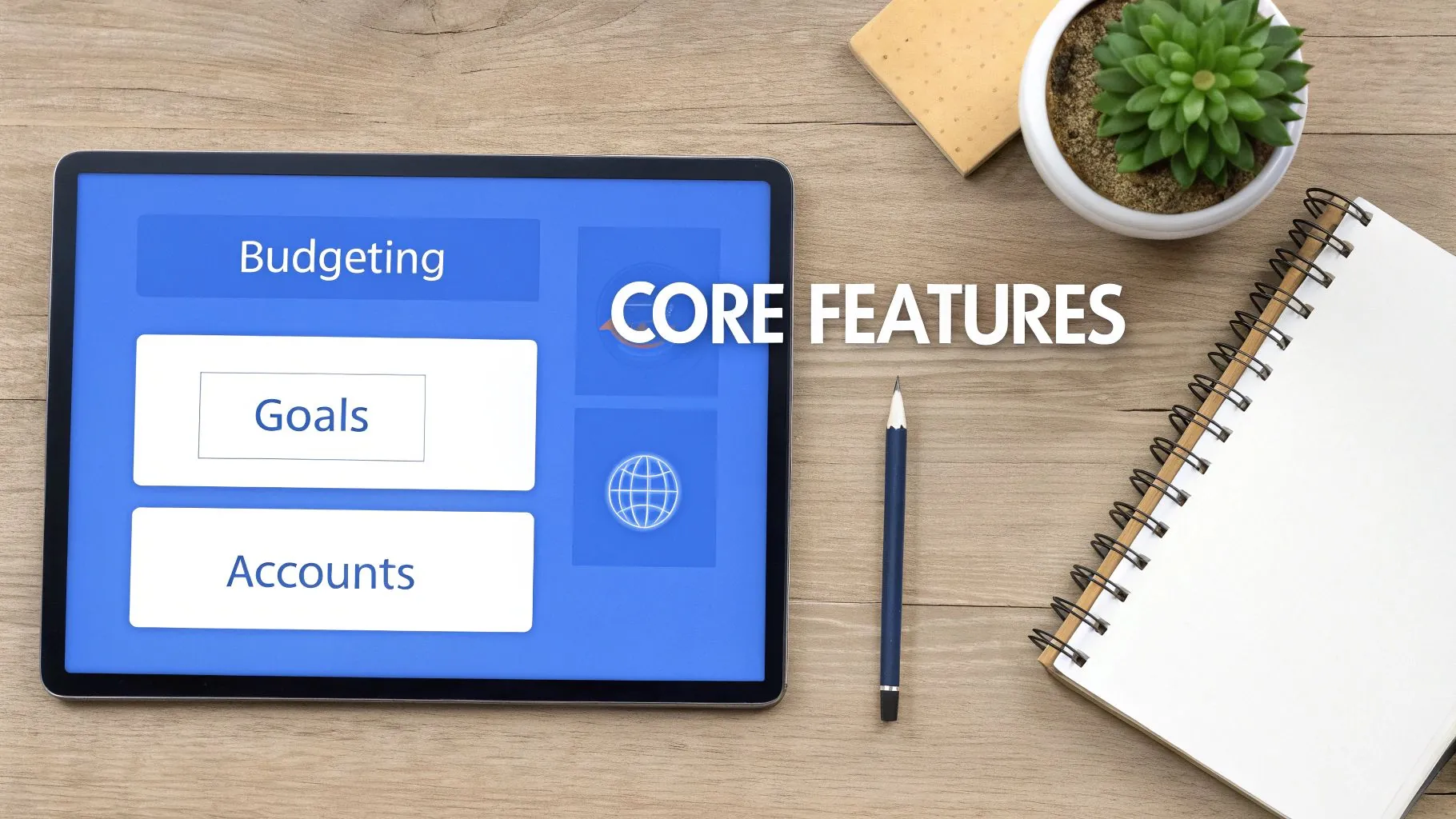
Before you can pick the right personal finance software, you need to know what it actually does. Think of it like test-driving a car—it helps to know what the buttons and gauges are for before you decide to buy. The features in these tools are built to solve real financial problems, from figuring out your daily spending to growing your wealth for the long haul.
Getting a handle on these core functions is the first step toward finding a tool that genuinely fits your life and your goals. Let’s pop the hood and look at the most important features you’ll come across.
Budgeting and Expense Tracking
At its heart, most financial software is built around budgeting and expense tracking. This is the nutritional plan for your money. These tools automatically pull in transactions from your linked bank accounts and credit cards, sorting every purchase into categories so you can finally see where all your money is going.
Imagine trying to figure out your daily calorie intake without tracking your meals—it’s pure guesswork. It’s the same with your finances. Without tracking your spending, you’re just flying blind. This feature gives you the raw data you need to make every other financial decision.
Investment and Net Worth Tracking
While budgeting handles your day-to-day cash flow, investment and net worth tracking gives you the 30,000-foot view. This feature is like a regular check-up for your long-term financial health. It pulls all your assets (savings, stocks, property) and liabilities (loans, credit card debt) into one place to give you a single, powerful number.
Your net worth is the ultimate scorecard of your financial life. Seeing it grow over time is a powerful motivator and a clear sign that your financial strategies are working.
This complete picture is critical. It helps you see if you’re actually building wealth or just treading water, moving you beyond simple income versus expenses to show you where you truly stand.
Goal Setting and Financial Planning
The best personal finance software doesn’t just show you where you’ve been; it helps you map out where you’re going. Goal-setting features act as your financial GPS, letting you set specific targets like saving for a down payment, wiping out debt, or planning for retirement.
These tools often connect your current habits to your future. For instance, the software might show you that saving an extra $100 per month could let you hit your retirement goal two years ahead of schedule. It turns vague ambitions into concrete, actionable steps you can take today.
Bill Management and Payment Reminders
Late fees are silent wealth killers. Bill management is your early warning system, keeping track of recurring bills and their due dates so you can sidestep those painful penalties. Many platforms will even ping you with a notification when a payment is coming up, making it hard to forget.
This one feature takes a lot of the stress out of managing money. By corralling all your bills in one place, it clears away the mental clutter and cuts down on costly mistakes, freeing you up to focus on the bigger picture.
The personal finance software market is also getting smarter. AI and machine learning are no longer just buzzwords; platforms are investing heavily in these technologies to offer personalized financial advice and deeper insights. You can read more about this shift and what it means for you in the latest personal finance software market outlook.
Once you understand these core functions, you can start to see how different tools are built for different people. One person might need a rock-solid budgeting system, while another cares more about detailed investment tracking. The next step is figuring out how to evaluate these features to find your perfect match.
How to Evaluate Personal Finance Software
Knowing the features is one thing, but picking the right tool from a sea of options that all promise financial nirvana? That’s the real challenge.
Think of it like buying a car. You don’t just kick the tires and admire the paint job. You pop the hood, check the safety ratings, and take it for a test drive to see how it feels on the road. Evaluating financial software demands that same level of scrutiny. We need to look past the flashy landing pages and dig into what really matters.
Here’s a framework to help you judge each tool, moving beyond a simple feature checklist to find a platform you can truly trust with your financial life.
Is It a Bank Vault for Your Data?
First things first: security. You’re about to hand over the keys to your entire financial kingdom, so the platform better be built like a fortress. There are a couple of non-negotiables here.
Look for bank-level 256-bit AES encryption. It’s the gold standard for a reason and the bare minimum you should accept. Next up is multi-factor authentication (MFA). This simple step—requiring a code from your phone to log in—is a massive barrier against anyone trying to snoop around your accounts. A tool that skimps on security is an immediate deal-breaker, no matter how cool its charts look.
A platform’s commitment to security is a direct reflection of how much it values your trust. Never compromise on features like encryption and MFA—they are your first line of defense against potential threats.
Does It Connect to Your Financial Life?
The whole point of these tools is to bring everything together in one place. That magic only happens with solid integrations. Before you even think about signing up, check if the software connects to all your accounts—your main bank, that credit card you only use for travel, your 401(k) provider, and even your student loan servicer.
If a tool has spotty connections or doesn’t support one of your key accounts, you’ll be stuck plugging in numbers manually. That completely defeats the purpose and leaves you with an incomplete picture. The goal is to eliminate financial blind spots, not create new manual chores for yourself.
How Much Manual Work Does It Eliminate?
A great financial app should feel like a silent partner working for you in the background. This is where automation comes in. Does it automatically categorize your spending? Can it track your recurring bills without you lifting a finger? Does it update your net worth on its own?
The more the tool automates, the more time you have to actually think about your money instead of just organizing it. When you’re looking at different options, pay attention to their analytical capabilities. It can be helpful to see how other industries approach this by comparing different analytics tools, just to get a sense of what powerful, automated analysis really looks like. You want a system that does the heavy lifting for you.
What Is the True Cost?
Pricing in this space is all over the map, so you need to understand what you’re actually paying for.
- Free with Ads: These are tempting but often come with limited features and annoying ads.
- Freemium: You get a basic version for free, but the best features are locked behind a subscription.
- Subscription: You pay a monthly or annual fee for the full experience.
Don’t just default to the cheapest option. A small subscription fee can be well worth it for an ad-free interface, rock-solid security, and features that genuinely save you time and money. If you’re curious about what’s out there on the free end, we’ve put together a guide on the best free personal finance apps to give you a detailed look.
And one last thing: don’t overlook customer support. When an account link inevitably breaks or you can’t figure out a feature, you’ll want help—and fast. Look for platforms that offer live chat, responsive email support, or at least a thorough help center. Good support can be the difference between a minor hiccup and a major headache.
Matching Software to Your Financial Life
Let’s be honest: the phrase “best personal finance software” is a bit of a myth. There’s no single tool that’s perfect for everyone. The best one is the one that fits your life, your goals, and your habits right now. Think of it like picking a workout plan—what a marathon runner needs is total overkill for someone who just wants to hit 10,000 steps a day.
To find your perfect match, we need to look at how different features solve real-world problems. I’ve broken down four common profiles to help you figure out which features are essential for you and which ones are just noise. See if you recognize yourself in one of these—it’ll help you cut through the marketing fluff and focus on what actually matters.
For the Beginner Budgeter
If you’re just starting to get a handle on your money, your number one goal is clarity. You need to see where your cash is going before you can start telling it where to go. Simplicity is your best friend here.
For this stage, these features are non-negotiable:
- Automatic Expense Tracking: The software absolutely must connect to your bank and credit cards. It needs to pull in and categorize your spending automatically. Manual entry is the fastest way to kill a new habit.
- Simple Budgeting Tools: Look for a tool that lets you easily set spending limits for categories like “groceries” or “entertainment” and shows your progress in real-time.
- Spending Alerts: Getting a notification when you’re close to a budget limit is an incredibly powerful way to build better habits.
Anything more complicated, like deep investment analysis or multi-currency support, is just a distraction at this point. Your job is to build a solid foundation.
For the Growing Family
Managing money for a family adds a whole new layer of complexity. Suddenly you’re juggling multiple incomes, shared expenses, long-term goals like saving for college, and a much bigger, more chaotic budget. Your software needs to become the financial command center for your household.
Key features to prioritize include:
- Shared Access or Household Accounts: The ability for you and your partner to see and manage the same financial picture is crucial. No more secrets.
- Advanced Goal Setting: You’re tracking multiple big goals at once, from a new car fund to retirement. Your tool needs to keep up.
- Bill Management: With a mortgage, utilities, childcare, and more, automated reminders and a central payment calendar are lifesavers.
This is where a comprehensive, all-in-one platform really starts to shine, bringing some much-needed order to the beautiful chaos of family life.
The infographic below shows the core pillars you should look for in any software, no matter where you are in life.
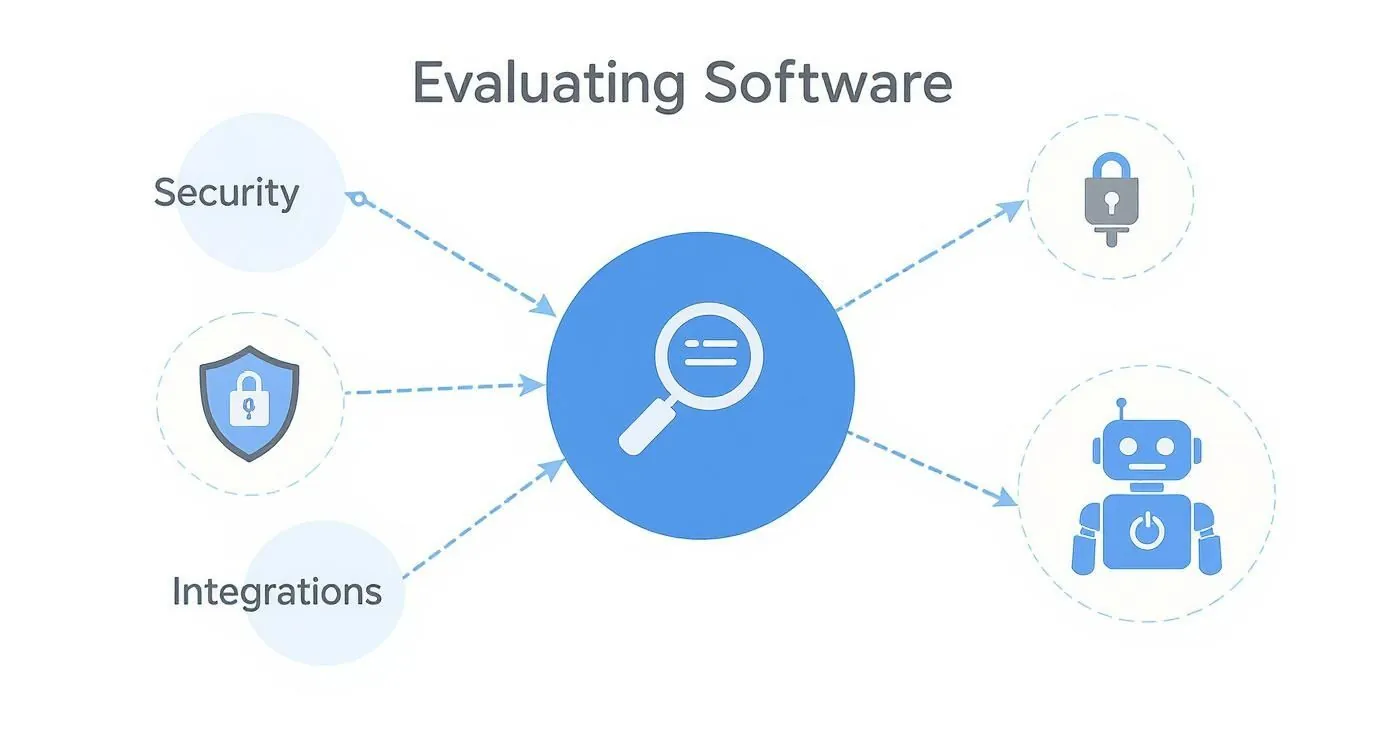
This visual drives home how security, integrations, and automation are the bedrock of any financial tool you can actually trust and rely on.
For the Savvy Investor
Once you’re focused on building wealth, your needs shift from tracking daily spending to seeing the big picture of your assets. Budgeting is still important, of course, but your main concern is watching your portfolio grow.
For investors, the most powerful feature is a consolidated view of net worth. It’s the ultimate scoreboard for your financial progress, showing the combined result of all your earning, saving, and investing efforts over time.
Essential features for this persona are:
- Robust Net Worth Tracking: You need a tool that syncs not just bank accounts, but also brokerage accounts, 401(k)s, and even lets you track assets like real estate. For a deeper dive, check out our guide on how a net worth tracker provides a complete financial picture.
- Portfolio Analysis Tools: Look for features that can show you your asset allocation, performance over time, and break down any fees you’re paying.
- Retirement Planning Calculators: These tools are invaluable for projecting your future wealth and figuring out if you’re on track to hit your retirement goals.
For the Freelancer or Gig Worker
Freelancers and other self-employed folks have a unique financial puzzle to solve: irregular income and the constant need to separate business and personal expenses. A standard budgeting app just won’t cut it.
The most critical features here are:
- Income and Expense Tagging: The ability to tag transactions as “business” or “personal” is non-negotiable. Your sanity at tax time depends on it.
- Tax Estimation Tools: Some software can help estimate your quarterly tax payments, which is a massive help when you don’t have an employer withholding them for you.
- Cash Flow Forecasting: When your income ebbs and flows, tools that can project your future account balances are incredibly valuable for planning ahead.
This focus on individual needs is a major trend. In fact, individual users are the driving force in this market, making up over 57% of the industry’s revenue in 2022 as more people demand control over their finances. You can read more about personal finance software trends to see how the market is evolving to meet these demands.
Your Action Plan for Making the Switch
Switching to new software can feel like a huge project, but breaking it down into a few simple steps makes it completely manageable. Think of this as your roadmap for a smooth transition, designed to get you from overwhelmed to in control with your new financial co-pilot.
Moving to the best personal finance software goes beyond picking an app; it’s about building a better habit. A smart approach ensures you not only choose the right tool but actually stick with it.
Step 1: Define Your Core Financial Goals
Before you even glance at a single app, ask yourself the most important question: “What problem am I actually trying to solve?”
Are you laser-focused on crushing debt? Trying to save up a down payment for a house? Or maybe you just need a clear, real-time picture of your investment performance.
Jot down your top one to three financial goals. This list is now your non-negotiable filter. An app with amazing investment tracking is totally useless if your main mission is to kill your credit card balance with a zero-based budget. Getting this clear from the start keeps you from getting distracted by shiny features you don’t need.
Step 2: Audit Your Current Methods
Next, get brutally honest about what you’re doing right now. Are you wrestling with a clunky spreadsheet? Using another app that drives you crazy? Or are you just winging it, hoping for the best each month?
Figure out what’s working, but more importantly, pinpoint what isn’t.
Maybe your spreadsheet tracks everything perfectly but offers zero motivation because you can’t visualize your progress. Or perhaps your current app is constantly losing connection to your bank. Naming these pain points helps you build a “must-have” feature list for whatever comes next.
Your new tool should solve your existing frustrations, not create new ones. A clear audit of your current system is the best way to ensure you’re making a genuine upgrade.
Step 3: Shortlist Contenders and Start Free Trials
Okay, now you’re ready to go shopping. Armed with your goals and your “must-have” list, find two or three top contenders. Don’t sign up for ten different trials—you’ll just get analysis paralysis. A focused comparison of a few good options is way more effective.
Just about every reputable platform offers a free trial. Use it. This is your chance to take the software for a real test drive with your own numbers.
- Connect Your Accounts: How painful is the setup? Does it sync with all your banks, credit cards, and investment platforms?
- Test Key Features: If budgeting is your priority, build a quick budget. If you’re an investor, dive into the portfolio tools. See how it handles the tasks you’ll do most often.
- Evaluate the User Experience: Does the layout make sense, or do you feel like you need a manual to find anything? A clean, intuitive design is crucial if you want to use it consistently.
Step 4: Plan Your Data Migration
Once you’ve picked a winner, it’s time to make the move. But don’t just delete your old system and jump in headfirst. A planned migration is the key to preventing lost data and a frustrating start.
Most tools let you export your transaction history as a CSV file. See if your new software has an import function to bring that history over.
For the first month, I strongly recommend running both systems side-by-side. It might seem like extra work, but it lets you double-check that every transaction is flowing in and getting categorized correctly in the new tool. This short period of overlap gives you the confidence to fully commit to a system that will truly support your financial journey.
Where PopaDex Fits in Your Financial Toolkit
In a market flooded with financial apps, the real question isn’t “what’s the best software?” but “what’s the right software for me?” PopaDex was never meant to be a jack-of-all-trades. We built it with a laser focus on one thing: giving you an intuitive, powerful way to track the single most important metric—your total net worth.
PopaDex really comes into its own when you’ve moved past the basics of tracking every single expense and are ready to zoom out and focus on the big picture of wealth accumulation. Think of it as your financial command center, pulling every scattered piece of your financial life into one clear, cohesive view.
The Ideal PopaDex User
So, who gets the most out of this approach? When we look at the people who love using PopaDex, a few key profiles jump out. While anyone can appreciate a bit of financial clarity, our platform is a game-changer for these folks.
-
The Savvy Investor: This is our core user. The ability to connect brokerage accounts, track real estate, and keep an eye on liabilities gives investors the high-level overview they need to make smart moves. It cuts through the noise to answer the one question that matters: “Is my wealth actually growing?”
-
The Growing Family: For households juggling mortgages, college savings, and retirement accounts, PopaDex simplifies the complexity. It provides that single source of truth, ensuring the entire family is on the same page and moving in the right direction.
-
The Freelancer or Expat: With built-in multi-currency support and the flexibility to track diverse assets, PopaDex is a lifesaver for freelancers and expats. It effortlessly manages a financial picture that might span multiple countries, currencies, and income streams.
PopaDex is built for the moment you graduate from asking, “Where did my money go?” to “Where is my money going?” It shifts the focus from daily spending to long-term wealth building.
When Another Tool Might Be a Better Fit
Let’s be transparent: PopaDex isn’t for everyone. If you’re a Beginner Budgeter whose main goal is to get a handle on day-to-day spending and stick to a strict budget, a dedicated budgeting app is probably a better place to start. Tools like YNAB or EveryDollar are purpose-built for the mechanics of zero-based budgeting and reining in expenses.
But here’s the thing: PopaDex is the perfect next step. Many of our users start with a budgeting app to build good habits. Once they have their spending under control, they add PopaDex to track the bigger picture of their savings, investments, and overall net worth. It’s not about finding one tool to replace all others, but about adding the right one at the right time to guide you on your financial journey.
Got Questions? We Have Answers.
Picking the right personal finance software is a big decision. You’re trusting it with sensitive data, spending your hard-earned money, and investing time to get it set up. To help you feel completely confident, here are some straight answers to the questions we hear most often.
Is My Financial Data Actually Safe?
Absolutely, as long as you stick with a reputable platform. Legitimate providers treat your data like it’s locked in a bank vault, because it pretty much is.
When you’re comparing options, look for bank-level 256-bit AES encryption. That’s the gold standard for scrambling your information and keeping it unreadable to outsiders. You should also only consider software that offers multi-factor authentication (MFA). This adds a crucial second line of defense, like a deadbolt on your front door. Many apps also use “read-only” access, which means they can see your transactions but have zero ability to touch or move your money.
What Should I Expect to Pay for Good Software?
The price tag can swing quite a bit, but you’ve got options at every level. Free tools are a great way to dip your toes in the water, but they usually come with ads or limits on how many accounts you can connect.
Most premium software runs on a subscription, typically somewhere between $5 and $15 a month. What you’re paying for is usually more power—things like deep investment analysis, detailed tax reports, or a real human you can talk to for support. The best way to think about it is to weigh the fee against the value it delivers.
Think of the subscription fee as an investment in your own financial clarity. The right tool can easily save you more than it costs by helping you dodge late fees, spot savings opportunities, and grow your net worth with a clear plan.
What If I’m Already Using Another Tool? Can I Switch?
Yes, you can definitely make a switch. You’re never locked into one system forever, and a little bit of prep makes the process smooth.
Most financial apps let you export your complete transaction history, usually as a simple CSV file. You can then import that file right into your new software to bring your data along for the ride. Before you commit to a new tool, just double-check that it has a solid data import feature. A pro tip? Run your old and new software side-by-side for a month. This gives you time to make sure everything transferred correctly and to get comfortable with the new layout, ensuring a totally stress-free transition.
Ready to finally get a clear, complete picture of your financial health? PopaDex gives you the intuitive tools to track your net worth, monitor investments, and hit your goals with confidence. Start your free trial today!