
Our Marketing Team at PopaDex
The 12 Best Ways to Grow Wealth Systematically in 2026

Building sustainable wealth isn’t about chasing fleeting trends or getting lucky with a single speculative investment. It’s a deliberate, systematic process built on proven financial principles. In an increasingly complex global economy, understanding the best ways to grow wealth is more critical than ever for securing your financial future, whether you’re planning for retirement, managing multi-currency assets as an expat, or tracking irregular income as a freelancer.
This guide moves beyond generic advice. We will provide a comprehensive roundup of the 12 most effective strategies for wealth creation. Each method is presented as a distinct building block for your financial architecture. We will break down what each strategy is, why it works, who it’s best for, and the concrete first steps you can take to implement it immediately.
Furthermore, we’ll highlight common pitfalls to avoid and illustrate how consistently tracking your complete financial picture provides the clarity needed for long-term success. A clear view of your net worth, from investments to liabilities across different currencies, is the foundation for making informed decisions.
Whether you are just starting your financial journey or looking to optimize a sophisticated portfolio, these methods offer a clear roadmap. Let’s explore the powerful, repeatable strategies that consistently create lasting financial security and put you in control of your financial destiny. This is your blueprint for turning income into enduring wealth.
1. Automated Investment & Dollar-Cost Averaging
Automated investing combined with dollar-cost averaging (DCA) is one of the most powerful and accessible strategies for long-term wealth growth. This method involves investing a fixed amount of money at regular intervals, such as weekly or monthly, regardless of market fluctuations. By automating the process, you remove emotional decision-making from the equation, a common pitfall that leads investors to buy high out of excitement and sell low out of fear.
Why It’s a Top Way to Grow Wealth
This strategy’s power lies in its consistency. When market prices are high, your fixed investment buys fewer shares. When prices are low, that same amount buys more shares, effectively lowering your average cost per share over time. This approach mitigates the risk of “timing the market” and builds disciplined financial habits. It transforms wealth building from a stressful, active task into a seamless background process.
Actionable First Steps
- Choose Your Platform: Select a brokerage that offers automatic transfers and investments, like Vanguard, Fidelity, or a modern robo-advisor.
- Select Your Investments: Low-cost index funds or ETFs (like VOO or VTI) are ideal starting points, offering broad market diversification.
- Set the Schedule: Link your bank account and schedule a recurring transfer. Aligning this with your payday ensures the money is invested before you can spend it. A common example is automatically investing €200 into a global index fund on the 1st of every month.
Pro Tip: Using a net worth tracker like PopaDex helps visualize the cumulative effect of your automated investments. Integrating all your accounts provides a clear dashboard view of your progress, keeping you motivated as you see your wealth compound over time.
For a deeper dive into setting up these systems, you can learn more about automating your finances. This disciplined approach is one of the best ways to grow wealth by turning market volatility into an advantage.
2. Diversified Portfolio Management Across Asset Classes
Diversified portfolio management is the principle of spreading your investments across various asset classes, such as stocks, bonds, real estate, and commodities. The core idea, rooted in Modern Portfolio Theory, is that you shouldn’t put all your eggs in one basket. By holding a mix of assets that react differently to economic events, you can smooth out returns and reduce overall portfolio volatility.
Why It’s a Top Way to Grow Wealth
This strategy is fundamental to long-term success because it optimizes your risk-adjusted returns. When one asset class, like stocks, performs poorly, another, such as bonds or gold, may perform well, cushioning the impact. This balance prevents catastrophic losses during market downturns while still allowing for significant growth over time. It’s a proven method for building resilient wealth, making it one of the best ways to grow wealth without taking on excessive, concentrated risk.
Actionable First Steps
- Define Your Asset Allocation: Determine your ideal mix based on your risk tolerance and time horizon. A common starting point is a 60/40 portfolio (60% stocks, 40% bonds), but you can tailor this to include real estate, international stocks, and other assets.
- Select Low-Cost Investments: Use ETFs or index funds to gain exposure to each asset class. For example, you could combine VTI (US Stocks), VXUS (International Stocks), and BND (Total Bond Market).
- Consolidate and Track: Use a portfolio tracker to get a unified view of all your holdings from different brokerages and banks. This is crucial for monitoring your actual allocation against your target.
- Rebalance Periodically: Once or twice a year, review your portfolio. If stocks have performed well and now make up 70% of your holdings instead of 60%, sell some and buy more of your underperforming assets to return to your target allocation.
Pro Tip: Managing a diversified portfolio, especially one with multi-currency assets (USD, EUR, CHF), requires complete visibility. A tool like PopaDex consolidates accounts from over 15,000 institutions, providing a real-time dashboard of your asset allocation. This makes it easy to spot drift and make informed rebalancing decisions.
To master this technique, you can explore advanced portfolio analysis tools. Proper diversification is a cornerstone of sophisticated wealth-building.
3. Real Estate Investment & Property Appreciation
Real estate is a cornerstone of wealth creation, offering a tangible asset that can generate both passive income through rent and long-term growth through appreciation. Unlike stocks, property investment allows you to use leverage (a mortgage) to control a large asset with a relatively small down payment, amplifying potential returns. This makes it a powerful and historically proven method for building substantial net worth.

Why It’s a Top Way to Grow Wealth
Real estate provides multiple avenues for financial growth. Rental income offers consistent cash flow, while property values tend to increase over time, acting as a hedge against inflation. As you pay down the mortgage, you build equity, which is your ownership stake in the property. This combination of cash flow, appreciation, and equity buildup is a potent formula for wealth acceleration. One of the most effective strategies for long-term wealth creation involves acquiring investment homes to generate income and build equity.
Actionable First Steps
- Assess Your Capital: Determine how much you can afford for a down payment (typically 20% for an investment property) and secure pre-approval for a mortgage.
- Analyze Your Market: Research locations with strong rental demand, job growth, and potential for appreciation. Consider starting with a single-family home or a duplex.
- Explore Different Avenues: If direct ownership isn’t feasible, consider Real Estate Investment Trusts (REITs) or real estate crowdfunding platforms for passive exposure with less capital.
Pro Tip: For investors, especially expats with properties in multiple countries, a net worth tracker like PopaDex is essential. It allows you to consolidate all your properties and associated mortgages, track equity growth in different currencies, and monitor your global real estate portfolio in one unified dashboard.
Understanding the fundamentals is key. This video provides a great overview of getting started in real estate investing:
4. Tax Optimization & Strategic Deductions
Tax optimization is the art of legally reducing your tax liability to keep more of your hard-earned money working for you. This strategy involves leveraging tax-advantaged accounts, deductions, and credits to minimize what you owe. It’s not about evading taxes, but rather about using the tax code to your advantage, which can significantly accelerate your wealth-building journey.
Why It’s a Top Way to Grow Wealth
Every euro or dollar saved on taxes is another one that can be invested to compound over time. For high earners, self-employed individuals, and international workers, this impact is profound. For example, contributing to a tax-deferred retirement account not only boosts your savings but also lowers your taxable income today. This strategy turns a liability into a powerful engine for growing your net worth, making it one of the best ways to grow wealth efficiently.
Actionable First Steps
- Maximize Retirement Contributions: Prioritize contributing to tax-advantaged accounts like a 401(k) or IRA before investing in a standard taxable brokerage account.
- Track Deductible Expenses: If you’re self-employed, meticulously track all business-related expenses such as home office use, equipment, and travel.
- Explore Tax Credits: Research tax credits you may be eligible for, which reduce your tax bill on a dollar-for-dollar basis. Common examples include credits for education, energy efficiency, or having dependents.
Pro Tip: Systematically track your income and expenses throughout the year using a tool like PopaDex. This makes tax preparation seamless and ensures you don’t miss any potential deductions. A clear view of your financial data helps you and your tax professional identify optimization opportunities.
For those managing complex tax situations, especially across borders, it’s wise to consult a professional. They can help you apply strategies like the Foreign Earned Income Exclusion or tax loss harvesting to your specific circumstances.
5. Aggressive Debt Paydown & Liability Elimination
Aggressive debt paydown is a wealth-building strategy centered on systematically eliminating high-interest liabilities. This method provides a guaranteed, risk-free return on your money equal to the interest rate of the debt you are clearing. By strategically paying down expensive debt, such as credit cards or personal loans, you free up significant cash flow that can be redirected toward investments, accelerating your journey to financial independence.
Why It’s a Top Way to Grow Wealth
Eliminating high-interest debt is mathematically equivalent to earning a high-yield investment return. Paying off a credit card with an 18% APR is like finding an 18% guaranteed investment, something that simply doesn’t exist in traditional markets. This approach not only strengthens your financial foundation by reducing obligations but also creates powerful psychological momentum. Each cleared debt builds confidence and discipline, making it one of the most effective ways to grow wealth from a defensive standpoint.
Actionable First Steps
- Inventory Your Liabilities: List all your debts, including the balance, interest rate, and minimum payment. Gaining a clear, comprehensive view is the essential first step.
- Choose Your Strategy: Decide between the “avalanche” method (paying off the highest-interest debt first to save the most money) or the “snowball” method (paying off the smallest balance first for quick psychological wins).
- Automate Extra Payments: Set up automatic, recurring payments above the minimum on your target debt. For example, add an extra €300 per month toward your highest-interest student loan. As part of your strategy, learning how to tackle and eliminate liabilities is crucial. Discover practical steps on how to pay off debt fast.
Pro Tip: Use a net worth tracker like PopaDex to consolidate all your liabilities in one dashboard. Visualizing your total debt decrease and corresponding net worth increase provides powerful motivation and helps you see the direct impact of your paydown efforts.
6. Index Fund & ETF Investing
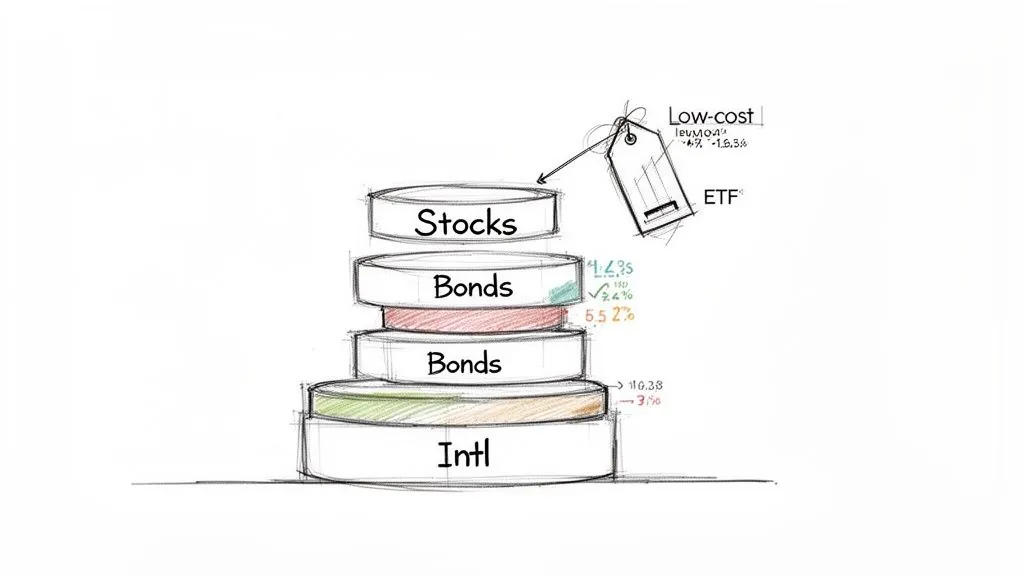
Passive investing through low-cost index funds and exchange-traded funds (ETFs) is a cornerstone strategy for building wealth without the complexity of stock picking. Instead of trying to beat the market, you aim to match its performance by investing in funds that track major indices like the S&P 500 or the total global stock market. This approach offers instant diversification at a fraction of the cost of actively managed funds.
Why It’s a Top Way to Grow Wealth
This method consistently outperforms the vast majority of professional, active fund managers over long periods, a fact championed by legendary investors like Warren Buffett. Its power comes from extremely low fees (known as expense ratios) and broad market exposure, which minimizes risk from the failure of any single company. This set-it-and-forget-it nature makes it one of the best ways to grow wealth for those who prefer a hands-off, evidence-based approach.
Actionable First Steps
- Open a Brokerage Account: Choose a low-cost provider such as Vanguard, Fidelity, or Charles Schwab that offers a wide selection of index funds and ETFs.
- Build a Simple Portfolio: Start with a diversified core. A popular strategy is the “three-fund portfolio” consisting of a US total stock market fund (like VTI), an international stock market fund (like VXUS), and a total bond market fund (like BND).
- Prioritize Low Fees: Focus on funds with expense ratios below 0.25%. These small percentages compound significantly over time, and keeping them low ensures more of your money works for you.
Pro Tip: Use a tool like PopaDex to connect all your brokerage accounts. This gives you a consolidated view of your entire index fund and ETF portfolio, making it easy to monitor your asset allocation and track overall performance against your wealth-building goals.
7. Income Diversification & Side Business Development
Relying on a single salary is like building a house on one pillar; it’s stable until it isn’t. Income diversification involves creating multiple revenue streams beyond your primary job, such as freelancing, a side business, or passive income ventures. This strategy reduces your financial risk from a potential job loss and dramatically accelerates your ability to save and invest. By increasing your total cash flow, you can channel more capital into wealth-building assets.
Why It’s a Top Way to Grow Wealth
This method directly increases the “supply” side of your wealth equation. While budgeting focuses on managing outflows, diversifying income boosts inflows, providing more fuel for investments. It transforms your time and skills into new assets, whether you’re a software developer freelancing for an extra €2,000 a month or a marketer building a niche affiliate website. This approach builds resilience and creates financial options, making it one of the best ways to grow wealth proactively.
Actionable First Steps
- Monetize Your Skills: Identify a skill from your primary job (e.g., writing, graphic design, coding) and offer it on platforms like Upwork or Fiverr to test the market.
- Explore Low-Friction Ideas: Start with ventures that require minimal upfront capital, such as creating a digital product, tutoring online, or starting a content-based business.
- Validate Before Committing: Treat your side business as an experiment. Test your idea with a small audience and validate its profitability before considering a larger commitment or leaving your main job.
Pro Tip: Managing multiple income streams requires clear tracking. Use a tool like PopaDex to categorize and monitor each source of income separately. This provides a precise overview of your total earnings and helps you calculate the profitability of each venture, ensuring your efforts are generating a real return.
8. Emergency Fund Building & Cash Reserves
Building a robust emergency fund is not just a defensive move; it’s a critical offensive strategy for wealth growth. This involves setting aside 3-12 months of essential living expenses in a liquid, easily accessible account. This cash reserve acts as a financial firewall, protecting you from unexpected life events like a job loss or medical emergency without forcing you to liquidate long-term investments at a loss or accumulate high-interest debt.
Why It’s a Top Way to Grow Wealth
An emergency fund provides the stability and psychological security needed to invest confidently for the long term. It prevents forced, poorly timed sales of your assets, allowing your investments to compound uninterrupted. This separation of short-term safety from long-term growth is a cornerstone of sustainable financial health. It ensures that a temporary setback doesn’t derail years of disciplined wealth-building efforts, making it one of the best ways to grow wealth securely.
Actionable First Steps
- Calculate Your Target: Tally your non-negotiable monthly expenses (rent/mortgage, utilities, food, insurance) and multiply by 6-12, depending on your job stability and risk tolerance. For example, with €2,000 in monthly expenses, aim for a €12,000 to €24,000 fund.
- Open a Separate Account: Choose a high-yield savings account (HYSA) that is separate from your daily checking account to reduce the temptation to spend it.
- Automate Your Savings: Set up automatic monthly transfers to your HYSA. Even small, consistent contributions will build the fund over time. Treat this transfer like any other essential bill.
Pro Tip: Track your emergency fund in a net worth tracker like PopaDex, but categorize it distinctly from your investment portfolio. This gives you a clear, real-time view of your total liquidity and helps you see how this cash cushion supports your overall wealth-building journey without distorting your investment performance metrics.
9. Retirement Account Maximization
Strategically maximizing contributions to tax-advantaged retirement accounts is a cornerstone of smart financial planning. These accounts, like a 401(k), IRA, ISA, or TFSA, are specifically designed to help your money grow more efficiently by offering significant tax benefits. Whether through tax-deferred contributions, tax-free growth, or tax-free withdrawals, these vehicles accelerate the power of compounding by shielding your investments from taxes year after year.
Why It’s a Top Way to Grow Wealth
The primary advantage is the “tax wrapper” that protects your investments. In a standard brokerage account, you pay taxes on dividends and capital gains annually, which slows down growth. Retirement accounts defer or eliminate these taxes, allowing your entire investment to compound more rapidly. Many employers also offer a contribution match, which is essentially free money and an instant 100% return on your investment up to the matched amount. This combination makes it one of the most effective ways to grow wealth.
Actionable First Steps
- Capture the Full Employer Match: If your employer offers a 401(k) match, contribute at least enough to get the full amount. Not doing so is leaving guaranteed money on the table.
- Understand Your Account Options: Research the differences between traditional (tax-deferred) and Roth (tax-free growth) accounts. If you expect to be in a higher tax bracket in retirement, a Roth may be more beneficial.
- Automate and Maximize: Set up automatic contributions from your paycheck to max out your accounts annually if possible. For 2024 in the U.S., this means up to $23,000 for a 401(k) and $7,000 for an IRA.
Pro Tip: As you change jobs, you might accumulate multiple retirement accounts. A net worth tracker like PopaDex is crucial for consolidating the view of these scattered assets, allowing you to see your total retirement picture and rebalance your overall portfolio allocation with clarity.
Leveraging these powerful accounts is a non-negotiable step for long-term financial success. You can learn more about retirement planning strategies to ensure you are on the right path.
10. Expense Tracking & Conscious Spending Optimization
Understanding exactly where your money goes is the foundation of any successful wealth-building plan. This strategy involves meticulously tracking your expenses to gain clarity on your spending habits, then consciously optimizing those habits to increase the gap between your income and outgoings. This creates a larger surplus that can be redirected toward investments, debt repayment, or other financial goals, directly accelerating your journey to wealth.

Why It’s a Top Way to Grow Wealth
Wealth isn’t just about how much you earn; it’s about how much you keep. By tracking your spending, you move from passively watching money leave your account to actively directing it. This heightened awareness often reveals “leaks,” like a forgotten €12/month subscription that has cost over €432 in three years, or opportunities to optimize, such as saving €300/month on groceries. This method empowers you to align your spending with your values, ensuring your money serves your long-term goals.
Actionable First Steps
- Choose Your Tracking Tool: Use a dedicated app or a net worth tracker with expense categorization features. Connecting all your accounts provides a comprehensive, automated view of your spending.
- Categorize and Analyze: For one month, categorize every expense. Look for patterns, especially in high-impact areas like food, subscriptions, and entertainment. Identify where your spending is unconscious or misaligned with your priorities.
- Optimize and Redirect: Target one or two categories for optimization. Focus on recurring expenses first for the greatest long-term impact. For example, identify €500 in discretionary spending and set up an automatic transfer for that amount into your investment account.
Pro Tip: Use PopaDex’s disposable income calculator after linking your accounts to instantly see how much cash is left after all fixed expenses. This clarifies exactly what you have available to optimize and redirect, making it one of the best ways to grow wealth by turning awareness into action.
To master your cash flow, you can learn more about creating a personal budget. This disciplined financial oversight is crucial for maximizing your savings and investment potential.
11. Long-Term Goal Setting & Net Worth Tracking
Establishing specific, measurable financial goals and systematically tracking your net worth is the strategic backbone of wealth creation. This approach transforms a vague desire for more money into a clear, actionable plan. By setting concrete targets, such as achieving a €1 million net worth by age 45, you create the accountability and motivation needed to stay disciplined over the long haul.
Why It’s a Top Way to Grow Wealth
This method turns wealth building from a passive hope into an active pursuit. Regularly tracking your progress provides tangible evidence that your strategies are working, which reinforces positive financial habits. It allows you to make informed decisions, identify which assets are performing well, and adjust your plan when needed. Without clear goals and consistent tracking, it’s easy to lose focus and drift financially.
Actionable First Steps
- Define Your Milestones: Set specific, time-bound goals. For example, “Increase my net worth from €250k to €500k in five years” by saving €20,000 annually and targeting a 7% investment return.
- Choose Your Tracking Tool: Select a platform that can aggregate all your financial accounts, including investments, real estate, and liabilities, across multiple currencies.
- Schedule Regular Check-ins: Commit to updating and reviewing your net worth on a monthly or quarterly basis. This regular cadence keeps you engaged with your progress and helps you spot trends.
Pro Tip: Using a comprehensive tool like PopaDex to create a visual dashboard of your progress can be highly motivating. Seeing your net worth chart climb over time provides the positive feedback loop needed to sustain your efforts for years, making it one of the best ways to grow wealth.
To see how this works in practice, you can explore how a net worth tracker works. This disciplined system of goal-setting and monitoring provides the clarity and direction essential for achieving financial independence.
12. Systematic Rebalancing & Portfolio Adjustment Strategy
Systematic rebalancing is the disciplined practice of periodically buying or selling assets in your portfolio to maintain your original target asset allocation. As markets fluctuate, some investments will grow faster than others, causing your portfolio to “drift” away from its intended risk level. Rebalancing forces you to systematically sell high and buy low, locking in gains and reinvesting in undervalued assets.
Why It’s a Top Way to Grow Wealth
This strategy enforces financial discipline and keeps your portfolio aligned with your long-term risk tolerance. Without rebalancing, a portfolio heavily weighted in stocks could become overly aggressive after a bull market, exposing you to significant losses in a downturn. It removes emotion from the process, turning market volatility into an opportunity to strengthen your position rather than a source of panic. This structured approach is one of the best ways to grow wealth by managing risk effectively.
Actionable First Steps
- Define Target Allocations: Determine your ideal mix of assets based on your goals and risk tolerance (e.g., 60% stocks, 30% bonds, 10% real estate).
- Set Rebalancing Triggers: Decide on a schedule (quarterly, annually) or a threshold (e.g., rebalance when any asset class drifts by more than 5%). A common approach is to rebalance every January.
- Execute the Rebalance: Sell over-performing assets and use the proceeds to buy under-performing ones. If possible, use new contributions to buy the underweighted assets to minimize taxes and transaction fees.
Pro Tip: Managing a multi-currency or complex portfolio makes tracking allocations difficult. A net worth tracker like PopaDex provides a unified dashboard that shows your precise asset allocation across all accounts, making it easy to see when a rebalance is needed.
12 Wealth-Building Strategies Comparison
| Strategy | 🔄 Implementation Complexity | ⚡ Resource Requirements | 📊 Expected Outcomes | 💡 Ideal Use Cases | ⭐ Key Advantages |
|---|---|---|---|---|---|
| Automated Investment & Dollar-Cost Averaging | Low — set-and-forget automation | Low cash flow + platform fees | Consistent compound growth, reduced timing risk | New investors, long-term accumulation, payroll automation | Discipline, volatility smoothing, low effort |
| Diversified Portfolio Management Across Asset Classes | Medium–High — allocation & rebalancing needed | Medium — multiple accounts, tracking tools | Improved risk‑adjusted returns, smoother cycles | Investors seeking stability and global exposure | Reduces unsystematic risk, smoother returns |
| Real Estate Investment & Property Appreciation | High — transactions, management, cross-border rules | High — capital, financing, management overhead | Rental income + long-term appreciation (illiquid) | Investors with capital or seeking cash flow, inflation hedge | Tangible asset, leverage amplifies returns |
| Tax Optimization & Strategic Deductions | High — complex, jurisdiction-specific rules | Low–Medium — time or professional fees | Higher after‑tax returns, faster wealth accumulation | Self‑employed, high earners, expats | Direct boost to net accumulation via tax savings |
| Aggressive Debt Paydown & Liability Elimination | Low–Medium — choose & execute strategy | Medium — extra cash flow, possible refinancing costs | Guaranteed return = interest saved; improved net worth | Holders of high‑interest debt seeking cash‑flow relief | Eliminates interest burden, psychological momentum |
| Index Fund & ETF Investing | Low — simple implementation | Low — minimal fees, low minimums | Market returns with broad diversification | Busy professionals, passive investors, DCA strategies | Low cost, broad diversification, simplicity |
| Income Diversification & Side Business Development | Medium–High — build and scale ventures | Medium — time, skills, startup capital | Potentially large income upside; variable stability | Entrepreneurs, freelancers, those seeking faster growth | Multiple income streams, high upside potential |
| Emergency Fund Building & Cash Reserves | Low — straightforward saving rules | Medium — idle liquid cash (opportunity cost) | Financial resilience; prevents forced asset sales | Everyone, especially with unstable income | Liquidity, peace of mind, downside protection |
| Retirement Account Maximization | Medium — learn limits & rules | Medium — contribution capacity, employer match | Tax‑advantaged compounding; large long‑term gains | All workers, especially with employer match | Tax deferral/free money from employer matching |
| Expense Tracking & Conscious Spending Optimization | Low–Medium — consistent tracking required | Low — time or automated tools | Increased savings rate to deploy toward goals | Budgeters, those wanting to free cash flow | Reveals savings, high ROI for low effort |
| Long-Term Goal Setting & Net Worth Tracking | Low–Medium — planning + regular monitoring | Low — tools/time to track | Better discipline, measurable progress toward milestones | Goal‑oriented savers, FI movement adherents | Accountability, motivated decision‑making |
| Systematic Rebalancing & Portfolio Adjustment Strategy | Medium — monitoring & execution rules | Low–Medium — trades, tax/transaction costs | Maintains risk profile, can modestly improve returns | Investors with target allocations and drift risk | Disciplined buy‑low/sell‑high, risk control |
Integrate, Track, and Accelerate Your Wealth Journey
The path to financial independence isn’t paved with a single secret formula. Instead, the best ways to grow wealth are built upon a foundation of interconnected strategies, each one strengthening the others. From the disciplined consistency of automated dollar-cost averaging to the strategic foresight of tax optimization and the powerful growth engine of diversified investing, you now have a comprehensive blueprint. The strategies detailed in this guide are not just isolated tactics; they are components of a holistic financial ecosystem.
The true acceleration begins when these components work in harmony. Aggressively paying down high-interest debt frees up capital that can then be funneled into maximizing your retirement accounts. Developing a side business diversifies your income, creating a robust cash flow to build your emergency fund and invest more heavily in real estate or index funds. Each action creates a positive ripple effect, compounding your efforts and propelling you toward your goals faster than any single strategy could alone.
From Blueprint to Reality: The Power of Clarity
Knowledge is the first step, but consistent action is what builds fortunes. The common thread weaving through all twelve of these powerful wealth-building methods is the non-negotiable need for clarity and control. You cannot optimize what you do not measure. This is where the discipline of tracking becomes your most valuable asset.
Attempting to manage a diversified portfolio, track property appreciation, monitor multiple income streams, and optimize spending across various accounts without a centralized system is like trying to conduct an orchestra without a conductor. Information gets lost, opportunities are missed, and it becomes nearly impossible to make informed, strategic decisions. A clear, real-time view of your entire financial landscape is what transforms a collection of good habits into a deliberate, high-performance wealth-building machine.
Key Takeaway: The most successful wealth builders don’t just implement smart strategies; they obsessively track their progress. This feedback loop allows them to identify what’s working, pivot when necessary, and stay motivated by seeing the tangible results of their discipline.
Your Actionable Path Forward
The sheer volume of information can feel overwhelming, but progress starts with a single step. Here’s how you can translate the insights from this article into immediate action:
-
Select Your Starting Point: You don’t have to implement everything at once. Review the twelve strategies and choose two or three that resonate most with your current financial situation and goals. Is high-interest debt your biggest obstacle? Start with an aggressive paydown plan. Are you a young professional with a long time horizon? Focus on maximizing retirement accounts and automated index fund investing.
-
Establish Your Baseline: The most critical first action is to get a complete and accurate picture of where you stand today. Calculate your net worth by listing all your assets (cash, investments, property, etc.) and subtracting all your liabilities (loans, credit card debt, mortgages). This number is your starting line.
-
Commit to a Tracking System: This is the cornerstone that supports all other efforts. A dedicated net-worth tracker is essential for managing the complexity of modern finances, especially for those with multi-currency assets or diverse investment types. A tool like PopaDex consolidates everything from your brokerage accounts and international holdings to your daily budget and property values, providing a single source of truth. This automated clarity frees you to focus on strategy, not spreadsheets.
-
Set a “Review and Rebalance” Cadence: Schedule time on your calendar, perhaps quarterly or semi-annually, to review your progress against your goals. This is your dedicated time to assess your portfolio’s performance, rebalance your asset allocation, and ensure your spending aligns with your wealth-building objectives.
The journey to building significant wealth is a marathon, defined by consistent, informed actions over time. By integrating these powerful strategies and committing to a rigorous tracking discipline, you are not just hoping for a better financial future; you are actively engineering it. The control and confidence that come from knowing your exact financial position at all times is the ultimate catalyst for growth.
Ready to stop guessing and start tracking? Gain a crystal-clear, consolidated view of your entire financial world with PopaDex. Integrate all your accounts, track your net worth in real-time, and make smarter decisions on your journey to financial independence. Sign up for free at PopaDex and take control of your wealth today.