
Our Marketing Team at PopaDex
How to Calculate Bond Yield for Better Returns
Relying only on a bond’s price or its coupon rate is a classic mistake that will almost certainly cap your returns. If you want to get a real sense of an investment’s potential, you have to calculate bond yield. This is what shows your actual rate of return based on the price you paid, and honestly, it’s the single most important number for sizing up fixed-income opportunities.
Why Bond Yield Is More Important Than Price
When you’re building out a portfolio, the sticker price of a bond is really just one part of the puzzle. The true value is hiding in its yield—what it actually earns you over its lifetime. Unlike the coupon rate, which is set in stone, a bond’s yield moves with the market, giving you a live, accurate read on its performance. It’s why seasoned investors always start with the yield calculations.
The focus on yield has become even more critical since the 2008 financial crisis, which pushed central banks into a new era of actively managing interest rates. The concept is straightforward: yield simply expresses your return as a percentage.
Let’s say you buy a government bond with a $1,000 par value but you snag it at a discount for $950. If it pays a $50 annual coupon, your current yield isn’t the coupon rate. It’s $50 divided by your $950 cost, which comes out to approximately 5.26%.
Right away, that simple math tells you more than the coupon rate ever could. It connects your return directly to what you paid out of pocket.
The Three Pillars of Bond Yield Analysis
To get the full picture, you can’t just stop at one number. Investors lean on three main calculations to evaluate a bond’s total value from different perspectives. Each one tells a slightly different story.
This infographic breaks down these three essential yield calculations and highlights where each one shines the brightest.
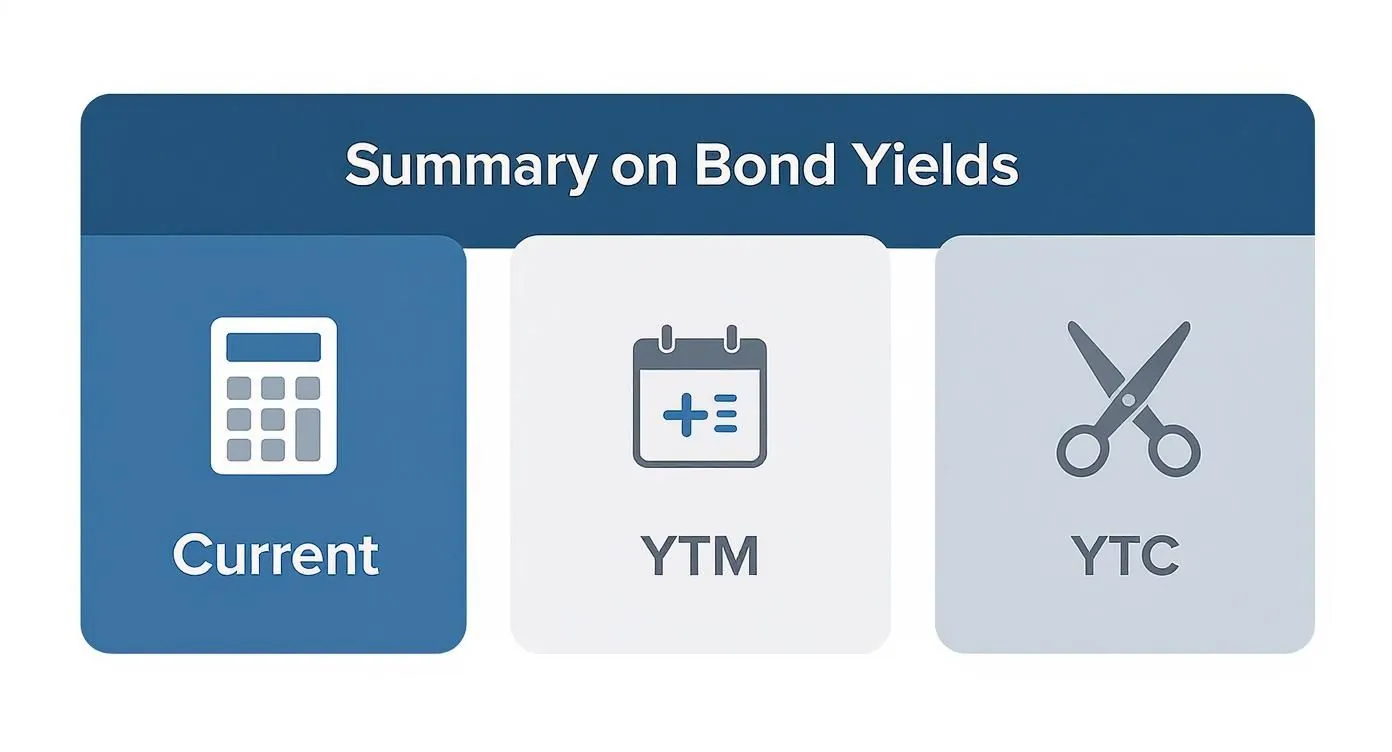
As you can see, each calculation has its place, whether you need a quick snapshot of your immediate return or a more detailed, long-term projection that factors in the time value of money.
Getting a grip on these concepts is fundamental. In fact, the logic behind yield to maturity is closely tied to understanding the future value of money and how an investment compounds over its lifespan. We’ll dig into each of these yield metrics next, giving you the tools to make much smarter, more strategic bond-buying decisions.
Key Bond Yield Metrics at a Glance
To keep things clear, here’s a quick summary of the different bond yield calculations we’ll cover. Think of this as your cheat sheet for knowing which metric to use and when.
| Yield Type | What It Measures | Best For |
|---|---|---|
| Current Yield | Annual income as a percentage of the bond’s current market price. | A quick, simple snapshot of the return on your investment right now. |
| Yield to Maturity (YTM) | The total expected return if you hold the bond until it matures. | Comprehensive, long-term analysis of a bond’s total potential return. |
| Yield to Call (YTC) | The total return if the bond is redeemed by the issuer before maturity. | Assessing callable bonds and understanding your potential return in an early redemption scenario. |
| Approximate Yield | A simplified estimation of YTM or YTC without complex calculations. | Quick, back-of-the-napkin estimates when a precise calculation isn’t needed. |
This table helps frame the purpose of each calculation. While Current Yield is great for a fast check-up, YTM and YTC give you a much more complete forecast of a bond’s performance over time.
Calculating Current Yield for a Quick Snapshot
If you need a quick, back-of-the-napkin way to gauge a bond’s earning power, the current yield is your best friend. It’s the most straightforward calculation in the bond world, giving you an immediate sense of the return you’ll get from the bond’s annual income compared to what it costs right now.
Think of it like sizing up a rental property. You wouldn’t just look at the total annual rent; you’d instinctively compare that income to the property’s current market value to see if it’s a good deal. Current yield does the exact same thing for a bond.
The Simple Formula for Current Yield
You don’t need a fancy financial calculator or a complicated spreadsheet for this one. It’s a simple, direct comparison between the bond’s yearly interest payment and its current trading price.
Here’s the formula: Current Yield = (Annual Coupon Payment / Current Market Price) x 100
Let’s quickly break down those two parts:
- Annual Coupon Payment: This is the fixed dollar amount of interest the bond pays each year. Just multiply the bond’s face value (typically $1,000) by its coupon rate.
- Current Market Price: This is what the bond is actually selling for on the open market today. This price moves up and down based on interest rates and general market vibes.
Key Takeaway: Current yield is a live metric. While the coupon rate is set in stone, the current yield changes every time the bond’s market price moves. This gives you a much more relevant picture of your potential return at any given moment.
A Practical Example in Action
Let’s run the numbers with a real-world scenario. Say you’re looking at a corporate bond with these specs:
- Face Value: $1,000
- Coupon Rate: 4%
- Current Market Price: $975
First, figure out the annual coupon payment. It’s simply 4% of the $1,000 face value, which comes out to $40 per year. Easy enough.
Now, plug it into the formula. You divide that $40 annual payment by the bond’s current price of $975.
Current Yield = ($40 / $975) x 100 = 4.10%
So, even though the bond has a stated 4% coupon rate, your current yield is actually a bit higher at 4.10%. Why? Because you’re able to buy it at a discount—for less than its face value. This simple math instantly tells you that you’re getting a slightly better immediate return than the coupon rate alone would suggest.
But here’s the catch. This metric has a major blind spot. It only accounts for the income you’ll get this year and completely ignores the capital gain you’ll pocket at maturity when you get back the full $1,000 face value. For a truly complete picture, we need to dig a little deeper.
Unlocking Total Return with Yield to Maturity
Current yield is a great starting point, but its biggest blind spot is that it completely ignores the future. That’s where Yield to Maturity (YTM) comes in. Frankly, this is the most important metric for any serious bond investor because it calculates your total annualized return if you hold the bond until it’s paid back in full.
Unlike the simpler current yield, YTM gives you the full story by accounting for three critical factors:
- The annual coupon payments you’ll collect.
- The difference between the price you paid and the face value you’ll get back at maturity—your capital gain or loss.
- The compounding effect of reinvesting those coupon payments over the life of the bond.
YTM provides a complete picture of a bond’s long-term value, making it the gold standard for comparing different bond opportunities. It’s a bit more involved, sure, but it’s essential for making truly informed investment decisions. This concept is closely related to the idea of a cumulative rate of return, as both aim to capture the total growth of an investment over a specific period.
The Components of a YTM Calculation
Look, nobody calculates YTM by hand anymore. It involves a complex trial-and-error formula that even financial pros skip in favor of software. But to use those tools effectively, you need to know what pieces of the puzzle they’re working with.
Let’s imagine you’re eyeing a 10-year corporate bond. You’ll need to gather this info:
- Settlement Date: The day you actually buy the bond.
- Maturity Date: The day the bond’s face value is repaid.
- Coupon Rate: The bond’s stated annual interest rate.
- Price (pr): What you pay per $100 of face value.
- Redemption: The amount paid back at maturity per $100 of face value (this is almost always 100).
- Frequency: How many coupon payments you get per year (usually 2 for semi-annually).
These inputs cover every financial event in the bond’s life, from the day you buy it to the day it pays you back.
Pro Tip: When you calculate bond yield to maturity, you’re finding the exact interest rate (the “yield”) that makes the present value of all the bond’s future cash flows equal to its current market price. It’s the ultimate equalizer for comparing bonds with different prices, coupon rates, and maturities.
How to Calculate YTM in Excel or Google Sheets
Forget the manual math. The most practical way to find YTM is with the built-in YIELD function in Excel and Google Sheets. It does all the heavy lifting behind the scenes.
The formula looks like this:
=YIELD(settlement, maturity, rate, pr, redemption, frequency)
Let’s plug in a real-world scenario. You’re looking to buy a bond with these details:
- Settlement Date: 1/15/2024
- Maturity Date: 1/15/2034 (a 10-year bond)
- Coupon Rate: 5% (entered as 0.05)
- Current Price: $950, which translates to $95 per $100 of face value.
- Redemption Value: $100 (the standard face value at maturity)
- Frequency: 2 (for semi-annual payments)
In your spreadsheet, you’d type this out:
=YIELD("2024/1/15", "2034/1/15", 0.05, 95, 100, 2)
The result? 5.73%. This is your true annualized return if you hold that bond for all 10 years. Notice how it’s significantly higher than both the 5% coupon rate and the 5.26% current yield ($50 / $950). That’s because it smartly factors in the $50 capital gain you’ll realize when the bond matures.
This kind of precision is what helps you accurately compare bonds. For example, a look at Netherlands’ government bonds showed that on November 14, 2025, yields ranged from 1.97% for 1-month bonds to over 2.4% for 6-year bonds. Understanding YTM allows an investor to see the true return differences across these varying timeframes and make smarter choices. You can explore more of these global bond yield variations on Investing.com.
Navigating Callable Bonds with Yield to Call
Just when you think you’ve got a bond’s return figured out, you can get thrown a curveball. In the world of corporate and municipal bonds, this often comes in the form of a call provision.
This is a clause that gives the issuer the right—but not the obligation—to buy back your bond before it matures. For you, the investor, this creates uncertainty and something called reinvestment risk.
So, why would they do this? It’s all about interest rates. Imagine a company issues a bond with a 6% coupon. A few years later, market rates have dropped to 4%. The company can save a ton of money by “calling” that old, expensive 6% debt and issuing new bonds at the cheaper 4% rate.
Because of this possibility, the Yield to Maturity (YTM) you calculated might be completely irrelevant. If your bond gets called early, your actual return changes. That’s why you absolutely have to calculate the bond’s yield to call (YTC). This tells you the annualized return you’ll get if the bond is redeemed at the earliest possible date.
How the YTC Calculation Works
The good news is that calculating YTC is almost identical to calculating YTM. You’re just tweaking two of the inputs to reflect the early redemption. You’re solving for the yield based on a shorter timeline and a slightly different final payout.
Here are the two critical adjustments:
- Maturity Date becomes the Call Date: Instead of using the bond’s final maturity date, you plug in the first date the issuer is allowed to call it back.
- Face Value becomes the Call Price: To make the early redemption a little more palatable for investors, issuers often pay a small premium. This “call price” is usually a bit higher than the bond’s standard $1,000 face value—say, $1,040.
These changes can dramatically alter your expected return, especially if you bought the bond at a discount. An early call cuts short the time you have to earn interest and for the price to accrete towards par value.
Investor Insight: Before you ever buy a bond, dig into its prospectus and find the call schedule. The call dates and prices are non-negotiable details that can make or break your investment. One of the costliest mistakes an investor can make is assuming a callable bond will be held to maturity.
Calculating YTC in a Spreadsheet
Let’s walk through a real-world example. You’re looking at a 10-year bond with a 5% coupon. You can buy it today for $980 (a discount). The catch? It’s callable in 5 years at a call price of $1,040.
You can find the YTC by adapting the same YIELD function in Excel or Google Sheets. The logic doesn’t change, you just swap in the call data.
- Settlement: “2024/1/15”
- Maturity (use Call Date instead): “2029/1/15” (5 years out)
- Rate: 0.05 (for the 5% coupon)
- Pr (Price): 98 (price per $100 of face value)
- Redemption (use Call Price instead): 104 (the call price per $100)
- Frequency: 2 (for semi-annual payments)
Your spreadsheet formula will look like this:
=YIELD("2024/1/15", "2029/1/15", 0.05, 98, 104, 2)
The answer is a YTC of 6.62%.
For comparison, the YTM for this same bond (if held for the full 10 years) would be 5.26%. This leads us to the single most important rule for callable bonds.
Whenever you analyze a callable bond, you have to calculate both YTM and YTC. Since an issuer will always act in its own best financial interest, you have to plan for the worst-case scenario from your perspective. This is called the yield-to-worst, and it’s simply the lower of the YTM and YTC. It’s the most conservative—and realistic—return you should expect.
How to Interpret What Your Bond Yield Means
Calculating a bond’s yield is a huge step, but the numbers are only half the story. The real skill is turning those percentages into smart investment decisions. This is where you graduate from just doing math to actually building a strategy.
The first, most fundamental concept to get your head around is the seesaw relationship between bond prices and yields. It’s simple: when market interest rates go up, new bonds are issued with juicier returns. This makes your older, lower-coupon bond look less appealing, so its price on the market has to drop.
That price drop is what pushes its yield up for a new buyer, bringing it back in line with the current market. This dynamic is always at play, and understanding it is the key to not panicking when you see your bond’s market value fluctuate.
Using Yield for Comparison and Risk Assessment
Your calculated yield is the ultimate tool for comparing different fixed-income opportunities on a true apples-to-apples basis. A 4% coupon bond trading at a discount might actually offer a better total return (YTM) than a 5% coupon bond trading at a premium. Without running the numbers, you’d never know.
Yield also doubles as a pretty reliable, if informal, risk indicator. If you spot a corporate bond with a yield that’s miles higher than a government bond with a similar maturity date, that’s a massive red flag. The market is screaming that the corporate bond carries significantly more credit risk—the chance the company could just stop paying you.
Investor Takeaway: Don’t get seduced by an unusually high yield. Always ask why it’s so high. More often than not, it’s a warning sign about the issuer’s financial health.
The Broader Economic Context
No bond exists in a vacuum. Your yield calculations are tied directly to what’s happening in the wider economy, making them a powerful barometer for what’s going on.
A few key factors shape bond yields across the entire market:
- Central Bank Policies: When a central bank like the Federal Reserve hikes interest rates to fight inflation, nearly all bond yields tend to climb with it.
- Inflation Expectations: If investors think inflation is about to spike, they’ll demand higher yields to protect the real, inflation-adjusted return on their money.
- Economic Growth: A booming economy often pushes yields higher as companies and governments compete for capital to fund new projects.
Professional investors live and breathe these calculations. For instance, as U.S. Treasury yields climbed from their pandemic-era lows through November 2025, having an accurate handle on yield was absolutely essential for valuing securities and managing portfolio risk. You can dive into the historical data yourself by reviewing this analysis from NYU Stern to see these trends in action.
Ultimately, when you calculate bond yield, you’re creating a data point that helps you understand not just a single investment, but its place in the bigger picture. This insight is essential for building a resilient portfolio and understanding the true performance of your assets—a core part of tracking your average rate of return.
Answering Your Top Bond Yield Questions
Once you get the hang of the formulas, you start running into those real-world “what if” scenarios. Let’s tackle some of the most common questions that pop up when you start calculating bond yields. Think of this as the practical advice I wish I’d had when I first started.
Clearing up these points will make your analysis much sharper.
What’s the Real Difference Between Coupon Rate and Yield?
This is easily the most common mix-up, but the distinction is everything.
The coupon rate is set in stone. It’s the fixed annual interest payment the issuer promises, calculated from the bond’s original face value. It will never change during the bond’s entire life.
Yield, on the other hand, is your actual return on the money you invested. It’s a dynamic number that depends entirely on the price you paid for the bond in the open market.
- If you buy a bond below its face value (at a discount), your yield will climb higher than the coupon rate.
- But if you pay more than face value (at a premium), your yield will be lower.
Bottom line: The coupon rate is what the bond pays. The yield is what you earn. Yield is the number that truly matters for your decision-making.
How Do I Figure Out the Yield for a Zero-Coupon Bond?
Zero-coupon bonds feel like a different beast because they don’t have those regular interest payments. Your entire profit comes from one single event: the difference between the deeply discounted price you pay today and the full face value you get back when it matures.
So, does this require some weird, specialized formula? Not at all.
The yield on a zero-coupon bond is simply its Yield to Maturity (YTM).
Practical Tip: To calculate this in a spreadsheet, you use the exact same
YIELDfunction we covered for YTM. The only tweak is you input ‘0’ for the ‘rate’ argument, since the coupon rate is zero. The function does the heavy lifting, automatically calculating your effective annualized return.
Why Did My Bond’s Price Just Drop When Interest Rates Went Up?
This is the fundamental see-saw relationship that drives the entire bond market. It’s a concept every investor needs to get comfortable with.
Imagine you own a bond with a 3% coupon. Suddenly, the central bank raises rates, and new bonds are being issued with a 4% coupon. Your older, lower-paying bond instantly looks less appealing, right?
For anyone to consider buying your 3% bond, its price has to drop. This price decline effectively boosts the bond’s yield for the next owner, bringing its total return in line with the new, higher-rate bonds available. It’s a self-correcting market mechanism.
So, whenever you hear news about rising market interest rates, you can be sure that the market value of your existing bonds will head in the opposite direction.
Ready to see how your own bond investments fit into your complete financial picture? With PopaDex, you can track all your assets—from stocks and bonds to property and cash—in one clear, intuitive dashboard. Stop juggling spreadsheets and start making smarter decisions with a real-time view of your net worth. Get started for free today at PopaDex.