
Our Marketing Team at PopaDex
Master Your Money with Centralized Financial Management
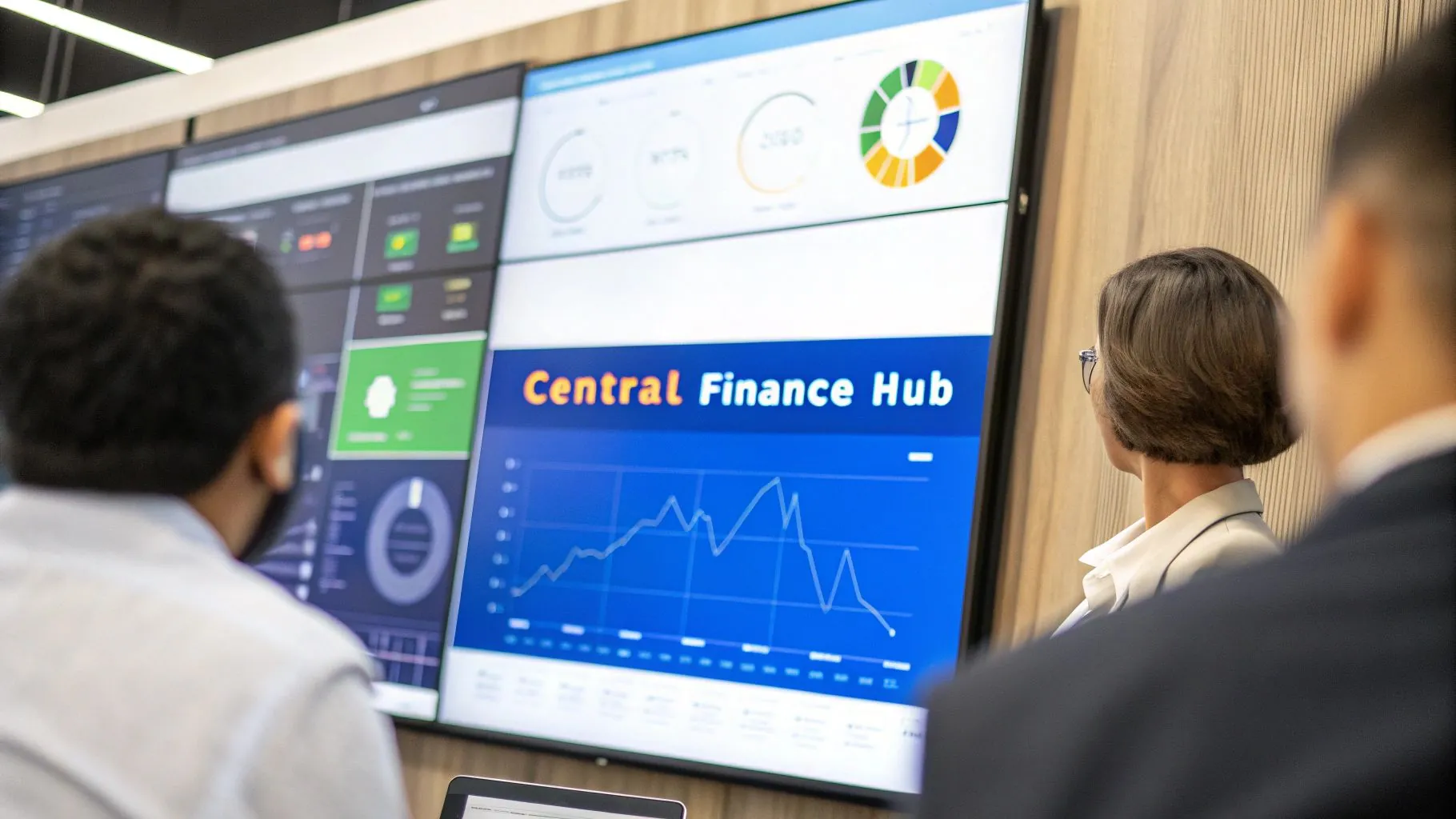
If you’ve ever tried to figure out your exact financial standing, you know the drill. You log into your banking app. Then your brokerage app. Then the credit card portal. Maybe you check a separate crypto wallet, too. Each one gives you a tiny sliver of the picture, but never the whole thing. It’s chaotic, inefficient, and honestly, a bit of a headache.
That scattered approach is how most people manage their money. It’s like trying to captain a ship by running to a dozen different windows to check the engine, the sails, and the rudder separately.

Centralized financial management is the modern alternative. Think of it as stepping onto a captain’s bridge with a single, comprehensive dashboard showing you everything at once. It’s not about becoming a professional accountant; it’s about finally bringing all your scattered financial pieces into one clear, coherent overview.
From Financial Chaos to Confident Control
Let’s be real: our financial lives are more fragmented than ever. With countless apps and digital accounts, just keeping track is a full-time job. A centralized system cuts through that noise by automatically pulling data from all your sources into one place.
This process is powered by a technology called financial data aggregation. It’s the engine that takes all the raw data from your various accounts and turns it into something you can actually use.
To give you a better idea of what this looks like in practice, here’s a quick comparison of the old way versus the new way.
Decentralized vs. Centralized Personal Finance
| Aspect | Decentralized (Traditional) | Centralized (Modern) |
|---|---|---|
| Financial Overview | Fragmented; requires logging into multiple apps and sites. | Holistic; all accounts are visible on a single dashboard. |
| Net Worth Tracking | Manual and time-consuming; often calculated in a spreadsheet. | Automatic and real-time; updates as your accounts change. |
| Decision-Making | Based on incomplete data, leading to guesswork. | Informed by a complete picture, enabling strategic choices. |
| Time Commitment | High; involves significant manual data entry and checking. | Low; data is synced automatically, saving you hours. |
| Error Potential | High risk of manual errors, typos, and outdated information. | Low risk of error; data is pulled directly from the source. |
Switching to a centralized view means you can finally get straight answers to the important questions, instantly.
- See Your True Net Worth: No more guesstimating. You know your total assets minus your total liabilities, down to the penny.
- Track Spending Effortlessly: Finally understand where your money is actually going without wrestling with manual spreadsheets.
- Make Smarter Decisions: With a clear view of the entire board, you can spot opportunities, catch potential issues early, and plan for the future with real confidence.
By consolidating your financial data, you shift from reactively managing separate accounts to proactively steering your entire financial future from a single command center.
Ultimately, this approach provides the clarity you need to navigate your financial journey effectively. Instead of feeling overwhelmed by disconnected information, you gain a powerful, holistic perspective that empowers you to build wealth with intention.
If you want to dive deeper into the tech that makes this all possible, check out our guide to financial data aggregation.
The Real Payoff of a Unified Financial View
Bringing all your finances under one roof does more than just clean up your spreadsheets—it fundamentally changes how you see and interact with your money. You stop making educated guesses and start making sharp, data-driven decisions. It’s the difference between navigating with a compass and navigating with GPS.
The first thing you’ll notice is the immediate clarity on your net worth. Forget digging through different apps and statements to tally up balances. A unified dashboard calculates it for you instantly. This single, hard number becomes your north star for building wealth, transforming a fuzzy concept of “financial health” into a metric you can actually track and improve.
Finally Simplify Your Budgeting and Spending
One of the biggest money mysteries for most people is figuring out where it all goes. A centralized system solves this puzzle by automatically pulling in and categorizing transactions from every account you link. It’s like having a financial detective on your team, revealing spending patterns you’d otherwise miss.
All of a sudden, you see exactly how much you’re spending on dining out, subscriptions, or travel across all your cards combined. This kind of clarity makes it shockingly simple to set a realistic budget, spot places to cut back, and funnel that cash toward what really matters, like investing or saving for a down payment.
Make Smarter Investment Moves
A scattered portfolio is a blind spot. You could be way too exposed to a certain stock or an entire industry without even realizing it, simply because you hold those assets across different brokerage accounts. Pulling everything together eliminates this risk in an instant.
When your entire portfolio is in one place, you can finally see your true asset allocation. This lets you rebalance with precision and make strategic moves based on the complete picture, not just isolated fragments.
This holistic view is absolutely critical for managing risk and optimizing your portfolio for growth. For example, discovering that 70% of your investments are tied up in tech stocks might be the wake-up call you need to diversify. That’s an insight that’s easy to miss when you’re toggling between separate accounts.
Bulletproof Your Financial Security
Just knowing where every single one of your accounts lives is a powerful defense against fraud and identity theft. When one dashboard monitors all the activity, sketchy transactions or weird changes stick out like a sore thumb. Instead of waiting for a monthly statement to discover a problem, you can catch it almost as it happens.
This kind of oversight delivers serious peace of mind. It guarantees no old, forgotten account is left vulnerable. You have a complete inventory of your financial footprint, making it far easier to lock down every access point.
How to Build Your Personal Finance Dashboard
Turning a messy pile of financial statements into a clean, unified dashboard is easier than you might think. Building your own command center isn’t about becoming a software guru; it’s about a simple, methodical process of gathering, consolidating, and organizing your information. The goal is to create a single, reliable view of your entire financial life—so you can stop guessing and start knowing.
The first step is simply taking inventory. You need to hunt down and list every single account that holds a piece of your financial puzzle. This means everything: your main checking and savings accounts, every credit card, student loans, your mortgage, car loans, and all your investment portfolios. Don’t forget the digital stuff, like crypto wallets or accounts scattered across different exchanges.
Consolidating Your Financial Data
Once you’ve got your list, it’s time to bring it all together. You have two main options here: the old-school manual route with spreadsheets or the modern, automated approach with a financial aggregation app. While a spreadsheet gives you total control, it also demands constant manual updates, which can quickly become a chore and a breeding ground for errors.
A modern platform like PopaDex, on the other hand, automates this entire process for you. By securely linking your accounts, it pulls in your data automatically. This eliminates the tedious manual entry and ensures your dashboard is always current. This is where the real power of centralized financial management truly shines.
The core principle of a great dashboard is simple: let technology do the heavy lifting. Your time is better spent analyzing your financial picture, not manually updating it row by row.
Getting data consolidation right is a big deal. Globally, spending on financial market data hit $42 billion in 2023, yet a staggering 66% of banks still struggle with data quality. For us as individuals, this just highlights the need for reliable tools to pull our personal financial data together. We need to avoid the same fragmentation traps that even the big institutions fall into. You can learn more about why high-quality financial data is so important from Genesis Global.
This infographic breaks down the simple but powerful process of turning scattered data into actionable clarity.
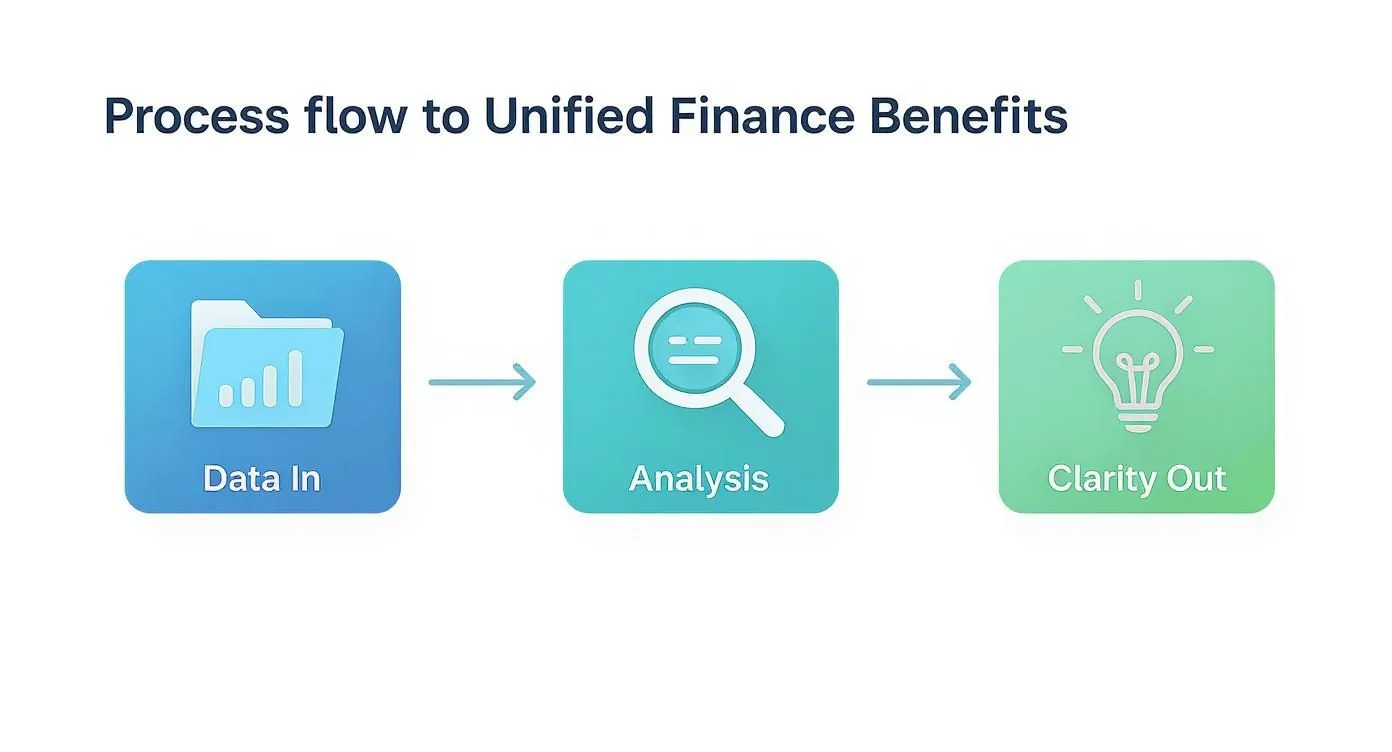
As you can see, the flow is straightforward: raw data gets collected, analyzed, and then transformed into the clear insights you need to make smart decisions.
Setting Up Your Command Center
With all your data flowing into one place, the next step is to organize it. A good system lets you categorize your assets and liabilities in a way that makes sense to you, giving you a complete financial picture at a single glance.
Here’s a practical way to get started:
- Link Your Accounts: Begin by connecting your most active accounts, like your primary checking account and credit cards. This will give you an instant baseline for your day-to-day cash flow.
- Add Major Assets and Liabilities: Next, add the big-ticket items. This includes your investment portfolios, the estimated value of your property, and any outstanding loans like your mortgage or car payment.
- Handle Multi-Currency Assets: If you’re an expat or a global investor, make sure you use a tool that automatically converts foreign holdings into your home currency. This is critical for getting an accurate, real-time calculation of your total net worth without fussing with manual conversions.
- Organize and Categorize: Group similar items together. You might create categories like “Liquid Cash,” “Retirement Investments,” “Real Estate,” and “Long-Term Debt” to keep things tidy.
A well-structured personal finance dashboard gives you that high-level overview you need to make genuinely informed choices.
For a deeper dive into creating your own financial command center, check out our complete guide to building a personal finance dashboard.
Keeping Your Consolidated Financial Data Secure
Bringing all your financial accounts into one place is a game-changer, but it naturally raises a big question: what about security? It’s a fair concern. The key is to treat digital safety as the foundation of your system, not an afterthought. Think of it as building a digital fortress around your data.
This all starts with mastering the basics of digital hygiene. Using a password manager to create and store strong, unique passwords for every single financial account is non-negotiable. Reusing the same password is like having one key for your house, car, and office—once a thief gets it, they have access to everything.
And don’t forget to enable two-factor authentication (2FA) everywhere you can. It’s like adding a second deadbolt to your digital door. Even if someone manages to steal your password, they can’t get in without a code from your phone.
Understanding Platform Security
When you choose a platform for your centralized financial management, you need to peek under the hood at its security features. Any tool worth its salt is built with your safety as the top priority, using proven technologies to shield your information.
Here’s what you should be looking for:
- Bank-Level Encryption: This is the standard. It scrambles your data, making it unreadable to anyone without authorization, whether it’s in transit or sitting on a server.
- Read-Only Access: This is a critical feature. It means the app can see your balances and transactions to fill your dashboard, but it has no permission to move money or make any changes to your accounts.
- End-to-End Encryption (E2EE): This is the gold standard for privacy. You can dive into how PopaDex uses end-to-end encryption to protect your data, ensuring that only you—and no one else—can ever access your financial details.
By selecting tools with robust, transparent security protocols, you are not just connecting accounts; you are extending the security perimeter of your trusted financial institutions to your personal dashboard.
A huge part of securing your consolidated data also involves knowing how to protect against identity theft. Always be on guard for phishing scams—those tricky emails or texts pretending to be from your bank, designed to fool you into giving up your login details.
Finally, make it a habit to regularly review the permissions you’ve given to any financial apps. If you stop using a service, cut off its access immediately. When you combine your own vigilance with the built-in security of trusted platforms, you can build a centralized system that is both incredibly powerful and seriously secure.
Adapting Centralized Finance for Your Life Stage
Centralized financial management isn’t some rigid, one-size-fits-all formula. Think of it more like a flexible framework you can shape to fit your specific goals and challenges, no matter where you are in life. Its real power comes from its ability to cut through the noise and bring clarity to your unique financial picture, whether you’re managing your first salary or a global portfolio.
It’s a bit like the dashboard in a car. A new driver probably just needs to see the speedometer and the fuel gauge. A race car driver, on the other hand, is watching engine temps and tire pressure like a hawk. The system is the same, but the focus changes completely based on who’s behind the wheel. Your financial dashboard should do the same, highlighting what matters most to you right now.
Let’s look at how different people can use a centralized approach to get a handle on their own financial worlds. These real-world examples show just how versatile this strategy can be.
The Young Professional Juggling Growth and Debt
For a young professional just kicking off their career, life is a whirlwind of new income, old student debt, and the first exciting steps into investing. Juggling all of that is tough, and a centralized view is the key to balancing these competing priorities. The main goal here is to build a solid financial foundation while chipping away at obligations.
With centralized financial management, they can see their salary, any side hustle income, and that looming student loan balance all in one place. This unified view makes it so much easier to track debt repayment progress right alongside savings goals.
Priorities for this profile usually include:
- Tracking Net Worth Growth: There’s nothing more motivating than watching your net worth climb from negative territory into the positive.
- Managing Debt: Visualizing how extra loan payments shrink the principal helps build a smart, effective pay-down strategy.
- Automating Investments: Connecting brokerage accounts lets them monitor those early investments and make sure they’re staying on course for the long haul.
The Expat or Digital Nomad Navigating Global Finances
For expats and digital nomads, financial life is often scattered across borders and currencies. They might have a retirement account back home, a checking account where they are now, and investments in a totally different currency. Just trying to calculate their true net worth can feel like a nightmare of spreadsheets and exchange rates.
A centralized system that can handle multi-currency assets is more than a nice-to-have; it’s an absolute necessity. It automatically converts all assets and liabilities into a single base currency, giving them an accurate, real-time snapshot of their global financial health. Considering the US dollar currently dominates 99% of the stablecoin market—a popular tool for cross-border transfers—this kind of clarity is critical.
For a global citizen, a centralized dashboard becomes the single source of truth, translating a complex web of international accounts into one clear, actionable number.
This approach gives them the confidence to manage their worldwide assets, understand potential tax liabilities, and make smart decisions without constantly doing currency conversions in their head.
The Freelancer or Gig Worker Taming Irregular Income
Freelancers and gig workers know the struggle of inconsistent income all too well. One month can be a feast, and the next can be a famine. A centralized view is their best weapon for smoothing out these financial peaks and valleys.
By tracking every payment and business expense in one place, they can finally draw a clear line between personal and business finances—something that’s absolutely crucial come tax season. More importantly, it helps them see their average monthly income over time, which lets them build a realistic budget and a solid emergency fund. A quick glance tells them if it’s a good time to invest a surplus or if they need to pull from savings to cover a slow month.
To make this even clearer, let’s summarize how the focus of centralization shifts depending on who you are and what you’re trying to achieve.
Centralization Focus by Life Stage
This table highlights the key financial priorities for each of the profiles we’ve discussed.
| Profile | Primary Goal | Key Accounts to Track | Recommended PopaDex Feature |
|---|---|---|---|
| Young Professional | Build a strong foundation and manage debt | Checking/Savings, Student Loans, 401(k)/Brokerage | Net Worth Tracker |
| Expat/Digital Nomad | Gain a clear view of global assets | Multi-currency bank accounts, International investments, Foreign property | Multi-Currency Support |
| Freelancer/Gig Worker | Smooth out income and manage cash flow | Business Checking, Personal Checking, Tax Savings Account | Budget Visualization Tool |
As you can see, while the tool is the same, the application is tailored to the individual’s most pressing needs. This adaptability is what makes a centralized financial system so powerful for achieving personal financial clarity and control.
Common Questions About Centralized Financial Management
Diving into centralized financial management can feel like a big step. It’s totally normal to have questions swirling around—about security, how much work it takes, and if it’s really any different from what you’re already doing. Let’s tackle some of the most common worries head-on so you can move forward with confidence.
Is It Actually Safe to Link All My Accounts?
This is probably the biggest question people have: is it truly safe to connect all your financial accounts to one app? It’s a smart concern, and the answer comes down to the quality of the tool you choose.
Reputable platforms are obsessed with security. They use bank-level encryption (like AES-256) to scramble your data, making it completely unreadable to anyone who shouldn’t see it. But here’s the most important part: they operate with read-only access. This is a critical feature. It means the app can see your financial data to build your dashboard, but it has zero permission to move money or change anything in your accounts.
Think of it like giving someone a copy of your bank statement, not your debit card and PIN.
Isn’t This Just a Glorified Banking App?
It’s easy to wonder how this is any different from just using your main bank’s mobile app. While your bank’s app is great for day-to-day tasks, it only shows you one small piece of your financial puzzle—the accounts you have with that specific bank. It has no idea about your 401(k) with another provider, your mortgage from a different lender, or the travel rewards credit card you love.
True centralized financial management is about seeing the entire picture. It pulls together data from all your financial sources:
- Multiple bank accounts
- Credit card providers
- Brokerage and retirement firms
- Loan and mortgage servicers
- Even cryptocurrency wallets
That 360-degree view is something a single bank app just can’t deliver. It gives you a real understanding of your net worth and cash flow that’s impossible to grasp when your information is scattered all over the place.
By pulling everything together, you move beyond the limited perspective of one institution and gain a holistic view of your entire financial universe.
What About My Assets in Different Currencies?
For expats, remote workers, and anyone investing globally, managing assets in multiple currencies is a massive headache. Manually converting balances just to figure out your total net worth is not only a chore but also ripe for error. This is where a modern centralized system really shines.
The best platforms are built to handle this exact complexity. They automatically convert your foreign assets into your home currency using real-time exchange rates. This feature is a game-changer, giving you an accurate, up-to-the-minute calculation of your global net worth without you having to lift a finger. It takes the guesswork out of the equation and gives you a clear financial snapshot, no matter where your assets are held.
How Much Time Does This Actually Take to Set Up?
Let’s be honest, the initial setup is the most hands-on part. You’ll need to round up the login details for your various accounts and connect them to the platform. This one-time effort is what lays the groundwork for your entire automated system.
After that? The ongoing time commitment is tiny. Instead of spending hours every month wrestling with spreadsheets, the system’s automated data feeds keep your numbers current. Your main job becomes a quick weekly or monthly check-in to see how you’re progressing toward your goals. In the long run, it’s a massive time-saver.
Ready to stop juggling accounts and start seeing your complete financial picture? With Popadex, you can build your personal finance dashboard in minutes, bringing all your accounts into one secure, clear, and powerful view. Start your free trial today and take control of your financial future.