
Our Marketing Team at PopaDex
How to Compare Salary and Uncover Your True Value

When you’re weighing job offers, the number on the page is just the beginning. True compensation is a mix of your base salary, benefits, bonuses, and the cost of living. A bigger salary in an expensive city might actually leave you with less cash in your pocket than a smaller one somewhere more affordable.
Why Base Salary Is Only Half the Story
It’s so easy to get fixated on the gross salary figure, but that number alone can be seriously misleading. To really stack up your options, you have to look at the whole package—all the “hidden” financial perks that add up. Just looking at the base pay is like comparing two cars based on engine size while ignoring fuel efficiency, insurance, and maintenance costs.
This is where the idea of an ‘effective salary’ comes in. It’s a much better metric because it shows your real purchasing power after taxes and location-specific costs are factored in.
From Gross Pay to Total Compensation
Getting from a simple salary number to a real, apples-to-apples comparison takes a few steps. You need to break down what each offer truly gives you:
- Gross Salary: The top-line number before anything gets taken out.
- Total Compensation: This is your gross pay plus the cash value of benefits like health insurance, retirement contributions (especially any company match!), and potential bonuses or stock options.
- Effective Salary: Your total compensation, but adjusted for local taxes and the actual cost of living in that city or country.
This layered approach is absolutely critical for remote or international roles. For example, global net salaries can be wildly different. In Switzerland, the average is $8,218 a month, while in the United States, it’s $6,562. It’s a stark reminder of how much location shapes your financial reality. You can discover more insights about global salary benchmarks here.
Visualizing Your Financial Future
Once you understand these moving parts, you can start to see how a salary translates into long-term wealth. This is where tools like PopaDex’s net worth calculator become incredibly useful. They let you model how different compensation packages could impact your ability to save, invest, and grow your assets down the line.
Here’s a look at how the PopaDex tool projects future net worth based on inputs like income and savings.
By plugging in different salary scenarios, you can get a clear visual of which job offer actually gets you closer to your financial goals. It moves the decision way beyond a simple paycheck comparison.
Building Your Total Compensation Scorecard
To really stack up job offers, you need a system that goes beyond a simple gut check. Think of a total compensation scorecard as your framework for seeing the whole picture—every single component, from the base pay all the way to the hidden value tucked away in benefits. This is how you put a real number on perks that are otherwise easy to gloss over.
For instance, a high-deductible health plan might look fine on paper, but it could cost you thousands out-of-pocket when you actually need it. On the flip side, a solid 401(k) match is literally free money that compounds over time, giving your long-term wealth a massive boost. Creating a scorecard forces you to assign a real-world dollar value to every piece of the puzzle.
Quantifying the Intangibles
The first step is to list every financial component of an offer. Your goal here is to translate each perk into an annual cash value.
- Health Insurance: Tally up the total annual premiums you’ll pay. Then, add the plan’s maximum out-of-pocket cost to see your worst-case financial exposure.
- Retirement Contributions: The company’s 401(k) match is a direct, tax-advantaged addition to your salary. A 6% match on an $80,000 salary is an extra $4,800 in your pocket each year.
- Bonuses and Stock Options: For performance bonuses, it’s wise to use a conservative estimate, maybe 75% of the target, to keep your expectations realistic. For stock options (RSUs), calculate their current market value based on the total grant amount.
A classic mistake is getting fixated on a high base salary in a high-tax state. Once the taxman takes his cut, a slightly lower salary in a state with no income tax might leave you with way more cash and financial breathing room.
This is where understanding broader salary benchmarks becomes crucial. The infographic below shows just how much factors like your education, experience, and industry can swing your earning potential before you even start comparing offers.
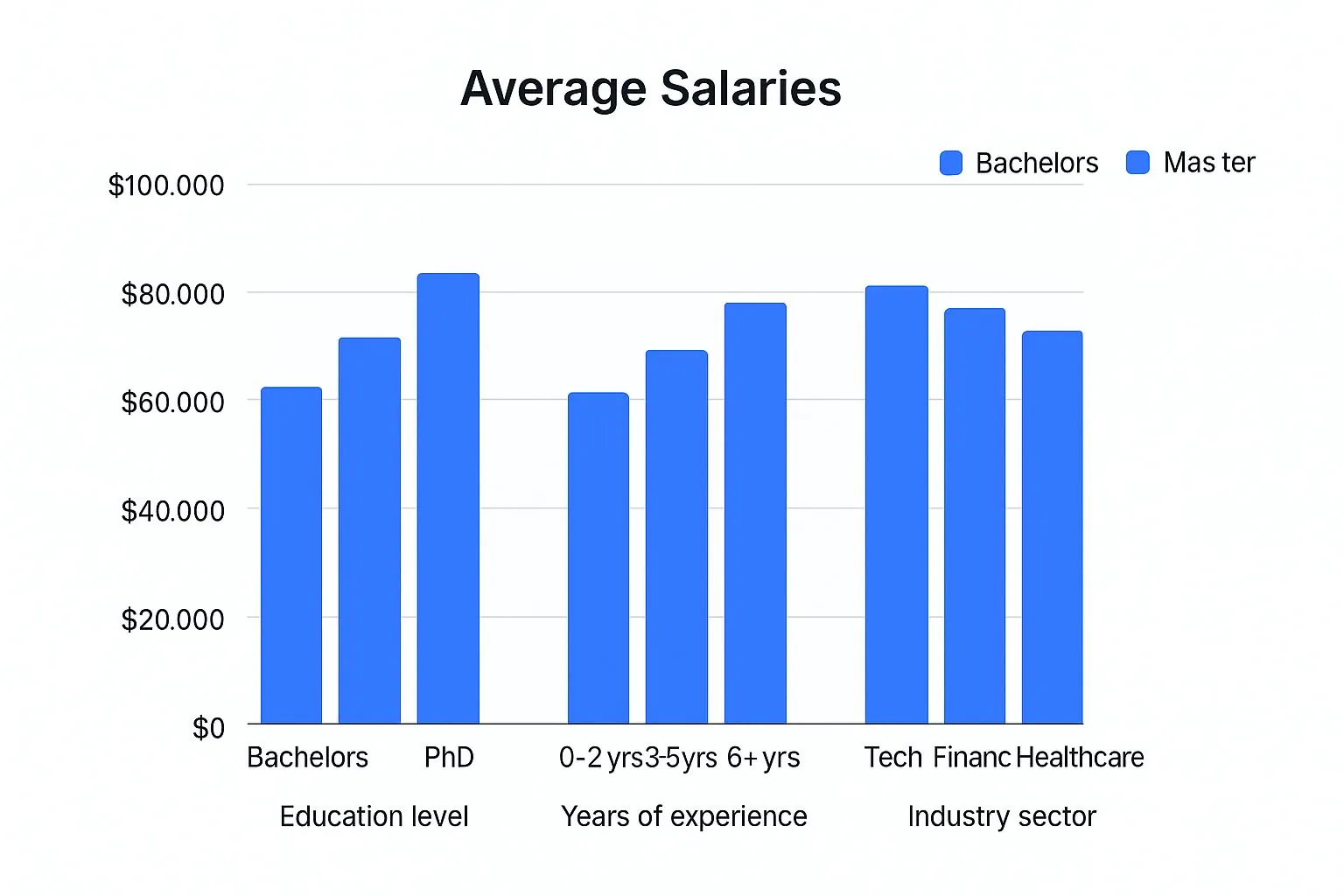
As you can see, the data consistently shows that advanced degrees and more years in the trenches directly correlate to higher earning potential across the board.
The High-Tax vs. High-Benefit Scenario
Let’s walk through a real-world comparison. Offer A is $100,000 in California (a high-tax state) but comes with premium-free health insurance and a hefty 6% 401(k) match. Offer B is $105,000 in Texas (no state income tax) but makes you pay $300/month for health premiums and only offers a 3% 401(k) match.
At first glance, Offer B’s base salary looks like the clear winner. But once you run the numbers through a scorecard, the story changes.
The tax savings in Texas get eaten up pretty quickly by the higher insurance costs and the smaller retirement contribution. After doing the math, Offer A’s total package actually provides more net value. The final step is connecting this to your budget, and you can learn more about how to calculate your actual disposable income with our guide. It’s the only way to see what you’ll really take home.
Total Compensation Comparison Scorecard
Ready to compare offers like a pro? Use this scorecard to weigh the key financial and non-financial factors side-by-side. Just fill in the details for each offer to see which one truly comes out on top.
| Comparison Factor | Offer A Details & Value | Offer B Details & Value | Notes & Considerations |
|---|---|---|---|
| Base Salary | The starting point, but not the whole story. | ||
| Performance Bonus (Target) | Use a conservative estimate (e.g., 75% of target). | ||
| Signing Bonus | One-time cash, but can be a big perk. | ||
| Stock Options/RSUs (Annual Value) | Calculate current market value. | ||
| 401(k) Match (Annual Value) | This is a 100% return on your contribution. | ||
| Health Insurance Premiums (Annual Cost) | Subtract this from your total compensation. | ||
| HSA/FSA Contribution | Employer contributions are tax-free money. | ||
| Paid Time Off (Value) | (Daily Rate) x (Number of PTO Days) | ||
| Estimated Annual Taxes | State and local taxes can vary wildly. | ||
| Other Perks (e.g., Commuter, Gym) | Assign a reasonable cash value to each. | ||
| TOTAL ESTIMATED COMPENSATION | Add it all up for the final comparison. |
Once you’ve filled this out, you’ll have a much clearer, data-driven view of which offer is the smarter financial move for your future.
How to Benchmark Your Salary Against the Market
If you’re trying to figure out a fair salary, guesswork just won’t cut it. To confidently compare a job offer or see if your current pay is up to snuff, you need a solid benchmark. This isn’t about pulling a number out of thin air; it’s about building a defensible salary range based on real, reliable data from multiple sources.
The goal is to understand what the market is willing to pay for your specific skills, in your city, right now. Instead of grabbing the first number you see from a single online calculator, you’ll want to triangulate information from a few different places. This smooths out any weird inconsistencies and puts you in a much stronger position when it’s time to negotiate.

Finding Reliable Compensation Data
You’ll want to start broad and then narrow your focus. Think of it like gathering layers of intel—each source gives you a slightly different, but valuable, piece of the puzzle.
- Government Statistics: The Bureau of Labor Statistics (BLS) is your foundational source. It offers massive amounts of occupational wage data. The downside? It can sometimes be a bit slow to catch up with fast-moving industries, but it’s an excellent baseline for national and regional averages.
- Industry-Specific Reports: For more specialized roles, check out reports from professional associations or research firms in your field. These are gold because they often account for niche skills that broader sources might overlook.
- Third-Party Platforms: This is where you get into the nitty-gritty. Reputable platforms that aggregate both user-submitted and company-reported data are invaluable. The trick is to find ones that let you filter the data in detail.
To get the most accurate picture, exploring a mix of salary benchmarking tools will give you the nuanced data you really need. Cross-referencing these sources is what turns a vague idea into a solid number.
Filtering Data for an Accurate Comparison
A raw average salary figure is pretty much useless. To get a benchmark that actually means something, you have to slice and dice the data you’ve collected. The most important filters are:
- Geographic Location: This one’s huge. A software developer in San Francisco makes a completely different salary than one in St. Louis. Always filter by your specific metro area, not just the state.
- Years of Experience: Don’t compare your salary to an industry veteran if you’re just starting out. Break the data down into experience brackets like early-career (0-2 years), mid-level (3-7 years), and senior (8+ years).
- Company Size: A scrappy startup with 20 people on the payroll has a very different compensation structure than a Fortune 500 company with 50,000 employees. Filter by company size to keep the comparison relevant.
- Specific Skills: Your unique skill set is your secret weapon. Proficiency in a niche programming language or a specialized certification can add serious dollars to your value. Look for data points that reflect these specializations.
By triangulating data from at least three different sources—like the BLS, an industry report, and a third-party platform—you create a powerful, evidence-based salary range. This approach moves you from “I think I’m worth…” to “The market data shows my role is valued between X and Y.”
This research also gives you a feel for the bigger economic picture. For example, U.S. organizations are planning for average salary increases of 3.5% in 2026, which is consistent with 2025. Knowing this helps set realistic expectations for your annual raises and keeps your finger on the pulse of national trends.
Understanding Global and Regional Pay Differences
When you’re looking at salaries in a global marketplace, you’re seeing more than just numbers—you’re getting a glimpse into a complex web of economic forces. For anyone working remotely or even thinking about an international move, getting a handle on these regional pay dynamics is more than helpful; it’s essential for making a smart career decision.
A salary isn’t a fixed value. It’s constantly being shaped by things like local labor demand, government economic policies, and how mature the market is. These factors are exactly why a software developer in a booming Southeast Asian economy might see their salary grow faster in percentage terms than someone in Western Europe, even if their starting pay is lower.
It all comes down to supply and demand. Emerging markets often have a huge need for skilled professionals but a smaller local talent pool, which naturally drives wages up faster as companies compete for talent.

Emerging vs. Mature Markets
The biggest difference between salary trends in emerging and mature markets really boils down to one thing: growth versus stability.
- Mature Markets (like North America, Western Europe): You’ll typically find higher base salaries here, but the year-over-year growth can be slower. The pay scales are well-established and don’t swing wildly.
- Emerging Markets (like Latin America, Southeast Asia): The starting salaries might not look as impressive, but the potential for rapid pay increases is often much, much higher. Economic expansion and fierce competition for skilled workers keep pushing those numbers up.
Thinking about an international or remote role means you have to play the long game. A lower salary in a high-growth region with a cheap cost of living could actually be a much better path to building wealth than a higher salary in an expensive, stagnant city.
Macroeconomic Factors at Play
Several big-picture economic indicators have a direct impact on regional pay and what you can earn. Understanding them helps you see past the advertised salary and gauge the real financial opportunity.
First off, inflation is a huge deal. High inflation can chew through your purchasing power, making a big raise feel like you’re just treading water. On the flip side, in a low-inflation economy, even a modest raise can feel like a real win for your bank account.
Then there’s local labor demand. This one is critical. If you have skills that are in high demand in a specific region, you have way more leverage at the negotiating table. This is especially true for roles in tech and specialized finance, where the talent shortage is a global headache for employers. To really see what you’re worth, you can use a salary comparison by country calculator to benchmark roles across different locations and get a clearer picture.
Looking ahead, global salary growth projections for 2025 really drive home these regional differences. While the global average salary increase is expected to be around 4.5%, countries in Latin America like Colombia and Mexico are projected to see raises of 6.1% and 5.4%, respectively. That’s a whole lot more than many mature economies. This data just goes to show why you need a global perspective when you’re comparing job offers.
Using Your Research to Negotiate with Confidence
Once you have your numbers straight, you can walk into a salary negotiation talking business, not just feelings. The research you’ve done is your single biggest advantage, turning you from a hopeful applicant into an informed professional. This data is more than your opinion—it’s an objective benchmark that grounds your request in market reality, not just personal desire.
The trick is to frame it as a strategic conversation, not a confrontation. You aren’t making a demand; you’re simply sharing what the market values for your specific skills and experience. This instantly positions you as a sharp, well-prepared thinker, which is exactly the kind of person companies want to hire or keep.
Structuring Your Data-Driven Request
Whether you’re negotiating a new offer or asking for a raise, structure is everything. You need to build a logical case that leads the hiring manager or your current boss to your desired number. Just throwing out a figure won’t cut it. You need to tell a story that makes your salary request the obvious conclusion.
A simple, powerful framework looks like this:
- Lead with Enthusiasm: Kick things off by reinforcing how excited you are about the role or how committed you are to the company.
- Highlight Your Value: Give a quick recap of your key wins or the specific skills you bring to the table that solve their problems.
- Introduce the Market Data: This is where you bring in the research. Mention the salary benchmarks you found for similar jobs in your city and industry.
- State Your Request: Clearly name the salary you’re seeking, tying it directly back to both the market data and the value you’ve just demonstrated.
A classic mistake is making it all about what you need. Winning negotiations are about what the role is worth and the value you deliver. Your research is the objective proof of that worth.
Phrasing for Maximum Impact
How you say it matters just as much as what you’re saying. You want to sound collaborative and confident, never aggressive.
Scenario A: Countering a Job Offer “Thank you so much for the offer; I’m very excited about the opportunity to join the team. Based on my research for similar roles in the [City Name] area requiring [Skill X and Y], the market rate appears to be between $X and $Y. Considering my experience in [mention specific achievement], would you be able to consider a salary of $Z?”
Scenario B: Requesting a Raise “I’ve really enjoyed my work on the [Project Name] initiative and am proud of the [mention specific metric] we achieved. As we head into performance reviews, I’ve been researching compensation trends. My findings indicate that the market rate for a [Your Role] with my level of experience is now in the $X to $Y range. I’d like to discuss bringing my compensation in line with these industry benchmarks.”
Once you’ve done your homework, you’ll be more than ready to handle these conversations. For further insights on salary negotiation, you can explore additional resources to sharpen your skills.
How Your Salary Shapes Your Long-Term Net Worth
Think of your salary as more than just a paycheck. It’s the engine that powers your entire journey toward long-term wealth. When you’re weighing different salary offers, you aren’t just picking a job—you’re making a fundamental investment in your financial future. A higher income gives you a direct, powerful advantage in saving, investing, and crushing debt.
Even a small pay bump can have a massive ripple effect over time, all thanks to the magic of compounding. For example, an extra $5,000 a year, if invested with an average 7% annual return, could balloon to over $200,000 in just 20 years. This shows how a well-negotiated salary is more than a win for today; it’s a catalyst that can help you reach financial independence years ahead of schedule.
See Your Wealth Trajectory in Real Time
To really get a feel for this connection, you have to visualize how different income levels will shape your financial goals. Abstract numbers on a job offer don’t tell the whole story, but a dedicated tool can translate them into a tangible, long-term plan.
Here’s a look at how the PopaDex net worth calculator can map out your financial growth based on what you earn and how much you save.

This kind of projection makes it crystal clear: a higher salary provides the fuel you need to build assets and hit your financial milestones much faster.
The time and effort you pour into salary research and negotiation pays dividends for decades. It’s one of the highest-impact financial moves you can make, directly shaping your ability to build a secure future.
At the end of the day, every dollar you earn is a seed for future wealth. Benchmarking and negotiating your salary is simply about making sure you’re planting as many of those seeds as you possibly can. By tying your earning potential directly to your financial plan, you transform your career into a powerful wealth-building machine.
For a deeper dive, check out our guide on what net worth means and how to calculate it.
Salary Comparison: Your Questions Answered
Even with all the data in the world, compensation can feel like a maze. Let’s tackle some of the most common questions people have when they start benchmarking their salary. These are the things that often trip people up, but with a bit of clarity, you can move forward with confidence.
How Often Should I Check My Salary Against the Market?
As a simple rule of thumb, you should benchmark your salary at least once a year. This cadence lines up perfectly with most annual performance reviews, giving you fresh, relevant data to bring to the table when discussing a raise.
That said, life doesn’t always wait for an annual review. Certain events should trigger an immediate salary check-in:
- Changing jobs: This is non-negotiable. It’s your single best opportunity to reset your market value.
- A major promotion: More responsibility means a new pay grade. Don’t assume your company’s bump is in line with the market—verify it.
- Gaining a new skill or certification: If you’ve just earned a PMP, a CISSP, or mastered a high-demand coding language, your value has increased.
- Your industry is heating up: Sometimes, demand for a specific role explodes. If you’re seeing recruiters flood your inbox, it’s time to see what the market is really paying.
Are Online Salary Calculators Actually Accurate?
They can be, but you have to be smart about it. Think of them as a starting point, not the final word. The accuracy of any online calculator depends entirely on the data it’s built on. Some tools rely on self-reported numbers, which can be inflated or outdated, while others use more robust employer-reported figures.
The best approach is to triangulate your data. Never trust a single source. Pull numbers from at least three different places—like a government source (Bureau of Labor Statistics), a big third-party site, and an industry-specific report. This helps you build a credible salary range you can actually defend.
How Do I Talk About Salary with a Mentor or Peer?
This is where you get the real inside scoop, but it can feel awkward. The key is to frame the conversation correctly. Asking “How much do you make?” is often too direct and can put people on the spot.
Instead, lead with your own research. It shows you’ve done the work and just need a gut check from someone in the know.
Try saying something like this: “Hey, I’m doing some research for my role as a [Your Role] with [X] years of experience. My data suggests a range of $X to $Y is fair for the [City] market. From what you’ve seen, does that sound about right?”
This method invites them to share their industry knowledge without having to disclose their own paycheck. It turns a personal question into a professional discussion about market rates, helping you ground your salary expectations in reality.
Ready to stop guessing and start tracking your financial growth with precision? PopaDex provides the tools you need to see how every salary decision impacts your long-term wealth. Consolidate your accounts, visualize your net worth, and take control of your financial future today. Get started for free at popadex.com.
Now You Know Your Pay — Are You Building Wealth?
Salary is what you earn. Net worth is what you keep. Track whether your income is actually building wealth — connect your accounts in under 2 minutes with PopaDex.
Now You Know Your Pay — Are You Building Wealth?
Salary is what you earn. Net worth is what you keep. Track whether your income is actually building wealth — connect your accounts in under 2 minutes with PopaDex.