
A Complete Guide to Global Asset Tracking

Global asset tracking is the big-picture view of your company’s physical stuff—shipping containers, trucks, high-value machinery—as it moves around the world. It’s a system that uses tech like GPS, RFID tags, and IoT sensors to give you real-time data on where your assets are, what condition they’re in, and what they’re doing. This turns the chaos of a global supply chain into a process you can actually see and manage.
Why Global Asset Tracking Is a Business Imperative
Think of your supply chain as a high-stakes international relay race. Your assets are the baton, passed from suppliers to carriers to warehouses across different continents. Without a tracking system, you’re running blind. You’re just hoping the baton gets to the next handoff on time and in one piece. Global asset tracking is like having a live camera feed for the entire race.
But this isn’t just about putting a dot on a map. It’s about getting deep operational intelligence. For instance, you could be monitoring the temperature of a refrigerated container full of perishable goods on its way from one country to another, making sure it never deviates from the safe range. That kind of granular insight shifts your whole operation from reactive to proactive. Instead of finding out about a spoiled shipment after it’s too late, you can prevent expensive write-offs, cut down on theft, and make smarter logistical calls on the fly.
The Growing Demand for Visibility
The need for this kind of visibility is exploding. Supply chains are more tangled than ever, and customers expect things to arrive faster and more reliably. That demand is fueling some serious market growth. The global asset tracking market is projected to swell to USD 80.36 billion by 2034. That’s not a fluke—it’s driven by a steady compound annual growth rate (CAGR) of over 12%, which tells you businesses are consistently investing in these solutions.
Global asset tracking is no longer a luxury for huge corporations; it’s a fundamental tool for any company trying to compete in a connected world. It gives you a single source of truth for assets that are thousands of miles away, turning what-ifs into actionable data.
From Individual Items to Entire Fleets
The same core ideas of tracking apply everywhere, from massive corporate supply chains right down to personal collections. A business might be keeping tabs on thousands of shipping containers, but an individual can use similar concepts to manage their own valuable items. Getting a handle on the basics of tracking shows you how these systems bring clarity and control, no matter the scale. For a different perspective on this, our guide to modern collection tracking offers some great insights into managing assets on a smaller scale. This foundation helps establish why visibility is so critical for businesses and sets us up to explore how the technology actually works.
Comparing Core Asset Tracking Technologies
Picking the right technology for your global asset tracking strategy can feel like a chore. With so many options, each with its own pros and cons, it’s easy to get lost. But getting this right is the difference between a system that delivers a solid return and one that just creates operational headaches.
Think of it like choosing the right tool for a job. You wouldn’t use a sledgehammer to hang a picture frame, right? In the same way, the technology you choose has to fit the asset’s environment, its value, and the kind of data you actually need. The main players you’ll hear about are GPS, RFID, Bluetooth Low Energy (BLE), and Cellular IoT.
Before you even start comparing them, it helps to ask a fundamental question: do you even know where your stuff is? This simple decision tree can help you visualize that first step.
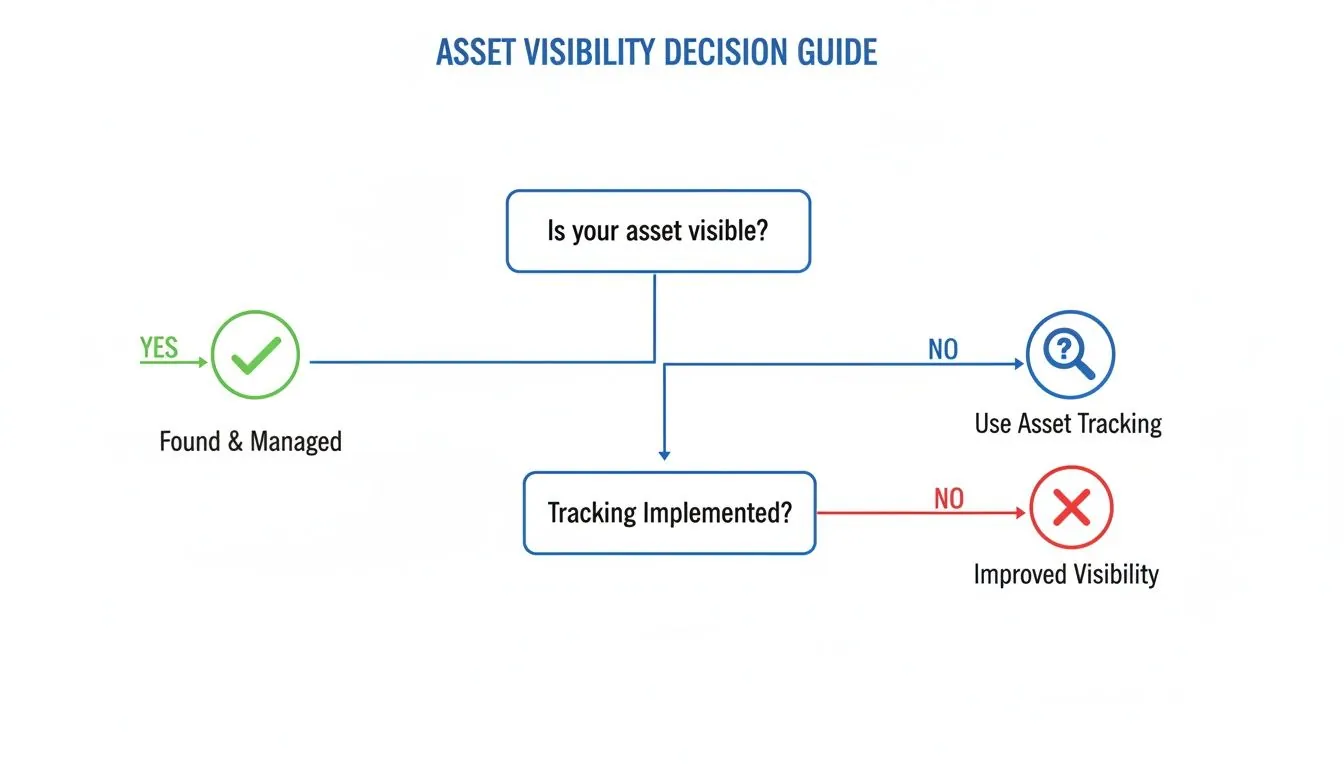
The takeaway is pretty clear: if you can’t easily find or account for your assets, you’ve got an asset visibility problem. That’s where a tracking system comes in to help you regain control.
Breaking Down the Primary Options
To make a smart decision, let’s look at how each of these core technologies works in the real world. Each one has a sweet spot, from pinpointing a shipping container in the middle of the Pacific to scanning hundreds of tools inside a warehouse in seconds.
To make this easier, here’s a quick side-by-side look at the most common technologies you’ll encounter.
Comparison of Asset Tracking Technologies
| Technology | Best Use Case | Typical Range | Key Advantage | Key Limitation |
|---|---|---|---|---|
| GPS | Outdoor, long-haul tracking (vehicles, containers) | Global | Pinpoint global accuracy | Needs clear sky view; poor indoors |
| RFID | High-volume, short-range scanning (warehouses) | Up to a few meters | Scans hundreds of items at once | Extremely short range |
| BLE | Indoor tracking in defined areas (hospitals, factories) | Up to 100 meters | Low power consumption, cost-effective | Requires gateways for wide coverage |
| Cellular IoT | Mixed indoor/outdoor environments | Global (where cell service exists) | Connects directly to cell networks | Higher power use and data costs |
This table gives you a high-level view, but the magic is often in combining these technologies to cover all your bases.
Let’s dive a bit deeper into each one.
-
GPS (Global Positioning System): This is your long-haul champion. GPS trackers talk to satellites to get their exact location anywhere on Earth. It’s the go-to for tracking vehicles, shipping containers, and high-value machinery moving across huge distances outdoors. The big catch? It needs a clear line of sight to the sky, which means it struggles the second it goes inside a building.
-
RFID (Radio-Frequency Identification): Think of RFID as your warehouse workhorse. It’s built for high-volume, short-range scenarios and uses radio waves to transfer data from a tiny tag to a reader. You can scan hundreds of tagged items at once without needing to see each one, making it a superstar for inventory counts, tool tracking in a workshop, or even access control. Its range, however, is usually just a few meters.
-
BLE (Bluetooth Low Energy): BLE is the master of localized, low-power tracking. Imagine keeping tabs on tools in a massive factory or finding medical equipment in a sprawling hospital. BLE tags send out signals that are picked up by gateways, striking a great balance between decent range (up to 100 meters) and fantastic battery life. It’s a very cost-effective way to track a lot of assets within a specific zone.
The best global asset tracking systems often don’t rely on a single technology. They create a hybrid solution, using GPS for the open road, cellular for mixed environments, and BLE or RFID for the final-mile destination inside a facility.
- Cellular IoT: This technology gives you ultimate flexibility by connecting your assets directly to cellular networks (like 4G LTE or 5G). It shines wherever assets move between indoor and outdoor spaces because it doesn’t need local gateways or readers. A cellular tracker on a delivery truck can send updates from the highway and keep reporting even after it pulls into a distribution center, making it a versatile pick for complete supply chain visibility.
Unlocking Key Business Benefits
Knowing where your assets are is one thing. Turning that knowledge into real business value is another entirely. The magic of global asset tracking isn’t just about dots on a map; it’s about how that visibility strengthens your bottom line and gives you a serious competitive edge. A constant, reliable stream of data from your assets makes your entire operation smarter, leaner, and far more resilient.
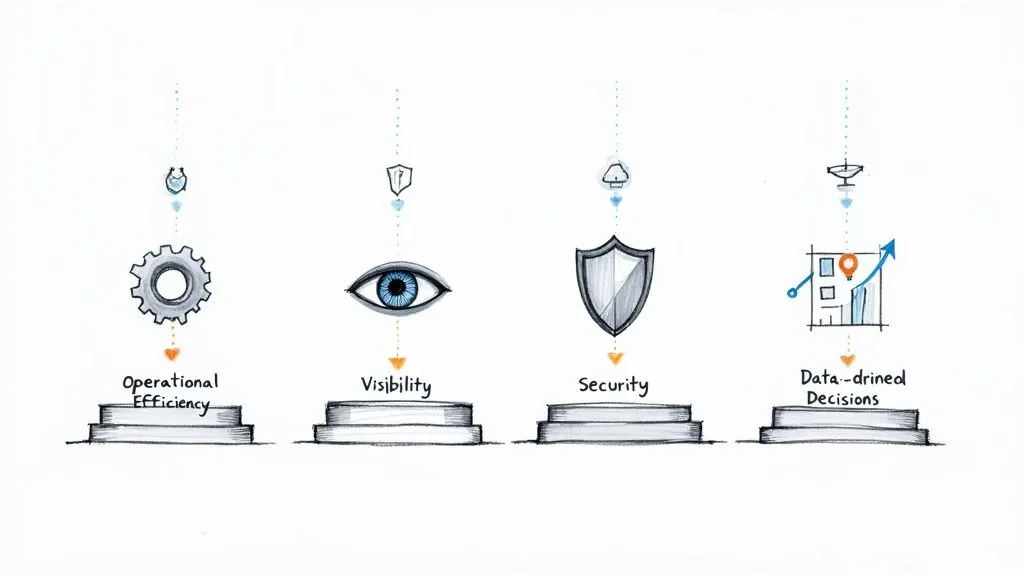
This value isn’t just a vague promise. It’s built on four solid pillars: operational efficiency, supply chain visibility, beefed-up security, and genuinely data-driven decisions. Each one tackles a critical business headache, transforming operational blind spots into opportunities for growth.
Enhanced Operational Efficiency
Operational efficiency is all about cutting out the waste—wasted time, wasted fuel, and wasted manual effort. Global asset tracking automates the tedious, error-prone tasks that have slowed businesses down for decades. This automation has a direct impact, boosting productivity and slashing operational costs.
Take a logistics company, for example. Instead of drivers idling in the yard waiting for manual instructions, a tracking system can instantly identify an arriving truck, assign it to the right loading bay, and notify the warehouse team. This one change can cut out hours of wasted time, reduce fuel burn, and get shipments back on the road in record time.
Effective asset tracking turns data into action. It doesn’t just tell you there’s a problem; it provides the insights needed to prevent that problem from happening again, creating a cycle of continuous improvement.
Improved Security and Loss Prevention
High-value assets are tempting targets, especially when scattered across remote or unsecured locations. A solid asset tracking solution is like a digital security guard, dramatically cutting the risk of theft and unauthorized use. In fact, companies can recover stolen assets up to 90% of the time with a reliable system in place.
Imagine a construction company with expensive machinery on a sprawling job site. By setting up a geofence—a virtual perimeter around the site—the system can trigger an instant alert if a bulldozer moves outside that boundary after hours. That immediate notification lets the team contact authorities right away, preventing a loss that could easily run into tens of thousands of dollars.
Superior Supply Chain Visibility
Today’s supply chains are a complex web of handoffs between suppliers, carriers, and distribution centers. Global asset tracking cuts through the confusion by providing a single source of truth. It gives every stakeholder a clear, real-time view of an asset’s journey from origin to destination. That kind of transparency is gold for managing expectations and nipping potential delays in the bud.
Data-Driven Decision Making
At the end of the day, the data pulled from your assets is one of your most powerful resources. Tracking systems deliver a firehose of information on everything from asset utilization and dwell times to route efficiency. Digging into this data helps you spot trends and bottlenecks you’d otherwise never see. It empowers leaders to make strategic calls based on hard evidence, not guesswork, optimizing everything from fleet maintenance schedules to inventory placement.
Seeing the Big Picture: The Global Market Landscape
Knowing the tech behind global asset tracking is one thing, but understanding the bigger picture is where the real insights live. The market isn’t a single, monolithic entity. It’s a dynamic, shifting landscape shaped by regional trends, economic forces, and unique industrial demands. Demand for tracking solutions explodes in some regions while growing steadily in others, all based on local needs and infrastructure.
For any business with a global footprint, this isn’t just trivia—it’s critical intelligence for making smart investment and expansion decisions. A solution that’s a perfect fit for the mature, high-speed logistics networks of North America might fall flat in the rapidly expanding manufacturing hubs of Asia without some serious tweaks. These regional differences create both challenges and massive opportunities.
A Tale of Two Markets
Right now, the global asset tracking market is really a story of two dominant regions, each with its own character. North America currently leads the charge, holding between 36.93% and 39% of the total market share. What’s driving this? A super-developed e-commerce sector, incredibly sophisticated supply chains, and the early, widespread adoption of IoT tech in transportation and logistics. Companies here have been chasing visibility for years to streamline their operations and keep demanding customers happy.
But the real fireworks are happening elsewhere. The Asia-Pacific (APAC) region is on an absolute tear, projected to grow at a blistering compound annual growth rate of 22.7% between 2026 and 2035. This explosive growth is fueled by a massive manufacturing base, a flood of foreign investment, and a powerful push toward digital transformation across countless industries.
It’s not enough to know where the market is today. The real trick is anticipating where it’s going tomorrow so you can position your business ahead of the curve.
This global game isn’t just about logistics, either. When you operate across borders, you’re also juggling fluctuating economies and currencies. Managing assets on a global scale means dealing with this financial complexity head-on. Keeping a close watch on these monetary shifts is just as vital as tracking the physical location of a container. We dive deeper into this in our guide to mastering currency exchange rate tracking. It’s this broader context—marrying the operational with the financial—that allows businesses to make truly informed decisions.
A Practical Guide to Successful Implementation
Turning a global asset tracking strategy into a functional reality is where the real work begins. A successful rollout isn’t just about flipping a switch; it requires a clear plan that aligns technology with concrete business goals. Jumping in without this roadmap often leads to wasted resources and a system that fails to deliver on its promise.
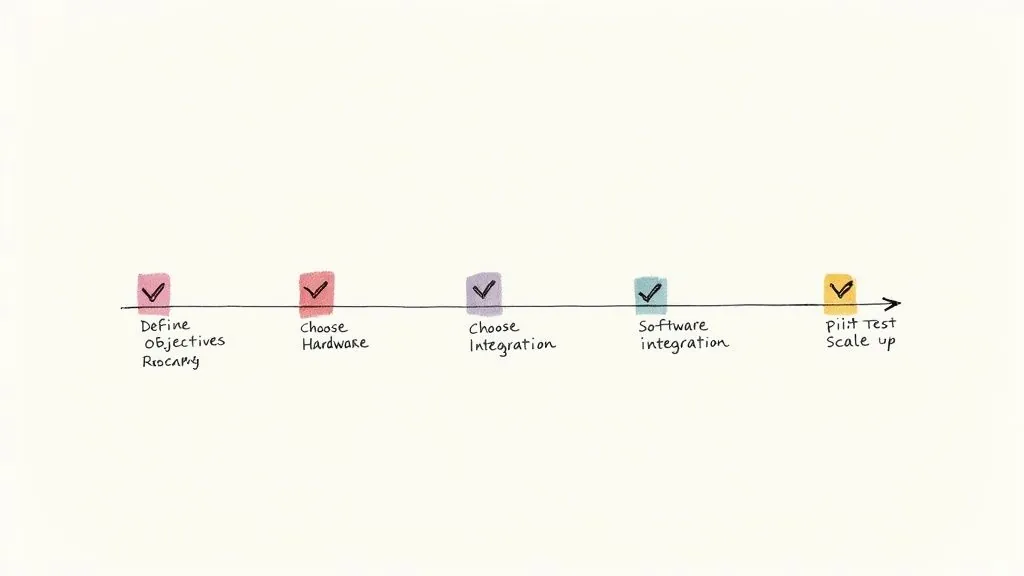
The journey starts with defining precise, measurable objectives. Instead of a vague goal like “improve efficiency,” aim for something specific. Think “reduce spoilage of perishable goods by 15%” or “cut average equipment search time by 25 minutes.” These clear targets provide a benchmark for success and ensure everyone involved knows exactly what you’re trying to achieve.
Building Your Technology Stack
With your objectives set, the next step is picking the right hardware. The trackers you choose must be tough enough for the environments your assets will face. A sensor for a refrigerated container crossing the ocean has very different requirements than a BLE tag used on tools inside a climate-controlled factory. You’ll need to consider factors like battery life, durability, and connectivity needs for each type of asset.
Equally important is the software integration. Your new tracking platform has to communicate seamlessly with your existing systems, like your Enterprise Resource Planning (ERP) or Warehouse Management System (WMS). This integration is what transforms raw location data into actionable business intelligence. For developers tackling this phase, understanding how to connect different financial and operational systems is crucial. PopaDex offers a helpful guide on adding Plaid to a Rails app that explores the principles of secure API integration.
For a solid foundation, it’s also worth reviewing the fundamentals of practical inventory management for small businesses.
The Power of a Pilot Program
Before you commit to a full-scale, company-wide rollout, launching a pilot program is a non-negotiable step. Think of it as a dress rehearsal in a controlled setting.
A pilot program allows you to test your entire global asset tracking solution—from hardware performance to software usability—on a small scale. This approach helps identify and iron out any issues before they become costly, enterprise-level problems.
This trial run gives you invaluable, real-world feedback. During the pilot phase, you can:
- Validate Hardware Performance: Confirm that your chosen trackers work reliably in their intended environments, not just in a lab.
- Test Software Integration: Ensure data flows correctly between the tracking platform and your other business systems without errors or hiccups.
- Gather User Feedback: Collect insights from the employees who will use the system daily. Their input is gold for refining workflows and improving usability.
- Calculate Preliminary ROI: Use data from the pilot to build a strong business case and project the return on investment for the full rollout.
By starting small, you de-risk the entire project and build momentum for what’s to come. A successful pilot demonstrates tangible value to stakeholders, making it much easier to get buy-in for a broader implementation. This careful, step-by-step approach ensures your investment in global asset tracking delivers measurable results from day one.
Let PopaDex Tame Your Tracking Chaos
Trying to manage global assets often feels like you’re drowning in a sea of raw data from a dozen different technologies. The real headache isn’t just collecting all that information; it’s piecing it together into a picture that actually helps you make smarter business decisions. This is exactly why a dedicated platform is no longer a luxury—it’s what moves you from messy spreadsheets to a clear, automated view of everything you own.
Think about a company trying to track its international shipments with manual updates and a patchwork of disconnected systems. Delays are just part of the daily grind, and finding one specific container means a flurry of panicked phone calls. Once they switch to a centralized platform, they suddenly have a single, reliable source of truth.
Get a Single Pane of Glass View
One of the biggest wins of a modern tracking solution is a simple dashboard that pulls all your asset data into one place. PopaDex gives you this single-pane-of-glass view, consolidating information from all your different tracking devices into one clean interface. No more logging into five different systems—your whole team sees everything, all at once.
This unified view doesn’t just make daily operations easier; it lets you spot trends and potential problems before they blow up. It’s like having a mission control center for your entire fleet of assets.
The best asset tracking platforms are hardware-agnostic. They work with a huge range of sensor types, so you can pick the perfect device for each asset without getting locked into one provider’s ecosystem.
Turn Your Data into Actionable Intelligence
Raw data—like an endless stream of location pings or temperature readings—is only half the story. The real magic happens when advanced analytics turn that flood of information into sharp, actionable intelligence.
This is where PopaDex really shines. It uses powerful analytics to pull out the insights that matter:
- Find Your Bottlenecks: Instantly see where your assets are getting stuck in the supply chain.
- Optimize Your Routes: Use historical data to discover faster, more efficient shipping lanes.
- Monitor Conditions: Get immediate alerts when something’s wrong, like a temperature spike for sensitive cargo.
For that company we mentioned, this means the end of guesswork. They can now see that a specific port is causing chronic hold-ups and just reroute future shipments around it. That shift—from frantically reacting to problems to proactively shaping your strategy—is the entire point of effective global asset tracking. A platform like PopaDex makes this level of control not just possible, but simple.
Your Top Asset Tracking Questions, Answered
Jumping into a new system always brings up a few practical questions. When it comes to global asset tracking, most leaders are rightly focused on three things: the cost, the security of their data, and how long it’ll take to get everything up and running.
What’s the Real Cost of a Global Asset Tracking System?
There’s no single price tag, as costs hinge entirely on the technology you choose, how many assets you’re tracking, and what features you need in the software. It could be as little as a few dollars per asset each month for basic location tracking, or significantly more if you need advanced sensors and analytics.
The best way to get a real number for your business? Start with a pilot program. It’s the clearest path to understanding your specific costs.
How Secure Is the Data from Asset Trackers?
Any provider worth their salt uses end-to-end encryption for all data, whether it’s being sent from a tracker or sitting in the cloud. Things like security protocols, strict user access controls, and a secure cloud setup are non-negotiable standards.
Before you commit, always ask to see a provider’s security certifications and data privacy policies. This isn’t just a formality—it’s about ensuring they meet your compliance needs.
A huge piece of the security puzzle is simply clear communication. A solid customer agreement should spell out everyone’s duties and responsibilities, covering everything from governance to how third-party services are used.
How Long Does Implementation Actually Take?
This one comes down to scale and complexity. If you’re running a small pilot with a few dozen assets, you could be up and running in just a couple of weeks. It’s a great way to get a quick win and learn the ropes.
On the other hand, a full-blown, enterprise-wide deployment that spans multiple global sites is a different beast. That kind of project could easily take several months to plan, integrate with your existing systems, and roll out to all your teams.
Ready to get a clear, consolidated view of your most important assets? With PopaDex, you can effortlessly monitor your entire portfolio in one place. Start your free trial today and take control of your financial future.