
Our Marketing Team at PopaDex
self employed quarterly taxes: Quick guide for freelancers

If you’re your own boss, you’re the one responsible for sending the IRS its cut. Forget automatic payroll deductions—being self-employed means you have to pay your own income, Social Security, and Medicare taxes in four chunks throughout the year. It’s the system we’ve got, and skipping it can lead to some nasty penalties.
Why Quarterly Taxes Are a Reality for the Self-Employed
Making the leap from a W-2 employee to an independent contractor means you’re now wearing two hats: employee and employer. This is a huge deal because the U.S. tax system is built on a “pay-as-you-go” model. Traditional employers handle this by withholding taxes from every paycheck.
But for the roughly 15 million self-employed Americans out there, there’s no employer to manage that. It’s all on you.
You’ll need to estimate what you’ll earn for the year and send the IRS a portion of that income four times a year. This keeps tax revenue flowing to the government steadily, not just in one lump sum in April. Blow it off, and you’ll be staring down a surprise tax bill and some hefty underpayment penalties when you file your annual return.
What These Payments Cover
Your quarterly payments aren’t just for income tax. They’re a package deal covering two key obligations:
- Income Tax: This is the same federal (and often state) income tax that W-2 employees pay, figured out based on your tax bracket.
- Self-Employment Tax: Think of this as the freelancer’s version of FICA taxes. It covers both the employee and employer shares of Social Security and Medicare, adding up to a 15.3% tax rate on your net earnings.
The whole point of quarterly taxes is to avoid a massive, budget-busting tax bill at the end of the year. Paying in smaller installments helps you manage cash flow and stay on the right side of the IRS.
Managing Irregular Income and Payments
Let’s be real—freelance income is rarely consistent. One month you’re killing it, the next it’s crickets. This makes it tough to nail down your annual earnings with perfect accuracy.
This is exactly why a solid budget is non-negotiable. If your income is all over the map, our guide on creating an irregular income budget template can give you the framework you need. It’ll help you figure out how much to stash away for taxes each quarter, so you’re always prepared, no matter what your bank account looks like. A little planning goes a long way in avoiding financial headaches.
How to Calculate Your Estimated Tax Payments
Figuring out exactly how much to pay for your self-employed quarterly taxes can feel like the most intimidating part of the whole process. The good news? It’s more about simple arithmetic than complex accounting. We’ll walk through the logic using the IRS Form 1040-ES as our guide, turning a confusing task into a clear, repeatable process.
The goal is to project your total income for the year, subtract your business expenses to find your net profit, and then calculate the tax you’ll owe on that profit. This isn’t a one-and-done calculation. You should revisit it each quarter, especially if your income fluctuates. Adjusting your payments as you go is the key to preventing nasty surprises in April.
This chart gives a solid high-level overview of the quarterly tax system, from who needs to pay to those all-important deadlines.
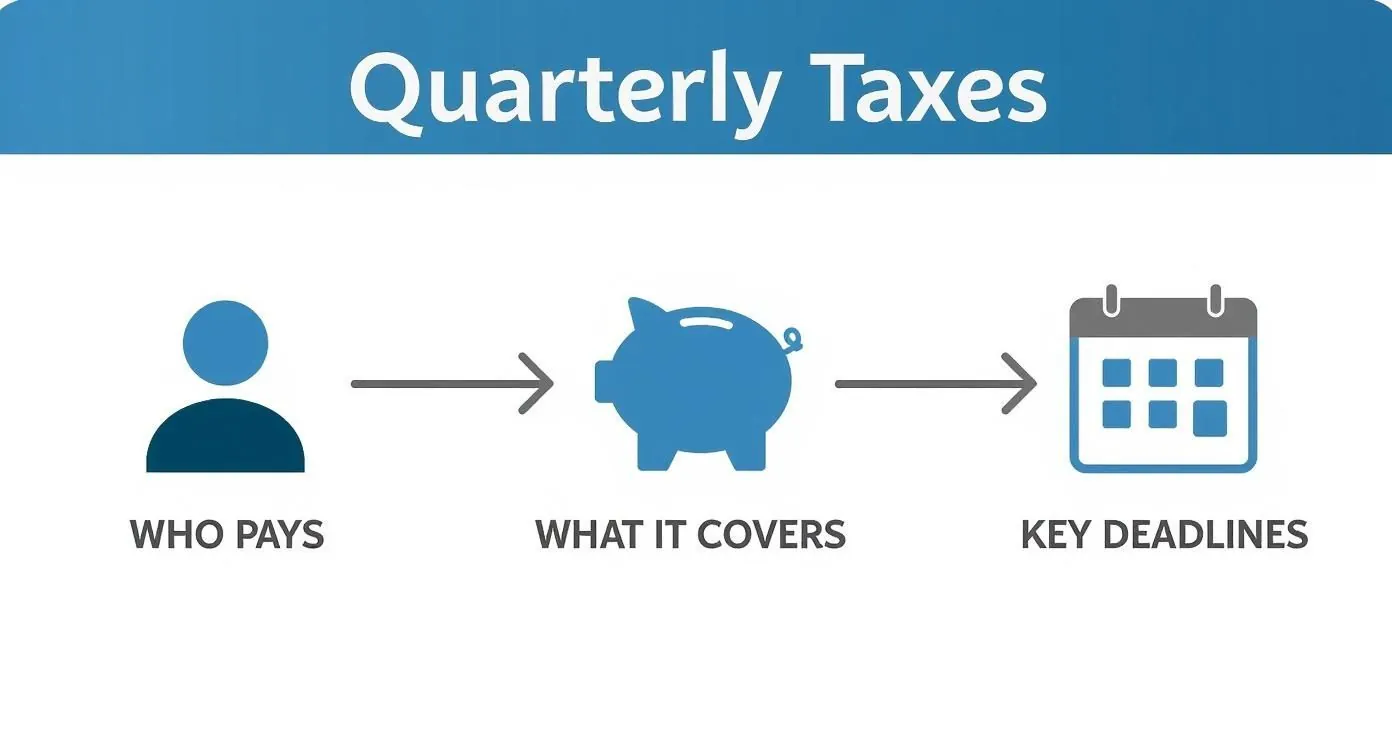
This visual breaks down the core components of estimated taxes, reminding you that these payments cover both your income tax and self-employment taxes (that’s Social Security and Medicare).
Projecting Your Annual Income
First up, you need to estimate your total gross income for the entire year. If your work is pretty stable with recurring clients, you might just multiply your monthly average by 12. If your income is more of a rollercoaster, look at your year-to-date earnings and make a reasonable forecast for the months ahead.
For example, a freelance consultant who has already earned $30,000 by the end of the first quarter could project an annual income of $120,000. This number is your starting point.
Calculating Your Net Earnings
Here’s the fun part: your taxable income isn’t your gross revenue; it’s your profit after expenses. This is where meticulous record-keeping really pays off. Tally up all your anticipated business expenses for the year.
Common deductions you don’t want to miss include:
- Home office expenses (a portion of your rent/mortgage and utilities)
- Software subscriptions and online tools
- Marketing and advertising costs
- Business travel and mileage
- Professional development and education
Let’s say our consultant projects $20,000 in business expenses for the year. Their estimated net earnings would be $100,000 ($120,000 gross income - $20,000 expenses). You can explore a detailed list of common freelancer tax deductions to make sure you’re not leaving any money on the table.
Key Takeaway: Your business deductions are your most powerful tool for lowering your tax bill. Every legitimate expense you track directly reduces the amount of profit you’ll be taxed on.
Figuring Out Your Tax Liability
With your net earnings estimated, you can now get down to the two main tax obligations: self-employment tax and income tax.
1. Self-Employment Tax Calculation First, let’s tackle the self-employment tax (for Social Security and Medicare). This is paid on 92.35% of your net earnings from your business. For our consultant:
- $100,000 (Net Earnings) x 0.9235 = $92,350 (This is your taxable self-employment income)
- $92,350 x 0.153 (The SE Tax Rate) = $14,130 in self-employment tax.
2. Income Tax Calculation Next, it’s time to figure out your income tax. You’ll start with your gross income, subtract business expenses, and then take the self-employment tax deduction (a nice little perk where you can deduct one-half of your SE tax).
- $100,000 (Net Earnings) - $7,065 (Half of your SE Tax) = $92,935 (Your Adjusted Gross Income)
From there, you subtract your standard or itemized deduction to find your final taxable income, then apply the appropriate tax brackets to see what you owe.
Once you have your total estimated tax for the year (SE tax + income tax), just divide that number by four. That’s your quarterly payment. Simple as that.
Making Your Quarterly Tax Payments to the IRS

You’ve crunched the numbers and pinpointed exactly what you owe. Now comes the most important part—actually sending that money to the IRS on time. Luckily, the agency offers multiple ways to get the job done, whether you thrive on digital convenience or prefer a paper trail.
Picking a payment option you trust—and can repeat every quarter—keeps you in compliance, sidesteps late-payment penalties, and helps you avoid unnecessary stress around self employed quarterly taxes.
Popular Online Payment Methods
Most self-employed folks favor the speed and clarity of digital payments. The IRS has modern tools that make this smooth and secure.
-
IRS Direct Pay
Totally free, no sign-up required. Funds transfer directly from your checking or savings account, and you’ll see an immediate confirmation on screen. -
Electronic Federal Tax Payment System (EFTPS)
Also free, but you must enroll ahead of time. EFTPS lets you schedule payments up to 365 days in advance and keeps a detailed log of your entire payment history. -
Debit or Credit Card
Process payments through one of the IRS’s approved third-party vendors. It’s fast and familiar—just note the processing fee, which varies by processor and card network.
Paying electronically is the quickest way to guarantee your taxes arrive on time. You walk away with a digital receipt and peace of mind, rather than wondering if the post office dropped the ball.
The Traditional Mail-In Option
Sometimes you just need that physical proof. If you’d rather send a check or money order, here’s how to do it right:
Include the payment voucher from Form 1040-ES, Estimated Tax for Individuals.
Make your check payable to “U.S. Treasury” and clearly write your Social Security number plus the tax year (for example, “2024 Form 1040-ES”).
Double-check the IRS mailing address for your state—sending it to the wrong location can delay posting. Above all, ensure your envelope is postmarked by the due date.
Self-employment tax collections topped $150 billion in fiscal year 2023, underwriting Social Security and Medicare benefits nationwide. For a deeper dive into key deadlines and strategies, check out understanding quarterly tax deadlines. And if you’re curious about broader trends, these international business tax statistics on IRS.gov shed light on how today’s contributions fit into the bigger picture.
Avoiding Common Mistakes And IRS Penalties
Missing a due date or misreading safe harbor rules can leave self-employed folks facing hefty penalties. Underpayment interest and penalties often creep in when your income suddenly jumps.
This guide walks you through real-world blunders and shows how to keep the IRS at bay.
Jenna, a freelance designer, underestimated her Q2 earnings by 25% and ended up with a $350 fine. Once she tapped into the IRS safe harbor rule, her payments clicked right into place and penalties vanished.
Understanding Safe Harbor Rules
Here’s a quick comparison of the two main IRS safe harbor options so you can pick the one that fits your cash flow.
Using Safe Harbor Rules to Avoid Penalties
Understand the two primary IRS safe harbor rules to protect yourself from underpayment penalties, even if your income fluctuates.
| Rule | Requirement | Best For |
|---|---|---|
| Current Year Method | Pay 90% of projected liability | Fluctuating or growing income |
| Prior Year Method | Pay 100% of previous liability | Stable or declining revenue |
| High Earner Option | Pay 110% if AGI > $150K | High-income professionals |
Choosing the right option means you avoid surprises without locking up too much cash. For many, the prior year method is the simplest benchmark.
Preventing Deadline Oversights
Tax deadlines arrive on April 15, June 15, September 15, and January 15. Miss one and penalties start at 0.5% of the underpayment each month.
- Set up calendar alerts—sync with Google Calendar or Outlook.
- Automate transfers through EFTPS and schedule them 365 days ahead.
“Automating each payment saved me from a $200 penalty last year,” says Carly, a content strategist who now treats quarterly taxes like clockwork.
Don’t forget state filings—most states mirror federal dates and penalty rates.
Building Tax Safeguards
Halfway through the year—around July—pause and run the numbers again. Adjust your projections and shield your cash flow.
- Review updated income after Q2 results
- Recalculate safe harbor thresholds
- Transfer the required funds to a dedicated tax savings account
Example: Miguel, a mobile developer, checked his books in July, set aside $1,200, and voilà—when September rolled around, his payment was already waiting.
- PopaDex integration can track earnings in real time.
- Visual dashboards pinpoint when you cross safe harbor thresholds.
Key Highlight: Building automated alerts in PopaDex reduces manual errors and surprises.
Staying proactive not only prevents penalties but also keeps your cash flow humming. Use these safe harbor rules and check-ins to master your self-employed quarterly taxes—stress free and penalty free.
Bookkeeping Systems To Simplify Tax Time
Keeping your ledgers orderly means quarterly taxes stop feeling like a fire drill. When everything’s in its place, you avoid scrambling at the last minute. A dedicated business bank account is non-negotiable—it’s the foundation of clean books and zero guesswork about which withdrawal paid for supplies or client coffee.
- Assign clear categories to every expense for straightforward tracking.
- Let automated software sync new transactions the moment they post.
- Run a quick reconciliation weekly to catch discrepancies early.
These steps take minutes but save hours later. In my experience, blending digital tools with simple manual checks cements routines that stick over time. Without a system, freelancers often chase down receipts or forget mileage logs entirely.
Essential Software Integration
Modern accounting platforms now pull bank feeds and auto-classify your spend. That alone can cut manual data entry and shrink error rates by up to 70%. I remember switching to a bank-feed system and suddenly my weekend-long catch-up sessions shrank to a few clicks.
For example, PopaDex imports transactions instantly and flags deductible items before you even realize you need them. Check out the self-employed expense tracker on PopaDex for seamless categorization.
Globally, roughly 28% of workers freelance or run their own show. In parts of South Asia and Sub-Saharan Africa, that figure climbs above 50%. Across OECD nations, self-employment hovers between 10% and 20%—all factors that shape how we tackle self employed quarterly taxes. Learn more about global taxation trends at Our World in Data.
Basic Paper And Digital Records
Even if you love automation, keep physical invoices and receipts for at least three years. Pair them with organized cloud folders so backups live everywhere. Naming conventions matter—digital files tagged with “YYYY-MM” sync effortlessly with most apps.
A simple spreadsheet still plays a starring role:
- Folders labeled by month and document type keep paper organized.
- Digital directories follow a YYYY-MM naming convention.
- Your spreadsheet can auto-update when linked to your accounting app.
Not sure where to start? The guide covers everything from invoice templates to vendor categorization. To simplify your tax preparation and maintain clear financial records, it’s essential to grasp the bookkeeping basics for small business owners. Read the full resource at bookkeeping basics for small business owners.
Automated dashboards then forecast your next tax bill using live income data. I’ve seen a graphic designer dodge a $500 penalty simply by spotting a shortfall early. Suddenly, self employed quarterly taxes become predictable instead of a last-minute scramble.
Tips For Sustainable Practices
Pair your bookkeeping review with payroll or end-of-month invoicing so nothing slips through the cracks. I schedule mine every first Friday—nothing beats wrapping the week with clear numbers.
- Skipping entries skews your profit projections.
- Unreconciled accounts raise IRS red flags.
- Outdated records cost hours (and stress) when deadlines loom.
Consistency turns bookkeeping into a habit, not a headache. Over time, these small rituals smooth out cash-flow surprises and reduce errors.
Building a reliable system saves hours and prevents costly mistakes.
Comparing Tracking Tools
Every business needs a fit that matches its size and budget. Here’s a quick glance:
| Tool | Features | Cost |
|---|---|---|
| Spreadsheet | Manual entry, free, fully customizable | $0 |
| PopaDex | Automated feeds, multi-currency support, visual dashboards | Free/$5 month |
If currency conversions or overseas clients matter, multi-currency support is a must. Otherwise, a no-frills spreadsheet might suffice. Choose based on how you work and where you plan to grow.
Final Thoughts
Invest an hour now to build your bookkeeping system and unlock stress-free tax quarters later. Whether you lean on DIY spreadsheets or platforms like PopaDex, the secret sauce is consistency. Begin today—your future self will thank you.
Frequently Asked Questions
Freelancers and small business owners often hit roadblocks with self employed quarterly taxes. Below, you’ll find clear, actionable insights to tackle the questions I hear most.
Whether you’re checking if you need to pay, figuring out calculations, or hunting for automation tips, this FAQ has you covered.
- Who actually needs to file estimates
- How to calculate payments, stick to deadlines, and avoid penalties
- Time-saving tools and methods to keep you on track
Who Needs To File Estimated Taxes
If you expect to owe $1,000 or more in federal tax after withholdings, it’s time to think quarterly. This rule applies to gig workers, independent contractors, sole proprietors—and even partners or S-corp shareholders when their net tax due crosses IRS thresholds.
Miss these payments and you’ll face penalties or surprise invoices. Ask yourself:
- Will my federal tax bill reach $1,000 after credits?
- Are my withholdings covering less than 90% of this year’s liability?
- For AGI under $150K, am I set to owe more than last year’s total (100% rule)?
If any of these ring true, start scheduling your quarterly transfers now. The IRS enforces deadlines strictly—no exceptions.
How To Avoid Underpayment Penalties
Penalties accrue at 0.5% of any shortfall each month past the due date. Thankfully, the IRS built in safe harbor rules so you can sidestep fees altogether.
To stay penalty-free, pay at least 90% of this year’s estimated tax or 100% of last year’s tax.
If your AGI tops $150K, aim for 110% of last year’s bill. That extra margin shields you if your income spikes unexpectedly.
Take Jenna, a freelance writer, for example. She missed her June payment and ended up with a $200 penalty. Once she switched to safe harbor planning, her payments sailed through without a hitch.
When your earnings shift midyear, update your projections and tweak the next estimate:
- Review your year-to-date income after Q2 wraps up
- Recalculate net earnings and deductions
- Divide the remaining tax liability across the remaining periods
Tools like PopaDex can automate these recalculations. A live dashboard flags any shortfalls well before deadlines loom.
What Payment Methods Work Best
Paying your quarterly estimates shouldn’t feel like a chore. Here are the IRS’s top options:
- IRS Direct Pay: Transfer funds straight from your bank with no fees
- Electronic Federal Tax Payment System (EFTPS): Schedule payments up to a year ahead
- Debit/Credit Cards: Fast confirmation, though a small processing fee applies
Prefer paper? Mail Form 1040-ES with your voucher, but use certified mail, keep your receipt, and double-check the IRS address to avoid delivery mishaps.
PopaDex ties all of this together in one seamless experience. Start your plan at PopaDex.