
Our Marketing Team at PopaDex
What Is Positive Cash Flow Explained Simply

When you boil it all down, positive cash flow is simple: it means you have more money coming in than you have going out. It’s the financial equivalent of having room to breathe, giving you the extra cash to save, invest, and handle curveballs without breaking a sweat.
Your Guide to Understanding Positive Cash Flow
Think of your finances like a reservoir. Your income—from your salary, side hustles, or investments—is like a steady stream flowing in. On the other side, your expenses—rent, groceries, bills—are the outlets draining the water away. Positive cash flow is what happens when the inflow is stronger than the outflow, causing the water level to rise.
This rising level is more than just a number on a spreadsheet; it’s a direct measure of your financial health and opportunity. It’s the money that empowers you to:
- Build a safety net: Create an emergency fund so a surprise car repair or medical bill doesn’t become a crisis.
- Invest for your future: Put your money to work in retirement accounts, stocks, or real estate to build long-term wealth.
- Crush your debt: Make extra payments on loans or credit cards, saving you a fortune in interest over time.
- Hit your goals faster: Save for a down payment, a dream vacation, or a big purchase without derailing your finances.
Getting a handle on this concept is the first real step toward solid cash flow management. It’s not just about how much you make, but how much you keep. A business can look profitable on paper but still go under if it runs out of actual cash to pay its bills. The same goes for individuals—a high salary means very little if your spending is even higher. To really understand the mechanics, it helps to explore what is cash flow analysis and see how money truly moves.
To make this crystal clear, let’s look at a side-by-side comparison of positive and negative cash flow.
Positive vs Negative Cash Flow at a Glance
This table breaks down the core differences and what each scenario means for your financial reality.
| Characteristic | Positive Cash Flow (Inflows > Outflows) | Negative Cash Flow (Outflows > Inflows) |
|---|---|---|
| Financial State | Financially stable and growing. You’re living within your means. | Financially strained. You’re spending more than you earn. |
| Savings & Investing | You have surplus cash to save, invest, and grow your net worth. | Little to no money left for savings or investments; may need to dip into them. |
| Debt Management | You can pay down debt aggressively and reduce interest costs. | Debt is likely increasing, or you’re only making minimum payments. |
| Handling Emergencies | You can cover unexpected expenses without taking on new debt. | An emergency often leads to more debt (e.g., credit cards, loans). |
| Long-Term Outlook | On track for financial independence, retirement, and major life goals. | Risk of financial instability, living paycheck-to-paycheck, and delaying goals. |
| Emotional Impact | Sense of security, freedom, and control over your finances. | Stress, anxiety, and a feeling of being trapped by financial obligations. |
As you can see, the implications go far beyond simple math. Achieving positive cash flow is fundamental to building a secure and prosperous financial future.
How to Calculate Your Cash Flow
Figuring out your cash flow isn’t some complex accounting nightmare. It’s really just simple addition and subtraction—tracking what comes in versus what goes out. This gives you a brutally honest snapshot of your financial reality. Whether it’s for your personal budget or your business, the core idea is exactly the same.
The whole process is about seeing if you have more money coming in than going out.
As you can see, a healthy, growing piggy bank is only possible when the green coins (inflows) outnumber the red ones (outflows). It’s that simple.
The Personal Cash Flow Formula
For your own finances, the formula is refreshingly straightforward. You just subtract your total expenses from your total income over a set period, which is typically a month.
Personal Cash Flow = Total Income - Total Expenses
Let’s walk through a quick example. Say your monthly finances look something like this:
- Total Income:
- Salary (after taxes): $4,000
- Side Gig Income: $500
- Total Monthly Income = $4,500
- Total Expenses:
- Rent: $1,500
- Utilities: $200
- Groceries: $450
- Car Payment & Insurance: $400
- Subscriptions & Entertainment: $150
- Student Loan Payment: $300
- Total Monthly Expenses = $3,000
Plugging those numbers into the formula, your monthly cash flow is $4,500 (Income) - $3,000 (Expenses) = $1,500. That $1,500 surplus is your positive cash flow. It’s the money you can use to save, invest, or knock down debt ahead of schedule. To skip the manual spreadsheets, you can use dedicated tools that help you automatically track cash flow and see where you stand in seconds.
The Business Cash Flow Formula
When it comes to a business, the calculation gets a little more involved. The focus shifts to the cash generated from core operations. The go-to metric here is Operating Cash Flow (OCF), which fine-tunes net income by adding back non-cash expenses.
The formula looks like this:
Operating Cash Flow (OCF) = Net Income + Non-Cash Expenses - Changes in Working Capital
Let’s quickly break down what those terms mean:
- Net Income: This is the classic “bottom line”—the company’s profit after every single expense, including taxes, has been paid.
- Non-Cash Expenses: Think of things like depreciation. They’re expenses that lower a company’s taxable income on paper but don’t actually involve cash leaving the bank.
- Changes in Working Capital: This just accounts for the cash tied up in day-to-day operations, like money customers owe you (accounts receivable) versus money you owe suppliers (accounts payable).
Getting this number right depends on solid financial tracking. If your business deals with digital assets, specialized bookkeeping and crypto tax tools are essential for keeping precise records. For any business owner, knowing your OCF is the first step toward achieving and sustaining positive cash flow.
Why Positive Cash Flow Matters More Than Profit
It’s easy to get fixated on a high salary or big profits, thinking they’re the ultimate scoreboard for financial success. And while they’re certainly important, profit is just an accounting figure. Positive cash flow, on the other hand, is the real-world fuel that powers your financial engine.
It’s the critical difference between looking wealthy on paper and actually being able to pay your bills, invest, and live your life.
Think of it this way: profit is like the impressive sticker price on a new sports car. It looks great in the showroom. But cash flow? That’s the actual gasoline in the tank. No matter how sleek or powerful the car is, it’s going nowhere without fuel. You can be “profitable” but still hit a wall if you don’t have enough cash to cover your expenses.
That distinction is everything. Consistent positive cash flow is what pays the mortgage, buys the groceries, and funds your retirement accounts. It’s the money you can actually use to build a solid emergency fund, protecting you from life’s curveballs without having to fall back on high-interest credit cards or loans.
The True Engine of Wealth Creation
Having a cash surplus each month does a lot more than just keep you afloat—it’s the foundation for building real wealth. It gives you the freedom and flexibility to make smart financial moves instead of being forced into desperate ones.
With positive cash flow, you can:
- Crush Your Debt: Aggressively pay down loans, saving yourself thousands in interest payments and freeing up even more cash every single month.
- Seize Opportunities: Jump on a great investment when the market dips or snap up a promising real estate deal without having to sell off your other assets.
- Build Your Credibility: Lenders view a strong cash position as a sign of reliability, which makes it much easier to get favorable loan terms when you need them.
The bottom line is simple: surplus cash is the only tool you can use to buy assets that grow your net worth. Without it, you’re just treading water, not moving forward.
This isn’t just some abstract theory; it’s a proven reality for both businesses and individuals. Businesses that maintain positive cash flow are drastically more likely to survive and grow. In fact, one of the main reasons small businesses fail—nearly 29% of them—is because they run out of cash, even while their income statements show a profit. You can see how these same insights apply directly to your personal finances.
At the end of the day, profit is an opinion, but cash is a fact. Mastering your cash flow is what allows you to stop just surviving and start actively designing the future you want. It’s the difference between being a passenger on your financial journey and grabbing the steering wheel.
Proven Strategies to Increase Your Cash Flow
Knowing what positive cash flow is and why it matters is a great first step. Now, let’s get into the action. Going from a negative or break-even position to consistently positive cash flow isn’t an accident; it takes a deliberate plan. By focusing on four key pillars of financial health, you can build powerful habits that generate and sustain a healthy cash surplus for good.
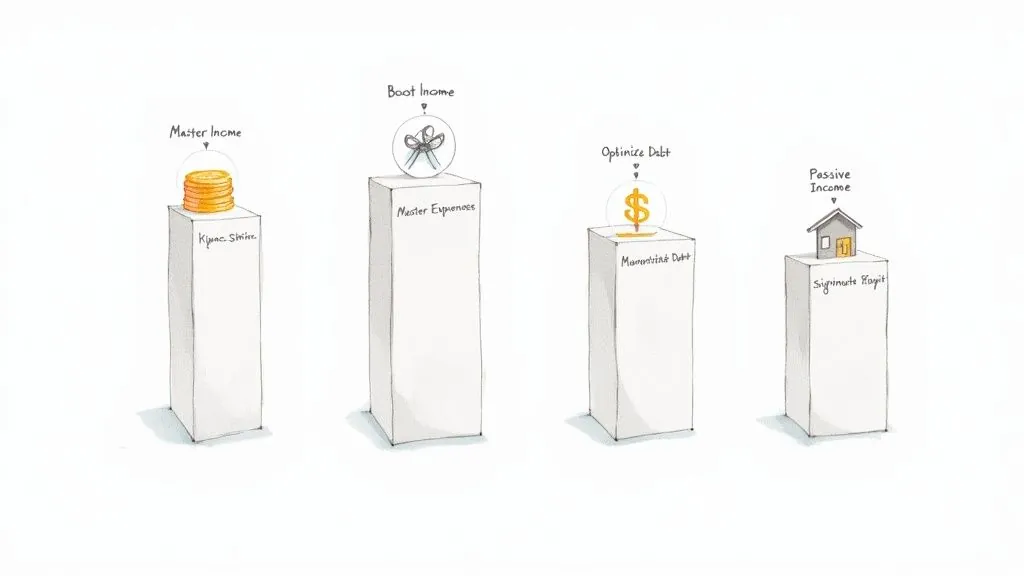
Think of these pillars as working together to reinforce your financial foundation, giving you more control over every dollar.
Boost Your Income Streams
The most straightforward way to improve your cash flow? Bring more money in. Relying on a single paycheck can be a precarious position; diversifying your income builds resilience and puts your savings and investment goals on the fast track.
You could start with these options:
- Negotiate a Raise: Do your homework, find out what your market value is, and build a clear case for a salary bump. Even a modest 5% raise can add hundreds of dollars to your monthly cash flow.
- Start a Side Hustle: Turn a skill you already have into a paycheck. This could be anything from freelancing and consulting to driving for a rideshare service or selling crafts online.
- Sell Unused Items: Declutter your space and list things you no longer need on platforms like Facebook Marketplace or eBay. It’s a quick way to get an immediate cash injection.
Master Your Expenses
While boosting your income is powerful, managing your outflow is just as crucial. It’s shocking how much money can leak out of a budget through small, untracked purchases. If you’re serious about positive cash flow, getting a firm grip on your spending is non-negotiable.
A realistic budget is the best place to start. Categorize everything you spend and shine a light on the non-essentials—like that gym membership you never use, the daily coffee runs, or frequent dinners out. Trimming just $150 per month from these costs adds up to an $1,800 annual boost to your cash flow.
Optimize Your Debt
High-interest debt is like an anchor dragging on your cash flow. It siphons away money that you could be using to build wealth. A smart pay-down strategy can free up hundreds of dollars every single month.
The goal goes beyond making payments; it is to eliminate the principal as efficiently as possible to stop the interest from accumulating.
Two popular strategies to tackle this are:
- The Avalanche Method: You hammer away at the debt with the highest interest rate first. This method saves you the most money in the long run.
- The Snowball Method: You focus on wiping out the smallest debt first, regardless of the interest rate. The quick win gives you a psychological boost to keep the momentum going.
Pick one and stick with it. You’ll be amazed at how quickly you can eliminate those hefty monthly payments and improve your cash flow.
Build Passive Income
This is the endgame for sustainable cash flow: having your money work for you. Passive income is money you earn from assets you own, not from trading your time. It’s the real key to long-term financial freedom.
Building these streams takes time and usually an initial investment, but the payoff is a continuous flow of cash that requires minimal day-to-day effort.
- Invest in Dividend Stocks: Own shares in solid companies that pay you a portion of their profits.
- Real Estate: You can do this by owning rental properties or by investing in real estate investment trusts (REITs) that pay dividends.
- High-Yield Savings Accounts: While the returns are modest, they offer a completely safe and passive way to earn interest on your cash reserves.
Putting these strategies into practice requires organization and consistent tracking. To make things easier, you can find great resources to automate finances, which cuts down on the manual work and gives you a much clearer picture of your progress.
How PopaDex Helps You Master Your Cash Flow
Knowing the strategies to improve your cash flow is one thing, but actually putting them into practice day after day is a whole different ball game. This is where having a dedicated financial co-pilot can make all the difference. PopaDex takes the tedious, often frustrating work of tracking your money and turns it into a simple, automated process, giving you the clarity you need to finally take control.
Forget wrestling with messy spreadsheets and punching numbers into a calculator. PopaDex gives you intuitive dashboards that create a crystal-clear picture of your inflows and outflows. When you can see exactly where every dollar comes from and where it goes, you can spot trends and make smarter decisions in an instant.
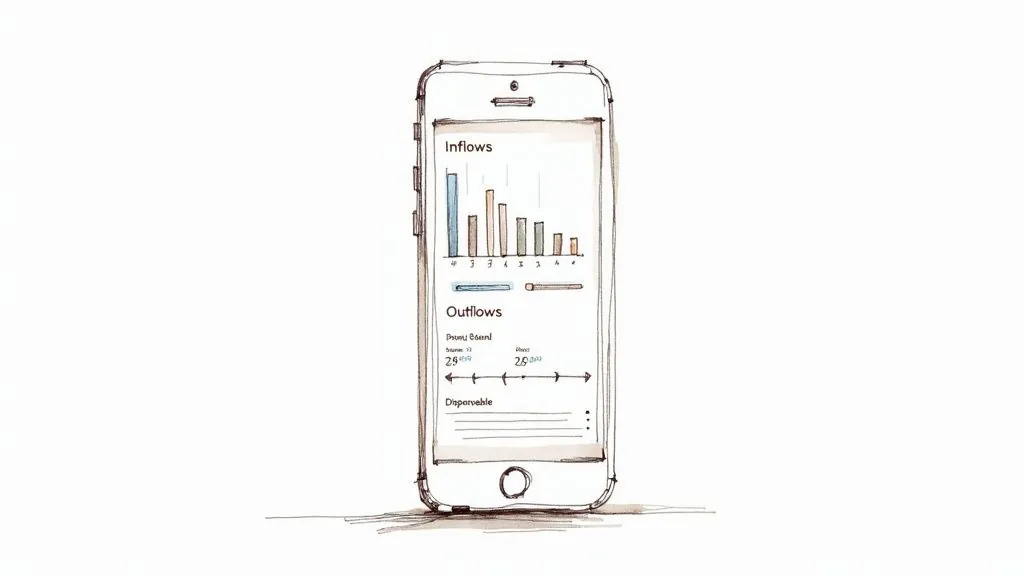
This visual approach turns abstract numbers into real insights, helping you see the immediate impact of your financial choices.
Turning Data Into Actionable Insights
PopaDex was built from the ground up to solve the real-world challenges of managing modern finances. It’s packed with powerful tools designed to cut through the complexity and empower you to build and maintain positive cash flow. The platform’s features directly tackle the common pain points that trip most people up.
Think about it this way: companies with consistently positive cash flow have a much stronger growth potential because they have the funds to reinvest in their future. As you can read about how strong cash flow helps firms withstand economic downturns on hbs.edu, this same exact principle applies to your personal finances—and PopaDex is the tool that helps you apply it.
Here’s how PopaDex helps you get there:
- Multi-Currency Support: If you’re an expat or invest internationally, managing money across borders is a massive headache. PopaDex seamlessly tracks assets in different currencies, giving you one unified view of your global net worth and cash position. No more guesswork.
- Disposable Income Calculator: This tool goes way beyond basic budgeting. It shows you precisely how much money you have left after all your essential expenses are paid, helping you make smarter decisions about saving, investing, or spending.
- Holistic Financial Overview: By connecting all your accounts—from your bank and credit cards to your investments—you get a complete, 360-degree picture of your financial health. This makes it so much easier to see how each part of your financial life affects your overall cash flow.
Ultimately, PopaDex is more than just a tracker; it’s a decision-making tool. It gives you the hard data you need to actively manage your money, spot opportunities for improvement, and build a truly sustainable financial future. By automating the boring parts of financial tracking, it frees you up to focus on what actually matters: hitting your goals.
Answering Your Top Cash Flow Questions
Even after you get the hang of the basics, some of the finer points of cash flow can still feel a bit fuzzy. Let’s clear the air and tackle some of the most common questions that come up. Getting these concepts straight is the final step to really owning your financial picture and understanding what a healthy cash flow means in the real world.
Can I Be Profitable But Still Have Negative Cash Flow?
You absolutely can. This is one of the most important distinctions to grasp in both personal and business finance, and it trips a lot of people up. Profit is an accounting figure you calculate on paper (Revenue - Expenses), and it often includes non-cash items. It tells you what you’ve earned, not what’s actually sitting in your bank account.
Let’s say you run a small consulting business. You finish a big project and send the client an invoice for $10,000. On your books, you just made a $10,000 profit this month. Great, right? But the client’s payment terms are 60 days, meaning you won’t see that cash for two months.
In the meantime, your own business expenses are due right now:
- Software subscriptions: $500
- Office rent: $2,000
- Employee salaries: $5,000
In this scenario, your cash outflows total $7,500, but your cash inflow is $0 until that invoice gets paid. So while you’re technically profitable by $10,000, your cash flow for the month is a negative $7,500. This is exactly why they say “cash is king”—it’s the real money you have on hand to pay the bills and keep the lights on.
What Is a Good Positive Cash Flow Margin?
There’s no single magic number that works for everyone; the ideal margin really comes down to your specific goals. But there are some solid benchmarks you can use to guide your financial planning.
For a healthy business, a great target to aim for is an operating cash flow margin of 15-20%. This means for every dollar in sales, you’re successfully turning 15 to 20 cents of it into actual cash. Hitting this shows you’re running an efficient operation and gives you a strong cushion for reinvesting or handling unexpected costs.
For personal finance, a fantastic goal is to have your positive cash flow align with the well-known 50/30/20 budget rule. This framework suggests putting 50% of your take-home pay toward needs, 30% toward wants, and saving or investing the final 20%. If you can consistently maintain a positive cash flow of at least 20% of your income, you’re in a powerful position to build wealth and work toward financial independence.
The most important thing isn’t just hitting a certain number once. It’s about achieving a consistently positive cash flow that reliably supports your long-term financial goals, month after month.
How Often Should I Calculate My Cash Flow?
The right rhythm for checking your cash flow really depends on where you are in your financial journey. As you gain more control, your needs will change.
-
Weekly Check-ins: If you’re just starting out, have an irregular income, or are navigating a tight budget, looking at your numbers weekly can be a lifesaver. It helps you spot problems early and make quick adjustments before they become bigger issues.
-
Monthly Reviews: Once your budget is stable and you have a good grip on your spending, a monthly analysis is usually the sweet spot. This gives you a clear picture of your progress over a standard financial cycle, making it the most practical cadence for most people and stable businesses.
-
Daily Monitoring: For businesses in fast-moving industries, dealing with rapid growth, or facing a cash crunch, daily tracking might be essential. This intense focus allows for nimble decision-making to navigate volatile times.
The key is to find a frequency that keeps you informed without feeling like a chore. You want to be proactive about managing your money, not just reacting to whatever comes your way.
Ready to stop guessing and start knowing exactly where your money is going? PopaDex provides intuitive dashboards that give you a crystal-clear, real-time view of your cash flow. Take control of your financial future today by visiting https://popadex.com to see how simple it can be.