
Our Marketing Team at PopaDex
Automate Financial Reporting: Simplify Your Finance Processes

Why Smart Finance Teams Are Ditching Manual Reporting
Let’s be real, if your month-end close still involves wrestling with spreadsheets and manual data entry, you’re fighting a losing battle. I’ve been there, and so have many of the finance leaders I’ve connected with. The consensus? Automating financial reporting is no longer a “nice-to-have” – it’s essential for survival. Manual reporting hides costs that go way beyond just overtime. Think compliance nightmares, strategic blind spots, and lost opportunities – the things that keep CFOs tossing and turning at night.
I recently spoke with a finance director who described their pre-automation month-end as a five-day fire drill. Errors were everywhere, and the team was constantly playing catch-up instead of actually analyzing data. After automating, their month-end close shrunk to two days, and accuracy improved significantly. This freed up their team to focus on strategic work, like building more accurate forecasts and finding growth opportunities. This isn’t some rare unicorn story. This kind of transformation is happening everywhere. The global financial automation market, valued at about $8.1 billion in 2024, is expected to hit $18.4 billion by 2030, growing at a 14.6% CAGR. That tells you everything you need to know about how valuable automation is becoming in finance. Learn more about the financial automation market here.
The Hidden Costs of Manual Reporting
Manual processes create a ripple effect of inefficiency across your entire finance operation. Think about it:
-
Time Drain: How many hours disappear each month hunting down data, reconciling spreadsheets, and creating reports? That’s valuable time that could be spent on more strategic activities.
-
Error Prone: Humans make mistakes. It’s inevitable with manual tasks, and in finance, those mistakes can lead to inaccurate reports, blown deadlines, and even compliance issues.
-
Limited Insights: When your team is drowning in manual work, they simply don’t have time for the analysis and insights that drive smart decision-making. They’re too busy keeping the lights on.
Before we dive into the automation advantage, let’s get real about the day-to-day differences. The table below paints a clear picture of what manual versus automated financial reporting actually looks like in practice.
Manual vs Automated Financial Reporting Reality Check An honest comparison of what your days actually look like with manual processes versus automated workflows
| Daily Reality | Manual Approach | Automated Approach | Life Improvement |
|---|---|---|---|
| Month-End Close | Five days of stress, late nights, and error-prone processes | Two days, significantly improved accuracy, and more time for analysis | Reduced stress, better work-life balance, and improved team morale |
| Data Gathering | Hours spent tracking down information from various sources and manually inputting data | Data automatically integrated and consolidated from multiple systems | Huge time savings and reduced risk of human error |
| Reporting | Creating reports manually, often leading to inconsistencies and version control issues | Automated report generation with consistent formatting and up-to-the-minute data | Improved efficiency and data reliability |
| Analysis | Limited time for analysis due to heavy workload of manual tasks | More time available for in-depth analysis and strategic decision-making | Better insights and more proactive planning |
As you can see, the impact of automation goes beyond just saving time. It’s about fundamentally changing how your finance team operates.
The Automation Advantage
Automating financial reporting goes beyond saving time (though that’s a major perk). It’s about transforming your finance team from number-crunchers to strategic advisors. Here’s how automation empowers your team:
-
Focus on Analysis: Automating routine tasks frees up your team to interpret data, identify trends, and give strategic recommendations.
-
Improve Accuracy: Automated systems reduce human error, resulting in more accurate and dependable financial reports.
-
Gain Real-Time Insights: Access current financial data to make quicker, data-driven decisions.
-
Enhance Compliance: Automated processes help ensure compliance with regulations by creating audit trails and reducing the risk of errors.
The finance professionals who are succeeding today are the ones who have embraced automation. They’re the ones providing valuable insights, driving growth, and setting their organizations up for success. Are you ready to join them?
Taking Stock of Your Current Reporting Chaos

Before diving headfirst into automated financial reporting, let’s take a good, hard look at your current reporting situation. Trust me, most finance teams are shocked (and slightly embarrassed) when they actually map out their processes. Those little inefficiencies that seemed so minor suddenly snowball into massive time-wasters. I’ve personally witnessed teams drastically underestimate the number of steps involved in even the simplest reports. This isn’t about pointing fingers; it’s about being honest with ourselves.
Mapping Your Reporting Workflow
Start by documenting absolutely everything involved in your main reporting processes. Channel your inner detective – no detail is too insignificant. For example, if you’re creating a monthly sales report, list how you pull data from various sources, consolidate it, run calculations, and format the final report. Include it all, even the little things like emailing the report to stakeholders. While assessing your current reporting chaos, it’s also helpful to consider the wider implications of switching to cloud accounting solutions.
Identifying Bottlenecks and Quick Wins
Once you’ve mapped out your workflows, start hunting for bottlenecks. Where do things slow down? Are there manual data entry tasks that take ages? Are multiple people handling the same data, increasing the risk of errors? These are perfect candidates for automation. But here’s the kicker: sometimes the biggest revelations come from finding processes that are broken before they even get to the reporting stage. Maybe your data entry process is a mess, resulting in unreliable reports. This is where you can score some early victories by cleaning up those fundamental processes before automating anything.
Warning Signs Your Processes Need Help
There are some telltale signs that a process is begging to be automated. Repetitive manual data entry is an obvious one. Frequent errors in reports are another, especially if those errors are due to manual calculations or data transfers. If your team spends hours (or even days!) reconciling data from different systems, that’s a huge red flag. A recent survey highlighted this, revealing that 49% of finance departments rely entirely on manual processes, while only 13% are fully automated. This really emphasizes the need for better efficiency through automation. You can find more insights into these automation statistics here. Finally, think about the strategic cost of manual processes. Is your team so swamped with routine tasks that they have no time for the insightful analysis that actually drives the business forward? That’s a sign that automation goes beyond saving time; it’s a strategic necessity. This initial assessment becomes your roadmap for pinpointing the right processes to automate and maximizing your return on investment.
Finding Automation Tools That Actually Fit Your World
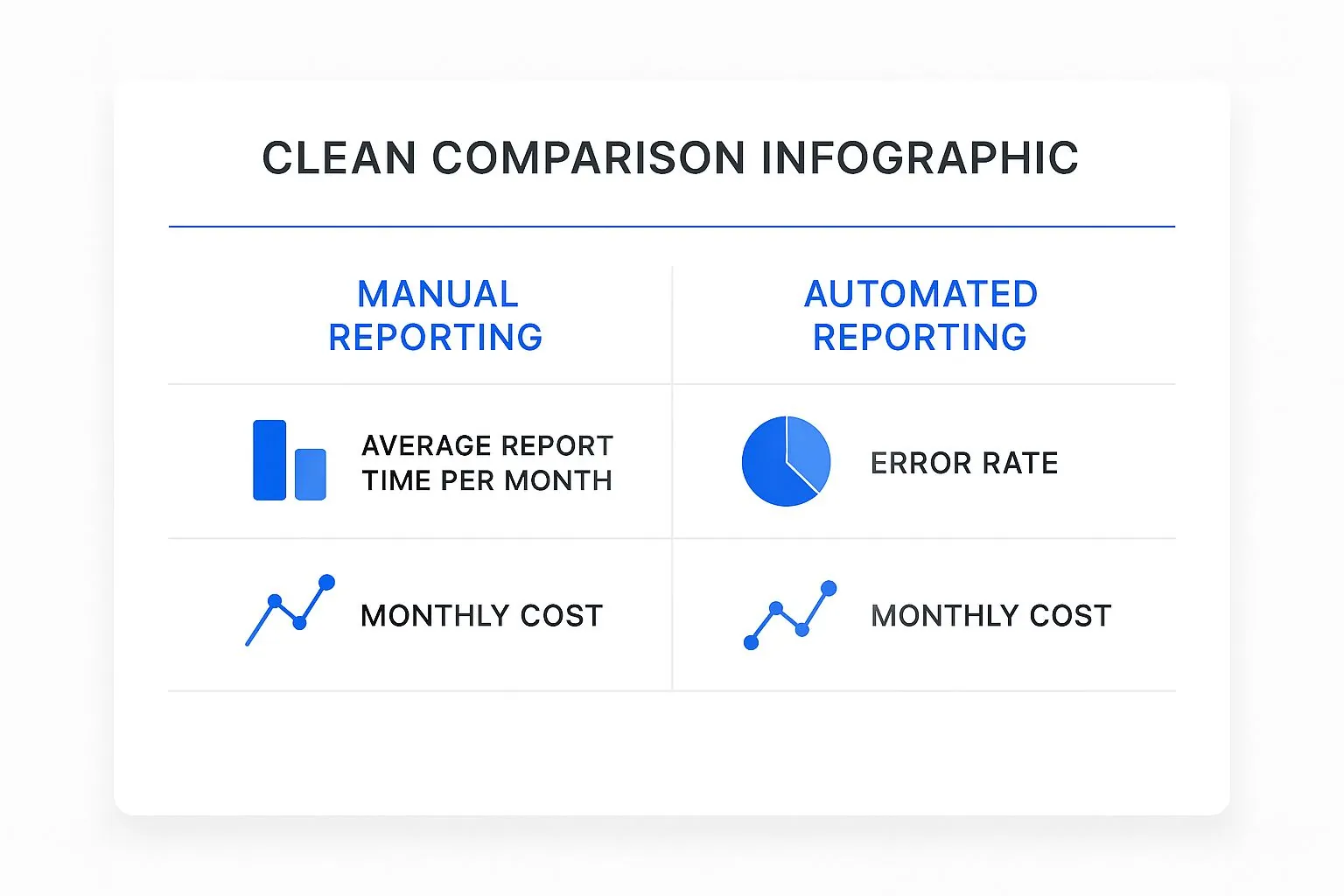
The infographic above gives you a quick comparison of manual and automated reporting. Look at the difference in average report time, error rate, and monthly cost! Automating your financial reporting saves you serious time, cuts down on errors, and can even lower your costs in the long run. Now, let’s find the right tools to make this happen for you. I know the automation marketplace can be a bit of a maze. Everyone promises you the world, but which solutions actually deliver?
This is where having been there and done that really helps. I’ve seen how picking the wrong tools can lead to wasted time, wasted money, and projects that just get abandoned.
Navigating the Automation Jungle
First things first: forget the hype. Sure, AI-powered platforms sound amazing, but they might be overkill if you’re just beginning your automation journey. For a lot of finance teams, Robotic Process Automation (RPA) is a great starting point. RPA is really good at handling those tedious, repetitive tasks like data entry and report generation. This frees up your team to focus on the bigger picture. As you get more comfortable with automation, then you can start looking at the more advanced options.
PopaDex and the Power of Specialized Solutions
Specialized tools like PopaDex are a game-changer for financial reporting automation. While those broader automation platforms can handle general tasks, PopaDex is focused on consolidating and monitoring your entire financial portfolio. This means you can automate how all your financial data is pulled together, giving you a real-time view of your net worth. If that sounds interesting, check out this guide on how to automate your finances with PopaDex. Integrating PopaDex with your other automation tools creates a truly comprehensive solution for managing and reporting on your finances.
Point Solutions vs. All-in-One Systems
The choice between focused tools (“point solutions”) and all-in-one platforms depends on your specific needs and resources. All-in-one systems are convenient, but can be pricey and complicated to set up. Point solutions, like using PopaDex for net worth tracking, let you tackle specific problems efficiently and without breaking the bank. Honestly, a mix of both often works best - a core automation platform along with some specialized tools for those unique tasks.
To help you decide, I’ve put together a table summarizing the key differences and when each type of tool makes the most sense:
Automation Tool Categories That Actually Matter A practical breakdown of tool types, what they’re genuinely good at, and when each makes sense for your situation
| Tool Type | What It Actually Does | Perfect For | Reality Check |
|---|---|---|---|
| Robotic Process Automation (RPA) | Automates repetitive tasks like data entry, report generation, and basic workflows. | Teams starting out with automation, needing to streamline simple processes. | Can be limited in handling complex scenarios or integrating with specialized systems. |
| All-in-One Automation Platforms | Offer a wide range of automation capabilities, often including RPA, AI, and data analytics. | Larger organizations with complex automation needs and resources for a larger implementation. | Can be expensive, complex to configure, and may not excel at specific financial reporting tasks. |
| Specialized Financial Reporting Tools (e.g., PopaDex) | Focus on automating tasks specific to financial reporting, like portfolio consolidation, net worth tracking, and performance analysis. | Finance teams needing to automate specific reporting workflows or gain deeper insights into financial data. | May require integration with other automation platforms for complete end-to-end automation. |
The main takeaway here is to choose the tools that best fit your current needs and budget. You can always add more sophisticated tools as you grow.
Asking the Right Questions
Don’t be shy about putting vendors through their paces. Ask them about their specific experience with financial reporting. How do they deal with complicated data structures? What about integrating with the systems you already have? A vendor that really gets finance will speak your language and offer solutions that actually address your challenges.
And remember, think long-term. Implementation is just the beginning. Factor in the ongoing maintenance, support, and potential future upgrades. Starting small and scaling up as you learn is usually the smartest way to automate financial reporting. This prevents you from over-complicating your first automation project and makes the shift to a more efficient finance function much smoother. Trust me, I’ve learned this one the hard way!
Building Implementation Momentum That Sticks

This is where so many automation projects unfortunately end up—stalled somewhere between the initial excitement and the often daunting task of changing ingrained habits. I’ve been there, seen the glazed-over eyes as teams get bogged down in the nitty-gritty. Trust me, it doesn’t have to be this way. Real momentum comes from focusing on early wins and acknowledging the human side of change.
Creating Early Wins and Enthusiasm
The secret sauce? Demonstrate value quickly. Pick a specific pain point your team regularly grapples with. For example, if reconciling intercompany transactions is a recurring headache, automate that first. A tangible, early win like this works wonders for building buy-in and generating genuine excitement.
This early success doesn’t need to be a massive overhaul; it just needs to be noticeable. Think automating a small but frequent report, or maybe streamlining a particularly tedious data entry process. When your team sees firsthand how automation solves a real problem, they become much more receptive to bigger changes down the line.
Once you’ve pinpointed those initial targets, you can start exploring how to best select automate business processes that truly fit your needs.
Managing the Messy Middle
Let’s face it, even the smoothest projects hit snags. Data migration hiccups, integration challenges, and unexpected errors are inevitable. The key is to anticipate these roadblocks and have a plan to deal with them. This is where clear, consistent communication becomes absolutely crucial.
Keep your team in the loop about progress, both the good and the bad. Transparency builds trust and prevents those office whispers from derailing your efforts. And don’t hesitate to ask for help! Vendors, consultants, or even colleagues in other departments can offer valuable perspective and support.
Change Management: Addressing the Human Element
Automation can sometimes spark concerns about job security. Address these worries directly. Emphasize that automating financial reporting isn’t about replacing people; it’s about empowering them. By automating tedious tasks, you’re freeing up your team to focus on more strategic, higher-value work that requires human insight and analysis. Think about it: up to 80% of transactional accounting work could be automated using technologies like Robotic Process Automation (RPA) and AI. Plus, businesses typically see ROI within 6 to 12 months of implementation. Learn more about automation statistics and insights here.
Measuring Progress and Keeping Momentum
Define clear metrics to track your progress. Time saved, error reduction, and improved accuracy are all great starting points. But don’t forget the strategic impact. How is automation enabling better decision-making? How is it strengthening your compliance posture?
Share these wins with your team and leadership. Celebrate milestones, even the small ones. This keeps everyone engaged and showcases the tangible benefits of your automation initiatives. Remember, building implementation momentum is an ongoing process. By focusing on early wins, proactively managing challenges, and addressing the human element, you can create lasting change and unlock the full potential of automating financial reporting.
Creating Dashboards People Actually Want to Use
Automated reports are a fantastic starting point, but let’s be honest, they’re not the end game. The real magic happens when you build dashboards people actually use. I’ve seen this transformation firsthand – finance teams moving from number-crunching to strategic thinking, all thanks to a well-designed dashboard. It’s about presenting data in a way that inspires action and reveals real insights.
Designing Dashboards for Different Stakeholders
Consider your audience. An executive summary needs to be a quick, compelling story focusing on high-level KPIs like revenue growth and profitability. Think visually appealing and easily digestible, even for non-finance folks.
On the flip side, a budget manager’s operational dashboard needs the nitty-gritty details of specific projects, highlighting variances and potential risks. This calls for detailed charts and tables, allowing for deep dives into specific data. The key takeaway? One size doesn’t fit all.
This example business dashboard shows how to visualize key performance indicators (KPIs) in a digestible format. Stakeholders can quickly spot trends and potential issues, leading to faster decision-making.
Structuring Data for Clean Reporting
The old adage “garbage in, garbage out” holds true, especially with reporting. I’ve seen countless projects derailed by messy data. If your data isn’t organized, your automated reports will be riddled with errors and need constant manual fixes. That defeats the purpose of automation!
Spending time upfront on data structure is a game-changer. Think consistent data formats, clear naming conventions, and a central repository for all your financial information. This groundwork is essential.
Reporting Hierarchies and Automated Distribution
A clear reporting hierarchy makes all the difference. I recommend starting with high-level summary reports and then letting users drill down for more detail. This keeps things organized and prevents information overload.
Once your reports are ready, automate their distribution. Schedule reports to reach the right people at the right time. No more manual emailing – let the system handle it! You might find our guide on creating a net worth dashboard helpful.
Tackling Common Technical Headaches
Technical hiccups are inevitable. Data formatting issues, integration glitches, and those mysterious errors always seem to appear at the worst possible time. Don’t panic! They’re usually solvable.
The trick? Have a troubleshooting plan. Document common problems and their solutions. Don’t hesitate to reach out to your vendors or internal IT team for support.
Automating financial reporting is a journey, not a sprint. By following these practical tips and anticipating challenges, you’ll create dashboards that not only look great but provide valuable business insights.
Navigating the Inevitable Implementation Bumps

Let’s be real: automation projects rarely unfold without a hitch. Anyone who’s launched a new system knows there will be snags. That flawless demo the vendor presented? Real-world implementation is usually a bit more complicated. But don’t sweat it, these hurdles are common and completely manageable with the right approach.
Common Challenges and Practical Solutions
One major roadblock is often legacy systems resistant to integrating with new tech. I’ve witnessed this firsthand countless times. One client spent weeks wrestling with their outdated accounting software, trying to make it compatible with a new reporting platform. Their solution? PopaDex for financial data aggregation. It acted as a bridge, pulling data from the old system, cleaning it, and then feeding it into the reporting platform. Problem solved!
Another frequent issue: data quality. You may believe your data is impeccable, but inconsistencies often surface during automation. I once worked with a company whose customer database was a jumble of duplicates and inconsistent formatting. Thorough data cleansing was essential before any automation could begin. This is a hidden cost many overlook.
Then there’s the human factor. Team resistance can extend beyond simply adapting to change. I’ve seen seasoned accountants worried that automation will render their skills obsolete. The solution? Involve your team from the outset. Clearly explain how automating financial reporting will liberate them for more strategic work, not replace them.
Common barriers to automation include resource constraints (cited by 38% of finance executives) and the difficulty of integrating legacy systems (58%). But the potential benefits are significant: automation can slash reporting errors by up to 90% and accelerate processes up to 85 times faster than manual methods. Check out more compelling automation statistics here.
Managing Expectations and Maintaining Momentum
Remember, things won’t always go as planned. Be flexible with timelines and communicate changes transparently with leadership. When designing dashboards for automated financial reporting, looking at examples can be helpful. Here are some ideas for Business Intelligence Dashboards. Celebrate small victories to keep your team energized. Successful implementation hinges on both technical expertise and managing the human side of change.
Measuring Success and Building Your Automation Empire
So, you’ve set up your automated financial reporting system, and it’s running smoothly. Fantastic! Now, how do you demonstrate the return on that investment? Let’s discuss how to showcase the real impact – moving beyond simply stating “we saved X hours” to demonstrating the strategic value and ROI that justifies further investment in automation. Think of it as building your automation empire, one successful project at a time.
Metrics That Matter to Leadership
While time savings are important, leadership is more interested in the bigger picture. Focus on metrics aligned with their strategic priorities. Did automation improve the accuracy of your forecasts? Did it reduce errors, bolstering your compliance efforts? Did it free up your team to deliver more insightful analysis? These are the victories that truly resonate.
For example, I once worked with a finance team that automated their revenue recognition. Not only did they save 20 hours per month, they also reduced recognition errors by a whopping 80%. This significantly impressed the CFO because it directly improved the company’s financial statements and minimized audit risk.
Tracking Improvements and Demonstrating Value
Don’t just talk about the benefits – show them. Visualize your successes using dashboards and reports that clearly demonstrate automation’s positive effects. Consider using before-and-after comparisons of key metrics. Highlight how automation has empowered your team to focus on more strategic activities. And whenever possible, quantify the financial benefits.
I’ve witnessed finance teams using dashboards to track metrics like report generation time, error rates, and even the number of insights gleaned from automated data analysis. This data-driven approach simplifies demonstrating the value of automation to stakeholders throughout the organization. Tools like Tableau or Power BI are excellent for creating these kinds of visualizations.
Expanding Your Automation Footprint
Once you’ve proven the value of automating financial reporting, explore opportunities to extend automation to other processes. Accounts payable, expense management, and even aspects of the budgeting process are all prime candidates. By strategically targeting these areas, you build internal expertise and position your team as the go-to resource for automation across the company.
This is how you transition from being viewed as a cost center to a value creator. Finance teams that embrace automation become catalysts for efficiency and innovation, contributing to the overall success of the organization.
Continuous Improvement and Staying Ahead of the Curve
Automation isn’t a set-it-and-forget-it project. The tools and technologies are constantly evolving. Stay current on the latest best practices and trends. Continuously look for ways to refine your existing automation workflows and integrate new capabilities as they become available.
This dedication to continuous improvement is what distinguishes the true automation champions. They are the ones who build a lasting and valuable automation framework that delivers consistent value for their organizations. Subscribing to industry newsletters and attending conferences can help you stay on top of the latest developments.
Ready to gain better control over your financial future? PopaDex can help you automate your financial tracking and gain immediate insights into your net worth. Start your free trial today and experience the difference firsthand!