
Our Marketing Team at PopaDex
Mastering Financial Clarity for Lasting Wealth

Achieving financial clarity is about so much more than just peeking at your bank balance. It’s about gaining a complete, accurate, and real-time picture of your entire financial world. It means knowing exactly where every dollar comes from, where it goes, and how it’s working to build the life you actually want.
What Does Financial Clarity Truly Mean?

Ever tried to navigate a long road trip without a map or GPS? You might be moving, but you have no idea if you’re heading in the right direction, how much fuel is left in the tank, or if you’re even on the right road. That feeling of uncertainty, stress, and confusion is what many people experience in a “financial fog.”
Financial clarity is the exact opposite. Think of it as your personal financial GPS, combined with a clear sky and an open road. It gives you a precise understanding of your current financial location, your ultimate destination, and the most efficient route to get there.
This is more than a personal finance concept; it’s a principle that underpins global economic stability. The International Monetary Fund’s Global Financial Stability Report, for example, uses complex modeling to bring clarity to the world economy. Recent projections show a 5% probability that global growth could dip below 0.4% in the next year—a downturn driven by murky financial conditions and policy uncertainty. It’s a powerful reminder of how a lack of clarity, even at a macro level, creates massive risk.
From Financial Fog To Financial Clarity
Let’s break down the shift that happens when you move from financial confusion to a state of clarity. It’s a fundamental change in how you experience and manage your money.
| Aspect | Financial Fog (Without Clarity) | Financial Clarity (With Clarity) |
|---|---|---|
| Decision Making | Based on guesswork, emotion, and anxiety. | Based on data, confidence, and clear goals. |
| Spending | Unsure where money is going; frequent “surprise” expenses. | Every dollar is accounted for; spending is intentional. |
| Saving | Inconsistent; feels like you’re never saving enough. | Methodical and aligned with specific future goals. |
| Debt | Overwhelming and stressful; unsure of the best payoff strategy. | Managed with a clear plan; debt is a tool, not a burden. |
| Future Outlook | Vague, uncertain, and often a source of stress. | Well-defined, motivating, and feels achievable. |
Ultimately, gaining clarity goes beyond organizing numbers; it’s about trading anxiety for empowerment.
The Feeling of Financial Clarity
Getting to a place of financial clarity isn’t about becoming a spreadsheet guru. It’s about completely transforming your relationship with money, moving from a state of passive worry to one of active, confident decision-making.
Once you have it, you can answer critical questions with ease:
- Am I really saving enough for my long-term goals?
- Can I comfortably afford this large purchase without derailing my future?
- Is my debt working for me or against me?
- Where are the hidden costs that are quietly draining my resources?
This level of insight removes the guesswork—and the anxiety that always comes with it.
Financial clarity isn’t about judging your past spending habits. It’s about gathering the information you need to empower your future self to make smarter, more aligned decisions.
At the end of the day, it’s about knowing that your financial actions today are methodically building the future you envision. You’re no longer just a passenger on your own financial journey; you are the driver, confidently in control and ready to navigate any turn the road takes.
The Three Pillars of Financial Clarity
Achieving real, lasting financial clarity isn’t about finding a single magic bullet. It’s more like building a sturdy structure for yourself, one that rests on three critical pillars: Visibility, Alignment, and Confidence. Each one supports the others, creating a foundation strong enough to weather any of life’s financial storms. If you’re missing even one, your financial house is wobbly, vulnerable to the stress of uncertainty and bad decisions.
Think of it like building a house. You’d never dream of putting up the walls before you’ve poured a solid foundation. The same logic applies here; you can’t skip steps and expect to feel in control. Mastering these pillars in order gives you a clear, progressive path from confusion to empowerment.
This diagram breaks down the fundamental flow of your money. Gaining visibility starts right here, by understanding how your income splits between what you spend and what you save.
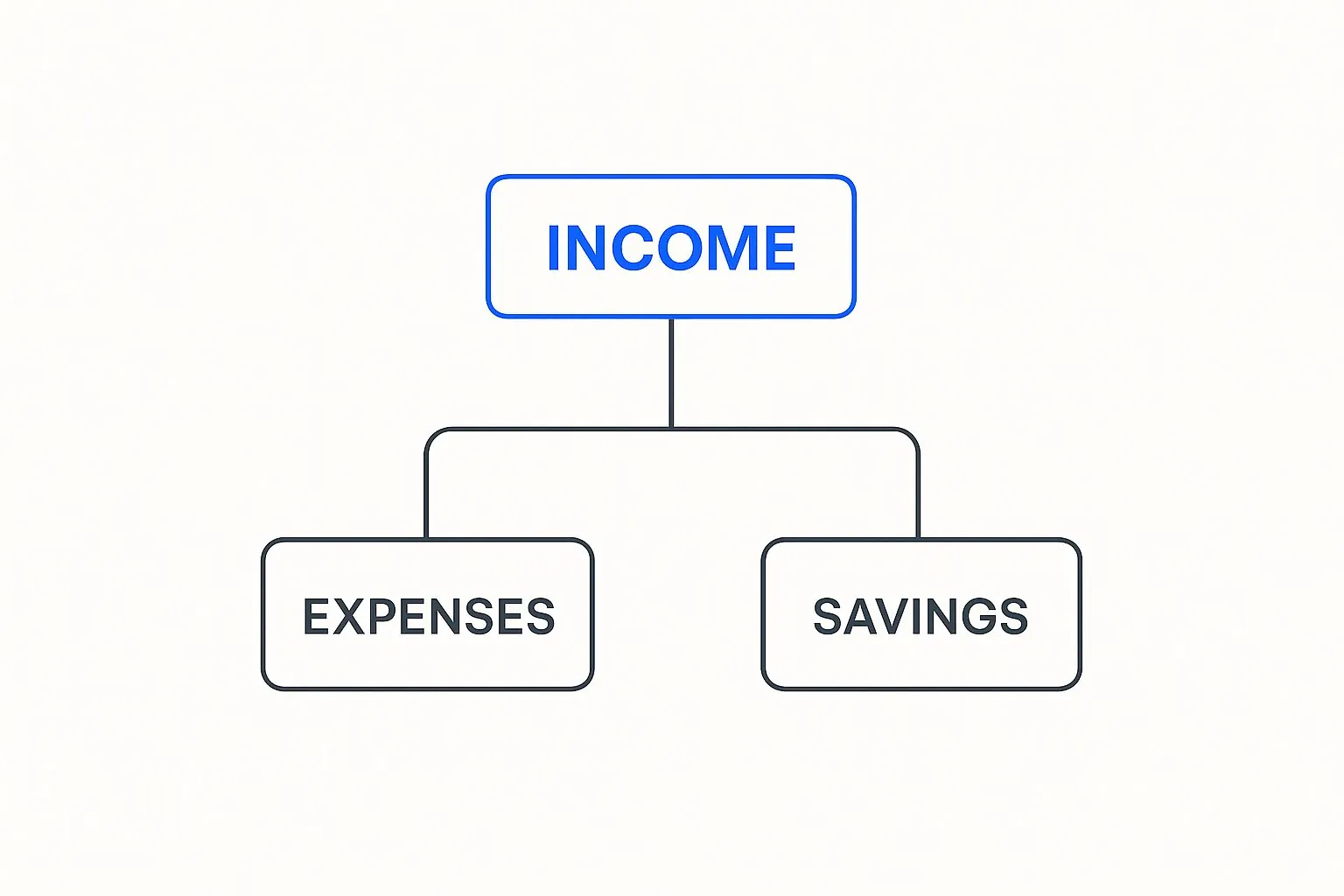
This simple hierarchy shows that every dollar you earn has a job to do—whether that’s covering an expense or funding a savings goal. This is the bedrock of financial visibility.
Pillar One: Visibility
The first and most important pillar is Visibility. This is simply the act of looking at your complete financial picture with total, brutal honesty—no judgment allowed. It means knowing exactly where every dollar comes from and, just as importantly, where it all goes. You’re essentially creating a detailed money map of your world.
Visibility isn’t about restriction; it’s about pure awareness. It’s the process of tracking your income, sorting your expenses into categories, and calculating your net worth. This raw data starts to tell a story about your financial habits, often uncovering patterns you never even knew existed.
Without this pillar, you’re flying completely blind. You might feel like you’re making progress, but you have zero hard data to prove it. Gaining visibility is the foundational step that makes everything else fall into place.
Visibility transforms money from an abstract source of stress into a tangible tool you can manage. It’s about replacing guesswork with facts, giving you the power to make informed choices rather than emotional reactions.
This need for a clear view isn’t just a personal finance thing; it’s essential on a global scale, too. Global financial wealth recently hit $305 trillion, jumping over 8% thanks to strong markets. At the same time, net wealth growth actually slowed to 4.4%, falling below the five-year average due to things like inflation and geopolitical issues. This just goes to show how vital clear insight is for investors and wealth managers trying to navigate choppy waters. You can dive deeper into these trends in the full BCG Global Wealth Report.
Pillar Two: Alignment
Once you can see your finances clearly, you’re ready to build the second pillar: Alignment. This is where you make sure your financial decisions are actively moving you toward your life goals, not pulling you away from them. Visibility shows you what is happening with your money; alignment answers why.
Alignment is all about connecting your daily spending habits to your biggest dreams. Want to buy a house? Travel the world? Retire early? Your financial actions need to be in lockstep with those desires.
This process involves a few key steps:
- Defining Your Values: Figure out what truly matters to you, beyond just stuff.
- Setting Meaningful Goals: Turn those values into specific, measurable financial targets.
- Creating a Plan: Build a roadmap that channels your money toward hitting those goals.
Alignment makes sure your money is working for a purpose—your purpose. Every financial choice, from your morning coffee to your investment strategy, becomes a deliberate step toward the life you actually want to live.
Pillar Three: Confidence
The final pillar is Confidence, and it’s the natural result of getting the first two right. Once you have full visibility into your finances and everything is aligned with your goals, the fear and anxiety start to melt away. In their place, you’ll find a quiet, steady sense of control.
This isn’t about being fearless; it’s about being prepared. Financial confidence means you can face big decisions—like a career change, a major investment, or an unexpected emergency—without hitting the panic button. You have the knowledge and the plan to handle whatever comes your way.
Confidence grows from understanding the ‘why’ behind your entire financial strategy. You know your numbers, you trust your plan, and you have a system to keep you on track. This third pillar is what cements your journey toward true financial well-being, turning clarity from a one-time project into a sustainable, lifelong habit.
Gaining Total Financial Visibility

The first step toward financial clarity is moving from abstract ideas to concrete action. To gain total financial visibility, you need to create an honest, detailed “money map” of your entire financial world. It’s all about seeing where every single dollar comes from, where it goes, and where it ends up each month.
This isn’t about slapping together a restrictive budget that makes you feel guilty for buying a coffee. Think of it more as a discovery mission. You’re simply gathering the raw data to understand the story your money is already telling. Without this baseline, any attempt you make to change your habits is just a shot in the dark.
True visibility gets rid of the financial surprises. It puts an end to those “Where did all my money go?” moments by replacing anxiety with cold, hard facts. This is what empowers you to start making intentional, informed choices that actually line up with your goals.
Tracking The Flow of Your Money
The bedrock of visibility is understanding your cash flow—the simple relationship between what you earn and what you spend. It sounds elementary, but a shocking number of people only have a vague sense of these numbers. The goal here is to make this tracking process simple and sustainable.
You don’t need complex, expensive software to get started. The best tool is whichever one you’ll actually use.
- Modern Apps: Automated tools are great because they can link directly to your bank accounts and credit cards, categorizing transactions for you and giving you instant insights with minimal effort.
- Simple Spreadsheets: The classic spreadsheet gives you total control. You can customize categories and track everything manually, which can help the numbers stick in your mind.
- A Plain Notebook: For those who prefer a more hands-on approach, a dedicated notebook is just as powerful for jotting down income and expenses every day.
The real key is consistency. Pick one method and commit to tracking everything for at least one full month. This will give you an accurate snapshot of your financial habits and uncover spending patterns you probably never knew existed.
Financial visibility isn’t a one-time chore; it’s an ongoing practice. It’s about building a system that gives you a clear, real-time feedback loop on your financial health, just like a GPS constantly updating your position on a map.
This is the same principle that drives efficiency in the business world. Companies use detailed financial tracking to stay agile, spot red flags early, and make quick, data-driven decisions to protect their bottom line. You can apply that exact same powerful concept to your personal finances.
Calculating Your Financial Snapshot
Once you have a grip on your monthly cash flow, the next step is to calculate your net worth. This number is a crucial snapshot of your overall financial health at a specific moment in time. It gives you that high-level perspective that just tracking your cash flow can’t provide.
Calculating it is refreshingly simple:
Assets (What You Own) - Liabilities (What You Owe) = Your Net Worth
This simple equation tells a surprisingly powerful story. A positive and growing net worth means you’re on the right track to building wealth. On the other hand, a negative or shrinking number is a clear signal that your current financial strategy needs a serious rethink.
What to Include in Your Calculation
To get an accurate picture, you need to be thorough. Don’t leave anything out.
- List Your Assets: This is everything of value you own.
- Cash in your checking and savings accounts
- Investments like stocks, bonds, and retirement funds (401k, IRA)
- Real estate (the current market value of your home, not what you paid for it)
- Valuable personal property, like your vehicles
- List Your Liabilities: This includes every penny you owe to someone else.
- Your mortgage balance
- Car loans
- Student loan debt
- Credit card balances
- Any other personal loans
After you have these totals, just subtract your liabilities from your assets to find your current net worth. This number is your starting line. For a more detailed way to visualize this over time, you might want to explore resources that guide you in setting up a net worth dashboard to monitor your progress.
Tracking this figure quarterly or annually is one of the most effective ways to make sure you’re consistently moving in the right direction toward your long-term goals.
Aligning Your Money With Your Life Goals
Once you have a brutally honest picture of your finances, it’s time to give every dollar a job. Getting visibility shows you what your money is doing; alignment is all about telling it what you want it to do. This is the second pillar of financial clarity, and it’s where raw data gets a soul.
Think of it like this: without alignment, your financial life is a powerful ship with no rudder. You might be moving, but you’re drifting at the mercy of every current and gust of wind. Alignment is the act of grabbing the wheel, setting a course, and making sure all your financial energy pushes you toward a destination you choose.
This is where your money stops being a bunch of numbers in an app and starts becoming the tool you use to build the life you actually want.
Moving Beyond The Traditional Budget
Let’s be honest, the word “budget” makes most people cringe. It brings up images of restriction, deprivation, and soul-crushing spreadsheets. But alignment isn’t about cutting back on everything that brings you joy.
Instead, we’re talking about values-based budgeting. This framework flips the script, using your personal values—not just your bills—to guide your spending. It boils down to one simple but powerful question:
“Does this purchase get me closer to the life I want?”
If your core value is “adventure,” then spending on that trip to Southeast Asia is a win. But if you’re dropping hundreds each month on streaming services you barely watch, that’s a clear misalignment. This isn’t about guilt; it’s about consciously redirecting cash from low-value spending to high-fulfillment goals.
Financial alignment isn’t about spending less; it’s about spending smarter. It ensures your money is a source of joy and progress, funding your experiences and ambitions rather than just acquiring more “stuff.”
Setting Goals That Actually Motivate You
Vague goals like “save more money” are boring and completely uninspiring. They don’t work. Real financial alignment demands goals that are specific, meaningful, and hit you on an emotional level. These are the big-picture ambitions that make you want to stick to the plan.
So, what does a meaningful goal look like?
- Instead of: “buy a house” Try: “Save a $50,000 down payment in three years for a three-bedroom home in the Northwood neighborhood so my kids have a backyard to play in.”
- Instead of: “get out of debt” Try: “Pay off my $22,000 in student loans in four years to free up $450 per month for investing in my future.”
- Instead of: “retire someday” Try: “Build a $1.5 million retirement fund by age 60 to travel Europe and live comfortably without financial stress.”
See the difference? Each one is specific, measurable, and connected to a deep “why.” That emotional hook is the fuel that keeps you going when a shiny new gadget tries to tempt you off course. To get these ambitions nailed down, you can use our guide and a dedicated financial goal-setting worksheet to turn those daydreams into a concrete plan.
Creating Your Personal Financial Roadmap
With your values clear and your goals defined, the last piece of the alignment puzzle is creating your roadmap. This is your personalized game plan, the bridge connecting your daily habits to your long-term dreams. It’s what turns “I wish” into “I will.”
Your roadmap needs to outline specific, actionable steps. Maybe that means setting up automatic transfers to a high-yield savings account every payday. Or maybe it’s creating a debt-payoff schedule that targets your highest-interest loan first. It could be allocating a set percentage of your income to your investment portfolio.
This is the part that proves achieving financial clarity is deeply personal. A roadmap for a single person gunning for early retirement looks completely different from one for a family saving for their kids’ college. Alignment ensures your financial plan is a true reflection of your life, nobody else’s.
Building Unshakeable Financial Confidence

Real financial clarity goes beyond spreadsheets and numbers; it’s the bedrock for unshakeable confidence. Once you have a clear view of your money (visibility) and a plan that reflects your goals (alignment), you can build the final piece: a deep, quiet assurance in your financial future.
This isn’t about being reckless or blindly optimistic. It’s the steady calm that comes from truly understanding how money works and knowing your place within that system.
Too many people feel shut out by the financial world’s love for complicated jargon and intimidating charts. We’re here to cut through that noise. By breaking down core ideas into simple, memorable concepts, you’ll feel empowered to take part in any financial conversation as an equal.
The goal is simple: to arm you with the “why” behind your strategy. This lets you face economic news, new investment opportunities, or unexpected life events with a clear mind and a steady hand, not a knot of anxiety.
Demystifying Core Financial Concepts
So, where does this confidence come from? It starts with knowledge. Grasping just a few key principles can completely change your perspective, turning confusing industry terms into powerful tools for building wealth.
Let’s break down the big ones.
-
Compound Interest: Einstein supposedly called it the eighth wonder of the world, and for good reason. It’s your money making money, and then that money making even more money. Think of a snowball rolling downhill—it starts small but gathers speed and size as it goes. This is why starting to invest early, even with tiny amounts, is an absolute game-changer.
-
Asset Allocation: This sounds way more complicated than it is. It’s simply the age-old advice: don’t put all your eggs in one basket. By spreading your investments across different categories, like stocks and bonds, you manage risk. It’s like building a balanced meal; you wouldn’t just eat protein. You need a mix of food groups for a healthy diet, and your portfolio needs a mix of asset types to stay resilient.
-
Good Debt vs. Bad Debt: Not all debt is a four-letter word. Good debt is borrowing money for something that will likely grow in value or boost your income, like a mortgage or a student loan for a high-paying career. Bad debt, on the other hand, is for things that lose value, like using a high-interest credit card for a shopping spree. Understanding the difference is the first step to making debt work for you.
Financial literacy is your best defense against fear and uncertainty. The more you understand the mechanics of money, the less power scary headlines and market swings will have over your emotions—and your decisions.
Navigating the World of Financial Advice
With a solid grip on these ideas, you’re in a much better position to weigh the financial advice that comes your way. Confidence helps you spot the difference between a genuine recommendation and a sales pitch in disguise. You’ll ask smarter questions because you understand the game.
This is more important than ever, as even global economic systems grapple with their own clarity issues. For example, at a recent World Economic Forum meeting, leaders debated the sustainability of the current financial system. A major point of concern was that interest payments on U.S. debt now cost more than its entire military budget, with total debt soaring past 100% of GDP.
This kind of global instability highlights why a resilient personal financial plan is so crucial. You can find more details on these high-level discussions at weforum.org. Understanding these bigger forces gives you context and reinforces the need for a strategy that doesn’t depend on one single economic outcome.
For a clearer understanding of the terms that underpin all of this, here’s a quick-reference table to demystify some essential financial concepts.
Key Financial Concepts Demystified
This table breaks down some common financial jargon into plain English, so you can see what these terms really mean for your money.
| Financial Term | What It Really Means | Why It Matters For You |
|---|---|---|
| Net Worth | The simple total of what you own (assets) minus what you owe (liabilities). | It’s the ultimate scoreboard for your financial health and progress over time. |
| Liquidity | How quickly you can turn an asset into cash without losing much value. | Having liquid assets (like cash in a savings account) is crucial for emergencies. |
| Diversification | Spreading your investments around to avoid having all your eggs in one basket. | It’s your primary strategy for reducing risk and protecting your portfolio from shocks. |
| Inflation | The rate at which the cost of living increases, reducing the purchasing power of your money. | Your investments and savings need to grow faster than inflation to actually build wealth. |
Understanding these terms is the first step toward speaking the language of finance fluently and confidently.
The Power of a Confident Mindset
Ultimately, financial confidence is about trusting your own judgment because it’s backed by knowledge and a solid plan. It’s what allows you to stick with your long-term investment strategy when the market gets choppy, knowing that downturns are just part of the ride.
It’s the peace of mind that comes from having an emergency fund, which turns a potential catastrophe into a manageable inconvenience. This calm control is the real prize of financial clarity. You’re no longer just reacting to your finances; you’re proactively directing them toward the life you want.
If you’re ready to build that solid foundation, exploring our guide on budgeting best practices is a great next step toward managing your money with conviction.
Maintaining Your Financial Clarity for the Long Haul
Getting a handle on your finances isn’t a one-and-done task you can just check off your list. Think of it more like tending to a garden. You can’t just toss some seeds in the ground and expect a masterpiece; it needs constant attention—weeding, watering, and care—to really thrive. Your financial health is no different; it needs regular check-ups to stay strong through all of life’s curveballs.
This is the secret sauce that separates a temporary feeling of control from building real, lasting wealth. Life is unpredictable. Careers pivot, families expand, and the economy is always in flux. A financial plan you set and forget will be useless in a year, leaving you right back in the same confusing fog you worked so hard to clear.
Get into a Financial Check-In Rhythm
The best way to keep that clarity sharp is to build a simple, repeatable habit of reviewing your finances. It’s the difference between catching a small leak and dealing with a flooded basement. Staying connected to your money and your goals keeps you in the driver’s seat.
Your schedule doesn’t need to be complicated. Just two key cadences will do the trick:
- Quick Monthly Reviews: Just 30 minutes a month is all it takes. Glance at your spending, see how your savings are stacking up, and make sure you’re still on track. Think of it like a pilot making small adjustments mid-flight to stay on course.
- Deeper Annual Planning: Once a year, block off a few hours for a full deep-dive. This is where you zoom out. Revisit your big-picture goals, tweak your investment strategy, and calculate your updated net worth. It’s your chance to look at the whole map, not just the next turn.
Maintaining financial clarity is a marathon, not a sprint. Consistent, scheduled check-ins are your pacing strategy—they give you the endurance to cross the finish line, no matter how long or winding the road gets.
Put Your Progress on Autopilot
One of the most powerful moves you can make for long-term clarity is to embrace automation. When you put your savings and investments on autopilot, you take willpower and forgetfulness completely out of the equation. It’s like setting up a drip irrigation system for that garden we talked about—the important stuff gets watered without you having to think about it.
This strategy guarantees that your biggest goals get funded first, every single time. Set up automatic transfers from your checking to your savings, retirement, and investment accounts, timed for right after your paycheck hits. It’s a simple action that quietly and consistently builds wealth in the background, no daily effort required.
Ultimately, this whole journey is about continuous learning and adapting. By building a rhythm of regular check-ins and using automation to your advantage, you turn financial management from a chore you dread into a powerful, lifelong habit. That sustained effort is the real key to building a secure and genuinely fulfilling financial future.
Common Questions About Finding Financial Clarity
Starting the journey to financial clarity always kicks up a few questions. It’s completely normal to feel a bit of nervousness mixed with excitement when you decide to take the reins of your financial life. Let’s tackle some of the most common worries people have right at the start.
Getting these questions out of the way early helps you push past those initial roadblocks with confidence. The idea is to swap out that nagging uncertainty for solid, actionable answers that keep you moving forward.
How Long Does It Take to Achieve Financial Clarity?
There’s no set-in-stone timeline, but you’ll see progress a lot faster than you probably think. That first burst of insight—where you track a full month of spending or calculate your net worth for the first time—can happen in just a few weeks. This initial phase gives you the raw data you need to stop guessing and start making smart moves.
But true, lasting financial clarity isn’t a finish line you cross once. It’s a habit you build. The real goal is to create sustainable routines, like monthly financial check-ins and goal reviews, that keep your vision sharp and adapt as your life changes.
This whole process is about progress, not perfection. The most important thing you can do is just start. Small, consistent actions are what build incredible momentum over time.
What If My Financial Situation Is Worse Than I Thought?
That sinking feeling when you realize the numbers aren’t what you hoped for? It’s tough, but it’s also the single most important moment in this entire process. Trust me, you’re not alone in feeling this way, and it actually marks the end of worrying about the unknown.
Think about it: you’re no longer operating on vague fears and worst-case assumptions. You have facts. That visibility is your new superpower. It lets you stop guessing and start building a real, targeted plan to fix things from a known starting point.
Do I Need Expensive Software to Gain Financial Clarity?
Not at all. While there are some slick apps and tools out there that can help, they are definitely not a requirement. You can get a perfectly clear picture of your finances using something as simple as a spreadsheet or even a dedicated notebook.
The best tool is always the one you’ll actually stick with. Your first priority should be mastering the core principles of visibility and getting your goals in line with your money. How you track your progress is way less important than the simple habit of doing it.
Ready to see your entire financial world in one, crystal-clear view? PopaDex is the intuitive net worth tracker built to give you the clarity and confidence you need. Bring all your accounts together, watch your progress, and make smarter decisions with our powerful dashboard. Start your journey for free at PopaDex.com today.