
Retirement Portfolio Allocation by Age: A Smart Guide
A fundamental truth of building a retirement portfolio is that your strategy has to change with you. The name of the game is to gradually dial down your risk the closer you get to your last day of work. When you’re young, you can afford to be aggressive with stocks for maximum growth. As retirement looms, the focus shifts to protecting what you’ve built, which means leaning more heavily on stable assets like bonds.
A Quick Snapshot of Retirement Portfolios
I like to think of the investment journey like a long-distance flight. In your 20s and 30s, you’re flying at high altitude, using the powerful tailwinds of the stock market to cover as much ground as possible. As you approach your destination—retirement—you begin a slow, controlled descent by adding more bonds to your mix. This ensures a smooth and predictable landing.
This strategic shift from high-growth to capital preservation is often called a glide path. It’s the key to making sure you arrive at retirement with your nest egg intact.
Below, we’ll look at some sample portfolios to see what this looks like in practice. Getting this concept right is the first step toward building a financial future you can count on.
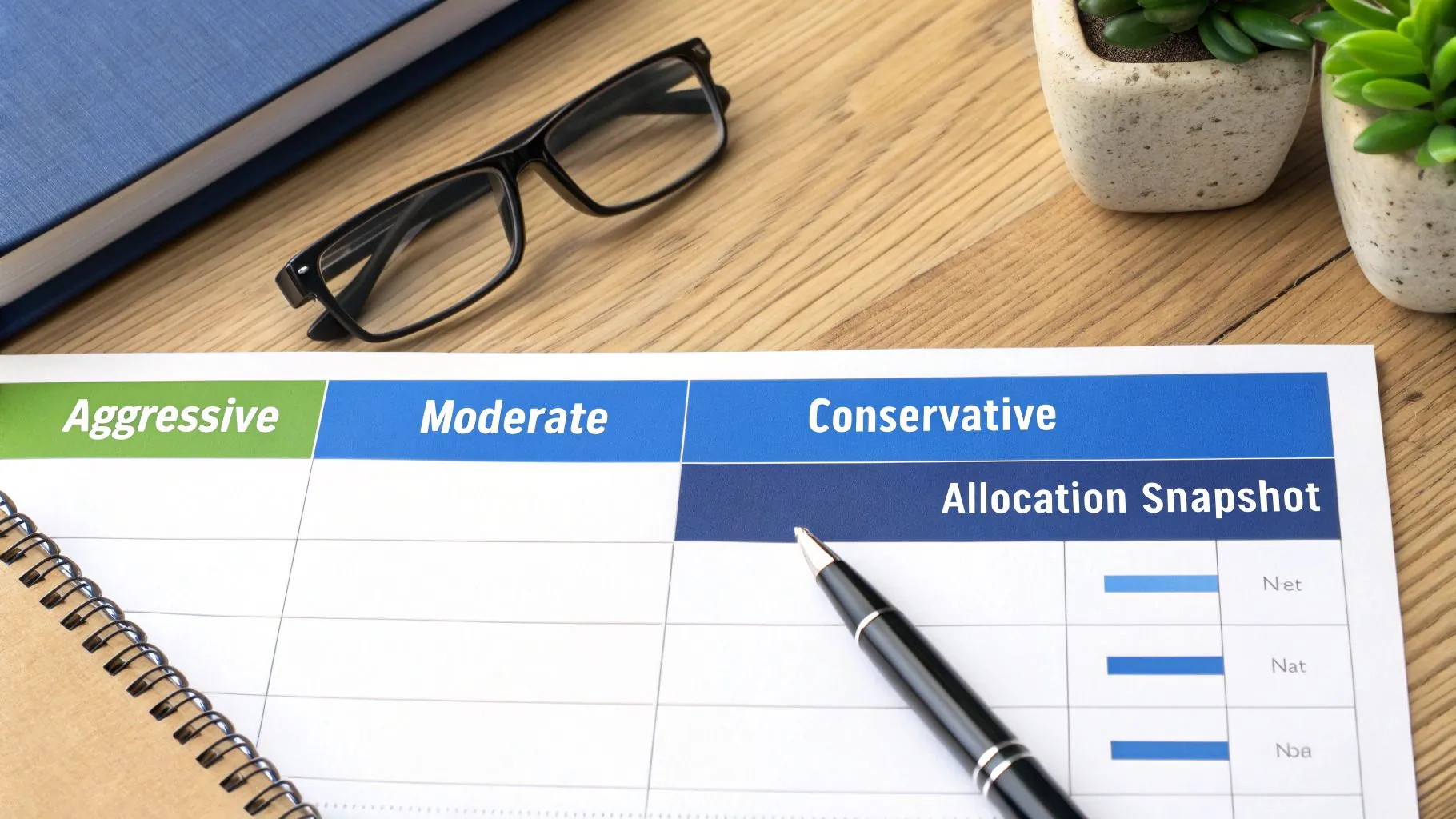
Sample Allocations by Age and Risk Profile
Of course, the “right” mix of assets is deeply personal. It depends heavily on your comfort with risk and how many years are left on your retirement countdown. An aggressive portfolio goes all-in on growth, a conservative one prioritizes protecting your capital, and a moderate approach tries to find a happy medium.
For those who are self-employed, figuring out the best ways to even get money into these accounts is the crucial first step. There are some excellent retirement savings strategies for the self-employed that use special tax-advantaged accounts like SEP IRAs or Solo 401(k)s.
Sample Retirement Portfolio Allocations by Age and Risk Profile
To make this more concrete, here’s a table showing how these allocations might shift over your lifetime. Think of these as starting points, not rigid rules.
| Age Group | Risk Profile | Stocks % | Bonds % | Alternatives/Cash % |
|---|---|---|---|---|
| 20s-30s | Aggressive | 90% | 10% | 0% |
| 20s-30s | Moderate | 80% | 20% | 0% |
| 40s-50s | Moderate | 65% | 30% | 5% |
| 40s-50s | Conservative | 50% | 45% | 5% |
| 60s+ | Moderate | 40% | 50% | 10% |
| 60s+ | Conservative | 30% | 60% | 10% |
See the pattern? Stock allocations drop steadily over time, while bonds and cash take up a bigger and bigger slice of the pie. This strategic de-risking is the absolute cornerstone of age-based investing. It’s all about making sure the money you worked so hard to save is there for you when you need it most.
Why Your Age Shapes Your Investment Strategy
Ever wondered why a 30-year-old’s investment portfolio looks nothing like a 60-year-old’s? It all comes down to one critical factor: your investment runway. Think of it as the amount of time you have left on the clock until retirement. This single variable is the most powerful force shaping how much risk you can—and should—take on.
Imagine you’re planning a road trip from New York to Los Angeles. If you’ve got two weeks, you can afford to take scenic detours, explore winding back roads, and a flat tire is just an interesting hiccup. But if you have to be there in three days? You’re sticking to the interstate, driving carefully, and avoiding anything that could derail your arrival.
Your investment journey is exactly the same. A long runway means you have decades to recover from market bumps, making it the perfect time to lean into high-growth assets like stocks. As you get closer to your destination, the game changes. The priority shifts to protecting the nest egg you’ve worked so hard to build, which is when safer assets like bonds take center stage.
The Investment Glide Path Explained
This gradual shift from a high-growth strategy to one focused on capital preservation is what we call an investment glide path. Just like an airplane doesn’t just drop out of the sky but makes a smooth, controlled descent, your portfolio should slowly and intentionally reduce risk as retirement approaches. It’s not a sudden slam on the brakes; it’s a calculated, steady adjustment.
The whole point of a glide path is to systematically de-risk your portfolio over time. It’s a safety mechanism designed to protect you from a big market crash right when you’re about to start drawing on your funds.
For a young investor, a market dip is a fantastic buying opportunity—everything’s on sale! But for someone five years from retirement, that same dip could be devastating if they’re still all-in on stocks. The glide path is your defense against that exact kind of last-minute disaster.
Rules of Thumb for Age-Based Allocation
Financial planners have used simple rules for decades to get this point across. You’ve probably heard of the ‘100 minus age’ rule, where a 30-year-old would hold 70% in stocks and a 60-year-old would hold 40%. It’s a decent starting point, but it’s getting a little long in the tooth.
Today, people are living and staying invested for much longer. With the average life expectancy in the U.S. now around 78 years, a 65-year-old might need their money to last another 20 or 30 years. That’s why many experts now suggest using 110 or even 120 as the starting number, giving portfolios a bit more growth potential to outpace inflation over a long retirement. You can read more about how these asset allocation models have changed over time on commonsllc.com.
Ultimately, understanding this fundamental link between your age and your capacity for risk is the secret to building a resilient retirement portfolio allocation by age. It lets you make smart, strategic moves that align with your stage of life, ensuring you’re taking the right amount of risk at the right time.
Sample Portfolios From Your 20s to Your 70s
Knowing the theory behind asset allocation is one thing, but seeing it in action is what really matters. Let’s move from abstract concepts to concrete examples. We’ll walk through sample retirement portfolios for every major life stage, from your ambitious 20s all the way to your income-focused 70s.
For each decade, we’ll look at three distinct profiles: Aggressive, Moderate, and Conservative. Think of these as practical templates you can adjust to fit your own risk tolerance, financial situation, and timeline.
This visual captures the typical investment journey perfectly—starting with the high-growth “rocket” phase in your early career and ending with the capital preservation “parachute” phase as you near retirement.
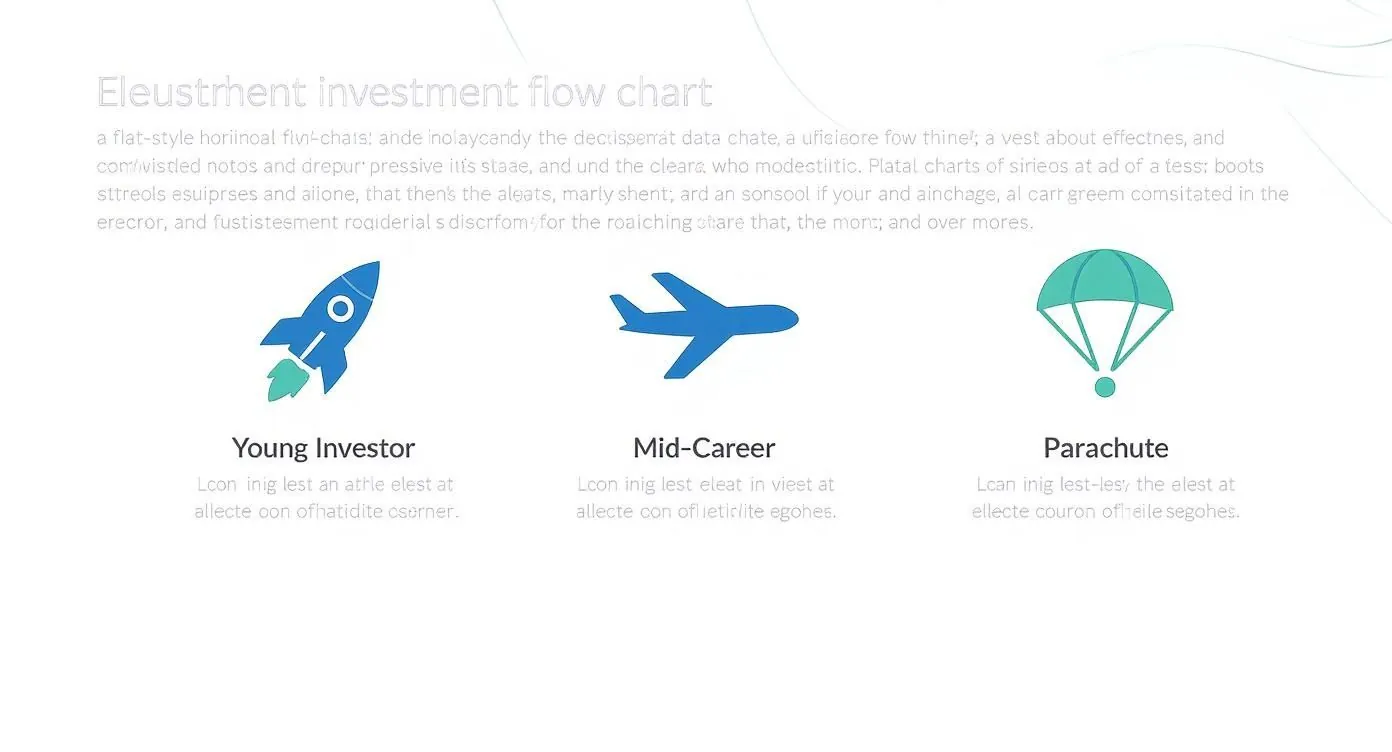
The big idea here is that your strategy should evolve. You’re shifting from a focus on speed and altitude to one of safety and a smooth landing.
Portfolios for Your 20s and 30s
This is your prime growth phase. With decades standing between you and retirement, your portfolio can afford to take on maximum risk for maximum potential returns. Time is your single greatest asset, giving you a long runway to ride out any market turbulence.
- Aggressive (90% Stocks / 10% Bonds): This is for investors with a high risk tolerance who are laser-focused on growth. That small bond allocation is just there to provide a tiny bit of stability.
- Moderate (80% Stocks / 20% Bonds): A classic choice for this age group. It’s still heavily weighted toward growth but introduces a more meaningful bond allocation to smooth out the ride.
- Conservative (70% Stocks / 30% Bonds): Ideal for those in their 20s and 30s who are naturally more risk-averse. This mix still packs a strong growth punch but with noticeably less volatility.
At this stage, your savings rate is incredibly powerful. To see how your contributions stack up against your peers and get motivated, check out our guide on the average 401(k) savings by age.
Portfolios for Your 40s and 50s
During these peak earning years, the focus starts to shift. Growth is still a priority, of course, but protecting the wealth you’ve already built becomes just as important. This is the heart of the “glide path,” where you begin to strategically and gradually de-risk your portfolio.
What’s interesting is how real-world investors behave. Many are more conservative than the old-school rules of thumb suggest. A recent Empower survey found that investors across their 20s, 30s, and 40s hold about 51% of their portfolios in stocks (43% US and 8% international). This is a far cry from the classic ‘100 minus age’ rule, which would put a 30-year-old at 70% stocks. It just goes to show how much personal risk tolerance shapes these decisions.
- Aggressive (75% Stocks / 25% Bonds): A great fit for confident investors with a high savings rate or other income streams. This allocation keeps a strong foot on the growth pedal.
- Moderate (60% Stocks / 40% Bonds): This is the quintessential balanced portfolio. It aims to capture market upside while providing a substantial cushion during downturns.
- Conservative (50% Stocks / 50% Bonds): A solid choice for those more concerned with capital preservation or who might be eyeing an earlier retirement.
Key Takeaway: Your 40s and 50s are all about finding the right balance between growing your assets and protecting them. Your allocation should reflect this dual priority.
Portfolios for Your 60s and 70s
Welcome to the capital preservation and income generation phase. As you enter or move through retirement, your portfolio’s main job is to provide a reliable stream of income while protecting your principal from major market shocks.
The question shifts dramatically from “How much can I grow?” to “How can I make this last?”
- Aggressive (50% Stocks / 50% Bonds): This might work for retirees with a long life expectancy, a strong pension, or other guaranteed income. The stock allocation is there to help your money outpace inflation over a multi-decade retirement.
- Moderate (40% Stocks / 60% Bonds): A very standard allocation for this age, balancing the need for some growth with a strong emphasis on stability and income from bonds.
- Conservative (30% Stocks / 70% Bonds): This is for retirees who prioritize maximum safety and predictable income above all else. The portfolio is designed to minimize volatility.
Decade-by-Decade Allocation Strategy Examples
To bring it all together, here’s a table summarizing these strategies. It provides a more detailed breakdown of how you might split your investments between US stocks, international stocks, bonds, and cash across different life stages and risk profiles.
| Age Decade | Profile | US Stocks % | Int’l Stocks % | Bonds % | Cash/Other % |
|---|---|---|---|---|---|
| 20s-30s | Aggressive | 65% | 25% | 10% | 0% |
| 20s-30s | Moderate | 55% | 25% | 20% | 0% |
| 40s-50s | Moderate | 40% | 20% | 40% | 0% |
| 40s-50s | Conservative | 35% | 15% | 45% | 5% |
| 60s-70s+ | Moderate | 25% | 15% | 50% | 10% |
| 60s-70s+ | Conservative | 20% | 10% | 60% | 10% |
These sample portfolios offer a clear roadmap. By aligning your asset mix with your life stage and personal comfort with risk, you can build a resilient strategy designed to get you to your long-term financial goals with confidence.
How to Personalize Your Portfolio Beyond Your Age
Age-based guidelines are a fantastic starting point, but let’s be honest—they treat everyone the same. Your financial life isn’t generic. It’s a unique mix of your goals, habits, and resources. To build a retirement portfolio that actually works for you, you need to look beyond your birth year and get personal.
Think of it like this: a standard city map will get you to the right neighborhood. But a personalized GPS route accounts for traffic, your driving style, and that one road you always try to avoid. It finds the best path for you. Customizing your portfolio does the same thing, fine-tuning your approach for a smoother ride to retirement.
This is about moving past a one-size-fits-all model and building a strategy that truly reflects your personal financial landscape.
Adjust Your Risk for Your Savings Rate
One of the most powerful levers you can pull is your savings rate—the percentage of your income you stash away for the future. A high savings rate is a massive advantage. It gives you permission to be more aggressive with your investments, even if you’re older than the “typical” growth investor.
How does that work? Someone saving 25% or more of their income is buying assets relentlessly, month in and month out. This strategy, known as dollar-cost averaging, literally turns market downturns into opportunities. While others are panicking about their portfolio’s value dropping, high-savers are scooping up more shares at a discount, which can seriously accelerate growth down the line.
A high savings rate acts as a shock absorber for market volatility. The more you save, the more you can afford to embrace the higher potential returns of stocks because your consistent contributions smooth out the bumps along the way.
With such a steady flow of new cash, your portfolio’s success becomes less about the day-to-day performance of your current assets and more about your ability to keep saving and investing.
Placing Assets for Tax Efficiency
Another critical layer of personalization is asset location. This isn’t about what you invest in, but where you hold those investments to slash your long-term tax bill. Getting this right can easily add tens of thousands of dollars to your nest egg over time.
The core principle is simple: put your highest-growth assets in accounts with the best tax breaks.
- Tax-Deferred Accounts (like a Traditional 401(k) or IRA): These are great spots for investments that kick off regular income, like dividend stocks or bonds. You put off paying taxes until retirement, letting your money compound without interruption.
- Tax-Free Accounts (like a Roth IRA or Roth 401(k)): This is the prime real estate for your highest-growth stocks. Why? Because all future growth and withdrawals are 100% tax-free. It’s the perfect home for assets you believe could multiply in value.
- Taxable Brokerage Accounts: These are best suited for your most tax-efficient investments, like growth stocks that don’t pay dividends or broad-market index funds that minimize taxable events.
For example, sticking a high-growth tech stock in a Roth IRA means its potential explosion in value over 30 years will never be taxed. Put that same stock in a taxable account, and you could be looking at a painful capital gains tax bill when you decide to sell.
Factoring in Other Income Streams
Finally, your retirement portfolio allocation needs to account for any other income you expect to have. Think of these external sources as a financial safety net, one that allows you to keep a higher allocation to stocks than someone your age might normally consider.
Here are a few common scenarios:
- Pensions: A guaranteed pension is like owning a super-stable bond. That predictable income stream frees you up to take on more equity risk in your investment portfolio to chase higher returns.
- Rental Properties: The consistent cash flow from real estate also creates a reliable income floor, meaning you don’t have to rely as heavily on selling portfolio assets to cover your bills.
- Annuities: Much like a pension, an annuity can provide a guaranteed income for life, adding another layer of security to your overall financial picture.
If a good chunk of your retirement income is already locked in from these sources, you can let your investment portfolio do what it does best: focus on growth to beat inflation and fund your bigger goals. It’s about making sure every piece of your financial puzzle is working together.
Keeping Your Portfolio on Track with Rebalancing
Setting up your retirement portfolio is a great first step, but it’s not a “set it and forget it” deal. The real secret to long-term success is disciplined maintenance. This is where rebalancing comes in—it’s the engine that keeps your investment strategy running smoothly, preventing market swings and emotions from derailing your plan.
Think of your portfolio like a well-tuned guitar. When you first set it up, every string (each asset class) is perfectly tuned to your target allocation—say, 60% stocks and 40% bonds. As the market plays its song, some strings will stretch and go sharp (stocks might soar) while others loosen and go flat (bonds might lag). Before you know it, your whole portfolio is out of tune.
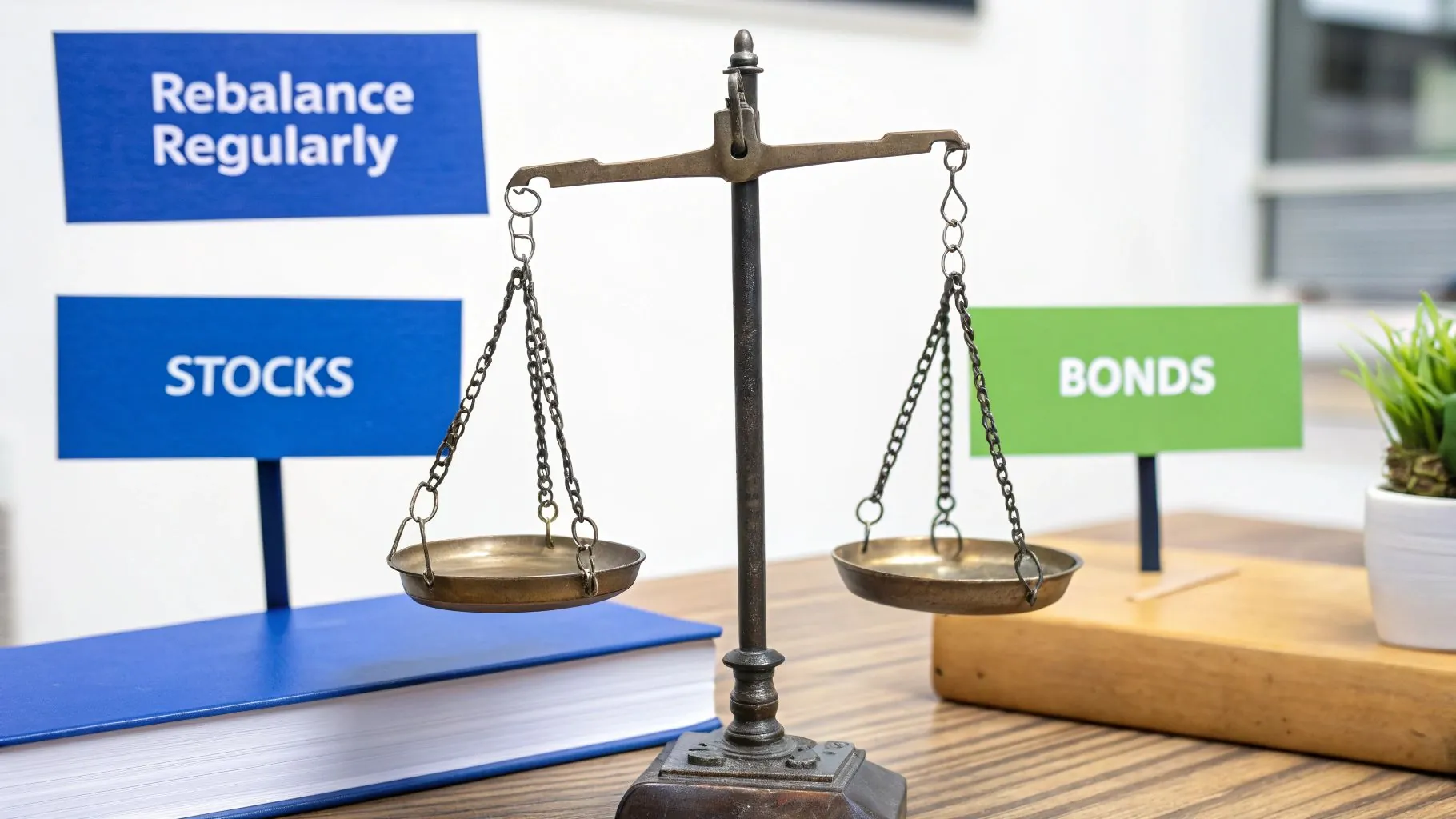
Rebalancing is simply the act of re-tuning your portfolio back to its original harmony. It’s a systematic process that forces you to follow the cardinal rule of investing—buy low and sell high—without letting fear or greed call the shots.
A Simple Rebalancing Example
Let’s walk through a quick example. Imagine you start with a $100,000 portfolio, allocated 60% to stocks ($60,000) and 40% to bonds ($40,000). After a great year in the market, your stocks jump to $80,000, while your bonds grow modestly to $42,000. Your new total is $122,000.
Your allocation has now drifted to roughly 66% stocks and 34% bonds—a bit too aggressive for your original plan. To rebalance, you would:
- Calculate your target dollar amounts for the new total: 60% of $122,000 is $73,200.
- Sell $6,800 worth of your outperforming stocks ($80,000 - $73,200).
- Use that $6,800 to buy more of your underperforming bonds.
This simple action locks in some of your stock gains and reinvests them into the asset class that is currently “on sale.” When tailoring your portfolio, it’s also helpful to look at advice for specific accounts, like these essential TSP investment tips.
Choosing Your Rebalancing Method
There are two main ways to decide when to rebalance. Neither is universally “better,” so the key is just to pick one and stick with it. What matters most is having a plan in place before market volatility strikes.
- Time-Based Rebalancing: This is the simplest approach. You just check in and rebalance on a fixed schedule—quarterly, semi-annually, or annually. For most long-term investors, an annual check-up is plenty.
- Threshold-Based Rebalancing: Here, you only rebalance when an asset class drifts from its target by a set amount, often 5% or 10%. For example, if your 60% stock allocation creeps up to 65%, that’s your trigger to rebalance.
Figuring out how often to rebalance is a cornerstone of your investment strategy. A consistent, planned approach is your best defense against risk and helps keep your asset mix right where you want it. Learn more about rebalancing frequency here.
A clear rebalancing strategy gives you the power to manage risk systematically and stay disciplined, no matter what the market is doing. And at the end of the day, that discipline is the real foundation of successful retirement investing.
Put Allocation in the Right Tracking Layer
Use a brokerage or specialist portfolio analyzer for holdings, target allocations, drift alerts, rebalancing, tax lots, fees, and performance. Those functions require current security-level data and should not be inferred from a net-worth balance alone.
PopaDex can record dated investment balances alongside the rest of your assets and debts. Standard is manual in one consistent currency. Premium adds ongoing original-currency records and optional connections only where the exact institution and account type are supported. It does not promise automatic target-allocation monitoring or rebalancing alerts.
At each review, reconcile the recorded investment balance to its source statement. Then review allocation and rebalancing decisions in the specialist investment tool, taking tax and transaction costs into account.
Your Top Asset Allocation Questions, Answered
Once you’ve mapped out your core retirement allocation, a few practical questions always seem to pop up. Think of this as the fine-tuning phase—making sure all the smaller parts of your financial engine are working together for a smoother ride to your goals.
Let’s tackle some of the most common points of confusion to help you move forward with confidence.
How Often Should I Re-evaluate My Strategy?
It’s crucial to distinguish between rebalancing and re-evaluating. Rebalancing is a simple, annual tune-up to get your portfolio back to its target weights. A full strategy re-evaluation, however, is a much bigger deal.
You should plan a deep dive into your overall glide path and risk tolerance every 3-5 years. The goal here is to avoid knee-jerk reactions to scary headlines or a hot market. Your long-term plan should be resilient, not reactive.
Of course, major life events are the exception—they’re a clear signal to review everything. These moments can fundamentally change your financial picture and timeline.
- Getting married or combining finances: Now, you’re aligning on shared goals and figuring out a unified household risk tolerance.
- Having a child: This introduces huge new long-term expenses, like college savings, that have to be factored into your plan.
- A major career or income shift: A big promotion or a jump into a less stable industry might change your ability or willingness to take on risk.
Should My Spouse and I Combine Our Allocations?
Yes, absolutely. It’s almost always best to view all household accounts—your 401(k), their IRA, a joint brokerage account—as one big, cohesive portfolio. Managing them in isolation is like having two rowers in a boat paddling out of sync.
This holistic approach unlocks much smarter strategies.
By treating all your accounts as a single entity, you can practice more effective asset location. This means you can strategically place your highest-growth investments (like stocks) in the accounts with the best tax advantages (like a Roth IRA), regardless of whose name is on the account.
A unified view ensures you’re both pulling in the same direction with a shared risk profile. It prevents one partner from being overly aggressive while the other is too conservative, a mismatch that could sabotage your combined goals.
What Role Do Alternatives Play?
Alternative investments like real estate, private equity, or crypto can be alluring. They promise diversification and juicy returns, but they come with serious trade-offs: higher risk, less liquidity (meaning they can be tough to sell quickly), and way more complexity than your standard stocks and bonds.
For most of us building a retirement portfolio, alternatives should be treated as a small, satellite position—not a core holding. A sensible limit is around 5-10% of your total portfolio, and that’s only after you have a solid foundation of stocks and bonds in place. Always do your homework to understand their unique risks before you even consider diving in.
Is a Target-Date Fund a Good Substitute?
Target-date funds (TDFs) are a fantastic, hands-off solution for millions of investors. They automatically handle your allocation, gradually shifting from aggressive to conservative as you near the fund’s target retirement year. This built-in glide path makes them an excellent “set it and forget it” option.
But there’s a catch: they’re a one-size-fits-all product. A TDF’s pre-programmed glide path might be too aggressive for your comfort or too conservative for your goals. They can also have slightly higher expense ratios than building a similar portfolio yourself with a few low-cost index funds or ETFs.
Ready to place investment balances in your wider balance sheet? PopaDex Standard supports free manual asset and debt records in one consistent currency. Use a specialist analyzer for current allocation, drift, fees, and performance. Start with free manual tracking.
Allocation for retirees and within a 401(k)
Asset allocation is the mix of stocks, bonds, cash, and other holdings. The mix should reflect the time until money is needed, ability to withstand losses, other guaranteed income, and the need for near-term withdrawals. There is no single age-based ratio for every retiree. Holding several years of expected withdrawals in lower-volatility assets may reduce the need to sell shares after a sharp fall, but also changes expected return.
Within a 401(k), review the actual fund menu, expense ratios, diversification, and any target-date option. Compare the allocation across all accounts before adding another fund; a diversified-looking 401(k) can still overlap heavily with holdings elsewhere. Rebalance to your chosen range periodically or after a material drift.