
Top Budget Forecasting Methods You Need to Know
Budget forecasting goes beyond crunching numbers; it’s the process businesses use to peek into the future, estimating revenue and expenses to build a financial roadmap. These methods can be anything from a simple look at last year’s performance to highly complex models, but they all serve the same purpose: helping leaders allocate resources wisely, manage risk, and keep spending in line with big-picture goals.
Why Budget Forecasting Methods Matter
Stop thinking of forecasting as a rigid accounting chore. It’s your company’s strategic GPS. Just like a pilot uses weather forecasts to chart the safest, most efficient course, these financial methods help you navigate the inevitable turbulence of the market. They give you a solid framework for making smart decisions, turning abstract ambitions into a concrete action plan.
Without a reliable forecast, you’re essentially flying blind. Decisions get made on gut feelings, not data. That’s a recipe for disaster, whether it’s overspending on shiny projects with low ROI or missing a huge growth opportunity because you didn’t have the capital ready.
Navigating an Unpredictable Landscape
If the last few years have taught us anything, it’s that the old ways of planning don’t always cut it. Traditional forecasting often relied on static, linear models that simply can’t keep up with today’s economic whiplash. The COVID-19 pandemic, massive supply chain disruptions, and surging inflation have all shown just how fragile those old-school budgets can be.
The companies that thrive are the ones using more flexible, dynamic strategies. As we’ll see, modern methods allow for much better adaptability when things get messy. You can discover more insights about flexible forecasting on Sage.com.
This guide will walk you through the most essential forecasting methods, so you can pick the right approach for your business. We’ll cover:
- Top-Down vs. Bottom-Up: Two foundational—and completely opposite—philosophies for creating a budget.
- Zero-Based Budgeting: The demanding method that makes you justify every single dollar, every single time.
- Rolling Forecasts: A dynamic approach that keeps you constantly looking 12-18 months ahead.
- Scenario Analysis: A strategic tool that prepares you for multiple possible futures, not just the one you hope for.
Getting a handle on these methods is the first step toward building a resilient financial strategy that can weather any storm and drive real, sustainable growth.
A Quick Look at Key Forecasting Methods
To get your bearings, here’s a quick-reference table that boils down each method we’re about to explore. Think of it as a cheat sheet for understanding the core idea behind each approach and where it shines.
| Method | Core Principle | Best For |
|---|---|---|
| Top-Down Forecasting | Executive leadership sets high-level financial targets that flow down to departments. | Stable companies needing quick budget creation and strong strategic alignment. |
| Bottom-Up Forecasting | Individual departments build budget requests from the ground up, which are then consolidated. | Growing businesses that require granular accuracy and departmental accountability. |
| Zero-Based Budgeting | Every expense must be justified from a “zero base” for each new budget period. | Organizations focused on deep cost-cutting and eliminating inefficient spending. |
| Rolling Forecasts | The forecast is continuously updated, always looking a set period into the future (e.g., 12 months). | Businesses in volatile industries that need to adapt quickly to changing conditions. |
| Scenario Analysis | Creating budgets for multiple “what-if” scenarios (best, worst, and most likely cases). | Companies wanting to stress-test their financial plans and prepare for uncertainty. |
Each method has its own strengths and weaknesses. Now, let’s dive into the details to figure out which one—or which combination—is the perfect fit for your business.
Comparing Top-Down and Bottom-Up Forecasting
When it comes to building a budget, there are two classic schools of thought: top-down and bottom-up. Think of it like building a house. Do you start with the architect’s grand vision and make the rooms fit, or do you design each room meticulously and then assemble them into a cohesive whole?
Each approach has its place, and the right choice depends entirely on your company’s structure, goals, and culture. This isn’t just an accounting exercise; it’s a strategic decision that shapes how your entire organization plans for the future.

Let’s break down how each one works and where they really shine.
The Top-Down Approach
The top-down method is the architect’s approach. Executive leadership, with their 30,000-foot view of strategic goals, market conditions, and shareholder expectations, sets the overall financial targets. They might decide on a 15% revenue growth target and a total expense budget of $50 million for the year ahead.
These high-level numbers then cascade down the org chart. Division heads get their piece of the pie, and they, in turn, slice it up for their department managers. It’s then up to each team to figure out how to make their plans work within the numbers they’ve been handed.
The biggest advantage? It’s fast, and it guarantees the budget is perfectly aligned with the C-suite’s vision from day one.
Pros and Cons of Top-Down Forecasting
| Advantages | Disadvantages |
|---|---|
| Speed and Simplicity The process is quick since it involves fewer decision-makers at the initial stage. | Lack of Accuracy Budgets can be pure fiction if executives are out of touch with day-to-day operational costs. |
| Strong Strategic Alignment Every dollar is tethered directly to the company’s overarching goals. | Lower Team Buy-In Department heads can feel ignored, leading to disengagement and a lack of ownership. |
| High-Level Control It gives senior leadership a firm grip on the company’s financial steering wheel. | Missed Opportunities The best insights often come from the front lines, and this method silences those voices. |
The Bottom-Up Approach
In stark contrast, bottom-up forecasting is like building with LEGOs. You start with the smallest pieces. The marketing team projects what its campaigns will cost, engineering estimates R&D expenses, and sales forecasts its travel and commission needs.
Each department submits a detailed budget proposal, justifying every line item based on its specific plans. These individual “bricks” are then passed up the chain of command, where they’re reviewed, tweaked, and eventually stacked together to form a single, comprehensive company budget.
This approach is almost always more realistic because it’s built on the real-world knowledge of the people who actually do the work.
Key Insight: Bottom-up budgeting is a powerful tool for empowerment. When teams build their own budgets, they become far more invested in sticking to them, fostering a strong sense of ownership and accountability.
Pros and Cons of Bottom-Up Forecasting
| Advantages | Disadvantages |
|---|---|
| Greater Accuracy Budgets are grounded in the reality of operational data from those on the front lines. | Time-Consuming This is a slow, methodical process that requires input and coordination from everyone. |
| Increased Motivation People feel more involved and accountable for the numbers they helped create. | Risk of Misalignment Without strong oversight, departmental wish lists might not add up to a coherent company strategy. |
| Better Resource Allocation It shines a light on where resources are truly needed to hit targets. | Potential for Budget Padding Savvy managers might inflate their requests to grab a bigger slice of the pie, demanding careful review. |
Which Method Is Right for You?
So, which path should you take? The honest answer is: it depends entirely on your business.
A top-down approach is often a great fit for:
- Stable, mature companies where revenue and costs are highly predictable.
- Organizations that need to lock in a budget quickly.
- Businesses where tight central control is the top priority.
On the other hand, a bottom-up approach tends to work best for:
- Dynamic startups or high-growth companies with constantly shifting operations.
- Organizations that value accuracy and detailed planning above all else.
- Businesses that want to build a culture of empowerment and accountability.
In the real world, many of the smartest companies don’t choose one over the other. They use a hybrid model. Leadership might set an ambitious revenue goal (top-down) while letting departments build their expense budgets from the ground up (bottom-up). This blend often delivers the best of both worlds: strategic direction from the top and realistic detail from the front lines.
Adopting More Dynamic Forecasting Methods
While the classic methods give you a solid foundation, today’s business environment doesn’t always play by last year’s rules. Static annual budgets can feel ancient just a few months into the year, leaving you to navigate a brand-new reality with an old, outdated map.
This is where more dynamic budget forecasting methods really shine. They’re built for agility, offering far greater control, discipline, and the ability to react to change. Let’s dig into two powerful approaches that go way beyond just tweaking last year’s numbers: Zero-Based Budgeting and Rolling Forecasts.
Driving Efficiency with Zero-Based Budgeting
Imagine starting every single year by wiping your financial slate completely clean. That’s the core philosophy of Zero-Based Budgeting (ZBB). Instead of just taking last year’s budget and tacking on a few percentage points, ZBB forces every department to build its budget from scratch—from a base of zero.
Every single line item, from that new software subscription to the marketing team’s ad spend, has to be justified. The question isn’t “What did we spend before?” but rather “What do we absolutely need to spend now to hit our current goals?” It’s a total financial reset designed to root out old habits and inefficiencies.
Benefits of a Zero-Base Approach
The biggest win with ZBB is the intense cost discipline it builds. When you question everything, you inevitably find redundant spending and can shift those funds to projects that will actually move the needle.
Key benefits include:
- Tighter Cost Control: It forces a hard look at every expense, killing off the wasteful habits that sneak into standard incremental budgets.
- Better Strategic Alignment: Every dollar is directly tied to a current business objective, so you know your resources are pointed in the right direction.
- Radical Transparency: The process gives you a granular view of operational costs, helping leaders understand what truly drives expenses.
But ZBB isn’t a walk in the park. It’s an incredibly time-consuming and labor-intensive process that demands serious effort from every team. Without the right tools and a real commitment from leadership, it can quickly become an administrative nightmare.
Maintaining Momentum with Rolling Forecasts
If ZBB is a periodic deep clean, a Rolling Forecast is more like a continuous, forward-looking financial GPS. Unlike a static annual budget that’s set in stone for 12 months, a rolling forecast is constantly updated to reflect what’s actually happening in the business.
Think of it like this: an annual budget is a single photograph of the year ahead. A rolling forecast is a live video feed, always showing you what’s just around the corner.
Key Takeaway: A rolling forecast usually looks ahead for a set period, like 12 or 18 months. As one month or quarter ends, a new one is tacked onto the end. This ensures you always have a consistent, long-range view of the future based on the latest data.
So, at the end of Q1, you don’t just see how you did. You also update the forecast for the next four quarters, plugging in your actual results and any new assumptions. This creates a living document that evolves right alongside your business.
Why Rolling Forecasts Excel in Volatility
In markets that change on a dime, the ability to react quickly is everything. Rolling forecasts are built for this kind of environment.
Here’s why they give you an edge:
- Real-Time Adaptability: This method lets you pivot based on new market trends, competitor moves, or internal performance shifts—without having to wait for the next budget season.
- Improved Accuracy: Because they’re frequently updated with fresh data, these forecasts are usually much more accurate than a static budget created months ago.
- Proactive Decision-Making: With a constant view of what’s coming, leaders can spot challenges and jump on opportunities much earlier, making smarter strategic calls.
The main catch is that this approach needs a solid data setup and a company culture that’s okay with frequent planning. Teams have to be ready to revisit their numbers regularly, which can be a big cultural shift for organizations used to the old “set it and forget it” annual budget.
Play Out the Future with Scenarios and Predictive Models
A static budget gives you one single, fixed picture of the future. But let’s be real—when does the future ever stick to the script? This is where forward-looking techniques like scenario analysis and predictive modeling come in. They turn your budget from a rigid document into a dynamic, strategic tool that gets you ready for whatever’s around the corner.
Instead of just crossing your fingers and hoping for the best, these methods let you put numbers to potential risks and opportunities. It’s the difference between reacting to a problem and already having a plan in place before it even happens.
Prepare for Multiple Futures with Scenario Analysis
Think of scenario analysis as creating different “what-if” storylines for your business. It’s like writing three different endings to a book: one where everything goes perfectly, one where disaster strikes, and one that lands somewhere in the middle.
By building a budget for each of these possibilities, you’re not just guessing—you’re creating a playbook. You’ll know exactly which levers to pull if a key supplier suddenly jacks up prices by 20%, or if a new marketing campaign blows up and doubles your lead volume overnight.
Key Insight: Scenario analysis forces you to identify your business’s most critical variables and stress-test your assumptions. This process alone often reveals vulnerabilities and opportunities you might have otherwise missed.
This approach pushes your team beyond simple variance reports and gets them thinking strategically about the entire business environment.
Use Your Data to Predict What’s Next
While scenario analysis is all about exploring possibilities, predictive forecasting is about calculating probabilities. This method uses your historical data, statistical algorithms, and even machine learning to model future outcomes far more accurately than old-school approaches.
It goes way beyond just drawing a trend line on a chart. A good predictive model can spot complex patterns and connections that a human might never see. For example, it could analyze years of sales data alongside economic indicators and competitor moves to generate a sales forecast with a much higher degree of confidence.
This is where today’s tech really shines. A major trend in budget forecasting methods is the move toward artificial intelligence (AI) to sharpen accuracy. By 2025, you can expect more large companies to use AI-powered tools that sift through massive data sets, turning the annual budget slog into a continuous, smarter process.
How to Get Started Without Overhauling Everything
You don’t need to flip your whole process upside down to start using these advanced methods. The key is to start small and build from there as your team and your data get more sophisticated.
Here are a few practical first steps:
- Find Your Key Drivers: What are the 3-5 most important variables that move the needle on your financial results? Think customer acquisition cost, market growth rates, or raw material prices.
- Build Simple Scenarios: Start with the basics. Create your first best-case, worst-case, and most-likely scenarios based on those drivers. The goal isn’t perfection—it’s to define a realistic range of outcomes.
- Start with Your History: Begin with simple time-series analysis. Just looking at your past performance to project future trends can create a solid baseline you can build on later.
If you want to dig deeper into implementing these models and get some practical guidance, you can find great resources to help you master your cash flow projection.
Ultimately, bringing these forward-looking methods into your process is about building a more resilient business. When you embrace uncertainty and actually prepare for it, you give your organization a serious competitive edge. For more tips on building a rock-solid financial plan, check out our deep dive into https://popadex.com/budgeting-best-practices/.
Choosing and Implementing Your Method
Picking the right forecasting method isn’t about finding a single “best” option—it’s about finding the best fit for your company’s unique DNA. This is where your high-level strategy meets the road. The perfect approach for a stable manufacturing firm will look completely different from what a high-growth tech startup needs to navigate a chaotic market.
Making the right choice demands a clear-eyed assessment of your business. You have to weigh factors like your company size, the stability of your industry, how much accuracy you truly need, and the resources you can dedicate to the process. A fast-moving company might thrive with a rolling forecast, while a business laser-focused on radical cost-cutting will find its answer in Zero-Based Budgeting.
Matching the Method to Your Business
To make this decision easier, start with your primary goals. Are you trying to get a large organization aligned behind a single strategic vision? Or is getting granular, department-level accuracy the most critical thing? The answer will point you toward the most effective framework.
Matching the Method to Your Business
Use this table to select the best forecasting method based on common business characteristics and strategic objectives.
| Business Characteristic | Top-Down | Bottom-Up | Zero-Based | Rolling Forecast |
|---|---|---|---|---|
| Industry Stability | High | Low to High | Low to High | Low |
| Need for Speed | High | Low | Very Low | Moderate |
| Focus on Cost Control | Moderate | Moderate | Very High | High |
| Departmental Buy-In | Low | High | High | Moderate |
| Strategic Alignment | Very High | Moderate | High | High |
This comparison makes the trade-offs crystal clear. For instance, the sheer speed of a top-down forecast comes at the expense of the detailed, ground-level accuracy you get from a bottom-up process. It’s all about knowing what you’re willing to sacrifice.
A Practical Framework for Implementation
Once you’ve chosen a path, successful implementation hinges on a structured, step-by-step approach. This goes beyond crunching numbers; it’s about building a process that your entire organization can actually get behind and support.
A solid implementation plan breaks down into a few key steps:
- Gather Quality Data: Your starting point is always clean, accurate historical data from your financial statements. Think of it as the foundation of a house—if it’s cracked, the whole structure is unstable.
- Define Key Drivers: Identify the handful of variables that truly move the needle on your performance. This could be sales volume, customer acquisition costs, or production units. Don’t get lost in the weeds; focus on what matters.
- Secure Stakeholder Buy-In: Walk your department heads and key leaders through your chosen method. Explaining the “why” behind your decision is crucial to get everyone on board and clear on their roles.
- Select the Right Tools: While spreadsheets can work for simple models, specialized software can automate data collection and collaboration, which saves a ton of time and cuts down on human error.
This simple decision tree illustrates how to think about tool selection based on your company’s size and planning needs.
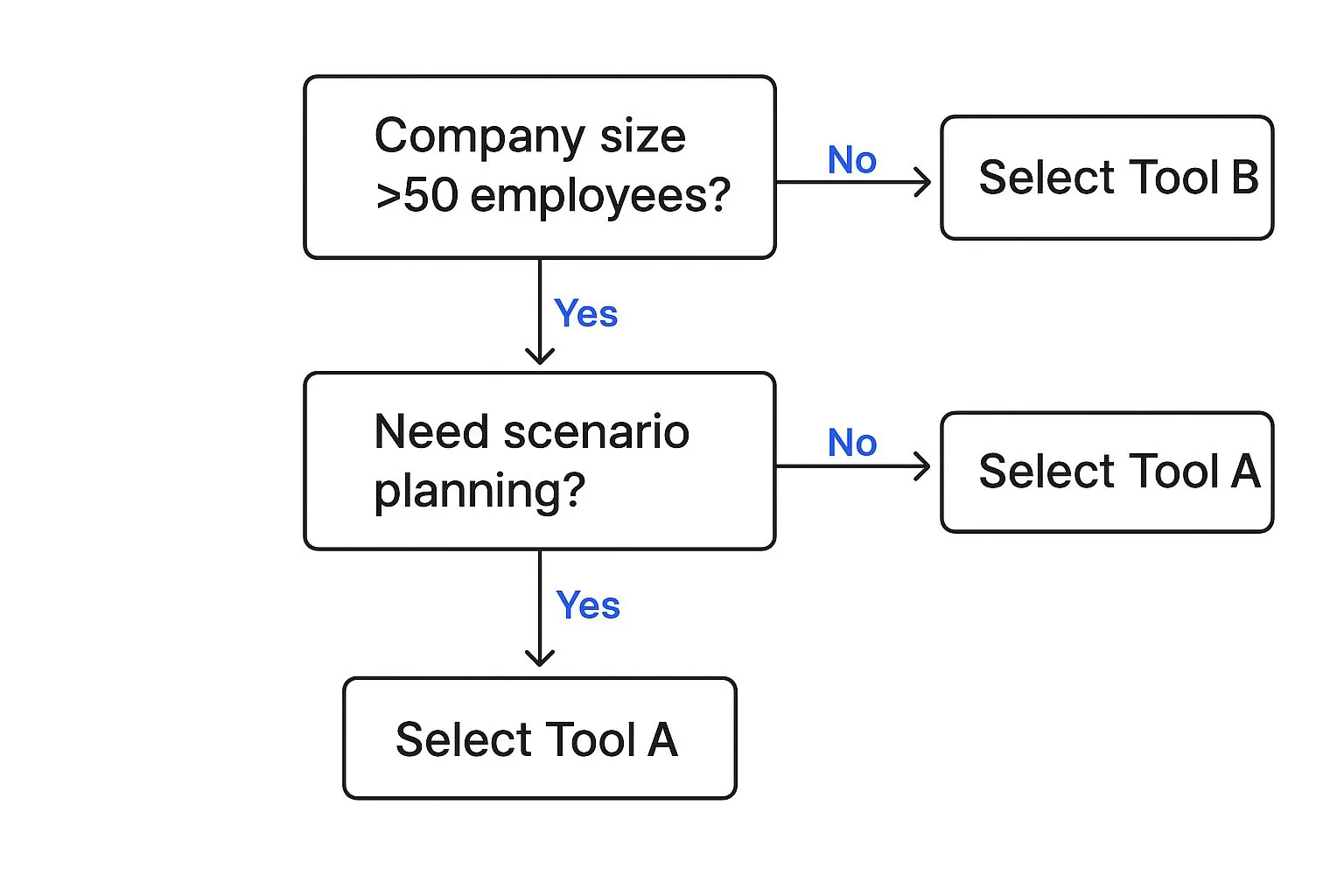
As you can see, the more complex your business gets, the more you’ll need advanced tools to keep up.
Embracing a Hybrid Approach
Here’s a secret: the most powerful solution often isn’t choosing just one of these methods. The reality is that many of the best finance teams mix and match. A hybrid model gives you the flexibility to apply the right technique to the right part of your business.
You could use a top-down approach to set high-level revenue targets from the C-suite, while empowering individual departments to build their expense budgets from the ground up. This brilliantly combines strategic direction with operational reality.
In the same vein, you might stick with a static annual budget for long-term capital projects while using a rolling forecast for more agile operational planning. This kind of customization helps you build a forecasting process that is both strategically sound and highly adaptive.
As you juggle these different inputs, using a personal finance tool can help you see the bigger picture. For instance, you can learn more about how to manage your complete financial portfolio with a net worth tracker. This is how you create a forecasting engine that’s truly powerful and tailored to you.
How Software Shapes Modern Forecasting
For years, spreadsheets were the undisputed workhorse of financial planning. But as a business scales, their cracks start to show. Relying on them for complex budget forecasting methods is a bit like using a paper map for a cross-country road trip—it can work, but it’s slow, full of potential wrong turns, and keeps information locked away in one person’s hands. Manual data entry, broken formulas, and version control nightmares are all too common.
These aren’t just small headaches; they’re genuine business risks. It’s why the global market for specialized budgeting and forecasting software is expected to more than double, hitting $12.4 billion by 2033. This surge is a direct answer to the flaws of spreadsheets, where studies have found errors in as many as 94% of cases. You can read more about this shift over at Abacum.ai.
Upgrading Your Forecasting Engine
The right software turns forecasting from a backward-looking reporting task into a forward-looking strategic advantage. These platforms become a central hub, pulling real-time data from all your other systems—accounting, HR, CRM—to create a single, reliable source of truth for everyone.
Key Takeaway: The real magic of dedicated software is automation. When you stop wasting time manually pulling numbers together, your finance team is freed up to actually analyze them and deliver strategic insights that move the business forward.
Forecasting methods themselves have evolved right alongside the software that powers them. The tools range from massive ERP systems to highly specialized calculators, like a solar panel calculator that helps estimate long-term energy savings. When picking your own tool, you need to focus on what will truly support your goals.
Here are the non-negotiables:
- Seamless Data Integration: It must connect directly to your existing business systems. No exceptions.
- Real-Time Collaboration: Multiple stakeholders should be able to work in the budget at the same time without tripping over each other.
- Advanced Modeling: The tool needs to handle the heavy lifting for complex scenario planning and rolling forecasts.
Investing in the right tech isn’t just about better accuracy; it’s about unlocking the true potential of your finance team. To see how this works in practice, check out our guide on financial reporting automation.
Common Questions About Budget Forecasting
As you start putting these forecasting methods into practice, you’ll inevitably run into a few common questions. It’s one thing to understand the theory, but another to apply it to your own business.
Think of this section as a quick FAQ to clear up those lingering uncertainties and help you build a forecasting process that actually works.
How Often Should We Update Our Forecast?
There’s no magic number here—the right frequency is all about your industry and business model. A one-size-fits-all answer just doesn’t exist.
If you’re in a stable, predictable market with a static annual budget, a quarterly review is probably sufficient. It gives you regular checkpoints without bogging you down in constant updates.
But if you’re in a fast-moving space like tech or retail, you need more agility. A rolling forecast updated monthly is almost essential to keep up with market shifts, competitor moves, or sudden changes in customer demand. The key is to see forecasting as a living process, not a once-a-year chore.
What Is the Biggest Forecasting Mistake to Avoid?
The most common trap is relying solely on historical data. Your past performance is a great starting point, but it’s a terrible crystal ball, especially when the economy is unpredictable.
Key Insight: A truly effective forecast is part art, part science. It blends historical trends with forward-looking assumptions about the economy, your own strategic plans, and what your competitors might do next. Ignoring these factors will leave you with a budget that’s irrelevant the moment it’s finished.
Can We Combine Different Forecasting Methods?
Absolutely. In fact, you probably should. A hybrid approach is often the most effective strategy because it lets you build a process that fits your company’s unique DNA. This is where forecasting shifts from a simple accounting task to a real strategic advantage.
Here are a couple of popular hybrid models:
- Top-Down for Goals, Bottom-Up for Details: Leadership can set the high-level revenue and profit targets using a top-down approach, while individual departments build their own detailed expense budgets from the ground up.
- Static for Long-Term, Rolling for Short-Term: Use a static annual budget for big, long-term capital projects, but manage your day-to-day operational planning with a more flexible rolling forecast.
Ready to get a crystal-clear view of your complete financial picture? With PopaDex, you can consolidate your entire portfolio into one intuitive dashboard, making it easier than ever to track your progress and make smarter financial decisions. Start building your financial future with clarity and confidence today by visiting https://popadex.com.